Entrepreneurs Alert: US and Cuba Talking

Shell Companies Revealed in Argentine Bond Investigation

The Economist reports:  “VULTURE” funds, which chase distressed borrowers for payment of outstanding debt, have few friends outside finance. Occasionally, though, their hunt for profit aligns neatly with calls for greater financial openness by campaigners, winning the rapacious funds unlikely admirers. So it has proved as Elliott Management looks to enforce court rulings demanding that Argentina cough up $2 billion it owes to the hedge fund. A collateral benefit of the fund’s hunt for assets is that it has put a crack in the wall of secrecy around American shell companies, which are among the world’s most impenetrable and thus often used for nefarious purposes.

The case involves $65m suspected of having been embezzled and laundered abroad by Lazaro Baez, a building tycoon with ties to Cristina Fernández de Kirchner, Argentina’s president, and her late husband (and predecessor), Nestor. Elliott joined the sleuthing, its logic being that any stolen money was misappropriated state funds and could therefore be grabbed to satisfy judgments in its favour.

The money trail led to Nevada, home to 123 brass-plate firms that Elliott suspected of being linked to the alleged fraud. But piercing the corporate veil in the state is far from easy. Its record-keeping requirements are minimal even by American standards.

Elliott sued in Nevada for information on the shell companies from their agent, MF Nevada, and, by association, Mossack Fonseca, the Panamanian law firm understood to be MF’s parent. Even if no records were held in Nevada, Mossack could be ordered to disclose what was on file in Panama or a third jurisdiction, Elliott hoped.

MF Nevada claimed, implausibly, that it was independent of Mossack. In a series of legal skirmishes, Elliott established numerous links between MF and Mossack: for instance that MF sets up Nevada companies exclusively for Mossack’s clients and that the employment contract of MF’s sole employee was signed by Mossack’s bosses.

Satisfied that MF was an “alter ego” of Mossack, a judge recently ruled that Mossack was subject to the jurisdiction of American courts and had to comply with the information subpoena. This was a big win for Elliott—and for anyone wanting to know more about shell companies. America is on some measures less compliant with anti-money-laundering standards for corporate vehicles than any other country.

The ruling will also increase scrutiny of one of the biggest purveyors of such vehicles: Mossack is an industrial-scale incorporator of anonymous companies. Shells it helped set up (but is not legally liable for) have been linked to tax evaders and kleptocrats. Mossack says it does not advise clients on the use of companies it forms, and that “we have never been investigated for any crime, including money-laundering.”

Elliott is not alone in trying to penetrate the murk, but its combination of money, tenacity and legal nous is rare. The fight is not over, however. If the relevant records are in Panama, a country with strict secrecy laws, they are unlikely to be produced in a hurry. Mossack has challenged the alter-ego ruling. The case will now move to a federal court. Separately, Elliott has won an order in the Seychelles, requiring Mossack to provide information on firms there linked to the Nevada entities. But the law firm is yet to hand over any documents.

Elliott is confident it can build a clear picture of the alleged fraud and use it to claw back some of what it is owed. Its efforts have a collateral benefit, too. Argentina’s elites are no longer universally hostile towards the firm, some of them applauding its fight to expose the corruption of political and business rivals.

Shell Companies

Iceland Experiments with a Sovereign Money System

Matthew C. Klein writes: One of the oddest things about the aftermath of the financial crisis is the extent to which things haven’t changed.


Yes, there are plenty of new rules, and stress tests, and of course there are more fines for wrongdoing, but the basic structure of the financial system doesn’t look much different from before it blew up. There is still plenty of money to be made (and lost) issuing short-term “safe” debt to buy long-term, illiquid, risky assets. Lenders still exacerbate the cycle by increasing their leverage when asset prices rise only to cut back on lending when the economy sours. And everyone knows that taxpayers are still on the hook when things go bad, which acts as a massive subsidy for the financial industry.

As if all that weren’t bad enough, the current system makes it far too hard for central bankers to accomplish their mission of stabilising the economy. Right now, changes in nominal spending power are largely due to decisions made at banks and other financial firms. The level of short-term interest rates affects their behaviour, as do asset purchases, but monetary policy is only one force among many that determines total nominal spending. Modestly raising the cost of short-term funds isn’t enough to stop excessive credit growth, just as aggressive bond-buying has proven insufficient to restore the pre-crisis trend of nominal spending.

The continuity can’t be explained by the lack of better ideas. In fact, the basic alternative to the status quo — moving the power to create money from private financial firms to the state — was suggested in detail in the 1930s by a group of economists led by Irving Fisher. Subsequent proponents have included Milton Friedman, James Tobin, researchers at the International Monetary Fund, John Cochrane, and Martin Wolf. (And me.)  Iceland’s Experiment with a Soverign Money System

Is the World Bank Obsolete?

A combination of growth in lower-income and middle-income countries around the world and change in their economic development challenges is leading to a crisis in the mission of the World Bank. Although the rhetoric used by the World Bank to describe its mission has changed over time, most of what the World Bank actually does has been broadly the same for decades. It makes loans to national governments, with a heavy focus on infrastructure investment, with one set of loans and conditions for low-income countries and another for middle-income countries. This model is under challenge from several directions.   World Bank at 75

First, with sustained growth in many low-income and middle-income countries around the world, the number of countries eligible for World Bank loans is likely to fall the next few years. Morris and Gleave offer a map of the countries eligible for World Bank lending in 2015, with the countries meeting the low-income (per capita) guidelines in orange and the middle-income countries in blue. They then project what countries will fall into those categories just four years from now in 2019. Either the World Bank is going to adjust its income guidelines substantially, or it is going to become very focused on Africa and south Asia in the next few years.

A second issue is that developments in the world financial system mean that governments and economies of low-income and middle-income countries now have access to many more alternative sources of finance.


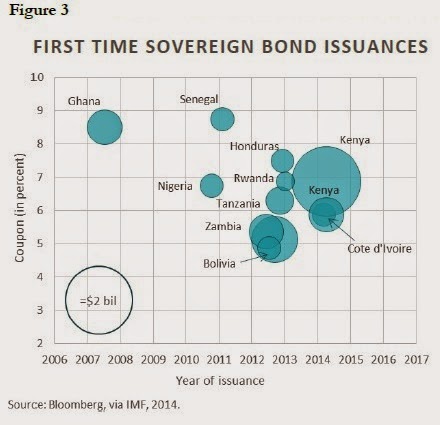
Along with the financial flows from remittances, foreign direct investment, and a newfound ability for low-income countries to issue sovereign debt, there is even new competition in the world of development banks. There are existing regional development banks with growing financial clout like the Inter-American Development Bank (IDB), the African Development Bank (AfDB), and the Asian Development Bank (AsDB).

Maybe instead of a focus on infrastructure, the World Banks should shift some of its emphasis to public goods like research and development for agriculture or disease prevention or reducing air pollution. Or course,these kinds of projects typically involve a large component of grants, rather than loans.

  • Maybe the World Bank should put more of its focus on crisis response, like its recent response to the Ebola outbreak, or on dealing with economic risks like the danger that the price of a key agricultural export commodity will fall.
  • Maybe instead of focusing on loans to national governments, the World Bank should consider loans to subnational areas, like water or transportation infrastructure for a certain city, or to regional areas, like transportation and electricity networks across national borders.
  • Maybe instead of making loans based national per capita income, the World Bank should focus on countries where high levels of deep poverty remain, or on countries that combine low income with issues like a high level of debt accumulated in past decades that is hindering future growth, or a lack of capacity to manage public finances and collect taxes.
  • Many researchers naturally look at the World Bank as an institution that could be a knowledge leader and a clearinghouse for what is known about how to make economic development work. This mission would emphasize that World Bank loans and projects should be designed to produce the kinds of measureable inputs and outputs that can be the grist for academic research.


Entrepreneur Alert: Maple Syrup Cartel

Twenty-five years ago, Quebec made a bold move to produce the most maple syrup in the world. Today, the syrup giant is unstoppable.

Just ask those in its path, like small producer Angèle Grenier, who will face criminal charges if she sells this year’s harvest to her buyer of choice.

In previous years she has sold syrup to a broker in New Brunswick. But this year, a Quebec court order will force her to hand all the syrup produced on her small patch of land to the Federation of Quebec Maple Syrup Producers.

The family has three choices for the upcoming harvest — capitulate to the demands of the court, cease production, or continue to sell it outside the province and face criminal charges.

“The federation’s goal by taking our maple syrup is that by taking our income, we cannot pay our lawyers,” says Grenier. “We’ll send our syrup to them this year because we need the money.”

Welcome to Big Syrup.    Maple Syrup Cartel in CanadaMaple Syrup

Should Indian Entrepreneurs Embrace Robots?

Avainish Persaud writes:  Prime Minister Narenda Modi’s declaration on the ramparts of the Red Fort last year that the world should come and make products in India, did not upset workers. Rightly or wrongly, they do not worry that India will eat their lunch. They are convinced that machines are already doing so.

What kept the angst in check was that while robots were increasingly doing complex things, like  IBM’s Deep Blue beat world champion Garry Kasparov at chess, they couldn’t get the hang of simple things. Computers could make human tasks easier but they could not do away with the human altogether and so a Nobel Laureate was able to say that “we see the computer age everywhere except for the productivity statistics”.

But after 50 years of the application of Moore’s Law—where the power of computers doubles every 18 months—that barrier has finally cracked.
Amazon’s Kiva Robots lift shelves that weigh around 1,360kg, 24×7, without a toilet break, lunch hour, health insurance or pension plan.  No surprise then that the world’s largest manufacturer of electronic products, Taiwan’s Foxconn, is considering replacing its workforce with one million “Foxbots”.
Economists tend to reject the lump of labour idea—that there are only so many jobs and if they no longer exist people would not have work. Back in 1810, 90% of the US workforce was employed in agriculture. Today it is just 2% and the 88% are not unemployed.  Yet John Maynard Keynes said our discovery of means of economizing the use of labour outruns the pace at which we find new uses for labour.
Some believe this process has been underway for a while and underscores a secular stagnation and worsening inequality in the advanced economies. The typical worker in the US has not seen a rise in their living standards since 1979 and since then income inequality has steadily worsened.
The rise of robots also questions whether this is the time for India to don the overalls of the world’s manufacturer and for Indian workers to compete against the Foxbots. In 1983, Wassily Leontief, the economist, predicted that the role of humans as the most important factor of production is bound to diminish in the same way that the role of horses in agricultural production was first diminished and then eliminated by the introduction of tractors.
Is the geography of manufacturing not about to change from production economies of scale to a world in which consumers pay to download the software that allows their robot to make the product they want? In which case is this not the time to build on India’s brand as a software powerhouse?
Perhaps the government should eliminate the high barriers to doing things in India, whatever it may be, and redistributing enough income to provide greater equality of opportunity for as many as possible. If the robots are coming, we should not try to compete against them or hide from them. We should embrace them, write their code, own them or tax their owners.
Manufacturing in India?

Should the Carry Trade be Regulated?

Harold James writes” During the early years of the global financial crisis, exchange rates were the least interesting part of the macroeconomic debate. A French proposal in 2011 for a sweeping reform of the international monetary regime went nowhere. Today, the subject has become the focus of intense anxiety – and with good reason.

Currency wars are a reminder of the fragility of the process of globalization.

The expectation that interest rates in the United States will rise is driving up the value of the dollar, even as monetary easing in Japan and Europe is pushing down the yen and the euro.

The euro’s depreciation has been greeted with delight by Europe’s business leaders. But in the US, where the dollar’s gains are threatening to choke off economic recovery, officials at the Federal Reserve are expressing signs of concern.

The swing in exchange rates could have an impact that extends far beyond the short-term rebalancing of the global marketplace.

Indeed, surges in the dollar’s value have long coincided with increased political pressure for trade protectionism. After all, the most obvious way to compensate for the apparent overvaluation of a country’s currency is by imposing import restrictions.

In the mid-1980s, the dollar’s appreciating exchange rate undermined US competitiveness, inaugurating a period of rapid and painful deindustrialization.

If anything, today’s exchange-rate swings are likely to be more extreme, and to last longer, than the surge in the dollar’s value in the 1980s or the volatility of the 1930s, when, in the aftermath of the financial crash that triggered the Great Depression, countries competed to devalue their currencies.

The problem is what is known as the carry trade, a common financial strategy in which an investor borrows money in a currency subject to a low interest rate in order to buy assets in a currency subject to a higher rate. The interest-rate differential, often combined with high amounts of leverage, provides a profit when the loans are paid off.

When exchange rates are stable and predictable, the carry trade is relatively safe. But this is rarely the case. For starters, the practice has the tendency to push exchange rates further apart, as investors sell the currency in which they borrowed to make their purchases.

The large corporate borrowers engaged in the carry trade consider themselves sophisticated investors, capable of predicting when exchange rates are about to reverse. Unfortunately, this only increases the risk, boosting the possibility of a sudden reversal as money pours back into the borrowed currency in an attempt to repay loans before the exchange rate soars to loss-generating levels.

The dangers are very real.

There is one historical precedent that could serve as a model, should we be able to muster the political will to consider it. In the 1930s, John Maynard Keynes championed limits on the movement of capital in order to blunt the more damaging consequences of globalization. The equivalent today would be to introduce regulations on the carry trade. Policymakers would do well to consider this option – before it is too late.

What Happens When Money Costs Nothing?

Daniel Gros writes:  The developed world seems to be moving toward a long-term zero-interest-rate environment. Though the United States, the United Kingdom, Japan, and the eurozone have kept central-bank policy rates at zero for several years already, the perception that this was a temporary aberration meant that medium- to long-term rates remained substantial. But this may be changing, especially in the eurozone.

Strictly speaking, zero rates are observed only for nominal, medium-term debt that is perceived to be riskless. But, throughout the eurozone, rates are close to zero – and negative for a substantial share of government debt – and are expected to remain low for quite some time.

In Germany, for example, interest rates on public debt up to five years will be negative, and only slightly positive beyond that, producing a weighted average of zero. Clearly, Japan’s near-zero interest-rate environment is no longer unique.

To be sure, the European Central Bank’s large-scale bond-buying program could be suppressing interest rates temporarily, and, once the purchases are halted next year, they will rise again. But investors do not seem to think so.

The eurozone seems stuck with near-zero rates at increasingly long maturities. What does this actually mean for its investors and debtors?

Japanese savers have been benefiting from this phenomenon for more than a decade, reaping higher real returns than their counterparts in the US, even though Japan’s near-zero nominal interest rates are much lower than America’s.

Nonetheless, nominal rates are negligible, they flatter profit statements, while balance-sheet problems slowly accumulate.

Given that balance-sheet accounting is conducted according to a curious mix of nominal and market values, it can be opaque and easy to manipulate. If prices – and thus average debt-service capacity – fall, the real burden of the debt increases.

In an environment of zero or near-zero interest rates, creditors have an incentive to “extend and pretend” – that is, roll over their maturing debt, so that they can keep their problems hidden for longer.

Japan’s experience illustrates this phenomenon perfectly. At more than 200% of GDP, the government’s mountain of debt seems unconquerable. But that debt costs only 1-2% of GDP to service, allowing Japan to remain solvent. Likewise, Greece can now manage its public-debt burden, which stands at about 175% of GDP, thanks to the ultra-low interest rates and long maturities (longer than those on Japan’s debt) granted by its European partners.

In short, with low enough interest rates, any debt-to-GDP ratio is manageable. That is why, in the current interest-rate environment, the Maastricht Treaty’s requirement limiting public debt to 60% of GDP is meaningless.

In fact, near-zero interest rates undermine the very notion of a “debt overhang” in countries like Greece, Ireland, Portugal, and Spain. While these countries did accumulate a huge volume of debt during the credit boom that went bust in 2008, the cost of debt service is now too low to have the impact – reducing incomes, preventing a return to growth, and generating uncertainty among investors – that one would normally expect. Today, these countries can simply refinance their obligations at longer maturities.

Cost-Free Money?


Financial and Economic Markets Might Mix Like Oil and Oil!

Open letter to the FInancial Times:

Sir, The European Central Bank forecasts unemployment in the eurozone to remain at 10 per cent even after €1.1tn of quantitative easing. (FT View, March 25). This is hardly surprising: the evidence suggests that conventional QE is an unreliable tool for boosting GDP or employment.

Bank of England research shows that it benefits the well-off, who gain from increasing asset prices, much more than the poorest. In the eurozone, where interest rates are at rock bottom and bond yields have already turned negative, injecting even more liquidity into the markets will do little to help the real economy.

There is an alternative. Rather than being injected into the financial markets, the new money created by eurozone central banks could be used to finance government spending (such as investing in much needed infrastructure projects); alternatively each eurozone citizen could be given €175 per month, for 19 months, which they could use to pay down existing debts or spend as they please. By directly boosting spending and employment, either approach would be far more effective than the ECB’s plans for conventional QE.

The ECB will argue that this approach breaks the taboo of mixing monetary and fiscal policy. But traditional monetary policy no longer works. Failure to consider new approaches will unnecessarily prolong stagnation and high unemployment. It is time for the ECB and eurozone central banks to bypass the financial system and work with governments to inject newly created money directly into the real economy.

 Print Money

Must Manufacturing and Growth Go Together?

Uri Dadush writes: Manufacturing is often seen as the key to sustainable export and productivity growth in developing countries. This column argues that, while manufacturing played a key role in some countries’ development, high growth can be sustained without relying primarily on manufacturing. A process of learning, productivity improvement, and investment that touches all sectors characterises the most successful economies. Policies that artificially favour manufacturing should instead give way to maximising learning from the frontier in all sectors of the economy.

The manufacturing sector has been a driver of development across at least the last three centuries, but its importance appears to be declining. The long-standing belief that manufacturing must lead the growth process, as set out for example by Rodrik (2015), rests on two critical assumptions:

  • First, that manufacturing is the only sector capable of sustainably achieving scale in the world market (downplaying the role of natural resources and other sectors); and
  • Second, that it is also the main sector capable of achieving sustained high productivity growth.

So, the argument goes, the rest of the economy, stodgy, unreliable, or confined to the home market, cannot grow unless pulled by the manufacturing sector. But neither of the critical assumptions holds up nowadays, if they ever did. Countries have shown that they can find many avenues to achieve scale on world markets, of which manufacturing is one, and, with the exception of some services that must still be provided face-to-face, rapid productivity improvements are being achieved in all sectors of the economy, often faster than in manufacturing. As I argue in Dadush (2015), this is cause for hope, not despair.

ICT (Information and Communications Technology) has created large new growth and high-productivity sectors in ‘modern’ services – such as finance, telecommunications, software, and business process outsourcing – and also made many services, previously provided face-to-face, such as retailing and banking, storable, divisible and tradable, boosting productivity. Exports of modern services have outpaced those of manufactures by a wide margin since 2000.

Globalisation, ICT, and the associated phenomenon of rapid catch-up growth of developing countries, have opened up many new avenues for earning foreign exchange, boosted the demand and supply of natural resources, and created opportunities in finer combinations of resources, services, and manufactures (‘tasks’) along the international value chain. Many economies that are poor in natural resources and too small or distant to be competitive in manufacturing have found that they can rely on migrant remittances, tourism, and investment links with their diaspora for foreign exchange and growth.  Is Manufacturing Necessary for Developing Nations

Manufacturing in Africa