Lee Kuan Yew’s Capitalism

Clive Crook writes:   If any national leader can claim to have worked an economic miracle, it’s Singapore’s Lee Kuan Yew. During his time as prime minister, from 1959 to 1990, the gross domestic product of this tiny country grew more than tenfold — from $8 billion (in 2010 inflation-adjusted dollars) to $98 billion.  Today the number is pushing $400 billion. When Lee took office, Singapore was poor; in 2015, it’s one of the richest countries in the world.
Lee was indisputably the architect of this astonishing transformation. He was also, it so
happens, learned and brilliant, and an articulate spokesman for what he saw as a distinctively non-Western path of economic development. Deng Xiaoping admired him and sought his advice. It isn’t outlandish to say that Lee deserves some credit for China’s equally startling economic expansion starting in the 1970s — a transformation that will reshape the world.

Westerners think that prosperity and liberty go hand in hand. Lee and Deng believed that order, more than liberty, is the handmaiden of growth. Their successors, and leaders elsewhere who’d like to emulate them, agree. Lee thought a competent meritocratic government should have the paramount role, not just in providing order but also in guiding economic development.

One can be in awe of what Lee achieved in Singapore without believing that Asia’s answer to that question must be different from the West’s — or that there are two different capitalisms, each best suited to regionally distinctive values and culture.

Start with that second proposition, that there’s such as thing as Asian capitalism. In fact, East Asia’s miracle economies achieved rapid growth in different ways. For instance, in its years of fastest growth, Hong Kong’s approach was close to laissez-faire; South Korea relied heavily on state-directed investment; Taiwan and Singapore were somewhere in between.

The main thing East Asian economies had in common was reliance on export-led growth. Ways of promoting trade differed from case to case, but the goal was to succeed in global markets. Some countries relied more heavily on import barriers and state-directed investment, but success in export markets guided their interventions.

This forced their producers to compete with more efficient producers, made their policies more transparent and helped guard against persisting with planning that didn’t work.
If Asian capitalism means anything, it’s “embrace globalization.”

Put the debate about economic policy, and the respective roles of state and market, to one side. Lee’s critics would argue that he stood for the simpler proposition that authoritarianism works, and that this is why China’s leaders, especially, look at Singapore with admiration and interest. Singapore is a democracy, but not a liberal one. The government is paternalistic and stern. The ruling People’s Action Party, led by Lee’s son, Lee Hsien Loong, is clean, competent and undeniably popular — but intolerant of critics and seemingly immovable.

Liberall Western politics can be turbulent. It involves fruitless politicking, too-frequent changes of government, populist incompetence and excessive attention to the short term. But these are side-effects of the checks and balances that keep politicians accountable. In an imperfect world, full of imperfect leaders, effective opposition isn’t unpatriotic; it’s indispensable.  Lee was right that Western democracy is flawed, and that an enlightened and meritocratic authoritarian can govern well:
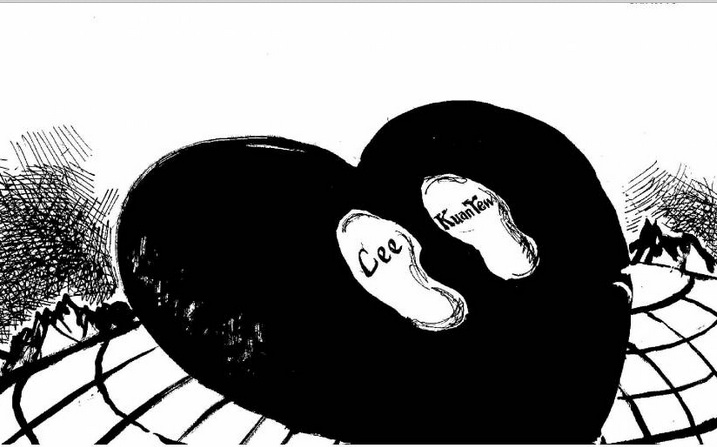
Lee Kuan Yew's Capitalism

South Africa Encourages Entrepreneurs

Small businesses are key to unlocking economic opportunities and achieving inclusive growth, Small Business Development Minister Lindiwe Zulu said last week at the Global Entrepreneurship Congress in Milan, Italy.

South Africa’s high rate of unemployment, poverty and extreme inequality call for bold and far-sighted interventions, she said. “As government, we remain open and receptive to new policy ideas that will help accelerate the formation of new businesses and sustainability of existing ones.”

Zulu said the government’s policy interventions aimed to ensure that small enterprises grew into thriving businesses: “They cannot remain small forever”. She said the government would focus on providing financial and non-financial support to small businesses as it wanted to reduce obstacles to doing business wherever possible. “There is general recognition that Africa is the next growth pole of the world. It is up to us Africans to seize the moment and ensure that Africa becomes an unprecedented economic success,” Zulu said.

The Global Entrepreneurship Congress provides opportunities for entrepreneurs to explore business networking opportunities and to learn and interact with their peers across the globe. Around 4 000 delegates from 150 countries attend the gathering. “We see the GEC as a powerful platform to learn what other successful nations are doing to promote and sustain enterprise development,” said Zulu. South Africa will be the first African country to host the GEC in 2017. The bid was awarded to Johannesburg as part of the opening ceremony at GEC 2015 in Milan. Accepting the award on behalf of Johannesburg, Zulu said: “GEC 2017 will ensure that small business development remains firmly on the national agenda and the radar screen of all stakeholders.”

Entrepreneurs in South Africa

Iceland Rebounds without Austerity?

Dirk Ehnts writes; The ongoing economic recovery in Iceland started in 2010. The economic crisis (= recession), as you can see in the chart below, started in about 2007.  Only 3 years and a loss of GDP of roughly 10% later, the economy started growing again.  Look, however, at the amount outstanding of domestic debt securities for general government issuers.  It has risen very fast in the crisis, probably because of falling tax income/

After 2010, the increase in government debt continues, now growing at a lower rate, but nevertheless growing steadily.

icegdpdebt

Iceland is not the euro zone.   It has its own currency, which is part of the success story.  The success consists at least to a part on the combination of flexible exchange rate with capital controls, discretionary government spending and no bank bail-out.  The Gini coefficient (0 = complete equality of income; 1 = inequality) in 2013 is back where it was in 2003:  at .24.

Capital controls are said to go within the next two years:

Most members of Iceland’s parliament say the coalition government led by Premier Sigmundur D. Gunnlaugsson will be able to lift capital controls before its term comes to an end in two years.

Iceland appears to have an exchange rate regime exchange that moves from capital controls and weak currency in bad times to flexible currency only in normal times and then might lead to a flexible exchange rates with exchange rate administration by the central bank in times of frenzy (just guessing here). This is an interesting development.

Iceland

Power Cuts, Congestion Crimp India’s IT Plans

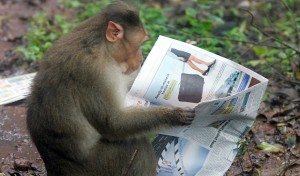
 As India launches an $18 billion plan to spread the information revolution to its provinces, the problems it faces are a holdover from the past – electricity shortages, badly planned, jam-packed cities, and monkeys.

The clash between the old world and the new is sharply in focus in the crowded 3,000-year-old holy city of Varanasi, where many devout Hindus come to die in the belief that doing so will give them salvation. Varanasi is also home to hundreds of macaque monkeys that live in its temples and are fed and venerated by devotees.

But the monkeys also feast on the fiber-optic cables that are strung along the banks of the Ganges river.

Srivastava, who oversees the expansion of new connections in the local district, said his team had to replace the riverside cables when the monkeys chewed them up less than two months after they were installed.

He said his team is now looking for alternatives, but there are few to be found. The city of over 2 million people is impossibly crowded and laying underground cable is out of the question. Chasing away or trapping the monkeys will outrage residents and temple-goers.

A shortage of electricity is further complicating efforts to set up stable Wi-Fi in public places – daily power cuts can last for hours during the sweltering summer in Varanasi and across much of India.

Modi’s government has pledged to lay 700,000 kms (434,960 miles) of broadband cable to connect India’s 250,000 village clusters within three years, build 100 new “Smart Cities” by 2020 and shift more public services like education and health to electronic platforms to improve access and accountability.

Varanasi was the first of an eventual 2,500 locations singled out for street-level Wi-Fi.

Industry experts predict that the broadband initiative, along with a surge in smartphone ownership, will mean about a third of Indians will have access to the internet by 2017, from about 20 percent, or 250 million people, now.

Expanding internet connectivity and making access cheaper could add up to 1.6 percentage points, or about $70 billion, to India’s GDP over a four-year period, consultants at McKinsey have estimated.

Global technology companies see opportunity in Modi’s commitment to a digital future and are adapting their products to India’s varied climates and external threats.

IBM is in discussions to provide software to help several cities make the leap into the digital age.

Network provider Cisco Systems is working with the government in the eastern city of Visakhapatnam to bring more education and healthcare services online, and has developed a “ruggedised” Wi-Fi box to survive India’s varied climates and cut down on the need for cables that will be at the mercy of the elements – or monkeys.

Monkeys and IT in India


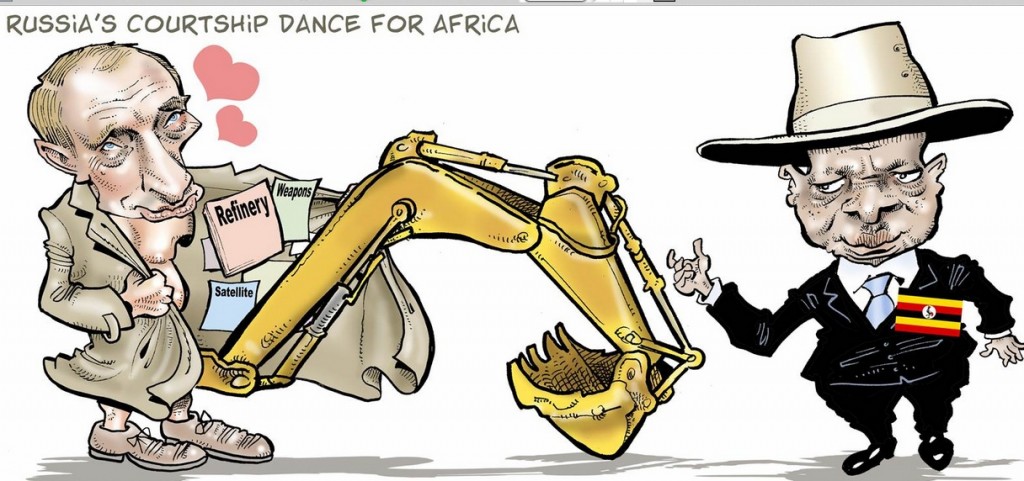
Russia Looks to the West Sahara?

Vitaly Naumkin writes:  Economic considerations will play a huge role in the future development of Russia’s role in the Western Sahara.   Morocco has already invested enormous resources in the part of Western Sahara it controls, and Western Sahara’s mineral reserves are of crucial importance for the Moroccan economy. It is worth mentioning that Western Sahara already produces about 2.4 million tons of phosphates annually.

One would expect that the dramatic events taking place in Palestine, Syria, Iraq, Libya and now in Yemen would monopolize the attention of Russian politicians and diplomats involved in the Arab East. However, this has not been the case. Among the old yet unsolved and “dormant” conflicts in the region is that of Western Sahara.

Recently a delegation of the Polisario Front (Western Sahara) visited Moscow.   The delegation was headed by a member of Polisario’s Secretariat and by M’hamed Khaddad,  Although the visit was not official — the delegation arrived in Moscow at the invitation of the Institute of Oriental Studies of the Russian Academy of Sciences — it was received by Deputy Foreign Minister Mikhail Bogdanov as well as by members of the Council of the Federation, the upper chamber of the Federal Assembly. It also held a meeting with a group of Russian experts on the region.

The visit is yet another sign that Russia seeks to play a more active and independent role in the region. It also stands as further evidence — as manifested in recent years — of the ability of Russian diplomacy to take atypical steps to lay the groundwork for solutions that fit Russia’s interests to the greatest extent possible, and to expand contacts with political forces of different orientations. Contrary to its former, more cautious style of diplomacy, illiant diplomat and expert on the Arab world — in leading Russian foreign policy there. Even those who disagree with Russia’s foreign policy hold him in high esteem.

Moscow needs to heed the position of such an important Arab partner today as Egypt. The counterterrorism cooperation between Algeria and Egypt over the Libyan crisis has not only fostered distrust on the part of Morocco, but also led to a brief information war between the latter and Egypt.

During his stay in Russia, at a Feb. 27 press conference at the international news agency Russia Today, Khaddad declared, “Russia can do much for the stability of the North African region. We hope and expect the help of the Russian Federation in maintaining regional peace and stability.” The Western Saharan politician also stressed, “Some countries, such as France, while speaking of their commitment to human rights, on the other hand … hindered the search for a solution.”

In Russian juridical circles it has been suggested that while Western Sahara has not been recognized as a state by the international community at large, a number of UN Security Council resolutions contain ad hoc recognition of Western Sahara and Polisario (that is, recognition for a specific purpose).

Russian experts do not rule out that the situation in Western Sahara may worsen, given the belligerent statements by Sahrawi Minister of Foreign Affairs Mohammad Ould Salek.

Russia Looking for More than Oil in Africa?

Schedule of Lifting Iran Sanctions?

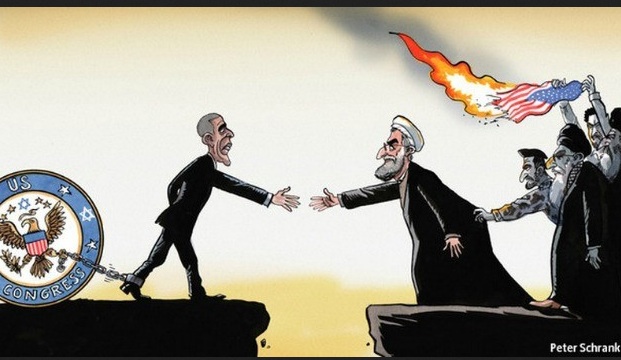
Arash Karami writes:  As nuclear negotiations between Iran and six world powers in Lausanne continue past the soft deadline of March 31, Iranian officials have made statements regarding sanctions removal that may show more flexibility than previously assumed.  Ayatollah Ali Khamenei, Iran’s supreme leader who has final say on the nuclear program, has previously said that all sanctions on Iran must be removed and that the deal will not be a multistep deal. Members of parliament and other officials have also stated this. Presumably, this means that once a deal is signed, all nuclear-related sanctions on Iran will be removed.

As with all other comments made by the supreme leader, competing sides attempt to interpret Ayatollah Khamenei’s statements through a bias that is beneficial to their own talking points. However, comments by Abbas Araghchi, one of Iran’s top negotiators, and Mehdi Mohammadi, a prominent conservative analyst whose views reflect the previous more hard-line nuclear negotiators in Iran, there appears to be a public consensus that not all sanctions will be removed at once but rather the removal of sanctions must be clearly stated.

Speaking from Lausanne to Iranian reporters April 1, Araghchi said: “We cannot have an agreement that does not contain the removal of sanctions…..The types of sanctions and the issuer of sanctions are diverse: the Security Council, the European Union and America. These have to be separated and it has to become clear in what order it will take place.”

Araghchi continued: “We insist that in the first step of the agreement all the financial, banking and oil sanctions be removed and find a clear framework for the removal of sanctions that are possibly associated with other parts. Either way, without a completely clear and precise outlook for the removal of sanctions, certainly we will not have an agreement.”

In a column titled “Dos and Don’ts of a Political Agreement,” Mohammadi also addressed the issue of sanctions, clarifying his views on how they should be removed. “All the sanctions have to be immediately removed after Iran implements its commitments within the framework of the final step,” he wrote. Second, “all the timing has to be in an fixed, clear and unconditional text.”
The article also referred to other instances of “final rounds” and “final steps,” implying that Iranian negotiators and analysts understand that, given the complex nature of how sanctions were applied, a very complex procedure would be required to remove them. This nuance may not be enough for some members of the six world powers, but it’s a clearer picture of what the Iranians are thinking regarding the removal of sanctions.
The official deadline for these nuclear talks is the end of June, though by the end of March there was supposed to be an announcement of a political framework agreement.

Iran Negotiations

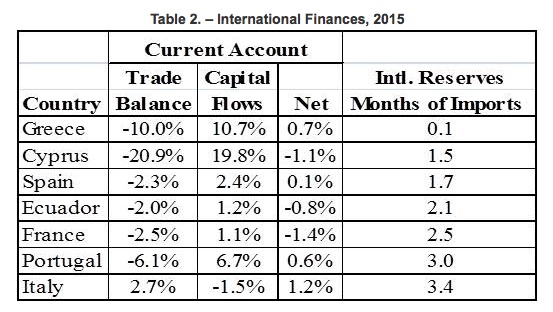
Troubled World Economies

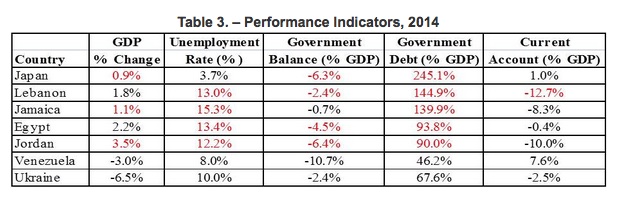
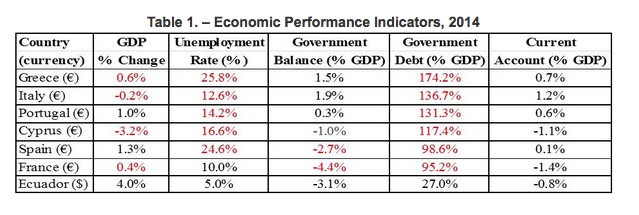
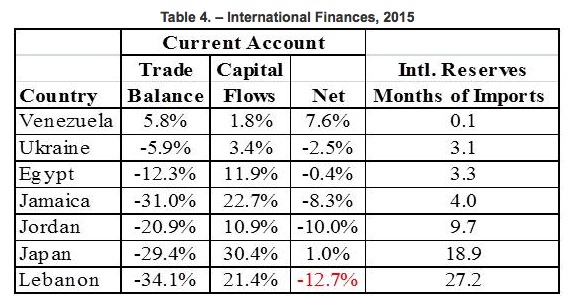
Eliot Morss writes:  Greece is getting all the attention, but there are other countries whose economies are in deep trouble.

Countries with populations of less than 500,000 were dropped. Then, the 30 countries with the worst 2014 performance on each of these indicators were selected. That narrowed the list to 74 countries. The list was paired further by choosing countries that performed worst on at least 3 of these 5 indicators. That left 12 countries. Those countries along with three others facing somewhat unique problems – Ecuador, Ukraine and Venezuela – are analyzed below. Libya and Syria are not included. Their serious economic problems are primarily attributable to wars. But at least for now, Libya is still pumping oil and Syria receives substantial economic assistance from Iran.  Troubled Countries Across the Globe

Performance Indicators 2014  IMFIMF Economic Indicators 1International FInance 2015  IMF and FOcusEconomicsInernational Finances IMF and FocusEconomics

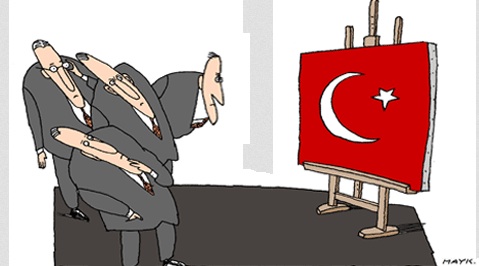
Poverty in Turkey?

Tulay Cetingulec writes:   Ahead of every election in Turkey, political parties make myriad promises to the jobless and the poor, pledging social benefits for low-income families and retirees and housing projects for the homeless. The promises are typically forgotten after a government is formed and then everything goes about as usual. Ahead of the June 7 parliamentary elections, however, issues appear bound to persist and keep fueling debate:

The CHP made a “profiling” of the population that drew up Turkey’s poverty map. The report, penned by a team led by CHP parliament member Umut Oran, detailed the economic woes of the impoverished masses and urged the government to struggle against poverty instead of busying itself with profiling.

The report is based on current data by the Turkish Statistics Institute (TUIK), which represent the state’s official figures that the government cannot dispute or deny. According to the report, 22 million Turks have an average monthly income of only 835 Turkish lira ($320), and 49 million are struggling with debt. It says 34 million cannot afford meat, chicken or fish once every two days, 56.2 million lack the means to renew worn-out furniture and 26 million are unable to buy new clothes. A one-week vacation per year is beyond the means of 58 million people.

While even the window glass of the new presidential palace was imported from abroad, 30.5 million Turks live in homes with leaking roofs, moisture-prone walls or decayed window frames. About 19 million people, or one in every four citizens, reside in dark homes deprived of sunlight. Accommodations without a bathroom, a toilet or a kitchen are home, respectively, to 2 million, 6.6 million and 2.1 million people. Another 12.1 million live in homes that lack warm water and 1.3 million in homes that lack water altogether. The report indicates that 22 million shiver during winter, unable to afford heating.
.

With respect to unemployment, the report said, “Over the past 12 years, the AKP [Justice and Development Party] has failed to resolve problems of employment and livelihood. TUIK’s monthly unemployment data reflect only the tip of the iceberg. According to official definitions, 3,145,000 people are jobless and the unemployment rate is 10.9%”

What difference a social-democrat government can make? “If the CHP comes to power, it will focus on alleviating poverty,” said Oran, who is also the vice president of the Socialist International.

Turkey