Taking on the Modi Government

The opposition is gearing up to take on the Modi government in the budget session of Parliament on the key issues of rising prices, inflation and the rail fare hike: indeed, opposition sources told The Hindu that these subjects may even be raised as soon as Parliament convenes on Monday for Question Hour.

If the government’s focus in the session starting Monday will be pushing through the general budget and railway budget, the opposition made it clear on Saturday at an all-party meeting convened by Lok Sabha Speaker Sumitra Mahajan that in the just over a month long session it plans to raise not just the price rise issue, but also the rail hike, the plight of Tamil fishermen, and Iraq.

The NDA government, on its part, will make a statement in both Houses on the condition of Indians in war-torn Iraq, union Parliamentary Affairs Minister M Venkaiah Naidu told journalists after the luncheon meeting.

At Saturday’s meeting, the government came under attack on the federalism issue: “Though the government is saying that they have great respect for federalism but in essence and effect we don’t see any signs of such federalism,” Trinamool Congress leader Kalyan Banerjee said, citing letters despatched by various ministers to states. He also expressed displeasure at the fact that the Trinamool hadn’t been given a room commensurate with its parliamentary strength.

Ms Mahajan, responding to a demand made by an opposition leader, agreed that since the Standing Committees for various ministries are yet to be constituted, the demands for grants for various ministries will be passed by both Houses by July 31 after discussion in Parliament instead of in the committees.

After the meeting, she said the meeting was held in a very cordial atmosphere: “The Government is willing to give full time to discuss any issue. Different suggestions have come and they will be decided after the meeting of the Business Advisory Committee,” she said.

Ms. Mahajan also said that the Lok Sabha proceedings this session will have a new feature where the picture of members speaking will be shown on the screen to enable all members sitting even on front benches to see those speaking from the rear benches.

Rising Prices in India


Economics 101 in a Graduation Speech


Nobel Laureate Thomas Sargent  began with a simple promise. “I will economize on words,” he said. And he did.

Economics is organized common sense. Here is a short list of valuable lessons that our beautiful subject teaches.

1. Many things that are desirable are not feasible.

2. Individuals and communities face trade-offs.

3. Other people have more information about their abilities, their efforts,
and their preferences than you do.

4. Everyone responds to incentives, including people you want to help. That
is why social safety nets don’t always end up working as intended.

5. There are tradeoffs between equality and efficiency.

6. In an equilibrium of a game or an economy, people are satisfied with their
choices. That is why it is difficult for well meaning outsiders to change
things for better or worse.

7. In the future, you too will respond to incentives. That is why there are
some promises that you’d like to make but can’t. No one will believe those
promises because they know that later it will not be in your interest to
deliver. The lesson here is this: before you make a promise, think about
whether you will want to keep it if and when your circumstances change.
This is how you earn a reputation.

8. Governments and voters respond to incentives too. That is why governments sometimes default on loans and other promises that they have made.

9. It is feasible for one generation to shift costs to subsequent ones. That is
what national government debts and the U.S. social security system do
(but not the social security system of Singapore).

10. When a government spends, its citizens eventually pay, either today or
tomorrow, either through explicit taxes or implicit ones like inflation.

11. Most people want other people to pay for public goods and government
transfers (especially transfers to themselves).

12. Because market prices aggregate traders’ information, it is difficult to forecast stock prices and interest rates and exchange rates.


Economics 101


Yuan Closer to Full Convertibility

Banks can now set their own exchange rates for the yuan against the dollar in over-the-counter transactions – another step toward freeing the exchange rate from government control.

Banks were previously required to price the yuan/dollar rate they offered retail clients within 3 percent in either direction of the Chinese central bank’s daily middle rate.

“The liberalization of the retail market implies that the People’s Bank of China believes that the yuan has now reached equilibrium,” said Cao Yang, an analyst at the Shanghai Pudong Development Bank Co Ltd.

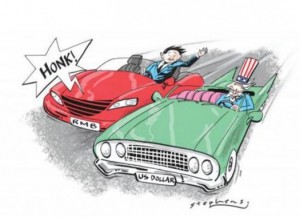
The move is aimed at further perfecting the mechanisms to establish a market-oriented exchange rate for the yuan.  The world’s second-largest economy is seeking to increase the use of the yuan in global trade and investment to reduce China’s dependence on the US dollar. The move is also aimed to reduce the exposure to the economic policy decisions made by global financial institutions, in which Washington has a big influence.

Convertibility of the Yuan

Timing the Ending of QE in the US

It has been a good six months for borrowers in the high yield market who raised a record $180bn in the period. Two-thirds of that has gone to refinance debt at ever lower yields, and another 16 per cent to help finance new mergers and acquisitions.

Still, although there is virtually no sign that the Federal Reserve has any intention of exiting its easy money policy any time soon, the congenitally pessimistic denizens of the bond markets are already fretting that when rates rise, the process will be far more painful than in the past as investors all decide to hit the sell button at the same time. Many hedge funds hold short futures positions in a bet that rates will rise in the middle of 2015,

Demand for credit has grown far faster than equities, according to analysts. Indeed, since the end of 2008, the three fastest growing asset classes have been fixed income exchange traded funds, emerging market corporate debt that is dollar denominated, and US high yield.

Meanwhile, spreads to Treasuries continue to grind tighter. All this makes these asset classes, and high yield debt in particular, more vulnerable to outflows with even a small move up in rates.

In other words, the longer easy money continues, the trickier the exit and more dire the consequences in the eyes of the debt markets. The end of easy money will hit bond markets hard if not timed right

It has been a good six months for borrowers in the high yield market who raised a record $180bn in the period. Two-thirds of that has gone to refinance debt at ever lower yields, and another 16 per cent to help finance new mergers and acquisitions.
Still, although there is virtually no sign that the Federal Reserve has any intention of exiting its easy money policy any time soon, the congenitally pessimistic denizens of the bond markets are already fretting that when rates rise, the process will be far more painful than in the past as investors all decide to hit the sell button at the same time.  The problem is that the Fed seems to want to begin tightening (at some stage in the future) without bringing asset prices down, since the whole point of the QE exercise was to raise asset prices in the first place.

The stock market continues to set new highs, though corporate earnings do not warrant those gains. Meanwhile, with growth down almost 3 per cent for the first quarter, GDP for the first half will probably be close to zero. Corporate investment in anything other than share buybacks is minimal. Indeed, the Fed policies give companies every incentive to indulge in share buybacks rather than investing in plant and equipment, let alone in hiring.
Meanwhile, speaking at the International Monetary Fund on July 2, Janet Yellen, chairwoman of the Fed said that “financial stability risks shouldn’t have a central role in monetary policy decisions, at least most of the time.” For financial stability, substitute asset price inflation. What she implies is that there is not enough of a bubble to warrant a departure from easy money. The desperate search for yield is considered an affirmation of Fed policies.

Does the Fed wants to have its cake and eat it too?

Cake?

How Far Can Amazon Go Without Profits

Ploughing the money it makes into its growth has been the Amazon model from the beginning.

Amazon enjoys an advantage most would-be competitors must envy: remarkably patient shareholders. The company made a net profit of just $274m last year, a minuscule sum in relation to its revenues and its $154-billion value on the stockmarket. Even after a recent slump (see chart 2) its shares still cost more than 500 times last year’s earnings, 34 times the multiple for Walmart. Its core retail business is thought to do little better than break-even; most of its profits come from the independent vendors who sell through Amazon’s marketplace. Matthew Yglesias, a blogger, memorably described Amazon as a “charitable organisation being run by elements of the investment community for the benefit of consumers.”

Can this go on?  How Far Can Amazon Go Without Profits

Amazon's Growth

How China Handles Picketty-type Inequality.

Andrew SHeng nad Xiao Geng write:

In order to ensure long-term social stability, China must promote inclusive wealth creation, for example, by establishing strong incentives for innovation. The rise of high-tech companies like Huawei, Tencent, and Alibaba is a step in the right direction, though the fact that the most successful Chinese tech companies are listed overseas, and are thus not available to mainland investors, is problematic. Regulations and exchange controls prevent the retail sector from benefiting from new wealth creation.
Another challenge lies in the decline in the Shanghai Stock Exchange Composite Index from its 2007 peak of 6,000 to around 2,000 today. With financial assets failing to bring adequate dividends or capital appreciation, many investors have switched to real estate as a hedge against inflation.
China’s leaders are already working to guide the transition to a growth model driven by domestic consumption and higher-value-added production. But the challenge is more complex than that. The new model – with the help of market forces, where and when appropriate – seeks to ensure that wealth is created sustainably and shared widely. To succeed would fulfill the Chinese Dream. Failure would mean that inequality would continue to fester worldwide.   Piketty in China

Income Inequality in China


Organized Crime Triggered a Bank Run in the EU Member State Bulgaria

Our correspondent Andreas Frank writes:  If anybody still had doubts that the European Union gets undermined by organized crime – here is more evidence.

On 29 June 2014, Bulgaria asked the Commission to authorise the provision of a credit line of 3.3 bn BGN ($2.3bn) to be provided by Bulgaria to the banking system in order to respond to speculative attacks that occurred over the past week.

With EU’s support, the Bulgarian National Bank overcame a run on deposits caused by an “organized criminal attack” against several banks, it said in a statement.


Earlier, queues formed outside some Sofia branches of First Investment Bank AD, which paid 800 million lev to clients on June 27. Bulgaria asked the European Commission to support the credit line a week after the central bank put fourth-largest Corporate Commercial Bank AD under administration after a big depositor withdrew funds.

“Last week, it transpired that certain individuals have been targeting the third-largest bank, urging customers to withdraw their deposits,” the European Commission said in an e-mailed statement. “This created concerns about the liquidity of the bank in question and risked spilling over to some other institutions, despite the fact that the Bulgarian banking system is well capitalized and has high levels of liquidity.”

Bulgaria’s ruling Socialists are under pressure to resign following a poor showing in European Parliament elections on May 25. The government, which took office a year ago, is fighting to keep the banking system stable as opposition politicians say the current leadership has brought the country to the brink of ruin. President Rosen Plevneliev called early elections yesterday for Oct. 5 and will dissolve Parliament Aug. 6.

The country of 7.5 million, which is the European Union’s poorest state by economic output per capita, joined the 28-nation bloc in 2007 along with neighboring Romania. The EU has repeatedly criticized both countries for failing to curb corruption among senior government officials and sever their links with organized crime.

The banking crisis has stoked tensions on the political scene. Speaking on National Television on June 28, Finance Minister Petar Chobanov accused former prime minister and opposition Gerb party leader Boiko Borissov of causing “panic” by making “uncontrollable and incompetent statements on such sensitive subjects as the financial security.”

Chobanov was responding to a statement made by Borissov, who was toppled from power by street protests 14 months ago, in a June 28 television interview that Bulgaria’s “finances and bank system are in a catastrophic state as a result of this government’s rule.”

While the credit line “should stabilize the situation in the short run,” questions remain over political stability, Peter Attard Montalto, an emerging-market economist at Nomura Holdings Plc, said by e-mail today.

The central bank said it will use cash from the Bulgarian Development Bank and the Deposit Guarantee Fund, both state-owned, to recapitalize Corporate Bank. Corporate Bank and FIB account for 18.5 percent of assets held by lenders, according to the central bank.
EU PressRelease
BNB PressRelease
Organized Crime

Is Goldman Sachs a Boys’ Club?


Goldman Sachs Group Inc. was accused of widespread gender discrimination and a “boy’s club” atmosphere that included bouts of binge drinking and trips to strip clubs, as two former female employees seek to expand their lawsuit against the firm with new evidence.

The women asked a federal judge in Manhattan to let them sue on behalf of current and former female associates and vice presidents. Support for their claims includes statements of former Goldman Sachs employees, expert statistical analyses and evidence on earnings and promotions from the firm’s own records, they said in a court filing.


The two women, H. Cristina Chen-Oster and Shanna Orlich, sued in 2010 and are seeking to broaden the case to include more than a decade of claimed discrimination at Goldman Sachs. A decision by U.S. District Judge Analisa Torres to allow the women to sue as a class would increase the risk to Goldman Sachs.

In the lawsuit, filed in 2010, the women seek unspecified damages and an order requiring Goldman Sachs to fix the alleged gender bias at the firm.

Female vice presidents earned 21 percent less than men and female associates made 8 percent less, the former employees claimed. About 23 percent fewer female vice presidents were promoted to managing director of the New York-based bank relative to their male counterparts, they said.

Goldman Sachs has denied the women’s claims and is fighting the case.

“This is a normal and anticipated procedural step for any proposed class action lawsuit and does not change the case’s lack of merit,” David Wells, a Goldman Sachs spokesman, said in an e-mailed statement.

Chen-Oster and Orlich are seeking to persuade Torres that their claims are sufficiently similar to those of other Goldman Sachs women so they can represent them in a single case.

They’re asking Torres to certify a class of female associates and vice presidents who worked for Goldman Sachs in the U.S. in its investment banking, investment management and securities divisions beginning Sept. 10, 2004. The start date for employees who worked in New York City would be July 7, 2002.

Denise Shelley, a vice president who left the firm in 2009, said in a court filing that men at Goldman Sachs repeatedly called women “bimbos,” mocked a new hire who had won a beauty pageant and took clients to strip clubs. Shelley said in the filing that she sat on the steering committee of the firm’s network for women and, after joining colleagues at a bar, was called a “party girl” by a managing director.

The case is Chen-Oster v. Goldman Sachs & Co., 10-cv-06950, U.S. District Court, Southern District of New York (Manhattan).

Goldman Sachs


Women on Boards

Dr. Morten Huse, who holds the Reinhard Mohn Endowed Chair for Corporate Governance, Business Ethics and Social Evolution at Witten/Herdecke University (UW/H), write in the Journal of Business Ethics about some of the issues surrounding women on boards as well as employee-elected board members. We focus on women in the following synopsis:

In recent years, there has been increasing pressure from society and investors to appoint women directors on corporate boards. The number of women in top management and board positions has slowly increased. How does gender diversity contribute to variations in board tasks. Some have argued that there are greater differences among men and women than there are between men and women.

Conventional wisdom suggests that men focus more on quantitative issues and that women are more concerned with qualitative issues. How the bottom line is affected by this difference is still debated. If women are more concerned with corporate governance and social issues, how does this impact shareholder value? Does the adding of women to boards increase diversity of thought in the boardroom? And if it does, increasing studies show that decision-making is improved.

Some recent studies have re-directed the questions about if women make contributions to how women make contributions. When women are in the boardroom, discussions appear to be more open and creative. Are they?

In showing the need to go beyond board composition and corporate financial performances Huse suggests 1. Going beyond demographic descriptions of women, 2. Exploring differences related to various boards takes to include open discussions in the boardroom as a mediating variable between board member characteristics and boardroom tasks.

1. Huse’s research results emphasize that backgrounds and experiences go beyond gender and external demographics and that the personalities of the individual board members should be considered when researching the implications of diversity.

2. While women are expected to have a more questioning attitude than men and contribute to more open discussions in the boardroom, Huse has found that the contribution of women to creative discussions only existed when the women had a different background from the men. However, this relationship was weak. A possible reason for the lack of strong findings may be that women directors tend to adopt the ideas of the conventional board members.

3. Other research has found that minority board members make a contribution to their boards dependent on (1) their own previous experience in a minority position of other corporate boards and (2) previous experience by other board members in a minority position. Hence, while women directors may bring alternative back- grounds and knowledge to the boardroom, they may lack the experience of how to actually present and bring through such knowledge.

4. There appears to be correlation between women board members and concerns of Corporate Social Responsibility (CSR).

5. In the case of women directors, Huse found that esteem was positively related to budget controls, but not to the other types of control. However, the esteem of the women directors was generally found to be high and the lack of variations in the data might have caused the lack of findings.  Women on Boards

Women On Boards

China Will Build a Modern Financial System

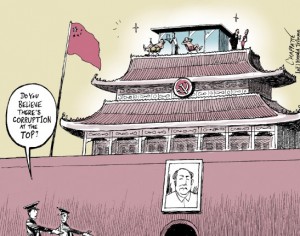
China will endeavor to build a comprehensive, transparent and efficient fiscal and tax system by deepening reforms in the coming years, the central leadership of the Communist Party of China (CPC) said on Monday.

Priorities include improving management and supervision of government budgets, facilitating the building of a comprehensive, well-regulated and transparent modern budget system and optimizing the tax system, said a statement released after a meeting of the Political Bureau of the CPC Central Committee, presided over by its general secretary, Xi Jinping.

High priority will also be given to adjusting power and spending responsibilities between central and local governments in a rational manner, adjusting distribution of revenue between them while keeping the current division of financial resources between them stable, it added.

Can China Modernize?

.
The goal of the reforms is to set up a unified, comprehensive, well-regulated, open, transparent and efficient modern fiscal system that is conducive to better resources allocation, social equality and national stability, according to the statement.
It noted that China aims to fulfill key tasks in the new round of fiscal and tax reforms by 2016, and basically establish a modern fiscal system by 2020.