Musk to Mars


Elon Musk Announces Plans to Put Humans on Mars by 2026

Electric car and rocket tycoon Elon Musk says that he’ll put the first human boots on Mars well before the 2020s are over – and says he’ll float his SpaceX company on Earth-bound stock exchanges once the interplanetary mission gets underway.

“I’m hopeful that the first people could be taken to Mars in 10 to 12 years, I think it’s certainly possible for that to occur. But the thing that matters long term is to have a self-sustaining city on Mars, to make life multi-planetary.”

Musk said that the SpaceX goal was essential to the future survival of humanity. Either mankind would slip the surly bonds of Earth and become an interplanetary species, or remain a single-planet culture and become extinct due to a man-made or natural catastrophe.

Musk’s schedule puts him well ahead of NASA, which is only talking about getting man to Mars by the 2030s – and then only if it can get billions in public funding and build a rocket big enough for the job. Musk’s Falcon Heavy booster is scheduled to fly within the next year, and will carry enough payload to make assembling a Mars spaceship possible.

That’s not to say Musk sees himself competing with the space agency. He paid tribute to NASA, saying that without that agency’s pioneering work, SpaceX couldn’t have got as far as it has.

Musk said that SpaceX is happy to carry on working with NASA, delivering cargo up to the International Space Station, and hopes to win a contract to deliver crew in the company’s Dragon capsule. But if it doesn’t win more contracts, Musk said he was confident the firm could still make it to the Red Planet.

Part of the funding could come from a float of the privately-held company on the stock exchange. This would be difficult, he said, given that the financial markets are obsessed with quarterly and annual goals – but it should be possible once the technology has been perfected.

“We need to get where things are steady and predictable,” Musk said. “Maybe we’re close to developing the Mars vehicle, or ideally we’ve flown it a few times, then I think going public would make more sense.”

Meanwhile, back on Earth, Musk said that he hoped his Tesla venture would have a mass-market car ready for public consumption within the next three years. The big challenge is getting a battery that can be built for less than $5,000, but he said that the company was in daily meetings with Panasonic trying to sort out the problems involved.

Humans to Mars


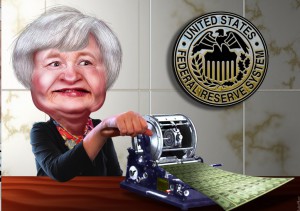
Janet Yellen: No Surprises. Markets Happy


WHAT HAPPENED: Fed stayed the course. Nothing happened to change expectations of first interest rate hikes happening early next year, and Fed officials announced another $10 billion taper. They also lowered 2014 GDP growth expectations from their March projection of 2.8 – 3 percent range to a 2.1 to 2.3 percent range. FOMC statement:  Fed projection: 

UNEMPLOYMENT FOMC adjusted its 2014 unemployment projection to 6 – 6.1 percent, a tick down from their March projection of 6.1 percent to 6.3 percent. Next year, they expect unemployment to be at 5.4 to 5.7 percent, and in 2016 between 5.1 percent and 5.5 percent.

KEY QUOTE: “A portion of the decline we’ve seen in the unemployment rate probably reflects a kind of shadow unemployment or discouragement,” Yellen said during her presser. “Committee participants generally see the unemployment rate declining to its longer-run normal level by the end of 2016.”

QUICK Q:Is 5.5 percent unemployment a new “normal level” for America’s economy?

QUICK A: Former President Clinton economic adviser ROBERT SHAPIRO, told OVERNIGHT FINANCE: “The new normal may involve lower growth and smaller productivity gains, which would also mean higher unemployment even when times are good.”

NEW NORMAL: 5 PERCENT UNEMPLOYMENT. “The Fed doesn’t believe the unemployment rate can fall below 5 percent in this cycle which, unforgettably, began with a financial collapse,” Shapiro said. “The cycles that follow those kinds of events usually involve slower growth, and thus higher unemployment.”

BLAME BOOMERS? Shapiro said: “The retirement of millions of baby boomers now and in coming years reduces the overall growth of the workforce, and since growth depends on increases in the workforce and increases in productivity, the boomers’ retirements may also slow growth.”

RT NYT economics reporter @Neil_Irwin: “The Wait ‘Til Next Year economy MT @BCAppelbaum: The US economy has basically become the Chicago Cubs.”  (It has been 105 years since the US baseball team, the Chicago Cubs, won the World Series).

Janet Yellen


Claire Chase of the International Contemporary Ensemble Paves the Way for Music’s Future

Claire Chase is a very special entrepreneur.  A concert level flutist who has championed contemporary music since her junior high school graduation, has put together an organization which is nimble, daring, fiscally sound and now global.

Chase is an unusual person, but suggests that if you can shape and discipline your passion, you can make what seems to be impossible come true.

Addressing the League of American Orchestras on June 5th, Chase gave the introduced her speech with a riveting solo performance of Density 21.5. The wailing rendition of the Varese piece had been turned down by her junior high school’s graduation committee. Instead she played Danny Boy.

The derailed attempt lit a fire in Chase to tell a different kind of story. She would not just be a seeker of sounds for the metal of the flute. Instead she would create stories we could all live in. Like the stories of Nation, Family, Religion and Community. We live within and with these narratives. In them, you constantly question. No longer is performance art segregated into unions, performers.

At ICE, performers run development and education departments. They bring their reverence for music and boundless curiosity to what are sometimes perceived as pedestrian tasks. Vast repertoire, past present and future. Palpable utopia one 100 people coming together to make music.

ICE is part circus troop, part garage band, part rock band. They have no fixed location instead performing wherever music can be made. Based in Chicago and New York, they are developing satellites on the West Coast, in Qatar and Greenland. Chase is willing to go out into space and perform on the moon. With her, this all seems possible.

Being a musician is being a teacher, and without any of the boredom of the classroom, ICE teaches and pulsates every moment. Claire Chase is a model entrepreneur.   ICE

The Future Looks Different

Pervasive Global Corruption Leaves Boards Struggling To Cope

Our correspondent Andreas Frank writes: As an illustration of the prevalence of fraud globally, 1 in 5 CEOs report they have been asked to pay a bribe. Another finding that should be a concern to general counsels and other in-house attorneys is that one in five businesses participating in the survey did not have an anti-bribery/anti-corruption policy in place.

In a statement, Ernst & Young (EY) said it is “imperative” for companies to have a “robust” strategy to respond to incidents.

The EY survey of over 2,700 executives located in 59 nations show that close to 40 percent of executives saw that bribery and corruption were widespread in their nations. Yet, some 48 percent of those surveyed, saw cyber-crime to be a very low risk or fairly low risk to their business. EY says the respondents apparently underestimate risk from organized crime and foreign governments.

More than 1 in 10 executives surveyed reported their company as having experienced a significant fraud in the past two years. In fact, the level of fraud reported by respondents has remained largely unchanged over the past six years: from 13% in 2008 to 12% in 2014.

At a country level, results are evenly split between those countries reporting an increased incidence of fraud and those reporting a decrease since our last survey.

Ten countries recorded a significant increase, including the US (16% in 2014, up from 8% in 2012), China (8%, up from 4%), Japan (10%, up from 6%) and Russia (16%, up from 10%).

In six countries, more than 25% of respondents reported experiencing a significant fraud in the past two years. These included Egypt (the highest level at 44%), but also Germany and Norway (26%).  Respondents also reported personal experiences of fraud risks. For example, 17% of respondents have been asked to pre-date or post-date contracts.

In a statement sent to Inside Counsel, Loughman said the survey data “suggests there is much work to be done in compliance because only 38% of c-suite executives responded they had been through ABAC [anti-bribery/anti-corruption] training.”

“To the extent compliance reports to legal there is an opportunity for improved advocacy by general counsels to strengthen the ‘tone at the top,’” he added.

The survey comes as cybercrime is becoming more prevalent, and the U.S. Securities and Exchange Commission (SEC) is increasingly focusing on cyber risks, Loughman said. As a result, company boards and their audit committees “need to be vigilant in monitoring these risks,” Loughman said.
Global Fraud Survey – Overcoming Compliance Fatigue – Reinforcing
The Commitment To Ethical Growth
Has Your Organisation Experienced A Significant Fraud In the Last Two YearsAnti Corruption Reports

Recalibrating Financial Regulation

Before the world’s twenty lead economies meet and financial regulation is on their agenda.  Douglas J. Eliot writes: We are part of many global reform initiatives, such as those undertaken by the Basel Committee on Banking Supervision and the Financial Stability Board. These have established important common rules on bank capital and liquidity requirements, as well as the new rules governing derivatives markets and certain other reforms. The U.S. has substantial influence on the shape of these rules and their application and we should help ensure that they are appropriately calibrated to optimize the balance of safety and economic efficiency.

In some areas, it appears that the global rules may be too harsh and may limit the availability of credit provision through banks or their affiliates, either making such credit harder to get or more expensive, or pushing the business into the so-called “shadow banking” sector, where it may be more dangerous to the financial system. (Some of this should move to markets or non-bank credit channels. The concern is about regulatory arbitrage where some business moves to where it is less safely and effectively controlled.) Concerns have been raised, for example, about infrastructure financing, loans to small and medium sized enterprises, and government debt of emerging market economies, which are important drivers of global growth.

Regulation

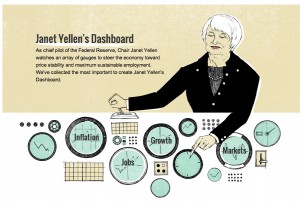
Hutchins Launches A Graphic Description of Yellen’s Choices

The Hutchins Center on Fiscal and Monetary Policy at the Brookings Institution is launching “Janet Yellen’s Dashboard,” an on-line version of the Fed chair’s gauges that will be updated frequently.  W-T-W.org will call your attention to it each time Yellen speaks.

In one interactive graphic on the Brookings’ website, the dashboard shows a dozen of the most important measures of the economy’s speed and direction. For inflation, for instance, it charts the recent trend in the Fed’s favorite inflation measure, the Personal Consumption Expenditure price index, as well as the trend in average hourly wages and the bond market’s expectations for future inflation.

We are offering a quick way for people to put themselves in Janet Yellen’s cockpit and see how the economy is doing—and to judge for themselves how well the Yellen Fed is doing in meeting the objectives that Congress has set for it. For now, inflation remains below the Fed’s 2% target and unemployment remains above the level that Fed officials deem full employment.

Janet Yellens Dashboard by the Hutchins Center

Citibank Shareholders To Fight Big DoJ Fines

Bank of America and JP Morgan Chase were more deeply involved in subprime mortgages than Citibank. JP Morgan settled because they assessed the risk of going to court with a possible criminal indictment too great for the bank to take…and survive.

An institutional Citibank shareholder said, “There’s no good PR to go through what your underwriting practices were and the losses that resulted.”

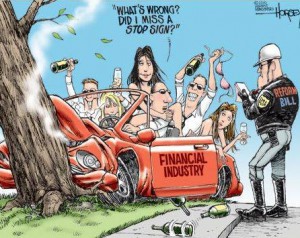
Why is Citi’s penalty so much greater than JP Morgan Chase’s.  Presidential politics?

DoJ and Citi Bank

Chicago: Drug Central USA?

Our correspondent Andreas Frank writes:  A joint federal and local task force that includes the DEA, FBI, Chicago police and other law enforcement agencies arrested and charged more than two dozen gang members who allegedly supplied a significant amount of heroin to customers coming from the city and suburbs.

The increasingly easy availability and lower street cost of heroin has led to a surge of not only in the Chicago area but in many parts of the country show how readily accessible the drug can be and give a glimpse into gang culture in Chicago, a city with a notoriously bad street gang problem.

Among those arrested Thursday was 47-year-old Kenneth Shoulders, also known as Kenny Shannon, who federal prosecutors say is a high-ranking leader of the Conservative Vice Lords street gang.  According to federal prosecutors, Shoulders controlled the drug trade in a 12-block area on Chicago’s West Side, just off what’s known as the “heroin highway” – the I-290 Eisenhower Expressway.

Authorities say Shoulders’ operation used several stash houses as distribution centers and corners as retail locations to sell heroin quickly to customers getting off the expressway. Those customers, many of them from the western suburbs, could exit, pay at one location, pick up the heroin at another and be back on the expressway in a matter of minutes, as if it were a fast-food drive-through.

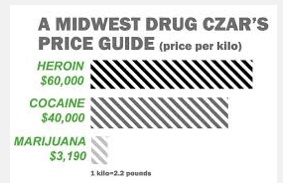
In making the arrests, authorities also seized several weapons – including an AR-15 assault rifle –approximately $140,000 in cash, nearly a half-kilogram of heroin and some cocaine.

Also among the 27 people arrested and charged by federal and local authorities were Shoulders’ 49-year-old sister, Sandra “Penny” Shoulders, and his 29-year-old son, Kenneth Williams, aka “Lil’ Kenny.”

While Kenneth Shoulders reportedly controlled all Vice Lord members in the area known as “12th Street,” prosecutors say he controlled the drug operation by forming a new faction called the 12th Street Vice Lords, which included members of other gangs and gang factions, including the Traveling Vice Lords, the Black Souls Nation, the New Breed and the Gangster Disciples street gangs.

Authorities say they’ve also seen a recent trend of gangs aligning to form new drug-dealing factions when it is lucrative to do so.

But just as the gangs pulled together to corner the drug market, so, too, did law enforcement. Authorities recently created a Chicago Strike Force, in which several local, state and federal law enforcement agencies team up to combat gangs, drugs and gun violence.  “We are working together, both here in the city and on a regional basis, because this is truly the new face of organized crime,” said Jack Riley of the DEA.

Drugs

How China Succeeds in Negotiating Three Key Features of Monetary Policy

Conventional economics suggests that you can only maintain two out of the three key factors:  monetary policy independence, a fixed exchange rate and free cross-border currency flows.  China is succeeding in doing all three at once.  Yu YongDing shows how:

China has run a capital-account surplus for most of the last 30 years, and a trade surplus every year since 1993. The PBOC keeps the exchange rate stable by intervening heavily in the foreign-exchange market, creating so much liquidity that the authorities must engage in massive sterilization to avoid overshooting the targeted increase in the monetary base.

In China, unlike in advanced countries, monetary and sterilization policy are often one in the same. The degree to which monetary policy is expansionary depends on the degree to which the liquidity created by currency-market intervention has been sterilized.

The most frequently used monetary instrument in sterilization is open-market operations. Given China’s twin surpluses, the PBOC sold all of the government bonds that it had accumulated in 2003, so it has been selling central-bank bills ever since, with CN¥5 trillion ($812 billion) in such bills currently held by banks.

Monetary Policy