How Money is Saved, Spent And Invested Worldwide

IMF’s Lagarde: Women In Workforce Key To Healthy Economies

As the first woman to lead the International Monetary Fund, Christine Lagarde is among an elite group of people determining how money is saved, spent and invested worldwide.

It’s not the first time she’s been a “first.” Lagarde was France’s first female finance minister, and before that, the first woman to chair the global law firm Baker & McKenzie.

As part of NPR’s look at the Changing Lives of Women, Morning Edition’s Renee Montagne spoke with Lagarde about her career, and what the IMF is doing to encourage economic growth by promoting women in the workforce.
Interview Highlights: On the findings of a recent IMF study on women in the workforce
Women In Workforce Key To Healthy Economies

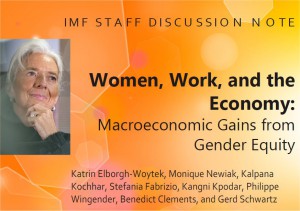
IMF Staff Discussion Note

Women Joining Sports Company Boards in Australia

The percentages are way up, often over fifty percent.  The problem with these boards is that they’re often unpaid directors.  On paid corporate boards, women still hover at around a 10 percent.

Sport NSW, the peak body representing sport in the state, has just appointed three women to its board, seeing its female representation hit the 60% mark.

And according to Sport NSW CEO Cheryl Battaerd, it wasn’t actually that hard to find the women. By seeking new names for its three open board positions via a nomination process, which hadn’t previously been done, they invited applications by advertising widely — including with Women on Boards, Pro Bono Australia and within their own existing newsletters.

It’s not the first time we’ve seen women dominate a sporting board: Netball Australia and Pony Club Australia have boasted female representation around the 80% mark for a number of years.  According to 2013 research by Women on Boards, 24.4% of directorships at national sporting bodies are held by women, a handful still do not have any women on their board. So far this financial year, less than 30% of new such board appointments have gone to women.

The organisation is also supporting the training and development of more female directors, running a three-day foundation course for women aspiring to join boards in the future.

Sport NSW has tipped the balance well past the 30% mark, uncovering new talent that will bring exceptional skills and expertise to the table. These women widen the pool of experienced female board directors, and hopefully the list of women who’ll recommend other women for such roles in the future.

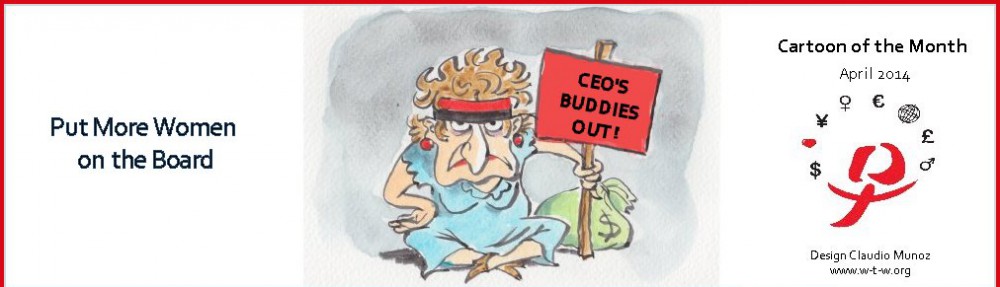
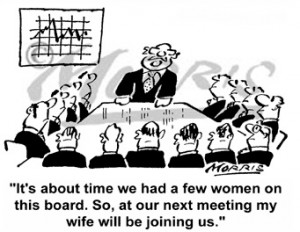
Women on Corporate Boards

Will Japanese Women Enter the Workforce at Full Strength?

That one of the brightest of Japan’s graduates needs to say such things should worry Shinzo Abe, the prime minister. Japan educates its women to a higher level than nearly anywhere else in the world: its girls come near the top in education league-tables compiled by the OECD. But when they leave university their potential is often squandered, as far as the economy is concerned. Female participation in the labour force is 63%, far lower than in other rich countries. When women have their first child, 70% of them stop working for a decade or more, compared with just 30% in America. Quite a lot of those 70% are gone for good.

At a private dinner in Davos Prime Minister Abe listened to a small group of senior women, including a former head of state, discuss what Japan should do differently. An awkward moment came when one of the guests, Miki Tsusaka, a partner at the Boston Consulting Group, told him she had dreaded returning to Japan after a successful career spent mostly in New York. Yet increasingly, behind their soft tones and feminine demeanour, many Japanese women are getting ready to break out of their dolls’ house. If the country’s policymakers can find the right ways to help them, those women could boost the economy and reform corporate culture. Both they and their sararimen stand greatly to benefit.   Japanese Women and the Workforce

Japanese Business Woman


TIAW Global Forum Honors Melanne Verveer

At a thrilling gathering of women (and men) from the world over who are working to make the world better for women, Melanne Verveer delivered an inspired address.  Verveer was chief of staff for first lady Hillary Clinton, President Obama’s choice as the first Ambassador for Global Women’s Issues, and is currently Executive Director for the Georgetown Institute for Women, Peace and Security.

She pointed out that 2015 marks the 20th anniversary of the World Conference on Women in Beijing in which Clinton forcefully remarked, “It is time for us to say here in Beijing, and the world to hear, that it is no longer acceptable to discuss women’s rights as separate from human rights.”

Ambassador Verveer noted the progress women have made, the work that remains to be done, and the miles we must go before we sleep.  The women she addressed are part of the progress, step by step, in educating women to take their independent place, in encouraging them to dare to be scientists and engineers, to always reach out so another voice can be heard.

The rustling of handwoven Indian silks and the bright geometry of Ugandan robes dressed up the meeting rooms.  A neatly attired Flora Villanosa, in muted browns and tans, is Mayor of what was once the Philippines poorest town.  She gave up her salary for three years and turned the town around.  So many remarkable stories, or her-stories as New Zealander Amanda Ellis, an Ambassador to the UN office in Geneva called them.  Thanks to Lisa Kaiser Hickey, TIAW’s President, a good time to be a working woman.

TIAW

Anti-Austerity Protests in Spain

The Christian Science Monitor reports:

The scale of this weekend’s anti-austerity protests in Spain spells political instability ahead for the country. Despite an influx of investor capital into the country’s export sector, the rest of Spain’s economy continues to lag, especially in creating employment for millions of young people.

“There’s a lot of frustration from all sides with the political establishment,” says our correspondent in Madrid. “Spain’s recovery, like much of the periphery, is a two-sided story. Some sectors are certainly benefiting, and there is growth, and there is job creation in some very specific sectors. But for broader society, there is no recovery.”

The hundreds of thousands of protesters who turned out Saturday are looking for the government to roll back deep austerity cuts in health-care, education, and the welfare state. Frustration with the rising cost of living and an unemployment problem that will take at least a decade to clear up has brought even center-right voters into the anti-austerity fold. But with fiscal targets mandated by the European Union, politicians’ hands are mostly tied, our correspondent notes.

The ruling center-right party looks increasingly weak heading into a trio of elections over the next year and a half. The ruling party hasn’t even fielded its candidate for European parliamentary elections in May, essentially throwing in the towel, our correspondent says. Then voters will head to the polls twice in 2015, first for regional elections, then a national election.

“Whoever wins is going to have a very weak majority, and they are going to need to negotiate. And regardless of how you negotiate, [the government] is just not going to have a lot of governing power. So it’s going to be hard to push through all the reforms that still need to be applied,” says our correspondent. “Even with the European elections, it’s just going to open up a lot of tension, and that’s without including external factors like Ukraine.”

Spain’s economy is driven by internal consumption, but there’s just no internal consumption.

Spain's Economy

If Ukraine Wants Help, Cyber Crime Must Go

Cyber-crime is among the top five most common economic crimes in Ukraine, according to a 2012 study by Ryerson University in Toronto. But for much of the past decade, Ukraine’s record in bringing cyber-criminals to justice has been poor.

Of the roughly 400 people arrested in the country on Internet and banking fraud charges from 2002 to 2011, only eight were convicted, according to Dr. Kshetri’s report.

Some progress has been made since 2009, when the FBI stationed a supervisory special agent at the US Embassy in Kiev to assist with cyber-crime targeting the US, the report adds. And Ukraine has also devoted more resources to its computer crime and fraud enforcement in recent years.  Cybercrime in the Ukraine

Cybercrims

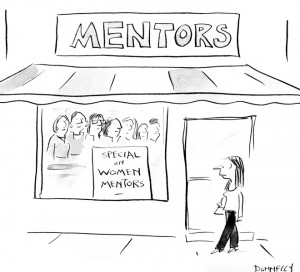
Women Mentoring Women

Women’s Agenda in Australia reports:

Spare time is a valuable commodity for many women. Whether you’re working full-time or part-time, managing kids or not, few of us can say we have too many additional hours available to help out other women with their careers.

And yet there are so many experienced and seemingly busy women out there who are willing and able to share their wisdom and offer a helping hand by mentoring women. They find the extra hours, oftentimes mentoring multiple women at once or even making themselves practically available 24/7 to offer guidance on pressing issues.

So why do they do it? And, more importantly, how can we ensure they keep doing it?.

EY Sydney managing partner Lynn Kraus has been mentoring four women over the past five years and sees building such relationships as a responsibility. “I am a believer that once you have ascended upwards on the corporate ladder, it is your duty and privilege to extend a helping hand down to help the next generation of female leaders.”

Kraus, who won the ‘Mentor of the Year’ prize at the NAB Women’s Agenda Leadership Awards, has been a ‘mentee’ herself and knows just what it means to be on the receiving end of excellent advice. “While these two [female mentors] were very different in many ways, they did share several things in common: personal resilience, self confidence and both were excellent communicators. They invested in me and believed in me and I feel it is my job to do the same for others.”

She says she never tells her ‘mentees’ what they should do, but rather listens to their issues and challenge them on their responses, encouraging them to find their own solutions. “This makes for a more sustainable solution than simply telling someone what to do,” she says.

Allied Health director Penny Munro also mentors multiple women and sees it as an opportunity to ‘give back’. “It’s my contribution to the community and to providing support and hope and encouragement to women.”

But Munro personally benefits too. “I get to constantly learn from remarkable people who often don’t think that they are remarkable. Listening to their stories always provides me with lots of food for thought, personally and professionally,” she says. “The second thing for me is the joy. It’s so lovely to watch women develop and be courageous and take risks and achieve. Mentees provide me with lots of joy and laughter and humility.”

Given the energy these women invest in their mentoring relationships, mentees have a responsibility to uphold their end of the bargain and ensure they’re not taking advantage of the arrangement, or wasting their time.

Munro believes mentees should enter such relationships with purpose. They should be prepared to engage themselves fully in the conversation, do the work that’s required and take risks.

That means getting over or being willing to at least see past any ‘imposter syndrome’. “I find just about every mentee starts with feeling like they are a fraud and believing they can’t possibly achieve what they aspire to so it’s important I give them regular feedback and encouragement, but I also ask them to reflect deeply on our discussions,” says Munro.

If that many mentees feel like a ‘fraud’ when they start out, we can only hope more women find the time and energy to continue creating mentoring relationships in the future.

Mentors

Inconclusive Fight Against Money Laundering In Norway

Our correspondent Andreas Frank reports; Meanwhile, a report commissioned by the Police Directorate (Politidirektoratet) found Norwegian police and prosecutors focus on petty crimes and drug crimes when investigating money laundering, and do not pay enough attention to economic crime.

Swedish law professor Dan Magnusson analysed all the money laundering and illegal goods handling cases closed under the Oslo police district in 2012. “The results of the survey suggest that the tax authorities, trustees in bankruptcy, the prosecution and the police are unable to identify and investigate money laundering,” Magnusson said. “Neither does the court seem to have an ambition to raise money laundering as a crime that should have a general deterrent effect.”

Norway has comparatively few money laundering cases. Part of Magnusson’s survey was to identify if cases had been wrongly classified, skewing the results. His report showed both illegal handling of goods cases misclassified as money laundering, and vice versa, but was most concerned by the fact most cases related to drug crime, not the economic organized crime the legislation is focusing on.

“We are not satisfied with the conclusions the report reaches about a lack of effort in the area of money laundering,” said Torgeir Magnussen, an inspector with the Police Directorate. “It is remarkable that he did not find money laundering in economic crime in the material he has gone through.”

The report covered a third of the criminal handling and money laundering cases in Norway, but excluded cases investigated by the national economic crime unit Økokrim. Magnussen said the directorate will ask the Police University College (Politihøgskolen) to do a similar investigation at Økokrim.
Politi PressRelease 26.3.14
GOV ML Report 26.3.14

How can women work against corruption ? If you see something, say something !!!

Swiss Decide Against Russian Sanctions

Our correspondent Andreas Frank reports; The Swiss federal government decided not to impose sanctions against Russia for its seizure of Crimea, claiming it wanted to find a “balance” between international law and Switzerland’s interests.

“The position of our country is independent of the UN,” Swiss president Didier Burkhalter told a press conference in Bern, saying Switzerland can only use sanctions when they are based upon “international law and the interests of the Swiss”.

“And in this case the rights and the interests play a role… we need to find a balance,” he added, as well as noting that Russian interests in Switzerland were “very large”.

“The federal council has noted the sanctions imposed by the European Union and the United States,” he added.

Burkhalter said some sanctions imposed by the EU would apply to Switzerland, including a ban on the freedom of movement of some Russian nationals as Switzerland is a member of the Schengen group of European countries, which allow passport-free movement between them.

Despite the decision not to impose sanctions, Burkhalter, who is also the country’s foreign minister, said Switzerland would not allow itself to be used by those trying to get round the restrictions already imposed on Russia by the West.

“We do not want to circumvent the sanctions,” said Burkhalter.

He also condemned the Russian annexation of Crimea, saying there was no violation of human rights to justify Moscow’s actions.

Since the beginning of the Ukrainian crisis, Switzerland has tried to tread a fine line between the various parties and in February ordered a freeze on assets held in the country by ousted president Viktor Yanukovych and his son, Oleksandr.

Earlier this month it announced it was looking into suspicions of money-laundering by the former president.

Switzerland has also frozen talks on a trade deal with Moscow and temporarily abandoned a training programme with the Russian military.

However, this year marks the 200th anniversary of relations between Switzerland and Russia and as part of the celebrations Burkhalter is supposed to visit Russia.

No date has yet been fixed.

The majority of Russian gas and petrol is traded in Geneva, and Switzerland is an increasingly popular destination for Russia’s wealthy.

In a March 27, 2013 report from the Swiss Federal Council it is estimated that around 500 companies and some 10,000 employees are active in the commodities sector, which, in addition to trading, also comprises shipping, transaction financing, inspections services and product testing. In 2011 the commodities industry made net receipts from merchanting of 20 billion francs, around 3.5 per cent of Switzerland’s GDP. Switzerland is one of the most important commodity trading centres in the world.
CH_Federal_Council_PressRelease_26.3.14
Swiss Report On Commodities Names Problems But Fails To  Provide Solutions

As the Swiss say: “s Fuenferli und s Weggli ha!”
Get the coins and get the bread».

Get the coins and get the bread