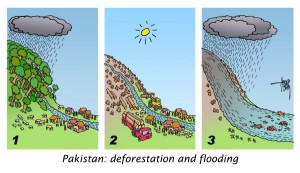
To Break Barriers, Give Women More Access To Climate Finance

Women displaced by heavy flooding in 2010 queue to fetch water inTo Break Barriers, Give Women More Access To Climate Finance
Pakistan. Women are among the most affected during climate-related
disasters.

When climate-related disasters strike, everyone is affected but
when it comes to health and household management, women
tend to suffer more than men.
Despite this, women and gender issues are yet to be included completely in large-scale climate finance facilities — mechanisms instituted to mitigate disaster effects and spur climate adaptability in development work — due to several challenges, including lack of information and accessibility.

For climate finance mechanisms to become truly sustainable, impactful and comprehensive, putting women at the center of climate action by breaking barriers on accessibility is vital, experts agreed in a recent online conversation hosted by the Asian Development Bank.

“Only when women are recognized as important contributors to address climate change — change agents — and actively sought out as relevant stakeholders are climate funds structures changing to allow more women to benefit from climate finance,” said Liane Schalatek, associate director of U.S.-based group Heinrich Böll Foundation.
To break barriers, give women more access to climate finance

arendvandam.com

arendvandam.com

Britain Refuses to Extradite Convicted Mafioso

Our correspondent Andreas Frank reports:  Britain has been accused of creating a “haven for the mafia” by refusing to extradite a convicted member of the crime organisation because of poor prison conditions he would face in Italy. Franco Roberti, Italy’s top anti-mafia prosecutor, described the decision as “devastating”, saying it would enable members of the mafia to take advantage of what he described as Britain’s apparently lax approach to fighting organised crime.

A senior district judge at Westminster Magistrates Court last week turned down Italy’s request for the extradition of mafia boss Domenico Rancadore, citing a ruling by the European court which claimed there was “a systemic problem” with its prison system, leading to degrading and inhuman treatment of inmates.

But Italian magistrates and politicians have reacted furiously to the British court’s ruling, claiming it threatens to undermine their fight against the Mafia.  Westminster Magistrate’s Court discharged Rancadore.

The ruling will come as a huge blow for the Italian authorities, who said Rancadore faced seven years in prison over the 1999 conviction. He is accused of being a “prominent representative” and a former “man of honour” in the Sicilian mafia offshoot, Cosa Nostra, for whom he allegedly collected bribes from builders in Trabia, near Palermo.

The mobster, who is accused of being a former “man of honour” in the Cosa Nostra group, fled to London with his wife in 1994 and lived under the radar for two decades before detectives raided his home last August.

Senior district judge Howard Riddle discharged Rancadore at Westminster magistrates court. In his 21-page judgment, Riddle said he could not accept assurances from the Italian authorities that prison conditions in the country would not breach Rancadore’s human rights.

The ruling represents a surprising turnaround for the judge, who said his original decision was to extradite Rancadore because he was satisfied that the European arrest warrant was valid and that to send him to Italy would not breach his human rights.

However, Riddle changed his decision following the ruling in a similar case involving the court of Florence and Hayle Abdi Badre. Riddle told the court that a recent ruling involving the court of Florence meant that he had to reject Italy’s request to extradite Rancadore.  The court heard concerns about overcrowding in Italian jails during a two-day extradition hearing last month.  Rancadore Ruling

Mafioso Freed in Britain

US Stock Markets Rigged in Favor of High Speed Traders

Bloomberg reports:

       On 60 Minutes last night, author Michael Lewis made a bland assertion: High-frequency traders, he said, working with U.S. stock exchanges and big banks, have rigged the markets in their favor.  The only surprising thing about Lewis’s assertion was that anyone could be even remotely surprised by it.

The math on trading is simple: It is a zero-sum game. One trader’s gain is another trader’s loss. Only in the case of HFT, the losers are the investors — by way of their pension funds, retirement accounts and institutional funds. The HFT’s take — the “skim” — comes out of these large institution’s trade executions.

The technology behind HFT may be complex, but the math is that simple. Once the Securities and Exchange Commission allowed stock exchanges to share with traders all of the unexecuted incoming orders, it was hard not to make money by skimming a few cents or fractions of a cent from each trade. Several years ago, the founder of Tradebot, one of the biggest high-frequency firms, had said that the firm had not had a single losing day of trading in four years. The firm’s average holding period for stocks is 11 seconds.

Any professional trader can tell you that his job is to manage risks. It is a statistical certainty that a percentage of trades will be losers. You are establishing a position with an unknown outcome. Sometimes they go your way, other times they go against you.

How is it possible that one of the largest high-frequency trading firms executes millions and millions of orders for four years without ever having a down day? The short answer is what they do is not trading — it is skimming. I call it legalized theft. High-frequency trading is a tax on investors, encouraged by the exchanges, allowed by the SEC. It is prima facie proof that something is amiss.

It is interesting to note that the rigging theme is consistent with everyone who looks closely at this subject.   What is different is the ability of high-frequency traders to see other people’s orders, jump ahead of them, and then sell that exact same stock to them, at a higher price. It is the ultimate market-skimming operation.

The specialist system that pre-dated HFT had its flaws, as we saw in the 1987 stock-market crash. But it also had one crucial redeeming factor: A human being stood ready, willing and able to make a market in a stock when other buyers and sellers disappeared. HFTs, on the other hand, have no such obligation. When things get rough, they unplug their machines. This makes their claims of added liquidity laughable. They are the centerpiece of a flawed system without any socially redeeming qualities.

High Speed Trading

Game Changers in Technology

Here some trends to consider:

No matter what industry you’re in, your company can’t survive without technology. From smart phones and tablets to mobile apps and cloud-based technology, there’s a plethora of technological advancements to not only keep track of, but also to profit from.

To stay competitive, your organization needs to anticipate the most significant technology trends that are shaping your business and changing your customer, and then develop innovative ways to use them to your advantage, both inside and outside of your organization. Remember, if it can be done, it will be done. If you don’t use these technologies to create a competitive advantage, someone else will.

Over the next five short years the following game-changing technologies will transform how we sell, market, communicate, collaborate, educate, train, innovate, and much more.

1. Big Data Gets Bigger and Becomes a Service. Big Datais a term to describe the technologies and techniques used to capture and utilize the exponentially increasing streams of datawith the goal ofbringing enterprise-wide visibility and insights to make rapid critical decisions. Companies are learning the hard way that Big Bad Data can get you into trouble fast, so there is a new push to focus on the quality of the data as it is being captured. High Speed Analytics using advanced cloud services will increasingly be used as a complement to existing information management systems and programs to tame the massive data explosion. This new level of data integration and analytics will require many new skills and cross-functional buy-in in order to break down the many data and organizational silos that still exist. The rapid increase in data makes this a fast-growing hard trend that cannot be ignored. Big Data as-a-Service (BDaaS) will emerge this year as cloud providers offer midsize and smaller organizations access to much larger streams of relevant data they could not tap into otherwise.

2. Cloud Computing Gets Personal and Advanced Cloud Services will be increasingly embraced by business of all sizes, as this represents a major shift in how organizations obtain and maintain software, hardware, and computing capacity. As consumers, we first experienced public clouds (think about when you use Google Docs or Apple’s iCloud). Then we saw more private clouds giving companies the security and limited access they needed, as well as hybrid clouds that provided both, giving customers and consumers access to specific areas of a company’s cloud. Companies of all sizes are using the cloud to cut costs in IT, human resources, and sales management functions. As individuals increasingly use personal mobile clouds, we will see a shift to services and less of a focus on the devices we use to access our services. This shift will also help us address the three limiting factors of mobility: battery life, memory, and processors.

3. On Demand Services will increasingly be offered to companies needing to rapidly deploy new services. Hardware-as-a-Service (HaaS) is increasinglyjoining Software-as-a-Service (SaaS), creating what some have called “IT as a service.” The rapid growth of Collaboration-as-a-Service (CaaS), Security-as-a-Service (SaaS), Networking as-a-Service (NaaS), and many more are all giving birth to Everything as-a-Service (XaaS). All will grow rapidly for small as well as large companies, with many new players in a multitude of business process categories. These services will help companies cut costs as they provide access to powerful software programs and the latest technology without having the expense of a large IT staff and time-consuming, expensive upgrades. As a result, IT departments in all industries will be increasingly freed to focus on enabling business process transformation, which will allow organizations to maximize their return on their technology investments.

4. Virtualization of Storage, Desktops, Applications, and Networking will see continued acceptance and growth by both large and small businesses as virtualization security improves. In addition to storage, we will continue to see the virtualization of processing power, allowing mobile devices to access supercomputer capabilities and apply it to processes such as purchasing and logistics, to name a few.

5. Consumerization of IT increases,as consumers become the driving source for innovation and technology, which is fueled by rapid advances in processing power, storage, and bandwidth. Smart companies have recognized that this is a hard trend that will continue and have stopped fighting consumerization. Instead, they are turning it into a competitive advantage by consumerizing their applications, such as recommending safe and secure third party hardware and apps. Encouraging employees to share productivity enhancing consumer technology will become a wise strategy.

6. Wear Your Own Device (WYOD) will take off this year as wearable technology goes mainstream with big players launching smart watches, smart glasses, and more, creating new problems as well as opportunities for organizations of all sizes. Over the past few years, Bring Your Own Device (BYOD) caught many IT departments by surprise; it’s now time to get in front of this this predictable hard trend and turn it into an advantage.

7. Gameification of Training and Education will acceleratea fast-moving hard trend ofusing advanced simulations and skill-based learning systems that are self-diagnostic, interactive, game-like, and competitive, all focused on giving the user an immersive experience thanks to a photo-realistic 3D interface. Some will develop software using these gaming techniques to work on existing hardware systems such as both old and new versions of Xbox and PlayStation. A social component that includes sharing will drive success.

8. Online Learning and Massive Open Online Courses (MOOC) have been embraced by highly recognized and traditional educational institutions, putting them in a position to challenge all educational systems by making Location and Tuition far less of a barrier to receiving the information, training, and knowledge people need to know in order to succeed in a rapidly changing world. This hard trend, combined with Gameification systems, will change the face of global education.

9. eBooks, eNewspapers, eMagazines and Interactive Multimedia eTextbooks are finallypassing the tipping pointdue to the abundance of smart phones and tablets that provide a full color experience, and publishers providing apps that give a better-than-paper experience by including cut, copy, paste, print, and multimedia capabilities. Interactive eTextbooks will finally take off thanks to easy-to-use software such as Apple’s iBook Author and other competing tools, freeing new publishers to create compelling and engaging content, and freeing students from a static, expensive, and literally heavy experience.

10. Social Business Applications take on a new level of urgency as organizations shift from an Information Age “informing”model to a Communication Age “communicating and engaging” model. Social Software for business will reach a new level of adoption with applications to enhance relationships, collaboration, networking, social validation, and more. Social Search and Social Analytics will increasingly be used by marketers and researchers, not to mention Wall Street, to tap into millions of daily tweets and Facebook conversations, providing real-time analysis of many key consumer metrics.

11. Smart Phones & Tablets Get Smarter with the rapid advances in processing power, storage, and bandwidth. Smart phones have already become our primary personal computer, and the Mobile Web hasbecomea must-have capability. An Enterprise Mobility Strategy Becomes Mandatory for all size organizations as we see mobile data, mobile media, mobile sales, mobile marketing, mobile commerce, mobile finance, mobile payments, mobile health, and many more explode. The vast majority of mobile phones sold globally will have a browser, making the smart phone our primary computer that is with us 24/7 and signaling a profound shift in global computing. This new level of mobility and connectivity by many millions around the world will allow any size business to transform how they market, sell, communicate, collaborate, educate, train, and innovate using mobility.

12. Mobile Apps for Business Processes such as purchasing, supply chain, logistics, distribution, service, sales, maintenance, and more will grow rapidly. There will be an increasing focus on Business App Stores within companies giving users access to personalized information they need on their mobile devices anytime and anywhere.
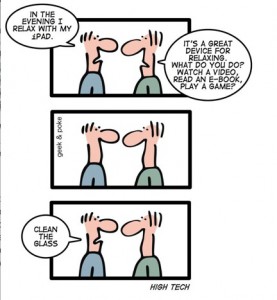

High Tech

A Hackathon in Myamar

It’s a Saturday afternoon and Ye Lin Aung has been holed up in an office all night. He and a group of friends have been working through the night on a mobile app that would help farmers to protect their crops.

They are competing in Myanmar’s first-ever hackathon, a 48-hour contest to create tech-based solutions for some of the country’s pressing development challenges.

It would be a familiar scene in San Francisco or New York. But not so Myanmar, a country where a slim segment of the population has access to phones and the vast majority of people have never been online.

After decades of military rule and isolation, Myanmar has begun opening up to international aid and investment. Its telecoms industry lags far behind neighbors like Thailand and India: mobile phone penetration is roughly ten percent; even fewer have access to the Internet.

Despite this low connectivity, Myanmar’s tech community is growing. Tech events such as this hackathon, and broader collaboration between coders and do-gooders, may yield technology solutions for development and humanitarian issues.

“The potential to do really good work, to use tech to solve real problems, is so clear,” said David Madden, founder of Code for Change Myanmar, which helped organize last week’s hackathon in Myanmar’s main city, Yangoon.

At the hackathon kick-off at the headquarters of Qatari telecom Ooredoo, one of the sponsors, representatives of Myanmar-based NGOs laid out the challenges for the team: to come up with a tech fix for a specific task. These ranged from how to reach sex workers to educate them about HIV/AIDS to crowdsourcing election monitoring for next year’s presidential vote.

Eighty-three people joined the hackathon and split into 17 teams. At the end, a panel of four judges gave each team three minutes to present their app or website.

NilBug won the competition with an app that would allow farmers to look up which pesticides were best to use on their crops, and to swap tips with other farmers on pest prevention.

While last week’s hackathon was the first of its kind, Myanmar has hosted other donor-funded tech events, including a BarCamp meet-up in Yangon in February that drew more than 5,000 participants. The previous month, a US embassy-supported TechCamp brought together more than 150 civil society activists for training in tech skills. BarCamp events have also been held in Mandalay, Myanmar’s second largest city.

While enthusiasts say that widespread tech literacy and access could lead to improvements in Myanmar’s fledgling democratic institutions, it’s no panacea for a country torn by ethnic-based conflicts, grinding rural poverty, and political divisions that no smartphone app can fix. Twenty-six percent of the population lives below the poverty line, according to the UN Office for Project Services. Starved for decades of investment, public infrastructure is decrepit and overwhelmed.

A spokesman from the US embassy in Yangon said digital literacy could support efforts in Myanmar toward better governance and economic growth. It could also bolster education by allowing schools to connect with counterparts in other countries, and improve communication with groups in rural areas.

Phil Morle, CEO of Pollenizer, a Australia-based company that helps start-ups in Asia and Australia, believes Myanmar is ripe for a digital revolution because of “latent interest combined with the on switch about to be ticked with the Internet.”

Hackathon

Australian Entrepreneur Runs Three Mines

Sinead Kaufman is often referred to as the ‘mayor’ of Tom Price: A West Australian mining town of 4500 residents with a Coles supermarket, post office, and temperatures that regularly hover around the 38 degree mark.

She’s that involved in the day-to-day operations of the growing Pilbara-based town – including supporting family-based facilities such as the childcare centre and two primary schools – that she’s earned a reputation as keeping the place in order.”

It’s all part of the job for Kaufman, who oversees three mines in the region as General Manager of the Tom Price and Marandoo Operations for Rio Tinto, managing 1400 staff and producing 40 million tonnes of iron ore a year. But not quite what she imagined studying geology at university twenty years ago. “I had a hugely romantic view of being off in a landrover somewhere exploring huge mines! It was highly romantic, in my mind.”

Last week, Kaufman was named one of Chief Executive Women’s seven education scholarship winners and the recipient of a $55,000 prize to attend a month-long Advanced Executive Program at INSEAD in Fontainebleau, France.

Working 12 hour shifts and travelling extensively between the three mines, Kaufman’s responsible for overall operations issues at the mines and dealing with the various employee and township issues that come up. With more than 90% of the houses in Tom Price own by Rio Tinto, that means dealing with everything from allocating houses to managing community issues and supporting the development of relevant facilities. She’s also on the board of the Tom Price Primary School, the Nintirri Community Centre and leads the Rio Tinto Iron Ore Mental health working group, supporting the health and wellbeing of miners across the state.

It’s a tough place to live, Kaufman concedes, but an interesting place to be. There are plenty of activities and facilities for the kids and some unique hobbies to explore on the ‘off’ days, such as gold prospering which Kaufman does with her husband and a metal detector whenever they get the chance.

She believes finding local, relevant hobbies is essential for getting involved in the local community and learning about a new town. In the far North Queensland where she was last posted, she took up fishing.

Meanwhile, having been flung far from her Irish upbringing to some of the globe’s most off-beat locations, including the Australian outback and underground copper mines in South Africa – she believes a close life partner and help at home are key to managing such a unique career. Her husband left the British Army to follow her mining career around the world, ultimately landing his own job with Rio Tinto.

Raising two children, ages two and six, the two have become a Rio Tinto “husband and wife team” by both sharing parental leave and flexible work arrangements. Kaufman took the first six months off when they hand their last child, while her husband followed it up by taking a further 18 months and continues to work flexibly and in line with ‘school hours’ to manage the childcare and school drop-offs.

Kaufman also takes great pride in supporting minority groups across the employee base – such as the 20% of the workforce that is female, and Rio Tinto’s Aboriginal employees. “We do spend plenty of time putting in support mechanisms for theses different groups,” she says. “The joke often is, ‘is there anything for the white males to do’?’

Sinead Kaufman

Cybercrime on the Rise?

Our correspondent Andreas Frank reports cybercrime on the rise.  Summarizing a  Rand Report which we have attached below, Frank notes:

  •  Economic Maturity: The hacker black market mirrors that of other free markets in both evolution and growth. RAND found five key indicators of economic maturity, including sophistication, specialization, accessibility, reliability and resilience.
  • More Profitable than Drug Trade: RAND’s report suggests the cyber black markets are a maturing, multi-billion-dollar economy, with robust infrastructure and social organization. In fact, RAND found the black market can be more profitable than the illegal drug trade. The links to end-users on the black market are more direct and worldwide distribution, being electronic, is trivial.
  • Rise of Twitter: In any traditional market, the yield or scarcity of a product influences its price. RAND found product prices on the illicit market are no different. Traditionally, credit card information was the currency of the black market, demanding high prices, ranging from $20-$40. However, high-profile breaches have created a recent influx of available credit card data. As a result, the scarcity and value of the stolen credit card information is decreasing. At the same time, social media and other online accounts are increasing in value due to scarcity on the market and a greater payoff for cyber criminals. RAND found hacking into accounts like Twitter can generate per-account revenues of $16 to $325+ depending on the account type.
  • Implications for Those Defending: One of the most disturbing and surprising findings from RAND is the increasingly rapid maturity of the market. RAND believes the ability to attack will outpace the ability for companies to defend. Juniper believes we must change the economics of hacking. Using forms of Active Defense like intrusion deception to actively identify, disrupt and frustrate attackers is a very promising approach.   Rand Report on Cybercrime       
  •                                                              Cybercrimes


Ben Ali Family’s Corrupt Grasp On Tunisian Economy

Our correspondent Andreas Frank reports; In Arabic it is called “wasta”, the connections and influence that grease the wheels of the bureaucracy and helps you get ahead. And the family of Zein al-Abidine Ben Ali, deposed president of Tunisia, had plenty of it.

A World Bank report confirmed that the Zine el-Abidine Ben Ali regime, ousted in Tunisia’s bent the rules to their own benefit – cashing in on the country in the process.

Government regulations on businesses, normally used to protect domestic industry from foreign competition or consumers and workers from corporate abuse, were often times instead used in Tunisia to further the private interests of the Ben Ali family, the authors Antonio Nucifora, Caroline Freund, and Bob Rijkers said.

The report underlines the depth of the challenges facing Tunisia today three years after Mr Ben Ali’s regime was overthrown, with many of the same rules of business still on the country’s books.

World Bank researchers analysed previously private tax data provided by Tunisia’s Ministry of Finance and relating to more than 600,000 firms. They found that 220 companies owned by Mr Ben Ali relatives earned 21 per cent of all the country’s private-sector profits between 1996 and 2010, in large part benefiting from rules in their favour.

The Ben Ali family appeared to know which sectors of the market to enter, staying away from businesses where there was too much competition. Moreover, sectors that piqued the interest of Mr Ben Ali’s family members tended to draw more regulatory activity, the report showed.

“It is easier to make money when there are regulations protecting you from competition and even more so when you can create new regulations as needed,” said Caroline Freund, a co-author of the report from the Peterson Institute for International Economics.

Mr Ben Ali’s clan included Sakher el-Materi, who is married to the president’s eldest daughter, Nesrine. In 2004 he bought Enakl, a state-owned car dealership, for about $16m. Soon after the government quadrupled Enakl’s import quota. Mr el-Materi floated 40 per cent of the company in 2009 and netted 53m Tunisian dinars ($33m).

He and his wife had by 2010 amassed ownership or stakes in a total of 36 businesses, including a lucrative shipping operation in the Tunis suburb of La Goulette which he set up after being granted a coveted permit to do so. In addition, he was elected to parliament as a member of his father-in-law’s party.

Companies linked to Mr Ben Ali’s circle on average controlled 6.3 per cent more market share than ordinary businesses, a differential “entirely due to Ben Ali firms sorting into [tending towards] the regulated sectors”, the report stated.

“There is nothing illegal happening here,” stressed Bob Rijkers, a World Bank economist who co-authored the report. “It is just that these laws do not necessarily benefit the public.
Over the years of Ben Ali’s rule, he issued 22 presidential decrees resulting in 73 amendments to the business code. Sometimes they were almost comically shaped to confirm the Ben Ali family’s various business interests. A 2007 rule requiring government authorisation for firms producing cement came as Mr Ben Ali’s brother-in-law established a new company called Carthage Cement.

At the time US diplomats noted in dispatches to Washington accusations that Mr Ben Ali’s circle were able to win advantages and crowd out competitors. Ordinary Tunisians also grumbled suspiciously at Mr Materi’s good fortune.

This concentration of wealth in just a few hands also fuelled broad discontent that would ultimately explode into revolution and the Arab Spring. Mr Ben Ali and Mr el-Materi were forced into exile in 2011.

“We tend to think of corruption more directly as bribes,” said Ms Freund. “But what people were upset about [in Tunisia] was this kind of crony-capitalism that characterises the whole region, and other countries as well”.

Well-connected cliques such as those close to Mr Ben Ali did help drive national growth rates of 4-5 per cent before the Arab Spring, impressing outside observers. Mr Ben Ali earned international praise for his handling of the economy by removing much of the regulations on export-oriented businesses.

“By opening up parts of the economy and giving the red-carpet treatment to foreign investors, he gave an impression of a country that was very open to business and investors,” said Antonio Nucifora, lead economist in the Middle East and North Africa region at the World Bank. “What this did was take away the spotlight from most of the economy which remained protected by barriers to entry, price control regulations.”

Unlike Egypt, Libya or Syria, Tunisia managed to squeeze its way out of a political crisis and avoid a descent into chaotic violence or political repression. Tunisia has since then drawn up a consensus constitution that has not only been lauded by the international community but has calmed political nerves after two assassinations last year nearly derailed the country’s transition.

But Mr Nucifora and his team said Tunisia has yet to unravel the regulatory structure at the heart of the Ben Ali era’s dysfunctional economy, and that business rules and restrictions stifling competition remain in place.

“It would be a mistake to assume that following the departure of Ben Ali and his family the cronyism [has] disappeared in Tunisia,” Mr Nucifora said.

Mr Ben Ali, now in exile in Saudi Arabia, has been convicted in absentia and sentenced to life in prison on charges of corruption, theft and complicity in murder.
World Bank Press Release
All in the Family – State Capture in Tunisia
Related reports

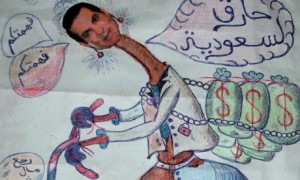
A cartoon displayed in Tunis last year depicts Zine al-Abidine Ben Ali fleeing with stolen dollars as a bird sings ‘bring back the people’s money’. Photograph: Eileen Byrne

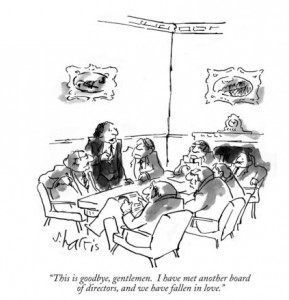
How Women Make Special Contributions to Boards of Directors

Gender equality is not the only issue when women ask for better representation on Boards of Directors.  In fact, companies perform better with women on boards.

Fortune 500 companies with the highest representation of women board directors attained significantly higher financial performance, on average, than those with the lowest representation of women board directors.  In addition, on average, notably stronger-than-average performance at companies with three or more women board directors.

The study, which is the second of Catalyst’s Bottom Line reports, looked at three critical financial measures: return on equity, return on sales, and return on invested capital, and compared the performance of companies with the highest representation of women on their boards to those with the lowest representation.

“Clearly, financial measures excel where women serve on corporate boards,” said the President of Catalyst. “This Catalyst study again demonstrates the very strong correlation between corporate financial performance and gender diversity. We know that diversity, well managed, produces better results. And smart companies appreciate that diversifying their boards with women can lead to more independence, innovation, and good governance and maximize their company’s performance.”

The report found higher financial performance for companies with higher representation of women board directors in three important measures:

  • Return on Equity: On average, companies with the highest percentages of women board directors outperformed those with the least by 53 percent.
  • Return on Sales: On average, companies with the highest percentages of women board directors outperformed those with the least by 42 percent.
  • Return on Invested Capital: On average, companies with the highest percentages of women board directors outperformed those with the least by 66 percent.

The correlation between gender diversity on boards and corporate performance can also be found across most industries—from consumer discretionary to information technology.

This study, sponsored by The Chubb Corporation, follows Catalyst’s 2004 Bottom Line report on the correlation between the percentage of women corporate officers and a company’s financial performance.     Corporate Performance and Women Directors

BODs

What Does Saudi Arabian Loan to Pakistan Mean?

CSM reporting:  Pakistan announced last week that it received a $1.5 billion grant from Saudi Arabia, which it termed a “friendly gift” and an “unconditional grant.”  Follow the Money.

Pakistan and Saudi Arabia have long had warm ties, but the no-strings-attached gift sparked immediate concern from Pakistani journalists, security experts, and opposition politicians, who question whether the grant is part of a behind-the-scenes deal for Pakistan to provide weapons for Syrian rebels.

“There are no free lunches in foreign diplomacy,” says Baqir Sajjad, a journalist at Pakistan’s Dawn newspaper, which has published articles questioning the deal.

The grant was confirmed at a briefing by Pakistan Prime Minister Nawaz Sharif’s advisor on national security and foreign affairs, who also said that Saudi Arabia had agreed to purchase weapons from Pakistan.

The Pakistan government declined to specify what kind of weapons the Kingdom was looking for and denied that any arms purchased by Saudi Arabia will be sent to Syria Pakistan, which has the sixth-largest army in the world, is known as a major arms importer, but it also sells fighter jets, anti-tank missiles, armored personal carriers, and small arms to Sri Lanka, Iraq, and Malaysia.

Ayesha Siddiqa, a defense expert based in Islamabad, says that Saudi Arabia – who is desperate to counter arch-rival Iran’s support for the Syrian regime and has publicly called for arming Syrian rebels – may want to buy weapons from Pakistan rather than other countries because Pakistan cannot enforce an agreement about where the arms end up.

“If the arms bought from the West were supplied to Syrian rebels and the sellers like the United States or other such countries found out, they would be able impose sanctions on the Saudis,” she says. “But Pakistan has no such leverage over the Saudis if they violate the agreement” because the government is cash-strapped and worried that US foreign aid will diminish once American troops withdraw from Afghanistan.

The disclosure of the grant and weapons agreement follows a series of high-level talks between Pakistan and Saudi Arabian officials over the past three months and Pakistan’s break last month from its neutral stance on the Syrian civil war. It said for the first time that the Assad regime should step down.

There is no proof that Pakistan’s decisions are the direct result of Saudi Arabia’s actions – or that its arms will reach Syria. Even if they did, “there are so many arms coming from so many different places,” says Michael Kugelman, a Pakistan scholar at the Woodrow Wilson International Center for Scholars in Washington in an e-mail. “Unless the level of Pakistani arms shipments reaches some sort of critical mass, I don’t see them being any kind of game-changer for the conflict.” At home, Pakistan is struggling with its Sunni-Shiite violence and ongoing strife from the Pakistan Taliban’s insurgency. There were 687 sectarian killings in Pakistan last year, an increase of 22 percent from 2012, according to the Pakistan Institute for Peace Studies. Violence between Sunni Muslims (about 75 percent of the population) and Shiites (15 to 20 percent) has never reached massive levels, but there’s concern that it’s on the rise.

Arms to Syria