Nuns Force Chase to Produce Report on Scandals

The Sisters of Charity of Saint Elizabeth demanded that JPMorgan produce a report for its shareholders on the scandals it has been involved in.

JPMorgan was finally able to satisfy the nuns when they agreed to write such a report.  It should make thrilling reading.

JPMorgan had initially said that the nuns request, backed by several other shareholders, was materially false and misleading.  The SEC, JPMorgan and The Nuns  

Unfortunately the dual role Dimon holds will not be divided until he steps down.

 The Nuns Beat Jamie Dimon

Women Climbing Slowly to the Top

A Harvard Business Review study suggests women are getting more top jobs.  Attributes at the top also reflect some broader trends within the Fortune 100 over the past three decades, such as a decrease in heavy industry and energy companies, which have fewer women at all levels of management, and a proliferation of health care and retail companies, which have more women. The study’s most striking findings have emerged in four areas: career trajectory, education, diversity, and hierarchy within the senior ranks.  Top Jobs in Business

Getting to the Top

Robert Reich’s Economics 101

Reich reminds us that we have forgotten three important economic lessons we learned during the 30 years following World War II:

1.  Real job creators are consumers, whose rising wages generate jobs and  growth.

2.  The rich do better with a smaller share of a rapidly growing economy than with a large share of an economy that is hardly growing at all.

3.  Taxes to finance public investments –roads, bridges, public transportation and education benefit us all.

Reich always is imminently reasonable.  Why is he so hard to hear?   Robert Reich’s Economics 101

Economics 101

Christine Lagarde’s Leadership Qualities

Madame Lagarde has always quickly grasped competing interests of the relevant stakeholders and is able to provide constructive responses. While it might have been tempting to condemn multinationals for engaging in sophisticated ‘tax optimisation’ schemes, for example, it is more constructive to identify the factors which facilitate that and evaluate the options for removing them. In every case Lagarde chose the latter.  She seemed genuinely committed to the constructive route which is a welcome priority for any leader.  Christine Lagarde’s Leadership Legacy

Christine Lagarde

Gender Impact on Private Investment

Women are less likely than men to find investors.  A study conducted by researchers at the University of North Carolina concluded that woman-owned firms are as much as 16 percentage points less likely to attract private investment dollarscompared to male-owned firms.  Although the group studied had a directive to include women proportionately, they were not.   Gender Impact on Private Investment Gender Impact on Private Investment

Gender Gap

A New Approach to the Sharp Divide Between Rich and Poor

Most of us agree that a society which has a dramatic fault line between the rich and the poor is not a good one.  How can we attack the problem with useful policies?  Stop discussing the middle class.  In simplest terms, the issues impacting the growing chasm are 1) Disproportionately high income in the top one percent and 2) Failure to prepare the poor for jobs in the new information economy.

Beating up on either the rich or the poor is not productive.  Ask why the rich are so rich today?  And why are the poor so poor?  Then address those issues. Take the dialogue out of a left-right debate.  Try instead to solve a problem. Below are proposals worth considering.

Our correspondent Lloyd McAulay a New York political activist and attorney, suggests the following:  Use taxes, not by hiking them on the rich, but by eliminating some favorable treatment.  Rethink luxury taxes.  Limit salaries in publicly -traded companies.  Limit power of the highly-skilled unions and government employees.

Train and educate people for jobs in the information economy.  Training must not be a cover for doing nothing.  Tie rewards from the system to work.  (Earned income credits).    Further ideas.   New Policies for the Income Divide
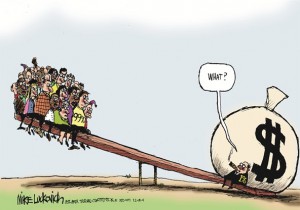
The Income Divide


European Banks Shift as US Capital Ratios Rise

The Federal Reserve published a final rule requiring higher capital levels from non-US banks like Deutsche Bank, Barclays and Credit Suisse.  European banks have responded by booking more busines outside the US and converting intercompany loans.

The banks lobbied hard for an extension to new Fed Rules and got it.  The Fed is reported to be scrutinizing the methods used to boost US capital levels.

Banking is surely international but the terms in which banks enter foreign markets will change.  Big US banks fear that if the US is too tough on foreign competitors, they will retaliate in their home countries.  No one has yet raised the issue about the purpose of banks and whether or not they are fulfilling their important social functions.

Capital Requirements


Indian Assessment of Risk Based on Gender

In the US and other Western European countries, admitting that risk is assessed based on gender would probably get you served with court papers.  But elsewhere in the world, this is not the case.  While the world of pawn shops and loans on gold jewelry may be a small target area, it is interesting to see a major company in the business seeking out women as customers, because they are a better risk.  These companies make more money when the article if reclaimed than they do if there is a default.   Gold loan company targets women.

Women's Gold Jewelry

What Elizabeth Warren Represents in the US?

Warren possesses a knack for earthy articulation of the liberal-populist worldview matched by no one else in American public life today. Videos of her speaking to supporters and donors, or decimating slow-witted cable hosts, go “viral” and get millions of views from liberals who’ve been desperate for years to hear a prominent Democrat talk the way she does. This is part of what she said in what is perhaps her most famous clip, from September 2011:

I hear all this, you know, well, this is class warfare, this is whatev…. No. There is nobody in this country who got rich on his own. Nobody. You built a factory out there? Good for you. But I wanna be clear. You moved your goods to market on the roads the rest of us paid for. You hired workers the rest of us paid to educate. You were safe in your factory because of police forces and fire forces that the rest of us paid for…. You built a factory and it turned into something terrific or a great idea, God bless. Keep a big hunk of it. But part of the underlying social contract is you take a hunk of that and pay forward for the next kid who comes along.

We live in an age when hedge fund managers and Wall Streeters complain of class warfare against them, and when, as Harvard professor Lawrence Lessig’s important research has shown, all but a small proportion of political campaign contributions are made by “the tiniest fraction of the one percent.”1 It’s been years since a high-profile politician has spoken like Warren and not only survived but flourished. Warren has aroused populist tendencies in parts of the liberal base and probably emboldened other senators and members of the House to speak more directly on class issues.   New Populism in America

Warren