Canada Fines Brokerage Firms for Money Laundering

Andreas Frank reports;  Canada’s financial watchdog that supervises money laundering and terrorist financing has issued details of violations committed by a Canadian regulated broker dealer.

Financial Transactions and Reports Analysis Centre of Canada (FINTRAC), a government organization that reports to Canada’s ministry of finance, has found Questrade, a domestic financial services firm guilty of negligence in relation to serious principles in the way it deals with money laundering. As a result, FINTRAC enforced a financial penalty in 2011 to the multi-asset discount broker.

FINTRAC announced full details of the violations committed by Questrade the press statement. The Order states that: “Questrade, Inc., a securities dealer in Toronto, Ontario, was imposed an administrative monetary penalty of $346,140 on October 19, 2011, for committing nine violations of the Proceeds of Crime (Money Laundering) and Terrorist Financing Act (the Act) and the Proceeds of Crime (Money Laundering) and Terrorist Financing Regulations (the Regulations).”

FINTRAC, a government organization, was set up in 2000 to specifically tackle money laundering and terrorist financing related crimes. Canada has a range of financial regulators for brokers, banks and fund managers operating in the financial markets arena. Questrade is a member of the Investment Industry Regulatory Organization of Canada, a self-regulatory organization which oversees all investment dealers.

During FINTRAC’s investigations, Questrade was found to have poor systems and controls in its compliance and anti-money laundering procedures. The major issues according to the briefing issues were:

  • Failure to report a suspicious transaction;
  • Incomplete compliance policies and procedures, failure to develop a written ongoing compliance training program and failure to take special measures for high risk activities;
  • Inadequate practices of ascertaining client identity and confirming the existence of an entity other than a corporation, failure to enter into an agreement or arrangement with an agent or mandatory for the purposes of ascertaining identity, and incomplete record keeping;
  • Failure to take reasonable measures to determine whether a person is a politically exposed foreign person.

The financial penalty is one of the first issued to a financial services broker for such activities, highlighting Canada’s commitment to safeguarding its financial services sector.

Canada’s financial regulators adhere to state regulations which vary from region to region. In October 2013, the Ontario Securities Commission (OSC) cautioned investors about global FX broker, YouTradeFX, and advised users not to deal with unauthorized brokerage firms.   FINTRAC Penalty  

Brokerage Carelessness

California Political Dynasty Accused of Money Laundering

Our correspondent Andreas Frank reports: The political dynasty of Ron and Tom Calderon took a body blow as U.S. Attorney Andre Birotte Jr. charged the brothers with criminal political corruption and painted a devastating picture of Ron Calderon as a man who drew his own son and daughter into his web.

Ronald S. Calderon, 56, of Montebello, is charged in a 24-count indictment that was returned late the before by a federal grand jury with mail fraud, wire fraud, honest services fraud, bribery, conspiracy to commit money laundering, money laundering and aiding in the filing of false tax returns.

Sen. Ron Calderon, a Democrat from a politically prominent family in Los Angeles’ blue-collar suburbs was charged with accepting $100,000 in bribes, lavish trips and no-show jobs for his children in exchange for pushing legislation to benefit a hospital engaged in billing fraud and participating in a film industry tax scheme that actually was an FBI sting.

The 24-count federal indictment against Sen. Ron Calderon depicts a rogue legislator eager to trade his clout at the state Capitol to enrich himself and his family. His brother Tom, a former state lawmaker-turned-lobbyist, was charged with money-laundering for funneling bribes through a tax-exempt group he controlled, prosecutors said.

State officials called one of the two schemes “the largest insurance fraud in California history” involving former hospital owner Michael Drobot in Long Beach. An IRS executive at the press conference said Drobot bribed Calderon by hiring his son for a phony job paying $10,000 that was solicited by Ron Calderon, and that Calderon knew was fake. Then, authorites allege, Calderon helped to lie about the income on his son’s tax return.

Bribery money flowed to lobbyist Tom Calderon’s entity, Californians for Diversity, officials allege, and that money was ultimately laundered by being deposited in banks in a manner meant to cover up the original bribery, according to Birotte and the IRS.

Investigators explained their actions in a prepared statement that flew through Sacramento legislative offices “like a storm cloud” says one legislator.    Calderone Indictment

Corruption

Matching Skills and Jobs

Most economists agree that there are plenty of jobs going begging because   potential employees are not trained for them.  How to solve the problem?

In an interview, Charles Tilley of the Chartered Institute of Management Accounts made these suggestions:

1.  Give students work experience while they are in college, or even high school, so that they can select a field that interests them.

2.  Training programs and apprenticeship are helpful to attractive candidates.

3.  Measure the effectiveness of training.  a.  an evaluation form filled out by the trainee.  b. Before an after tests to assess learning. c. Has training improved productivity?  Quality?

These basic tools may make hiring a good match for a job easier.

Matching Skills and Jobs


Matching Skills and Jobs

Sochi as Entrepreneurial Inspiration

One of the five Olympic rings malfunctioned and online stores in China are offering variations of the glitch.  Hospital administrator Zhang Zhen recognized it as a great business opportunity.  “I thought, ‘since everyone thinks this is funny, why don’t I make some T-shirts out of it’ – turn it into something memorable,” Zhang said.

Zhang and partner Yan Wenjuan took time out from their day jobs and transformed his spartan apartment into a workshop

The International Olympic Committee is very protective of its five rings and the newspaper quoted Wang Li, professor of Olympic Study at Beijing Sports University as saying: “Marketing an image that is suggestive of an official symbol without a permit is still (copyright) infringement.

For their part online sellers say is just a bit of fun, and that their image is different – just four rings and a malfunctioning snowflake.  They have made a quick buck with this ingenious and instant response.

Sochi Snowflake

Has the Cold War Shifted to the Pacific

Journalists and scholars are studyng the possibility of conflict in the Far East.  Some think China and Japan will shoot at each other in the next five years.

Financial Times reporting: The new era of military competition in the Pacific may become the defining geopolitical contest of the 21st century.  China’s turn to the seas is rooted in history and geography in a manner that transcends its current political system. It was from the sea that China was harassed during its “century of ­humiliation” at the hands of the west. China was one of the most prominent victims of 19th-century gunboat diplomacy, when Britain, France and other colonial powers used their naval supremacy to exercise control over Shanghai and a dozen other ports around the country. The instinct to control the surrounding seas is partly rooted in the widespread desire never to leave China so vulnerable again. “Ignoring the oceans is a historical error we committed,” says Yang Yong, a Chinese historian. “And now even in the future we will pay a price for this error.”

Anxieties about history and geography have meshed with broader concerns about economic security. One of the key turning points in China’s push to the high seas took place when it started to import oil for the first time, in 1993. By 2010, China had become the second-biggest consumer of oil, half of which is now imported. New great powers often fret that rivals could damage their economy with a blockade. For every 10 barrels of oil that China imports, more than eight travel by ship through the Strait of Malacca, the narrow sea channel between Indonesia, Malaysia and Singapore, which is patrolled by US ships. Fifteenth-century Venetians used to warn, “Whoever is the Lord of Malacca has his hand on the throat of Venice.” Hu Jintao echoed these sentiments when he warned in a 2003 speech that “certain major powers” are bent on controlling this crucial sea lane. Until now, China’s maritime security has been guaranteed largely by the US Navy. But, like aspiring great powers before it, China has been forced to confront a central geopolitical dilemma: can it rely on a rival to protect the country’s economic lifeline?

The US has not lost an aircraft carrier since the Japanese sank the Hornet in 1942. Both practically and symbolically, the aircraft carrier has been central to American power projection over the six decades during which it has dominated the Pacific. But it is those same vessels that are now potentially under threat from China’s vast new array of missiles. The loss of a carrier would be a massive psychological blow to American prestige and credibility, a naval 9/11. The mere prospect that carriers might be vulnerable could be enough to restrict their use. Even if the US Navy commanders thought their carriers would probably survive in a conflict, they might be reluctant to take the risk. As a result, the US needs a Plan B.

In the bowels of the Pentagon, that new plan has been taking shape. It is not actually described as a plan – instead, Pentagon officials call it a new “concept” for fighting wars. But it does have a name, AirSea Battle, which echoes the military doctrine from the later stages of the cold war called AirLand Battle, when the massive build-up in Soviet troops appeared to give the USSR the capacity to over-run western Europe. Many of the details about AirSea Battle remain vague. But the few indications that have been made public suggest an approach that, if pushed too far, could be a manifesto for a new cold war.

Then there are the allies. Asian governments are keen on a US military that can push back against Chinese aggression and are eager to enlist US help in this regard. But some allies might balk at the prospect of a plan to attack deep into mainland China, especially if it involved launching bombing raids from their territory. Ben Schreer, an Australian military strategist, says AirSea Battle is suited to “a future Asian cold war scenario”. Rather than providing assurance, Washington’s new battle plan could easily rattle some of its friends and allies.

Is AirSea Battle politically viable? Given the risks, especially the chance of nuclear escalation, it is not at all clear that a US president would endorse a war plan that involved such a rolling bombing campaign. Successful deterrence relies on being able to demonstrate a military threat that is credible and realistic. Pentagon planners hope the Chinese military will be cowed by the mere thought of an American military strategy based on AirSea Battle. But, equally, the Chinese might come to see it as a one great big bluff.

At the very least, AirSea Battle concentrates the mind. It is prompting a much broader debate in the US about how to respond to the Chinese challenge. With its superiority now under threat, Washington faces a choice: it can try to retain its primacy at all costs or it can shift to a more defensive approach that is geared towards preventing another power from ever controlling the region. Deterrence is not always the same as dominance.

Such bleak outcomes are not inevitable, of course – powerful economic connections narrow the space for reckless behaviour. Yet a previous era of globalisation failed to prevent the UK and Germany from going to war. Shinzo Abe, the Japanese prime minister, is not alone in comparing the current situation in Asia to Europe in 1914. Asian militaries lack the meticulous war plans that helped push Europe into conflict then but the region offered a familiar mixture of nationalism and the potential for miscalculations that can spin out of control. The western Pacific may now be the cockpit of the world economy but it is also turning into one of its most dangerous flashpoints.
AirSea Battle in Pacific?

SEC and Credit Suisse in 196 M Settlement

Our correspondent Andreas Frank writes:
Credit Suisse Group AG agreed to pay $196 million and admitted that it improperly solicited thousands of American clients, ending a U.S. regulatory probe while a broader criminal investigation of tax evasion still looms.  The settlement today includes almost $82.2 million in disgorgement, $64.3 million in prejudgment interest and a $50 million penalty.

The bank collected about $82.2 million in fees and amassed as many as 8,500 U.S. client accounts from at least 2002 through 2008, the SEC said in an administrative order today. The accounts held an average total of $5.6 billion in securities assets, the SEC said.

Credit Suisse has been ensnared in a wider Justice Department probe for the past three years into Americans’ use of off-shore bank accounts to avoid taxes. Eight bankers, including Credit Suisse’s former head of North America offshore banking, were charged in 2011 with conspiring to help American clients evade taxes through secret bank accounts.

“As Credit Suisse admitted as part of the settlement, its employees for many years failed to comply with these requirements, and the firm took far too long to achieve compliance,” Andrew Ceresney, director of the SEC’s enforcement division, said in the statement. “The broker-dealer and investment adviser registration provisions are core protections for investors.”

Credit Suisse admitted to the facts in the SEC order, which concluded that the bank “willfully violated” securities laws, and agreed to hire an independent consultant, according to the regulator.

Creidit Suisse has a history:
In 2012, Credit Suisse come into the spotlight when Christos Bagios a former banker at UBS AG and Credit Suisse was indicted and pled guilty supporting wealthy Americans hide millions of dollars from U.S. tax authorities.
In 2011 Credit Suisse was fined 149 million euros to settle allegations against the bank for helping German citizens to evade taxes.
In 2009 Credit Suisse was fined $536m  for money laundering and sanction violations by the DOJ.   SEC Credit Suisse Settlement

Credit Suisse


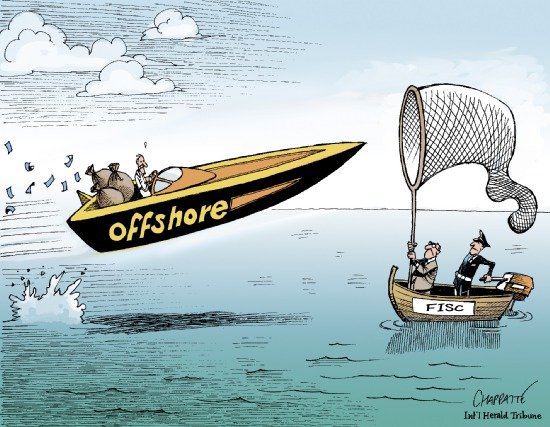
Where U.S. Offshore Tax Evaders Live And Bank

Andreas Frank International Anti-Money Laundering AML Expert  Reports:

The latest U.S. Government Accountability Office report shows which states have the most taxpayers disclosing such accounts (California is No. 1), and where they are located (Switzerland is No. 1). The report was published on Jan 6, 2014 but publicly released on Feb 19, 2014.GAO

The GAO report is a supplement  to its
“Offshore Tax Evasion: IRS Has Collected Billions of Dollars, but May be Missing Continued Evasion.”

There is nothing illegal about keeping money offshore, but you have to report it on a form called the Foreign Bank and Financial Account (FBAR) form – if the account value is $10,000 or more – and pay taxes on earnings. For those ready to fess up, the IRS held the 2009 voluntary disclosure program, followed by one in 2011, and another that opened in 2012 and is still reeling in taxpayers. The programs offer incentives for taxpayers to disclose their offshore accounts and pay delinquent taxes, interest and stiff penalties – to avoid criminal prosecution.
GAO_Offshore_Tax_Evaders

 Chappatte

Chappatte

Problem mit der Geldwäsche Bekämpfung

Half of New Italian Cabinet Female

In the group of eight women appointed to posts is Federica Mogherini is foreign minister.  She had been a party official in charge of European affairs. Roberta Pinotti becomes first female defense minister.  Minister for economic affairs is entrepreneur and close Berlusconi associate Frederica Guidi.

Carlo Padoan was appointed as finance minister.  This sends a positive signal to investors and the European Commission. The new minister has robustly defended fiscal consolidation while promoting reforms to make the eurozone’s third largest economy more competitive.

Padoan argues that fiscal consolidation has been necessary to get the European economy back on track and not the cause of high unemployment rates and poverty.


US Federal Reserve Allows Big Banks to Set Stress Test Rules

The stress tests proposed are based on capital ratios.  Distinguished economists like Anat Admati and Martin Helwig argue that we are looking in the wrong place to test stress.  Admati and Helwig argue that if banks had much more equity the financial system would be safer. It is in fact better for problems to be addressed quickly by rebuilding equity even when the economy is weak.  None of the big banks are factoring in this fact.  Stress Test Rules

Stress Test