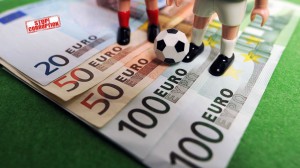
Allianz Buys 8.33% Stake in Bayern München For EUR110M

Allianz SE Tuesday said it is buying an 8.33% stake in FC Bayern München, thereby
extending its partnership with the premier league soccer club across town.
Allianz, Europe’s biggest insurer by revenues, said it would buy the stake for EUR110 million ($149.97 million), as part of a capital increase at the soccer club.
FC Bayern intends to use the capital from the Allianz investment for the repayment of debts and for launching a youth football center of excellence. The naming rights, including an option, for the FC Bayern München stadium, the Allianz Arena, have been secured long term until 2041.
Allianz Buys 8.33 %Stake in Bayern München For EUR110M

Money and  SportWarum steigt eine Versicherung beim Fussball ein?


Gender Pay Gap: Myth or Reality?

In Australia, men and women who graduate in the same fields do not necessarily start on equal footing in terms of pay. The Workplace Gender Equality Agency has been reporting figures on the gender pay gap at the graduate level since 1997 and during that time there has always been some discrepancy between what female and male graduates earn. At its best, this gap was 2.5% in 2005 but it has grown since then. In 2012 the gap was almost 10%, the biggest gap in 15 years.

If men and women who graduate in the same field do not even start on equal salaries it seems unlikely that disparity will not persist over the course of their careers, which seems to be borne out in the available data.

While it’s not accurate to say a woman always earns 17.5% less than a man doing the same job, it is accurate to say women earn less than men, even in the same fields, with the same qualifications. And the 17.5% figure, high level as it is, indicates very clearly that women, on the whole, still earn substantially less than men.    Gender Pay Gap- Myth or Reality

Mind the Gap


Assessing Bernanke

Thanks in large part to Bernanke’s policies, the rich have never been richer, and the gulf between the haves and have-nots has never been wider. No wonder billionaires like Bernanke.

But  there is the downright frightening prospect of what might happen to the bond market if the Fed ever decides to sell some of the $4 trillion of assets — all those bonds it has been buying — on its balance sheet, which is five times larger than before Bernanke’s buying spree.  Assessing Bernanke

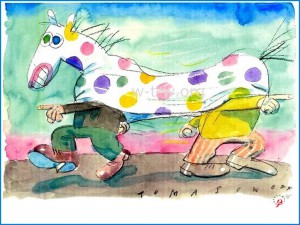
Japan is in QE mode and the US may be in Tapering.

Japan is in QE mode and the US may be in Tapering.

Drawing by Dr. JanTomashoff


Russia’s Central Bank Revokes Licences From Two Moscow Banks

Russia’s central bank has withdrawn the licences of two small Moscow-based banks, part

Банк России

Банк России

of its widening campaign to clean up the banking system and crack down on money laundering.

Russia has more than 900 banks, mostly small, and many are suspected of servicing the shadow economy. Since taking up her position as central bank head last year, Elvira Nabiullina, has made it clear she wants to tighten banking supervision and shore up large-scale capital flight to boost the flagging economy.

The central bank it had withdrawn Eurotrust bank’s licence because of a failure to meet obligations to its creditors and depositors, and to create sufficient reserves to cover potential losses on loans.

LINK Bank also failed to create provisions against risk and both banks were involved in “dubious operations”, such as money laundering, the central bank said in a statement.

Both banks are part of Russia’s system of retail deposit insurance, under which the state guarantees small savings if a bank fails. Last year, the withdrawal of Master Bank’s licence cost the state about 30 billion roubles ($890 million).
CBR Eurotrust Statement
CBR_LinkBank_Statement

Russia's Central Bank Revokes Licences From Two Moscow Banks

South Korea to Name and Shame Companies that Overlook Women

South Korea has come up with an original way of addressing gender disparity in the workforce. The country is set to publicly name and shame companies with low levels of female employment, as the country’s first female President looks to boost an additional 1.65 million jobs for women.

With an ageing population threatening South Korea’s economic growth and a World Economic Forum (WEF ranking of 111 (out of 136 countries) on the “gender gap index”, President Park Geun-Hye and a number of ministries pledged last week to increase the female employment rate to 61.9%, an increase from 53.3% before the end of her term in 2018.

With the help of the minister for gender equality, Cho Yoon-Sun, the government will seek to end the male-dominated workforce practices, with the announcement that it will facilitate the workforce growth of women by publicly naming and shaming companies that don’t do enough to to tackle gender diversity, or those that employ at least 500 workers and a female share of the workforce that’s less than 70% of their industry’s average for three consecutive years.

While women account for 42% of total government jobs and hold more advanced degrees than men, they only hold 3.2% of all senior government positions and earn only about 69% of what their male co-workers earn. Park has previously said that increasing female employment was among the “most critical” items on her agenda.

Child-rearing in South Korea is still viewed as a predominantly female job and many women are leaving the workforce mid-career to raise their families and finding it hard to reenter the workforce. In an interview with WSJ Cho pointed to the unfeasable working hours as a major cause of work/life imbalance for South Korean women.

“Koreans work for too long every day. In 2011, they worked an average of 2,116 hours, much higher than the 1,652-hour average of the OECD. That forces mothers to quit their jobs as they are unable to take care of their children,” she said.

Additional steps taken to increase employment for women include increasing childcare subsidies for working parents and preferential treatment for “family friendly” companies seeking government contracts, encouraging more flexible working hours and improved training for mothers who are looking to re-enter the workforce. More details of the scheme will be announced in December.

President of South Korea

Chinese Tax Haven Clients

The International Center for Investigative Journalism Reporting:  The ICIJ is back in the spotlight once again, this time revealing “nearly 22,000 tax haven clients from Hong Kong and mainland China. Among them are some of China’s most powerful men and women — including at least 15 of China’s richest, members of the National People’s Congress and executives from state-owned companies entangled in corruption scandals.”  The source of this treasure trove of data is secret.  All ICIJ says on the matter is that “In November, a mainland Chinese news organization that was working with ICIJ to analyze the offshore data withdrew from the reporting partnership, explaining that authorities had warned it not to publish anything about the material. ICIJ is keeping the identity of the news outlet confidential to protect journalists from government retaliation.” But where the data comes from is largely irrelevant.  China’s Tax Haven Clients  

Red Nobility

 China's Elite Part II

Why Liechtenstein?

Combating Financial Crimes  Liechtenstein Policy Statement

Combating and preventing money laundering, terrorist financing, corruption, organized crimes and tax evasion are a major focus of Liechtenstein’s financial center policy. Liechtenstein banking secrecy offers no protection to criminals and through the use of domestic and international legal mechanisms, financial secrecy is lifted in cases of suspected criminality. Liechtenstein has prevention and punishment systems to combat money laundering and terrorist financing.

Liechtenstein has made many comprehensive reforms in the regulation of its financial sector over the last ten years. Its initial reforms concentrated on anti-money laundering efforts. More recently, the government of Liechtenstein signed a landmark Tax Information Exchange Agreement (TIEA) with the United States and numerous other countries and concluded negotiations of an Anti-Fraud Agreement with the European Union. The United States government acknowledges Liechtenstein to be a trusted and effective collaborator in combating a wide range of financial crimes, including money laundering, terrorist financing, and tax fraud and recent reforms guarantee that Liechtenstein will provide the United States and others with a markedly increased range of cooperation on tax matters.

In addition to compliance with the highest international standards set by the Financial Action Task Force (FATF) in the fight against money laundering, Liechtenstein authorities also actively take part in the international dialogue on the further development of common standards. Milestones in the fight against money laundering and terrorist financing include:

  • Liechtenstein is a State Party to the Convention of the Council of Europe on Money Laundering, Search, Seizure, and Confiscation of the Proceeds from Crime (1990)
  • Implementation of the 1st EU Money Laundering Directive (1995)
  • Due Diligence Act enters into force (1997)
  • Total revision of the Liechtenstein Mutual Legal Assistance Act (2000)
  • Establishment of the Liechtenstein Financial Intelligence Unit (2001)
  • Mutual Legal Assistance Treaty with the United States and adoption of the “Counterterrorism Package” (2002)
  • Tightening of the Law on Professional Due Diligence in Financial Transactions (Due Diligence Act) (2004)
  • Establishment of the Liechtenstein Financial Market Authority through enactment of the Financial Market Authority Act (2004)
  • Implementation of the 2nd EU Money Laundering Directive (2005)
  • Partial revision of the Mutual Legal Assistance Act (2008)
  • Implementation of the 3rd EU Money Laundering Directive (2008)
  • Signing of a Criminal Law Convention on Corruption and a Second Additional Protocol to the European Convention on Mutual Assistance in Criminal Matters (2009)
  • Liechtenstein is a member of the Group of States against Corruption (GRECO), the monitoring body established by the Council of Europe to improve the capacity of countries to prevent and combat corruption (2010)

Yet, there are twice as many businesses as citizens in the country, which collaborates closely with Switzerland.  If the US tax authorities are scrutinizing Swiss financial institutions, can Liechtenstein be far behind?  Why Liechtenstein 

Liechtenstein

For the First Time, Swiss Asset Manager Charged with Hiding US Taxpayers’ Assets

Peter Amrein, a Swiss asset manager, indicted on charges that he assisted U.S. taxpayers in evading millions of dollars in taxes owed by hiding money in offshore trusts at multiple Swiss banks.

Offshore companies and trustees enable money laundering and tax evasion, according to the US senate hearings 2006, 2008, and 2009.

The “Amrein” case clearly demonstrates the the use of sham “foundations”,  and other entities formed in countries such as Liechtenstein, to conceal taxable assets from the IRS.  Reported by Andreas Frank for w-t-w.org.
Download: US Amrein Indictment 6.2.14
Peter Amrein, a Swiss asset manager 

www.koufogiorgos.de

www.koufogiorgos.de


BIS warns

Emerging markets more vulnerable than ever to Fed tightening,

Bank for International Settlements BIS says there had been a “massive expansion” in borrowing on global bond markets by banks and companies in developing countries.

Emerging markets may be even more vulnerable to an interest rate shock today than they were during the East Asia crisis in 1998, the Bank for International Settlements (BIS) has warned.

The Swiss-based watchdog said there had been a “massive expansion” in borrowing on global bond markets by banks and companies in developing countries, leaving them exposed to “powerful feedback” risks as borrowing costs rise in the West.
Emerging markets more vulnerable than ever to Fed tightening, warns BIS

Die neue Fed-Chefin Janet Yellen hat angekündigt, die Aufkäufe von US-Staatsanleihen weiter zu drosseln. jpg