China: From Manufacturing to Buying

For the better part of 20 years, China has been the world’s factory, and its low labor costs have helped tamp down inflation in developed nations by allowing them to import cheap, Chinese-made goods. The torrent of foreign direct investment (FDI) that flowed into mainland China—some $900 billion since 1990, according to United Nations data—helped finance factories along the southeastern coast that slaked the global thirst for inexpensive goods. It also underpinned phenomenal economic growth. The country’s GDP grew from $357 billion in 1990 to $9.3 trillion last year, a nearly thirty-fold increase in a single generation. But that growth also spurred deep social changes. Millions migrated from inland, rural provinces to coastal cities in search of manufacturing jobs, and some 300 million Chinese vaulted into the middle class. The net result: China’s days as the world’s low-cost factory are numbered. They’re going to be buyers now.  China – From Manufacturing to Buying

Chinese Manufacturing

The Finance Job Where Women Dominate In China

Financial planning is a major growth industry in China – the demand for relationship managers alone is an indication of how the industry is booming.

It is also an industry where women excel, demonstrated by this year’s survey by Forbes China, which revealed that of the top 50 financial planners on the mainland, 31 are women – up from 28 last year.

Forbes China managing editor Bridge Kang said that it stems from a tradition in Chinese households that “men earn the money and women manage it.” This helps female professional financial planners and advisers build good relationships with industry executives and customers.”
The finance job where women dominate in China

Ladies lead the way

Financial Education Groups Bring Women Together To Talk Money

On Meetup.com, a community bulletin board for the digital age, there are groups for like-minded people of all kinds.

Baby boomers, urban homesteaders, amateur psychics, weekend hikers, veterans interested in doomsday prepping — whatever your interest, there’s a group for you.

When it comes to money, though, many people still aren’t comfortable opening up with anyone, let alone strangers. Many women, in particular, report a lack of confidence in the subject.

While more than half of women today are primary breadwinners, less than a quarter — 22 percent — feel “well prepared” to make financial decisions, according to a survey conducted by Prudential in 2012-2013. Overall, women were twice as likely as men — 15 percent compared to 7 percent — to identify themselves as financial “beginners.”
Financial education groups bring women together to talk money

Financial education groups bring women together to talk money

CEO of BitInstant Arrested in US for Money Laundering

“Hiding behind their computers, BitInstant defendants are charged with knowingly contributing to and facilitating anonymous drug sales.”

Charlie Shrem, the vice chairman of the Bitcoin Foundation charged by federal prosecutors with conspiring to launder more than $1 million in the virtual currency tied to the illicit online bazaar Silk Road, can be freed on $1 million bond, a judge ruled.

Shrem, 24, will remain under house arrest at his parents’ home in Brooklyn, New York, with electronic monitoring, Magistrate Judge Henry Pitman said today in Manhattan federal court.

Keith Miller, a lawyer for Shrem, told the judge that his client was arrested yesterday at John F. Kennedy International Airport as he returned to New York after giving a speech about virtual currency in Amsterdam.

Charlie Shrem

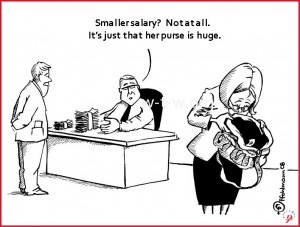
Female Graduates Demand Smaller Salaries Than Men

Quote

Female graduates request lower starting salaries than male graduates when Female Male Graduateslooking for their first job, a vacancy website has found.
Analysis of salary requests made by almost 500,000 graduate job seekers between 2003
and 2013 on Graduate-jobs.com revealed the
trend has remained the same for the past ten years.

The difference between the wage expectations of males and females in 2013 was £1,438. On average, men requested £20,219 a year while women asked for £18,781.

This gap has risen since 2003, when the gap was £999 – £18,506 for men and £17,507 for women.
Female graduates demand smaller salaries than menSmaller Salery


Give Women Credit: Financial Empowerment Matters

Deep-rooted attitudes on moneyAL ARABIYA NEWS

My work led me to question the deep-rooted attitudes about money. Why is it that some women feel they don’t understand money? What stops a woman from being interested in money and managing it? It is a vicious circle.
Give women credit Financial empowerment matters


Ozlem Denizmen

Ozlem Denizmen

As 13th century Anatolian spiritual leader, poet and philosopher Celaleddin Rumi put it, “A candle doesn’t lose anything from its light by lighting other candles.” So ladies and gentlemen, husbands, fathers, brothers, bosses, banks, governments, everybody: give women credit! Let us light up half the population by giving them financial freedom.


Yellen and the Fed

Co-authored with Akerlof, this is perhaps the most relevant paper Yellen wrote for understanding what she’s likely to do at the Fed, not least because it’s so recent. The paper is a critique of an argument made by Robert Lucas, the Nobel laureate who turned macroeconomics on its head with his mid-1970s critique of Keynesianism. Lucas was not only skeptical of the prescriptions traditional Keynesians proposed for combating economic downturns, such as fiscal stimulus. He also thought that they would be pointless even if they worked. The idea is that downturns are followed by upswings of equal size, and so the ebbs and flows of the business cycle sum to zero in the long run. If that’s true, Lucas theorized, then the net cost of recessions and booms is zero, and so policies to stabilize the economy and end recessions are unnecessary.

Akerlof and Yellen think this gets it all wrong. For one thing, being unemployed during a downturn is worse than being unemployed during a boom. “Weeks of unemployment are likely to be more onerous in a trough than in a boom,” they write. “Employment is correspondingly more beneficial in a bust than in a boom. Estimates of the welfare losses from the business cycle due to this latter effect alone are an order of magnitude greater than Lucas’s estimate.”

What’s more, Lucas’s central assumption, that booms and busts cancel each other out with or without stabilization policies, is wrong. Akerlof and Yellen quote a paper by their Berkeley colleague Brad DeLong and Summers to this effect: “…successful macroeconomic policies fill in troughs without shaving off peaks.” If that’s true, then stabilization can make income higher and unemployment lower if you look at both recessions and downturns. If that’s true, it’s hard to argue it’s not worth it.    Stabilization by Yellen and her husband, George Akerlof

Yellen and Akerlof Yellen and Akerlof

Jamie Dimon Under Attack by US Press

Willy Sutton robbed banks because “that’s where the money is.”  Jamie Dimon is even better at that, the New York Daily News suggests.  Can the US press call citizens attention to the outrageous and not socially useful position banks have now attained?

Like Willy Sutton, Jamie Dimon, the Chairman and CEO of JP Morgan Chase, knows where the money is.  But certainly the press is waking up to the fact that the Too Big Too Fail Banks no longer serve as useful function, except to provide big bucks to a very few people. The Daily News in New York is commendably pounding on Dimon.

Jamie DImon's Haul

Yellen, Lagarde a New Era for Women in Finance

Only a few years ago, if you had randomly asked people around the world to name the woman who in their countries had the most influence in the financial sector, many millions – perhaps billions – would have been stumped. The world of finance, particularly cross-border finance, has long been dominated by men.

To some extent, it still is, given the current furor over the dearth of female attendees at the World Economic Forum in Davos this week. But as of February 1, there will be virtually no country on the planet where decisions made by one of two women are not a major factor in the financial sector.
A New Era for Women and Finance

Women and Finance