KPMG To Pay $8.2 Million To Settle SEC Charges

KPMG will pay $8.2 million to settle allegations it broke rules that require auditors to be US Securities and Exchange Commissionindependent from clients in order to maintain objectivity and impartiality, the SEC said Friday.

Accounting firm KPMG LLP agreed to pay $8.2 million to settle allegations it broke rules that require auditors to be independent from clients to maintain objectivity and impartiality, the Securities and Exchange Commission said Friday.

The SEC said KPMG broke auditor independence rules by providing services such as bookkeeping and expert services to affiliates of companies whose books it was auditing. Some KPMG personnel also owned stock in companies or affiliates of companies that were KPMG audit clients, another violation, the SEC said.
KPMG To Pay $8.2 Million To Settle SEC Charges
SEC KPMG PressRelease
KPMG LLP SEC 
SEC vs KPMG Report of Investigation

KPMG

Leading US Paper Portrays Janet Yellen

A brilliant woman who is modest and collegial, Yellen is most likely to continue the policies of her predecessor.  Yet she has a need interest in employment, one of the two major charges of the US Federal Reserve.  Apart from the obvious secondary effects of monetary policy on job growth, how exactly can the Fed impact on a job market where the central problem is mismatch between available workers and the requirements of jobs?

A Portrait of Janet Yellen

Bernanke and Yellen

Jamie Dimon of Chase Laughing All the Way to the Bank

The New York Daily News editorial condemns the Chase Board for raising Dimon’s salary in a year when the banks has been fined billions in legal settlements for banking violations.

The chairman and chief executive of JP Morgan, Dimon will be paid $20m (£12.1m) for the past year’s work.  Mr Dimon’s pay was cut to $11.5m in 2012 following huge trading losses. This was half the $23m he received in 2011.  JP Morgan’s profits fell 16% last year, after costs resulting from legal issues dented the bank’s figures.  For 2013, Mr Dimon was paid $1.5m as a basic salary, and an additional $18.5m in shares, the company said.

Over the past year, JP Morgan has paid around $20bn to regulators for various violations relating to the US financial crisis.  Mr Dimon’s pay was initially cut after the so called “London Whale” trading loss, in which a single JP Morgan trader wracked up losses of $6bn.  The bank has also been caught up in another high-profile banking scandal – the manipulation of a key interest rate, the London inter-bank offered rate, or Libor.  It also had to pay fines totalling $2.6bn to settle government and private claims resulting from its handling of the accounts of the convicted fraudster Bernie Madoff. The bank was accused of not reporting its concerns about Madoff’s investment scheme.  JP Morgan’s net income fell 7.3% for the fourth quarter of 2013 to $5.3bn (£3.22bn), from $5.7bn in the final quarter of 2012.

Jamie Dimon

Chinese Regime: Chinese See Through Anti-Corruption Report

Report from our China correspondent Donna Charbone:
Although an annual report by the Chinese Communist Party’s corruption-fighting agency indicates an increased crackdown on corrupt government officials in China, some experts find it deceptive and shameful.

The Central Commission for Discipline Inspection (CCDI), an anti-corruption agency, published its annual report, touting progress in anti-corruption efforts this past year. The report states that more than 182,000 Chinese Communist Party (CCP) members and cadres, and state-owned enterprise executives have been investigated and punished for corruption.

The number of closed cases in 2013 increased by 12.3 percent over 2012, while the number of officials investigated increased by 13 percent. Additionally, the CCDI investigated 24,521 cases within a month and investigated 30,000 people after the 18th Congress—7,692 of which were subject to party and government disciplines.

There’s is much skepticism however.
Donna Charbone Reports:
Chinese See Through Anti-Corruption Report

Visitors look at a billboard featuring alleged corrupt Chinese Communist Party members

Women In Finance ‘Are More Likely’ To Attain Board Seats

Gulf BusinessWomen in the finance sector can assess the immediate financial impact on a business, which raises their credibility across boards.

Women with financial backgrounds are likely to attain board seats across corporates due to their ability to assess how finance impacts a company’s growth, according to Cynthia Corby, partner at Deloitte and Touche, Middle East.

Anecdotal evidence suggests that women in finance- because they can talk about factual information and link it to strategy- and assess the immediate financial impact that things can have on the business, gives them a very credible seat in the boardroom.
Women In Finance Are More Likely To Attain Board Seats


Women In Finance Are More Likely’To Attain Board Seats

Dimon of Chase Warns about Alternate Currency

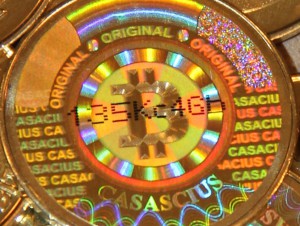
Bitcoin has been tossed into the virtual gutter at the World Economic Forum in Davos this week, as top US financial leaders warned the digital currency could be used to fund terrorism and predicted that regulation would put it out of business.

US Treasury secretary Jack Lew said: “From the government’s point of view, we have to make sure it does not become an avenue to funding illegal activities or to funding activities that have malign purposes like terrorist activities.

“It is an anonymous form of transaction and it offers places for people to hide,” Mr Lew said in a televised interview with CNBC at Davos.

Jamie Dimon, JPMorgan chairman and chief executive, told the same channel: “The question isn’t whether we accept it. The question is do we even participate with people who facilitate Bitcoin?”

Ultimately, Mr Dimon said, Bitcoin would be subjected to the same regulatory standards as other payment systems and “that will probably be the end of them”.

Regulatory uncertainty has deterred banks from offering services to virtual currency start-ups. But Mr Dimon’s cautious approach contrasts with rival Wells Fargo, which recently launched a group to examine how it might safely offer Bitcoin-related services or banking arrangements to virtual currency entrepreneurs.

The JPMorgan boss said: “Governments put a huge amount of pressure on banks, and so, to know who your client is, anti-money laundering, did you do real reviews of that? Obviously it’s almost impossible with something like that.”  Of course, Mr. DImon has tried hard to do just that.

Dimon added that Bitcoin was “a terrible store of value” that “can be replicated over and over,” and that according to reports, “a lot of it is being used for illicit purposes”.

The US Treasury secretary seemed to agree with the JPMorgan boss, saying: “I’ve talked to Jamie Dimon about it. I think he and I both share a certain incredulity about the whole phenomenon.”

The US Treasury declared last year that Bitcoin businesses must register as money services businesses and impose anti-money laundering checks on customers. Most of the 50 US states also impose their own regulations on money services businesses.

However, JPMorgan only last month filed a US patent application for a computerised payment system, which like Bitcoin would allow people to make anonymous, electronic payments over the internet, without having to reveal their name or account numbers.

Irish telecoms billionaire Denis O’Brien added his voice to the Davos sceptics of the virtual currency by saying he would avoid investing in Bitcoin.

Bitcoins at Davos

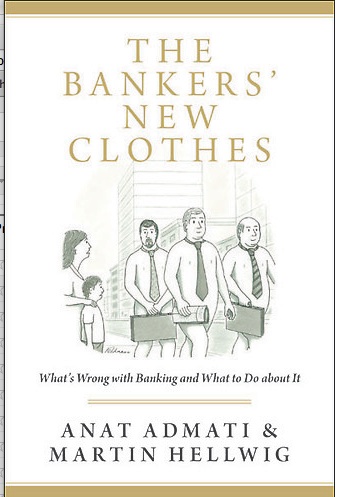
Anat Admati at Davos

Anat Admati, the Stanford economist and author of “The Banker’s New Clothes,”speaks out on banking issues, at the Davos debate on “Are the Markets Safer Now?”  Admati made it clear that markets are not much safer now. The banking lobby has too much influence.  US politicians and other politicians around the world fail to meet their legislative obligations.

The Banker's New Clothes