Lax EU Compliance Cost Third World $100BN

Tax avoidance by companies in the European Union is costing developing countries billions of dollars in lost tax revenues each year.

The Concordeurope report finds that in developing countries, between $859 billion and $1.138 trillion of illicit financial flows escaped developing countries in 2010 alone. Illicit financial flows includes the proceeds from both illicit activities such as corruption (bribery and embezzlement of national wealth), criminal activity, and the proceeds of licit business that become illicit when transported across borders in contravention of applicable laws and regulatory frameworks (most commonly in order to evade payment of taxes).

Approximately half this money (US$ 429.5 to US$ 569 billion) represents profit-shifting by transnationals, resulting in a loss to developing countries of at least
US$ 100 billion a year in tax revenue. Recent research also shows that just under one in every two dollars of large corporate investment in developing countries is now
being routed from or through a tax haven.

Concord_EU_Report Lax  EU Compliance Cost Third World $100BN

From Siberia to China to the US: The Long Reach of Money Laundering

Further details of the illegal lumbering going on in Russia’s Siberian forests led to a US raid of Lumber Liquidators in Virginia.  As W-T-W has repeatedly pointed out, criminal evasions of the law impact disproportionately on women and children as currencies are diverted from schools and public institutions.  Legitimate lumber businesses in the US cannot compete with the underworld.  Environmental Groups in US Target a Money Laundering Web

Original reporting from frank-cs.org

Criminal Lumber


Women and Finance Worldwide – NO to Slavery

Nearly 30 million people around the world are living as slaves, according to a new index ranking 162 countries.

The index was compiled by Australian-based rights organisation Walk Free Foundation using a definition of modern slavery that includes debt bondage, forced marriage and human trafficking.

The world has not changed, the ruthless just got smarter.

Thirty million people are slaves, half in India – survey

Summary: GlobalSlaveryIndex_2013

Report: GlobalSlaveryIndex_2013
Check your country

Modern Slavery WorldwideMore about Corruption

Marketing for Entrepreneurs Is Different From Any Other Marketing

Stanford University, which offers a free course for entrepreneurs suggests the fundamental difference in marketing when you are an entrepreneur:

Lumping everything that’s not a start-up into everyone else marketing is a vast over-simplification we use to make some points about entrepreneurial marketing. As someone who has been responsible for marketing in 19 different start-ups, I forget what it is like to market anything that anyone has ever heard of before. This is the most fundamental difference between entrepreneurial marketing and everyone else marketing: no one knows who you are, and secondly, you generally have very little money to tell them.

So, where do you start when you have no customers, no brand, no budget and maybe even no product? You “market” what you do have — your vision, your people and the work-in-progress that is becoming your product. This is done one-on-one or in small groups. If you are NOT out meeting with the people who may someday become your customers, and learning about their needs, their challenges and their dreams, you are making a classic mistake we call the “field of dreams” flaw — thinking, “if we build it they will come.”

Entrepreneurship is not like the movie. Customers don’t necessarily come to you; you have to go to them, and do so long before you have a product to sell. You need to understand not only their product requirements, but you need to learn how to sell it: who makes the decisions, where does the budget come from, what other issues is management facing and, most importantly, where do you fall on their priority list? We love to ask, “why would you NOT buy or use my product?” If you fail to truly understand what makes your customers tick, you will most certainly do one of three things: build too much, build the wrong thing, or deliver too late. Any of these perils can easily waste a round of funding, or, in a start-up, kill the company.

Another fundamental skill that will help you be a great entrepreneurial marketer is discovering what customers really care about. When we ask students what customers care about, usually we get responses like, “whether the product works,” or “cost effectiveness,” or “quality.” But the answer is much simpler. Customers care about themselves. They care about how you can help them be better at whatever they do. It’s about them — not about you. As soon as you realize that, you are freed from the need to have a finished and polished product. They have to believe that you 1) Comprehend their problem or opportunity, 2) have the Competence to address it and 3) Care about their success.

This is where a great entrepreneurial marketer starts: comprehending, competence and genuine caring about their customers. This customer insight goes into creating the right product. From there we can begin with the other aspects of marketing, like building awareness, generating leads, measuring success and so on. But it all starts with having the right product- one which is based on customer awareness.

Entrepreneurial Marketing

Robert Reich: Inequality for All, A Film

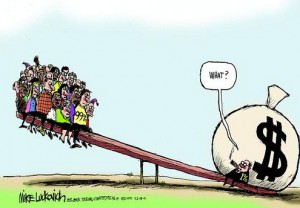
ROBERT REICH in Inequality For All: Of all developed nations today, the United States has the most unequal distribution of income and wealth by far. And we’re surging towards even greater inequality. One way of looking at and measuring inequality is to look at the earnings of people at the top versus the earnings of the typical worker in the middle.

The typical male worker in 1978 was making around $48,000, adjusting for inflation, while the average person in the top one percent earned $390,000. Now fast forward. By 2010, the typical male worker earned even less than he did then. But at person the top got more than twice as much as before. Today, the richest 400 Americans have more wealth than the bottom 150 million of us put together. Now think about it. Four hundred people have more wealth than half the population of the United States. Interview with Robert Reich

Income Inequality

Startups in Brazil with Government Support

With two major global events coming up — the 2014 World Cup and the 2016 Summer Olympics — now sounds like a good time for the Brazilian government to announce a startup accelerator program. The country’s Ministry of Science, Technology and Innovation is offering up to $78 million to entrepreneurs that apply to Start-Up Brasil for one of 100 slots. Selected participants will go through a business accelerator for six to 12 months. About one-quarter of available slots will go to foreign companies, but only if they plan to stay for a few years; the government will help them get visas.

Start-Up Brasil director Felipe Matos wasn’t a huge fan of the government when he started his own incubator, but when he was approached to run this project, he “thought that this would be a fantastic opportunity to do something for the Brazilian startup ecosystem.” He believes that businesses can take advantage of a shift towards those who can afford to choose entrepreneurship over other professions. Brazil is the second South American country to create this type of program; Chile began its version in 2010.   StartUp in Brazil

StartUp Brasil

 Apply by November 19. 2013 startupbrasil.21212.com/

The Jobs Problem and Training

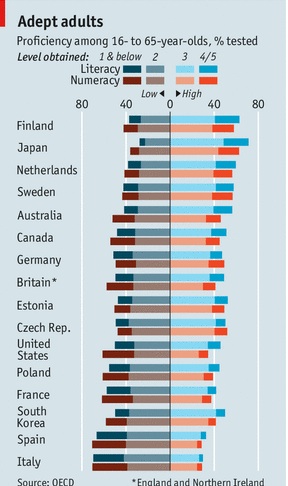
Well-intentioned plans to boost the brainpower of workforces by pushing more people into universities are now also looking flawed. Competence varied widely among individuals with similar qualifications, both within and across countries. Italy, Spain and America have large numbers of graduates, but still perform badly in literacy and numeracy tests. Even more worrying, some university degrees turn out not to offer much advantage over good secondary-school qualifications. Those who completed school in Japan and the Netherlands outperformed southern European graduates at the same age.

The lessons seem clear: vocational education needs to be both more consistent and more ambitious. But the bedrock of success is improving the quality of secondary education. Without that, letters after a name do not mean much.    The Jobs Problem

Adept Adults

Entrepreneurs in Zimbabwe

In the wake of President Robert Mugabe’s re-election in July, some speculated about a return to the Zimbabwe dollar, which collapsed in 2008 under the weight of hyperinflation. Two tech gurus ponder innovations that might emerge if such dark times returned. Perhaps a smartphone app that works out what to charge in the afternoon based on prices in the morning. Or one that uses GPS technology to direct motorists to petrol stations that have not yet run out of fuel.  Entrepreneurs in Zimbabwe from the Economist.

Tech Entrepreneurs in Zimbabwe