Do Negative Interest Rates Increase Financial Instabilty?

Stephen S. Rach writes:  In what could well be a final act of desperation, central banks are abdicating effective control of the economies they have been entrusted to manage. First came zero interest rates, then quantitative easing, and now negative interest rates – one futile attempt begetting another. Just as the first two gambits failed to gain meaningful economic traction in chronically weak recoveries, the shift to negative rates will only compound the risks of financial instability and set the stage for the next crisis.

The adoption of negative interest rates – initially launched in Europe in 2014 and now embraced in Japan – represents a major turning point for central banking. Previously, emphasis had been placed on boosting aggregate demand – primarily by lowering the cost of borrowing, but also by spurring wealth effects from appreciating financial assets. But now, by imposing penalties on excess reserves left on deposit with central banks, negative interest rates drive stimulus through the supply side of the credit equation – in effect, urging banks to make new loans regardless of the demand for such funds.

This misses the essence of what is ailing a post-crisis world. As Nomura economist Richard Koo has argued about Japan, the focus should be on the demand side of crisis-battered economies, where growth is impaired by a debt-rejection syndrome that invariably takes hold in the aftermath of a “balance sheet recession.”

Such impairment is global in scope. It’s not just Japan, where the purportedly powerful impetus of Abenomics has failed to dislodge a struggling economy from 24 years of 0.8% inflation-adjusted GDP growth. It’s also the US, where consumer demand – the epicenter of America’s Great Recession – remains stuck in an eight-year quagmire of just 1.5% average real growth. Even worse is the eurozone, where real GDP growth has averaged just 0.1% over the 2008-2015 period.

All of this speaks to the impotence of central banks to jump-start aggregate demand in balance-sheet-constrained economies that have fallen into 1930s-style “liquidity traps.”

This could be the greatest failure of modern central banking. Yet denial runs deep. Former Federal Reserve Chair Alan Greenspan’s “mission accomplished” speech in early 2004 is an important case in point. Greenspan took credit for using super-easy monetary policy to clean up the mess after the dot-com bubble burst in 2000, while insisting that the Fed should feel vindicated for not leaning against the speculative madness of the late 1990s.

That left Greenspan’s successor on a very slippery slope.

European Central Bank President Mario Draghi’s famous 2012 promise to do “whatever it takes” to defend the euro took the ECB down the same path – first zero interest rates, then quantitative easing, now negative policy rates.

Most major central banks are clinging to the false belief that there is no difference between the efficacy of the conventional tactics of monetary policy and unconventional tools such as quantitative easing and negative interest rates.

Therein lies the problem. In the era of conventional monetary policy, transmission channels were largely confined to borrowing costs and their associated impacts on credit-sensitive sectors of real economies, such as homebuilding, motor vehicles, and business capital spending.

As those sectors rose and fell in response to shifts in benchmark interest rates, repercussions throughout the system (so-called multiplier effects) were often reinforced by real and psychological gains in asset markets (wealth effects).

Two serious complications have arisen from this approach. The first is that central banks have ignored the risks of financial instability.

Second, politicians, drawing false comfort from frothy asset markets, were less inclined to opt for fiscal stimulus – effectively closing off the only realistic escape route from a liquidity trap.

The shift to negative interest rates is all the more problematic. Given persistent sluggish aggregate demand worldwide, a new set of risks is introduced by penalizing banks for not making new loans. This is the functional equivalent of promoting another surge of “zombie lending” – the uneconomic loans made to insolvent Japanese borrowers in the 1990s. Central banking, having lost its way, is in crisis. Can the world economy be far behind?
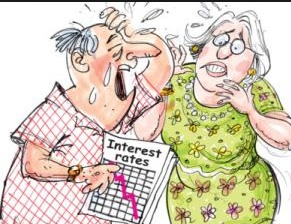
Negative Interest Rates


Can the EU Survive?

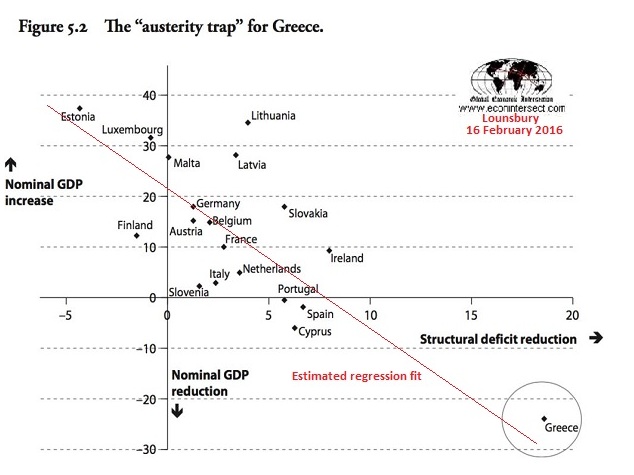
Focusing on the EU’s survival:

Although they disagree on solutions, experts broadly agree on the list of things that needed to be fixed. These include:

  • Completing the Banking Union;
  • Breaking the ‘doom loop’ between banks and their sovereigns;
  • Ensuring EZ-wide risk sharing for Europe-wide shocks;
  • Cleaning up the legacy debt problem;
  • Coordinating EZ-level fiscal policy while tightening national-level discipline;
  • Advancing structural reforms for a better functioning monetary union.

Each chapter presents solutions to one or more of these challenges, and several of the chapters view solutions to one problem as inexorably linked with the solution to one or more of the other problems.

Lessons learned and progress to date on fixing the Eurozone

At the outset, we must acknowledge that there is nothing novel about the notion that the Eurozone needs completing. The basic shortcomings have been known and discussed by economists since the euro was launched. This may be seen as reassuring in the sense that the realisation that the Eurozone has shortcomings does not depend on elaborate new theories, empirical findings, or controversial interpretations of the EZ Crisis. Based on nothing more than simple economic logic and basic economic facts, many flaws were obvious from the start.

For example, a CEPR report wrote:

“The ECB suffers serious faults in its design that sooner or later will surface. This is likely to happen when large shocks [Editors’ note: the Report refers to the 1997 Asian Crisis], hit euroland. … The lack of centralized banking supervision, together with the absence of clear responsibilities in crisis management, risk making the financial system in euroland fragile. No secure mechanism exists for creating liquidity in a crisis, and there remain flaws in proposals for dealing with insolvency during a large banking collapse.” (Begg et al 1998).

These problems were swept under the rug during the halcyon days of the Eurozone’s first decade.

Fixing the Eurozone is a job half done. Nobel Prize winner Chris Pissarides, writes:

“There are certain conditions needed to make a common currency across diverse economies a success and the Eurozone is clearly not satisfying them.”

Given the wide range of shocks arising from the current situation in Europe and beyond, now is not the time to relax. The job of fixing the Eurozone must be completed sooner rather than later. At their summit next week, EU leaders should find the time to restart the process of repairing Europe’s monetary union.

Will the US Be Replaced as the World’s Economic Powerhouse?

Adam Creighton writes:  Some of the world’s leading economists are hosing down fears that the US – and by extension the west – is about to lose its economic hegemony.

In the coming few years, even a decade, no. — Anat Admati, Professor of finance and economics at the Stanford Graduate School of Business. 

No, the primacy of the US follows from the fact that it offers the greatest scope for innovation by its population relative to any other country. Every American is thinking of a new way to do old things or a way to do new products and technologies, to make a fortune. And the venture capital market obliges by providing the finance to translate the idea of the new innovation into actual innovation. The US is a mecca for people with ideas and skills that blend into this landscape. — Jagdish Bhagwati, professor of economics, law and international relations at Columbia University.

That’s already happened as regards global trade. It is about to happen in the production of goods and services. In the area of finance, the US will remain the top dog for quite a bit longer. — Willem Buiter, Global chief economist at Citigroup, former professor of political economy at LSE. 

John Cochrane.

In a peaceful world other countries should catch up to the US way of doing things. And in the current trend, the US seems to be going out of its way to pursue inefficiency. Holland is a nice place to live. It was the “powerhouse” of the 17th century. Is it a worse place to live now that other countries have caught up? — John Cochrane, Senior fellow at the Hoover Institution, Stanford. 

No, China is headed rather rapidly toward zero per cent growth. After a long period of adjustment, it will re-emerge with something like a four per cent growth rate. I am a China optimist for the long-term, but not for the next 10 years. — Tyler Cowen, Professor of economics at George Mason University, US.

No, the only potential competitor is China, and it will hit a wall, or explode, unless it figures out how to make its political system much more open. I see no evidence that the Chinese Communist Party will ever let this happen. — Eugene Fama, Professor of finance at the University of Chicago Booth School of Business. He shared the Nobel prize in economic sciences in 2013 with Robert Shiller and Lars Peter Hansen for work on the empirical analysis of asset prices.

Edward Glaeser. Picture: Harvard

In due time, the US will surely cease to have the world’s largest GDP. Even if per capita incomes in China only grow to 40 per cent of US levels, China will become the larger economy. However, over the past few years, the US has looked somewhat stronger and China has looked somewhat weaker. The US system of decentralised capitalism can also create wasteful investment and overbuilding, but we continue to also have an abundant supply of more productive entrepreneurs. Like Australia, America’s open and free culture abets innovators and encourages start-ups. America’s biggest weakness, which will surely cause us even larger problems in the 21st century, is its education system.  Edward Glaeser, Professor of economics at Harvard. With a PhD from the University of Chicago.  

Yes, eventually. For a while the US will have company from China and Europe. —Michael Spence, Professor of economics at New York University’s Stern School of Business. He shared the Nobel Memorial Prize in economic sciences in 2001. 

Not any time soon. Europe could have given the US a run for its money but I think the troubles there will resurface; the single currency is a problem. — Richard Thaler, Professor of behavioural science and economics at the University of Chicago Booth School of Business. 

I doubt it. I would not deny that the economy of the US has structural problems, not least in the areas of education, health and infrastructure. Yet, when we look at China and Europe, potential US rivals, the problems they face seem even bigger. Future prosperity will also depend increasingly on innovation, and there the US still leads by a wide margin. — William White, Chair of the OECD’s economic and development review committee. 

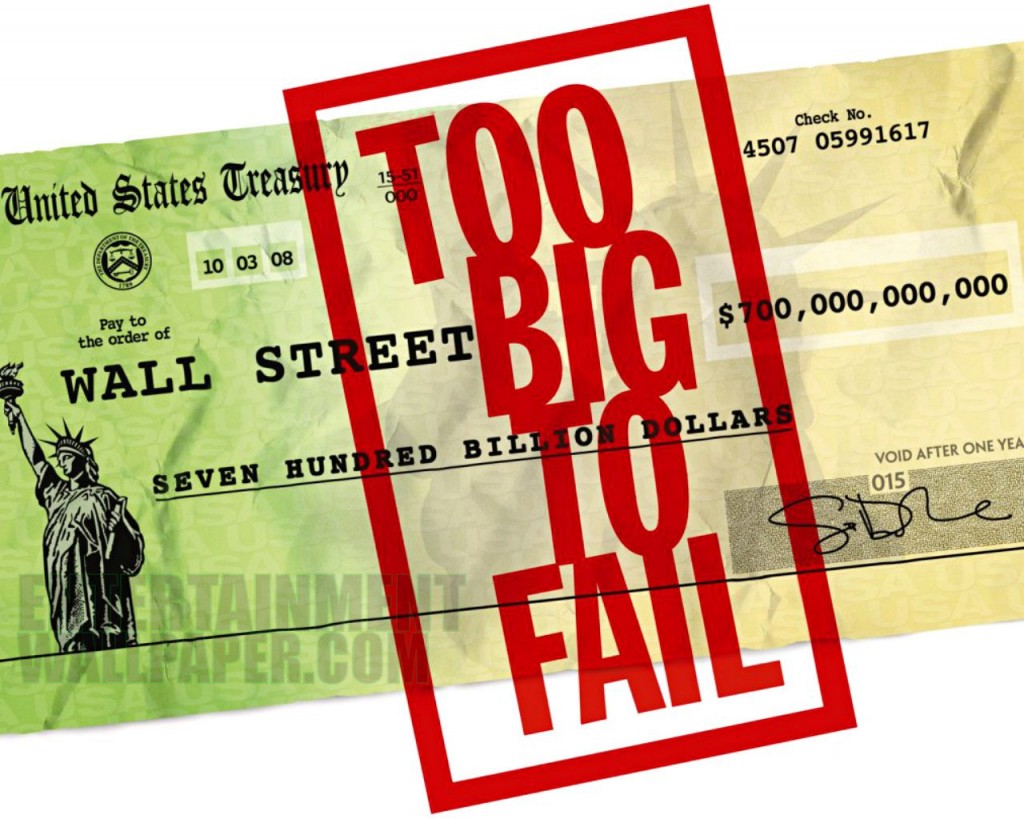
Bankers See US Banks Still Too Big to Fail

New Fed regional Governor discusses the need to reduce the threat of banks still ‘too big to fail.’  Kashkari on Ending TBTF.  Kashkari on Ending TBTF

Kashkari, who has worked for Goldman Sachs and in the Treasury Department during the administration of George W. Bush, is newly appointed to the US Federal Reserve in Minneapolis.  He finds big banks a significant threat to the US economy.

It is well to remember that banks are an unusual business.  They use other people’s money to store deposits, grant loans and earn interest on the monies they hold. These monies are always other peoples’ monies, and for this reason the business needs to be highly regulated.  It has not been.

too-big-to-fail01

Do We Need a New Approach to Economics?

For everyone but the top 1 percent of earners, the American economy is broken. Since the 1980s, there has been a widening disconnect between the lives lived by ordinary Americans and the statistics that say our prosperity is growing. Despite the setback of the Great Recession, the U.S. economy more than doubled in size during the last three decades while middle-class incomes and buying power have stagnated. Great fortunes were made while many baby boomers lost their retirement savings. Corporate profits reached record highs while social mobility reached record lows, lagging behind other developed countries. For too many families, the American Dream is becoming more a historical memory than an achievable reality. New Economics

European Banks Need Further Overhaul?

If you had to pick the moment when European banking reached the point of no return, which would you choose? The July day in 2012 when Bob Diamond resigned as Barclays’s chief executive officer amid the Libor rigging scandal? Or the fall morning later that year when UBS announced it was pulling out of fixed income and firing 10,000 employees? How about Sept. 12, 2010, when Basel III’s raft of costly capital requirements started upending the economics of global finance?

All signature events, to be sure. But try May 21, 2015. That’s when 40 per cent of Deutsche Bank stockholders gave co-CEOs Anshu Jain and Jürgen Fitschen a big thumbs down. By the end of June, Jain was out and Fitschen had agreed to leave the company by May of this year.

Illustration by David Foldvari

Investors are running out of patience with European bank chieftains, and no wonder. Since the fall of Lehman Brothers in September 2008, eight of Europe’s biggest banks have announced layoffs adding up to about 100,000 employees, paid $63 billion in legal penalties, and lost $420 billion in market value. In 2015, Deutsche Bank lost a record €6.8 billion ($7.6 billion). In mid-February the industry suffered an epic selloff as subzero interest rates, China’s slowdown, the oil crash, and looming regulatory and litigation costs triggered an outbreak of fear not seen since the fall of 2008. Just last year new CEOs took over at Barclays, Credit Suisse, Deutsche Bank, and Standard Chartered.

Credit Suisse’s new CEO, Tidjane Thiam, is “right-sizing” the investment bank and pushing for a 61 percent jump in pretax income from his international wealth management unit over the next two years. At Barclays, Jes Staley wasted no time cutting 1,200 investment banking jobs and closing offices in Asia and Australia after taking charge in December. Meanwhile, John Cryan, the British executive who replaced the India-born Jain, is pursuing an unprecedented overhaul of Deutsche Bank’s entire information technology infrastructure to shore up shaky risk-management systems.

Deutsche agreed to pay $2.5 billion in penalties to U.S. and U.K. authorities for its role in the Libor rate rigging. (No current or former member of the bank’s management board was implicated.) But something deeper was at work, too. European banks aren’t going through a stormy phase that will eventually clear and permit them to claim a new golden age.The industry is undergoing a metamorphosis that will demand a thorough and radical alteration of its core operating model.


Lagarde Re-Upped

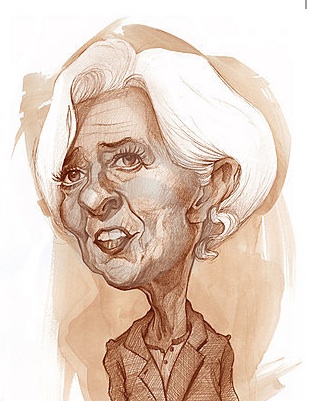
For the past five years, Christine Lagarde’s face has been splashed across the media above headlines pertaining to the International Monetary Fund (IMF). Lagarde has been one of the most visible leaders of an international economic organization in recent history, and the leadership of the IMF has noticed. As a result, Lagarde has been nominated to serve a second five-year term as the head of the International Monetary Fund.

The IMF is a made up of 188 member countries, and carries the mandate of ensuring the stability of the world’s monetary system. It does this via a system of exchange rates, loans, and international payments. These systems allow countries around the world to smoothly transact business with one another. To be sure, this is not an easy task.

Lagarde’s illustrious background includes serving as the French Finance Minister before becoming the first female director of the IMF in 2011. She was the only person nominated for the role of IMF chief this term. Observers have pointed out that Lagarde’s charisma, strong leadership, and intelligent choices, both politically and as a matter of policy, meant that there were no other obvious choices to fill the position.

Lagarde, now 60, has done a supreme job of unifying otherwise contentious factions behind her work and her vision for the IMF. Her nomination for a second term was supported by a broad cross-section of the world’s various economies, including the UK, Germany, China, and France.

According to Aleksei Mozhin, Dean of the IMF’s executive board, “The period for submitting nominations for the position of the next Managing Director of the International Monetary Fund closed on Wednesday, February 10 … One candidate, current managing director Christine Lagarde, has been nominated.” He went on to explain that the board’s goal is to complete the selection process as soon as possible to ensure the IMF’s business continues smoothly and without interruption.

Lagarde’s current term as Managing Director ends July 5, 2016. She had already announced her intention to seek a second term in January of this year, but few expected her to receive the nomination completely unopposed.

Despite the IMF’s approval, Lagarde still faces criticism in her home nation. Lagarde was recently asked to stand trial in her native country of France for alleged acts of negligence pertaining to a 2008 payment made to businessman, Bernard Tapie. Lagarde’s attorney called the decision to make her stand trial “incomprehensible” and noted that she would appeal.

Lagarde


Will Brazil’s Rough Patch Become a Swamp?

Otaviano Canuto writes:  After decades of rapid economic growth and per capita income gains, Brazil is struggling. According to the International Monetary Fund, the country’s GDP is poised to contract by more than 7% in 2015-2016. No single factor explains this reversal of fortune. Four do.

For starters, there is the structural trend of rising primary government expenditure as a share of GDP, which reached 36% in 2014, up from 22% in 1991.

The second factor shaping Brazil’s fortunes is the commodity-price super cycle. The upswing in commodity prices that began in 2004 brought many benefits for Brazil: external surpluses, the accumulation of foreign-exchange reserves, positive wealth effects, and higher investment in natural-resource-related sectors. Add to that exchange-rate appreciation and rising minimum-wage floors – not to mention public-sector disbursements indexed to the latter – and Brazil enjoyed a virtuous domestic cycle featuring positive feedback loops between demand for services and formal employment.

The problem is that Brazil allowed high commodity prices simply to reinforce the underlying growth model, instead of preparing its economy for the inevitable bust. Profitability levels in the manufacturing industry were crushed by exchange-rate appreciation and rising domestic production costs, and levels of production practically stagnated from 2008, before starting to decline in 2014. When world metal prices began to fall in 2011, followed by food prices in 2014, Brazil’s economy lost its growth engines.

Brazil’s government did make adjustments to its growth pattern following the global financial shocks of 2008-2009. But it took a shortcut, relying on counter-cyclical fiscal and monetary policies to boost growth. This is the third key factor contributing to Brazil’s current travails.

Given structural factors, however, the main outcome of this second round of stimulus was fiscal deterioration.

Over the last year, Brazil has been struggling to unwind that attempted shortcut. The realignment of regulated prices with market prices, together with that of foreign and domestic prices (through exchange-rate depreciation), produced an inflation shock, with the consumer-price index reaching a 13-year high last year. In order to contain the shock and control inflation expectations, Brazil’s central bank was driven to increase interest rates.

The fourth factor undermining Brazil’s economic performance arose unexpectedly last year, when a multibillion-dollar corruption scandal engulfed the state-controlled oil company Petrobras, prompting a far-reaching investigation of high-level politicians and triggering a collapse of private investment.

The medium-term silver lining is that the Petrobras investigation demonstrates Brazil’s commitment to the rule of law, implying that the country’s reputation among investors will recover.

In an effort to minimize the budget deficit, the authorities have proposed new tax measures, including new rules on capital gains and the reenactment of a tax on financial transactions. Given the current dependence of taxation on consumption and the ongoing current-account adjustment, the tax on financial transactions, in particular, will be vital to buy time for mandatory public expenditures to be reviewed. Among the expenditures that will come up for review are pensions, as social security expenditure probably reached close to 8% of GDP last year. Efforts to make the labor market more flexible and reduce the cost of tax compliance will also help to improve Brazil’s investment climate.

To recapture strong and reliable growth, however, the key will be improved confidence – and that hinges largely on the government’s capacity to overcome the current political crisis. If it fails, Brazil’s current economic rough patch could well turn into a swamp.

Swamp