Effective Anti-Corruption Techniques?

Bjorn Lomborg writes:  Some $1 trillion was lost to corruption last year. This is money that was not available for expanding health care, broadening access to education, improving nutrition, or cleaning up the environment. According to Transparency International, 68% of the world’s countries have a serious corruption problem, and no country is completely immune.

Corruption is one facet of poor governance; indeed, it correlates with ineffective public administration, weak accountability, low transparency, and inconsistent implementation of the rule of law. So it is little wonder that the United Nations’ brand-new Sustainable Development Goals, coming into force this year, aim to fight it. Nonetheless, the SDGs represent a departure from the previous development framework, the Millennium Development Goals, which contained no explicit targets relating to corruption.

The problem is that the SDGs have so many targets – 169 in total – that they promise virtually everything to everyone. Without enough time or resources to focus on everything, countries will prioritize.

Nobel laureate economists identified 19 super-targets that would do the most good for the world for each dollar spent. These include achieving universal access to contraception, stepping up the fight against tuberculosis, and expanding preschool access in Sub-Saharan Africa. The economists recommended that the world’s donors and governments focus first on these investments.

The UN’s 12 corruption and governance-related targets weren’t among these phenomenal investments. One reason is that several of the UN’s “targets” in these areas are so broad as to be meaningless. Indeed, it is all very well to say that we want to “develop effective, accountable and transparent institutions at all levels,” and to “substantially reduce corruption and bribery in all their forms,” but where do we start?

Higher wealth and economic growth lead to better governance.  A study of 80 countries where the World Bank tried to reduce corruption revealed improvement in 39%, but deterioration in 25%. More disturbing is that all of the countries the World Bank didn’t help had similar success and failure rates – suggesting that the Bank’s programs made no difference.

But the experts enlisted by the Copenhagen Consensus Center found one governance-related target that actually would do some good for each dollar spent: “By 2030, provide legal identity for all, including birth registration.”

Achieving this target requires functioning public services to provide registration facilities and maintain records. Establishing such institutional capacity would create a clear model for how other services could be provided effectively. In practice, a functioning registration service would almost certainly not exist in a vacuum, and thus would be a sign of emerging administrative competence.

But this is not just about bureaucracy; there are real benefits for citizens. They can claim legal rights, including property rights, which are vital to allow individuals to prosper and the economy to grow. Likewise, elections become less vulnerable to corruption and fraud when voters are properly registered.

If we want to place a high priority on fighting corruption, we should not settle for overly broad, well-meaning slogans. We should work on specific, proven, and effective approaches such as providing legal identity for all.

But we also have to confront the possibility that when it comes to helping the world’s poor, anti-corruption policies may not be the best place to spend our money first. This is partly because there are much more effective ways to tackle problems like tuberculosis or access to contraception, and partly because current anti-corruption policies are expensive and do little or no good.

This is not to deny that corruption hits the world’s poor hard. But there are many challenges, from lack of healthcare to starvation and pollution, that also hurt the poor but that we can address more effectively.

Focusing on what we can do well seems less impressive than promising everything to everyone – until it’s time to deliver. Those who prioritize properly will end up helping many more people.


Corruption

Will Legalizing Marajuana Help?


The widespread legalization of marijuana as a painkiller could help to bring America’s epidemic of opioid misuse under control. That’s the opinion of Massachusetts Senator Elizabeth Warren anyway, having spoken this weekend of the importance of national health bodies seriously and comprehensively considering regulatory change.

She spoke of the terrifying extend of prescription painkiller addiction in her letter to Thomas Frieden, head of the US Centers for Disease Control and Prevention. She made clear her belief that to explore the possibilities with legalized marijuana could make an enomous difference to a problem that’s already entirely out of control.

“Our country is faced with an opioid epidemic that only continues to grow at an alarming pace,” she wrote on Monday.

“Opioid abuse is a national concern and warrants swift an immediate action.”

“I hope that the CDC continues to explore every opportunity and tool available to work with states and other federal agencies on ways to tackle the opioid epidemic and collect information about alternative pain relief options,” she wrote.

“Your agency has produced an enormous amount of scientific and epidemiological data that has helped inform stakeholders on the breadth of this crisis — however there is still much we do not know.”

She insisted that the time had come to intelligently and realistically study the “effectiveness of medical marijuana as an alternative to opioids for pain treatment in states where it is legal,” while at the same time evaluating “the impact of the legalization of medical and recreational marijuana on opioid overdose deaths.”

Reports from the CDC suggest that opioid overdose deaths are skyrocketing across the United States each and every year – increasing more than 200% since the year 2000. Advocates argue that not only could marihuana be made available much more widely and for a lower price, but that it is considerably less addictive and almost impossible to overdose on.

Legalize Marajuana?

Can Ukraine Survive without the IMF?


“Ukraine risks a return to the pattern of failed economic policies that has plagued its recent history.”

Lagarde’s message struck at the heart of concerns of Ukrainians who joined three months of enthusiastic but ultimately bloody protests that brought down the ex-Soviet republic’s Russian-backed leadership in February 2014.

Polls show public frustration with Poroshenko and Prime Minister Arseniy Yatsenyuk mounting and hopes ebbing away that Ukraine was finally ridding itself of mind-numbing bureaucracy and bribe-taking.

That angst was encapsulated by this month’s resignation of reform-minded Aivaras Abromavicius as economy minister in protest at alleged influence-peddling by one of the most senior members of the president’s inner circle.


The IMF chief had said bluntly that it was “hard to see how the ($40-billion, 35-billion-euro) IMF-supported programme can continue” without Ukraine making good on its promise to take radical streamlining steps ignored in the past.

Both Yatsenyuk and Poroshenko know they cannot survive without foreign assistance and that early legislative polls could return to power Russian-backed deputies who just might be enticed into warming Kiev’s frozen relations with Moscow.

Ukraine’s central bank chief warned that the mounting uncertainty was putting renewed pressure on the hryvnia just as it was starting to find its footing from a 68-percent slide against the dollar since the start of 2014.

“Without IMF support, we should expect devaluation and social instability,” said Anatoliy Oktysyuk of Kiev’s International Centre for Policy Studies.

“The alternatives (to IMF support) are not even currently being considered because they are all apocalyptic,” Oktysyuk said.


Lawmakers have already shown their resolve by blocking a constitutional change pushed by Poroshenko that the West hoped would end Ukraine’s 21-month separatist conflict by giving limited special status to pro-Russian rebel-run parts of the east.

Analysts believe that deputies’ instinctive desire to keep their jobs and avoid snap elections will keep Yatsenyuk in place and lead only to a minor government shakeup aimed primarily at preserving the current coalition intact.

“If the government fails in Kiev, it will have a direct effect on political and economic support from the West. Ukraine’s many sceptics will gain the upper hand, and its few friends will face a steep uphill struggle,” said Joerg Forbrig of the US-based German Marshall Fund policy research institute.

“Reduced assistance — whether political, financial, administrative or military — will eventually forfeit the modest gains Ukraine has made and expose the country’s many vulnerabilities,” Forbrig said.

Impact Investing by All Sectors?

Jjuerg Zeltner writes:  Philanthropy’s Storming of the Bastille began in November, when a group of nearly 30 billionaires, including Amazon’s Jeff Bezos, Virgin’s Richard Branson, and Alibaba’s Jack Ma, announced the formation of the Breakthrough Energy Coalition. The BEC promised a “new model” that would leverage public-private partnerships to mobilize investment “in truly transformative energy solutions for the future.”

The announcement was closely followed by Mark Zuckerberg and Priscilla Chan’s commitment to give 99% of their Facebook shares (currently valued at some $45 billion) to improving the lives of newborns across the world. They, too, stressed the importance of “partnering with governments, non-profits, and companies.”

The game-changing development is the recognition of a funding gap – a “collective failure” of government, traditional philanthropy, and commercial investors, in the words of the BEC – that creates “a nearly impassable valley of death between promising concept and viable product.”


That is why the Chan Zuckerberg Initiative was designed for maximum flexibility, allowing funds to be channeled into non-profits, directed into private investments, or used to help influence policy debates. Similarly, the BEC has pledged to boost the work of others by taking “a flexible approach to early stage, providing seed, angel and Series A investments, with the expectation that once these investments are de-risked, traditional commercial capital will invest in the later stages.”

Of course, not even billionaires can solve the world’s problems on their own. Other stakeholders will need to play a part in the revolution as well. Traditional philanthropies should revisit their mandates. And governments must do more to facilitate a greater flow of private funds into more sustainable infrastructure assets. Policymakers could look at tax incentives, including credits in key areas.

There is an opportunity for the finance industry to participate, too, through so-called impact investing, which aims to achieve both social progress and financial returns high enough to attract mainstream private investors.

This, of course, is more easily said than done. As Bill Gates, who has given away more money than anyone in the history of the world, put it: “So many things have a social return, but not a financial return. You really have to be careful thinking you can have your cake and eat it.”

That is especially true for those who design financial instruments for impact investing. Among the most innovative are development impact bonds, in which investors provide financing for development projects, in exchange for returns provided by donors, NGOs, or government agencies if, and only if, the agreed-upon outcomes are achieved.

For example, one such bond is funding an effort to enroll and keep girls in school in Rajasthan, India. Depending on the program’s attendance rates and success at imparting numeracy and language skills, the Children’s Investment Fund Foundation will pay a return to bondholders. Programs like this, it is hoped, will provide a model that can be replicated and scaled up elsewhere.

Another promising opportunity are investments in the riskiest stage of the development process for new drugs: the phase between basic research and human clinical trials, which has traditionally struggled to attract funding. Indeed, for every $1 million dollars spent on this part of the process, some $8 million is spent on basic research and another $20 million on clinical trials.

Quarterly earnings cycles, real-time pricing, and constant scrutiny by shareholders have pushed pharmaceutical companies toward projects with clear, immediate payoffs – at the expense of more speculative, but potentially transformational research. With interest rates at record lows in much of the developed world, major players in the financial system have an opportunity – and, I would add, a responsibility – to help bridge this gap. In addition to providing a robust social impact, a patient investment strategy in this area would also offer high long-term financial returns.

There is a strong desire on the part of many in the finance industry to make investments that improve the world. The revolution in philanthropy will be truly successful only when we realize that we do not have to be billionaires to make a difference.

Impact Investing

Can China Bounce Back?

Keyu Jin writes:  Pessimism about China has become pervasive in recent months, with fear of a “China meltdown” sending shock waves through stock markets worldwide since the beginning of the year. And practically everyone, it seems, is going short on the country.

There is certainly plenty of reason for concern. GDP growth has slowed sharply; corporate-debt ratios are unprecedentedly high; the currency is sliding; equity markets are exceptionally volatile; and capital is flowing out of the country at an alarming pace. The question is why this is happening, and whether China’s authorities can fix it, before it is too late.

The popular – and official – view is that China is undergoing a transition to a “new normal” of slower GDP growth, underpinned by domestic consumption, rather than exports. And, as usual, a handful of economic studies have been found to justify the concept. But this interpretation, while convenient, can provide only false comfort.

China’s problem is not that it is “in transition.” It is that the state sector is choking the private sector. Cheap land, cheap capital, and preferential treatment for state-owned enterprises weakens the competitiveness of private firms, which face high borrowing costs and often must rely on family and friends for financing. As a result, many private firms have turned away from their core business to speculate in the equities and property markets.

Chinese households are also squeezed. In just 15 years, household income has fallen from 70% of GDP to 60%.

China has proved its capacity to implement radical reforms that eliminate major distortions, thereby boosting growth and absorbing excess debt.

The Chinese government launched a raft of radical reforms, including large-scale privatization of industry and elimination of price controls and protectionist policies and regulations.

China gdp growth

This time around, however, the task facing China’s government is complicated by political and social constraints. The economic reforms China needs now presuppose political reform; but those reforms are hampered by fears of the social repercussions.

The good news is that China has a promising track record on this front.

A similar ideological shift is needed today, only this time the focus must be on institutional development. S

With a concerted effort to create a level playing field that gives more people a bigger piece of the economic pie, not to mention more transparent governance and a stronger social safety net, China’s government could reinforce its legitimacy and credibility.

China’s experience in the 1990s suggests that the country can bounce back from its current struggles.

If economic conditions worsen, as seems plausible, action will become unavoidable. Good times may breed crises in the West; in China, it is crises that bring better times.

China: Improving Communication on the Economic Message

Zhang Jun writes  At a forum in Canberra last year, Andrew Sheng quipped, “China is transparent, but only in the Chinese sense.” The statement provoked laughter among those who view China’s decision-making processes as opaque; but it was laughter born of the recognition that Sheng was right. In the run-up to a major policy decision in China, editorials by high-ranking authorities in major publications, as well as reports and communiqués from official forums and meetings, almost always provide clues about what will happen. You just have to know how to read them.

Many interpreted last August as a last ditch effort by the People’s Bank of China (PBOC) to stave off an economic crash.  But China is not really on the verge of a currency crisis at all. Given that all of this activity is taking place in the offshore renminbi market, which is small in scale and has only limited connections to mainland China’s financial system – the result of China’s hesitancy about financial-market liberalization and capital-account convertibility – the situation remains controllable. Add to that China’s other strengths – annual GDP of over $10 trillion, a growth rate at least four percentage points higher than the global average, $3 trillion in foreign-exchange reserves, a savings rate of 40% of GDP, and a massive trade surplus – and an exchange-rate crisis seems highly unlikely.

But that does not mean that there are no risks. On the contrary, China has a strong interest in curbing the volatility – and, given China’s centrality to the global economy, so does the rest of the world. The key will be to get markets and policymakers on the same page.

Chinese policymakers have shown a clear commitment to minimizing government intervention and promoting a market-oriented approach for setting interest and exchange rates. And the authorities have made significant progress toward this end.

In fact, the devaluation last August was accompanied by the announcement of a more market-oriented mechanism for setting the renminbi’s exchange rate in the interbank market, with the daily fixing rate based on the previous day’s closing price. That move, was a prerequisite for the addition of the renminbi to the basket of currencies that determine the value of the International Monetary Fund’s reserve asset, the Special Drawing Right.

But even when China attempted to create a more reliably market-based system, investors’ responses were skewed, with unfounded expectations of a substantial and consistent devaluation fueling speculation in international markets. The subsequent attempt by China’s State Administration of Foreign Exchange to stabilize expectations by declaring that the renminbi would be valued against an undisclosed basket of currencies, instead of just the US dollar, failed to convince them. Short trades continued to rage offshore, putting the renminbi under increasing pressure.

The PBOC has been working vigorously to prevent further misunderstandings by designing policies that will safeguard exchange-rate stability, while taking care not to transmit any signal that monetary easing is in the cards.

The PBOC clearly remains committed to stabilizing the exchange rate, while advancing its market-oriented goals.

China’s leaders have plenty of challenges ahead, and improved communication with markets could help to overcome them. Fortunately, it seems that China’s leaders recognize this imperative, and are working to meet it.

China's Economy

Federally-Owned Lands Improve Surrounding Economies

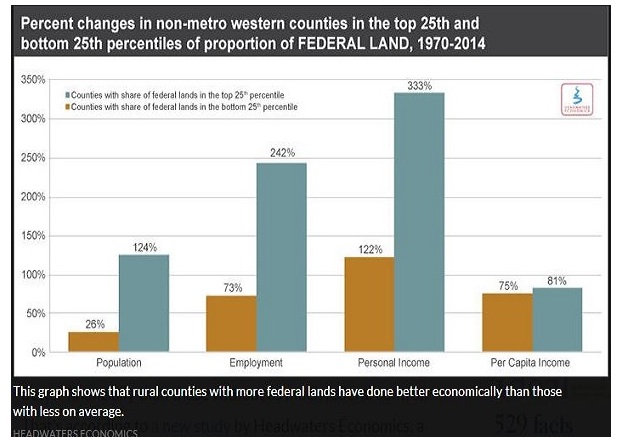
 Between 1970-2014, rural counties with a lot of federal lands did better financially than those without as much federal control. That’s according to a new study by Headwaters Economics, a non-partisan think tank based in Montana.  Economist Megan Lawson led the study which drew averages from around the West. She says federal lands aren’t necessarily the reason why those rural counties were better off, but that having federal land doesn’t automatically spell economic ruin. The graphic does not show median income comparisons which would reflect on whether high concentrations of federal lands correlate with less income inequality or not. 

US Federal Lands

M or F Not Important in Interpreting Brains

Gina Rippon writes:  The latest neuroscientific techniques employed to measure and map those brain structures and functions which might distinguish the two sexes are discussed in a recent special issue from the Royal Society. Daphna Joel had previously published a study of structures and connections in over 1,400 brains from men and women aged between 13 and 85, in which no evidence was found of two distinct groups of brains that could be described as either typically male or typically female. Brains were more typically unique “mosaics” of different features – something more correctly characterised as a single heterogeneous population.

Such a mosaic of features cannot be explained in purely biological terms; it is a measure of the effect of external factors. This is true even at the most fundamental level. For example, it can be shown that a “characteristically male” density of dendritic spines or branches of a nerve cell can be changed to the “female” form simply by the application of a mild external stress. Biological sex alone cannot explain brain differences; to do so requires an understanding of how, when and to what extent external events affect the structure of the brain.

The notion that our brains are plastic or malleable and, crucially, remain so throughout our lives is one of the key breakthroughs of the last 40 years in our understanding of the brain. Different short- and long-term experiences will change the brain’s structure. It has also been shown that social attitudes and expectations such as stereotypes can change how your brain processes information. Supposedly brain-based differences in behavioural characteristics and cognitive skills change across time, place and culture due to the different external factors experienced, such as access to education, financial independence, even diet.

The importance of this to the male/female brain debate is that, when comparing brains, it’s necessary to know more than just the sex of their owners.

Understanding how much the brains being examined are entangled with the worlds in which they exist must be part of any attempt to try and answer the question of what, if anything, separates male and female brains.

What is really meant by a “sex difference”? Taken straightforwardly, one would assume a “difference” implies the two groups measured are distinct. That the characteristics true of one are almost always not true of the other, that it’s possible to predict characteristics based on sex or vice versa, or that knowing to which group an individual belonged would allow you to reliably predict their performance, responses, abilities and potential. But we now know that this simply doesn’t reflect reality.

On a wide range of psychological measures, it’s clear that the two sexes are actually more similar than different.

The whole issue of male/female differences in the brain and the implications for male/female differences in any sphere – normal or abnormal behaviour, ability, aptitude or achievement – is really important to clarify. In the US, the National Institutes of Health recently mandated that, where appropriate, sex of the test subjects should be a variable in any research it funds.

The Brain

Greece is in Trouble Again?

It was just over a year ago that Greece elected Alexis Tsipras and Syriza amid a flurry of anti-austerity sentiment.

Things didn’t exactly go as planned.

The new PM and his “radical” finance minister Yanis Varoufakis thought they could shake things up in Brussels and wrench Greece from the clutches of Berlin-style fiscal rectitude. As it turns out, Wolfgang Schaeuble is not a man who is easily bested at the bargaining table and after more than six months of negotiations, the imposition of capital controls, a referendum on the euro that Tsipras promptly sold down the river, Greeks ended up facing an outright depression.

In the end, Varoufakis unceremoniously resigned and Tsipras agreed to a third bailout before calling for snap elections that would ultimately see the PM re-elected albeit at the helm of a party that was completely gutted by the arduous bailout talks.

As we and quite a few others warned, the new bailout and the attached terms would do exactly nothing to turn the Greek economy around. We’re all for being responsible with the budget but you can’t very well implement fiscal retrenchment during a depression unless you intend to remain in said depression in perpetuity, but alas, that’s exactly what Brussels forced Greece to do and the country has slipped back into recession.

With opposition mounting to the government’s pension reform plan, the European Union pressuring it to stem the tide of refugees entering the country and the global market rout hastening the sell-off in Greek assets, dark clouds are gathering again.  Ironically, capital controls appear to have helped the economy perform better than expected: “The economy fared less badly than those initial expectations in part due to a 90 percent annualized increase in cashless payments since the introduction of capital controls in June, shifting activity out of the shadow economy.” Another justification for banning cash we suppose.

Earlier this month we noted that Greek bank stocks were cut in half in just a matter of 72 hours while Greek equities as a whole had fallen to their lowest levels since 1989. Yields on the Greek 10Y had spiked back above 10%.

Greece, sources told MNI, “seems unable to deliver” on a number of measures Brussels says Athens needs to implement an effective fiscal consolidation plan. “We agreed to disagree,” one official said. “Judging from (last week’s) talks, the negotiations could drag for months. Anyway, I don’t see any real funding needs for Greece until June,” the official went on to note.

Greek riot police fired tear gas at farmers protesting against pension reform plans on Friday who hurled stones at the agriculture ministry in central Athens ahead of a major demonstration outside parliament scheduled for later in the day,

Greece is not “fixed.” And even as the farmers swear “they won’t make us bend,” something will have to give because Grexit fears to resurface once again [if all sides adopt] a plan built on over-optimistic assumptions.

Throw in a couple of hundred thousand refugees that are lliterally arriving in boats and you’ve got a particularly precarious situation that will likely devolve into the type of chaos shown above on an increasingly frequent basis.

Greece Saved?

World’s Oil Supplies and Suppliers

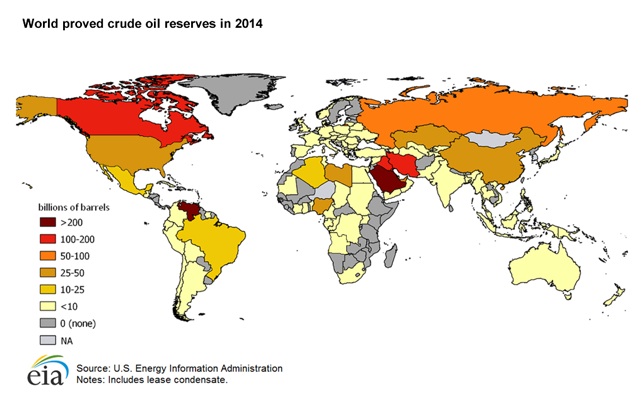
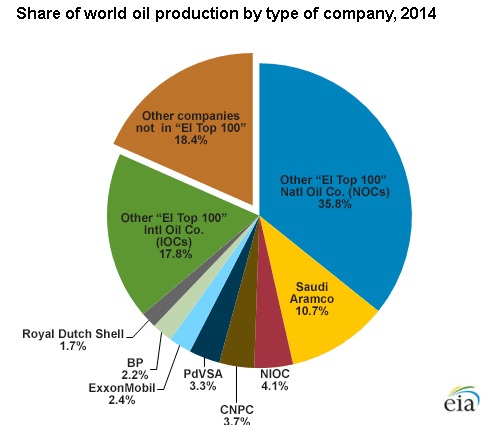
The world oil market is complex. Governments and private companies play various roles in moving oil from producers to consumers. Government-owned national oil companies (NOCs) control most of the world’s proved oil reserves (75% in 2014) and oil production (58% in 2014). International oil companies (IOCs), which are often stockholder-owned corporations, make up the balance of global oil reserves and production. Proved oil reserves consist of the amount of oil in a given area, known with reasonable certainty, that current technology can recover cost effectively. Worldwide proved oil reserves in 2014 were almost 1.7 trillion barrels, and global oil production averaged roughly 93.2 million barrels a day.

Oil Reserves

There are different types of oil companies

There are three types of companies that supply crude oil to the global market. Each type of company has different operational strategies and production-related goals:

  1. International oil companies (IOCs): These companies, which include ExxonMobil, BP, and Royal Dutch Shell, are entirely investor owned and primarily seek to increase their shareholder value. As a result, IOCs tend to make investment decisions based on economic factors. These companies typically move quickly to develop and produce the oil resources available to them and sell their output in the global market. Although these producers are affected by the laws of the countries in which they produce oil, all decisions are ultimately made in the interest of the company and its shareholders, not in the interest of a government.
  2. National oil companies (NOCs): These companies operate as an extension of a government or a government agency, and they include Saudi Aramco (Saudi Arabia), Pemex (Mexico), the China National Petroleum Corporation (CNPC), and Petróleos de Venezuela S.A. (PdVSA). These companies support government programs financially and sometimes strategically. These companies often provide fuels to domestic consumers at a lower price than the fuels they provide to the international market. These companies do not always have the incentive, means, or intention to develop their reserves at the same pace as investor owned international oil companies. Because of the diverse objectives of their supporting governments, these NOCs pursue goals that are not necessarily market oriented. The goals of these companies often include employing citizens, furthering a government’s domestic or foreign policies, generating long-term revenue to pay for government programs, and supplying inexpensive domestic energy. All NOCs belonging to members of the Organization of the Petroleum Exporting Countries (OPEC) fall into this category.
  3. NOCs with strategic and operational autonomy: The NOCs in this category function as corporate entities and do not operate as an extension of the government of their country. This category includes Petrobras (Brazil) and Statoil (Norway). These companies often balance profit-oriented concerns and the objectives of their country with the development of their corporate strategy. Although these companies are driven by commercial concerns, they may also take into account their nation’s goals when making investment or other strategic decisions.

In 2014, 100 companies produced 82% of the world’s oil. NOCs accounted for 58% of global oil production.

Companies Share of Oil Production