Resurrecting Glass-Steagall

Part of the problem with the candidacy of Hillary Clinton for President is that she is not free to set policy.  Surprisingly she has been supported by sophisticated banking Senator from Ohio, Sherrod Brown.  But can she ever resurrect Glass Steagall (if she gets the chance?)  Probably not.  A serious glitch in her potential Presidency.

SImon Johnson writes:  A major shift in American politics has taken place. All three of the remaining mainstream Democratic presidential candidates now agree that the existing state of the financial sector is not satisfactory and that more change is needed. President Barack Obama has long regarded the 2010 Dodd-Frank financial-reform legislation as bringing about sufficient change. Former Secretary of State Hillary Clinton, Senator Bernie Sanders, and former Governor Martin O’Malley want to do even more.

The three leading Democratic candidates disagree, however, on whether there should be legislation to re-erect a wall between the rather dull business of ordinary commercial banking and other kinds of finance (such as issuing and trading securities, commonly known as investment banking).

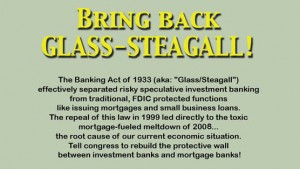
This issue is sometimes referred to as “reinstating Glass-Steagall,” a reference to the Depression-era legislation – the Banking Act of 1933 – that separated commercial and investment banking. This is a slight misnomer: the most credible bipartisan proposal on the table takes a much-modernized approach to distinguishing and making more transparent different kinds of finance activities. Sanders and O’Malley are in favor of this general idea; Clinton is not (yet).

Some prominent former officials argue that not all of the financial firms that got into trouble in 2008 were integrated commercial-investment banking operations. For example, Lehman Brothers was a standalone investment bank, and AIG was an insurance company.

This argument is, at best, irrelevant. What happened “last time” is rarely a good guide to fighting wars or anticipating future financial crises.

At worst, the argument is just plain wrong. Some of the greatest threats in 2008 were posed by banks – such as Citigroup – built on the premise that integrating commercial and investment banking would bring stability and better service.

Second, leading representatives of big banks argue that much has changed since 2008 – and that big banks have become significantly safer. Unfortunately, this is a great exaggeration.

Ensuring a financial system’s stability is a multifaceted endeavor – complex enough to keep many diligent people fully employed. But it also comes down to this: how much loss-absorbing shareholder equity is on the balance sheets of the largest financial firms?

In the run-up to the 2008 crisis, the largest US banks had around 4% equity relative to their assets. This was not enough to withstand the storm.

Now, under the most generous possible calculation, the surviving megabanks have on average about 5% equity relative to total assets – that is, they are 95% financed with debt.

Consider all the instances of money laundering and sanctions busting with evidence against Credit Agricole last week, Deutsche Bank this week, and almost every major international bank in the past few years.

This is the equivalent of near misses in aviation. If the US had the equivalent of the National Transportation Safety Board for finance, we would receive detailed public reports on what exactly is – still, after all these years – going wrong. Sadly, what we actually get is plea bargains in which all relevant details are kept secret.

The best argument for a modern Glass-Steagall act is the simplest. We should want a lot more loss-absorbing shareholder equity.

Building support for legislation to simplify the biggest banks would greatly strengthen the hand of those regulators who want to require more shareholder equity and better regulation for the shadows. These policies are complements, not substitutes.
Glass-Steagall


Japan and the TPP

Considerations for Japan as they participate in TPP.

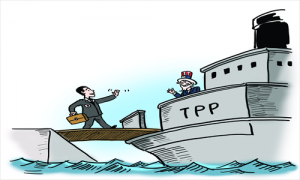
Yuriko Koiki writes:  After years of exhausting – and exhaustive – haggling, a dozen Pacific Rim countries finally signed up to the Trans-Pacific Partnership (TPP), an agreement that promises everything from more trade to a cleaner environment. The negotiations were such that the hair of Akira Amari, Japan’s economic and fiscal policy minister, turned completely grey. His solace, however, is that the TPP will prove to be a key foundation stone of the “Asian Century.”.

China’s exclusion was no accident. Its huge and complex economy would have injected insuperable problems.  In response, China has launched its “Silk Road” initiative to create an economic zone that will favor its own priorities. It is also seeking greater trade cooperation with European countries. One example is President Xi Jinping’s recent visit to the United Kingdom – which in essence is also an attempt to weaken Britain’s “special relationship” with the US by creating a cat’s cradle of trade, financial, and investment ties with Britain.

But, as Japanese Prime Minister Shinzo Abe’s recent call for talks with China on the issue confirm, the TPP is not off-limits to China – or to other Asian economies. South Korea is warming to the idea of the TPP, as is Indonesia, following President Joko Widodo’s recent visit to Washington, DC.

For Japan, the TPP is vital to achieve economic liberalization – the third arrow of “Abenomics,” the government’s program to revitalize the country’s ailing economy. The legislation to enact the TPP will simply push aside the lobbies and vested interests that have been so effective in slowing down or diverting piecemeal reforms.

The promise of greater exchange of goods, services, and capital across the Pacific, as well as the creation of international standards (for example, for intellectual-property rights), is simply too appealing to ignore. When Japan and other Asian countries weigh the risk of implementing the TPP against the risk of not participating, the risk of not participating is overwhelmingly higher.

Japan’s political challenge will be to sell the TPP to its voters, especially the farm lobby. The customs duty on beef imports, for example, is currently 38.5%. It will be 27.5% in the first year after the TPP takes effect, and will then be gradually lowered to 9% in the agreement’s 16th year.

That should surely provide more than enough time for Japanese beef ranchers to prepare themselves for foreign competition (of the 870,000 tons of beef imported annually, 520,000 tons come from Australia, the US, and New Zealand). And it will certainly be a boon for consumers, as the price of their beef-noodle soup and sukiyaki falls dramatically.

Japan’s ranchers do need time to adjust. Because they deal with animals, shortcuts cannot be taken, and there are limits to mechanization, particularly in creating the type of beef that Japanese consumers demand. Whereas ranchers in Australia and the US have huge herds of cattle, Japanese ranchers raise each individual cow on beer and massages.

The same applies to rice. Rumor has it that when the wife of a certain Chinese leader visited Japan, she bought a delicious variety of Japanese rice by the ton. Taking advantage of the worldwide sushi boom, Japan needs to emphasize that “real sushi requires Japanese rice,” branding it an exclusive product.

In fact, regardless of whether or not the TPP is implemented, Japan’s farmers must pursue this approach to secure their futures, rather than hoping that protective subsidies continue ad infinitum.

But now comes the truly hard part. The TPP has been signed – but it will not be implemented unless and until it is ratified by the legislatures of countries such as the US and Canada. That process could well be enough to turn Amari’s gray hair white.

Japan and TPP

Japan Post Undervalued?

Japan post sale may have been undervalued.  The people’s bank and insurance company shares rose 20 percent immediately.  The IPO was the biggest in the world this year and the largest since Alibaba’s record $25bn deal in 2014.

Shares in the parent company Japan Post Holdings closed up 20 percent. Shares of Japan Post Bank closed up 15% while Japan Post Insurance soared 56%.

The landmark debut marks the Japanese government’s largest asset sale in nearly three decades.

The listing is part of Prime Minister Shinzo Abe’s plans to boost the flagging economy by encouraging consumers to invest in the stock market.

About 10% of each company was sold to the public in the largest privatisation of a state-owned firm since Nippon Telegraph and Telephone in 1987.

The government allocated 80% of the shares to domestic investors, with the remaining 20% sold to international institutional investors.

The government plans to raise a total of 4tn yen in additional asset sales in the coming years.

It has said the funds will be used to help reconstruct areas hit by the 2011 earthquake and tsunami disaster.

Japan Post is headed up by Toru Takahashi, employs some 195,000 people, and has 24,000 post offices.

It also controls the country’s largest bank, Japan Post Bank, and Japan Post Insurance, the biggest insurer.

In February, the Japanese giant announced a $5.1bn offer for Australia’s Toll Holdings, the largest transport and logistics company in the Asia-Pacific region.

The deal, which went through for $4.6bn in May, has helped Japan Post become a leading global logistics player.

The Japan Post triple market debut, including its bank and insurance arms, is expected to occur in early November.

Japan Post employs some 195,000 people, and has 24,000 post offices.

It also controls the country’s largest bank, Japan Post Bank, and Japan Post Insurance, the biggest insurer.

Japan Post

Can VW Survive?

Volkswagen AG said it found faulty emissions readings for the first time in gasoline-powered vehicles, widening a scandal that so far had centered on diesel engines. Separately, the company’s Porsche unit said it’s halting North American sales of a model criticized by U.S. regulators.

Volkswagen said an internal probe showed 800,000 cars had “unexplained inconsistencies” concerning their carbon-dioxide output. Previously, the automaker estimated it would need to recall 11 million vehicles worldwide — more than Volkswagen sold last year.

The crisis that emerged after Volkswagen admitted in September to cheating U.S. pollution tests for years with illegal software has shaved more than one-third of the company’s stock price and led to a leadership change. Today’s revelation adds to the pressure on Volkswagen’s new chief executive officer, Matthias Mueller.

Most of the affected cars are in Europe and the 2 billion euros in possible costs are an initial estimate, according to the spokesman. The automaker will determine how much money to set aside once the probe has been finalized, he said.

The EPA said its new investigation centers on the Porsche Cayenne and VW Touareg sport utility vehicles and as well as larger sedans and the Q5 SUV from Audi.

But then late Tuesday, Porsche’s North American division said it would voluntarily discontinue sales of diesel-powered Cayennes from model years 2014 to 2016 until further notice. The Atlanta-based unit’s statement reiterated that the EPA notice was unexpected and that owners can operate their vehicles normally.

Mueller has pledged to overhaul the company’s corporate culture, which he said must change to create a more transparent environment that can discover possible faults.

“This is a painful process, but it is our only alternative,” Mueller said in an e-mailed statement. VW “deeply regrets this situation” and “will stop at nothing and nobody” to get to the bottom of the matter, he said.

The scandal has weighed heavily on Volkswagen’s earnings. The automaker reported its first quarterly loss last month in at least 15 years because of the reserve funds set aside to implement fixes.

Fixing VW

Entrepreneur Alert: Aluminum?

Alcoa Inc.’s latest aluminum-making cutback is signaling the end of the iconic American industry.

For 127 years, the New York-based company has been churning out the lightweight metal used in everything from beverage cans to airplanes, once making it a symbol of U.S. industrial might. Now, with prices languishing near six-year lows, it’s wiping out almost a third of domestic operating capacity, Harbor Intelligence estimates. If prices don’t recover, the researcher predicts almost all U.S. smelting plants will close by next year.

While that’s a big deal for the U.S. industry and the people it employs, it doesn’t mean much for global supplies. Alcoa’s decision to eliminate 503,000 metric tons of smelting capacity accounts for about 31 percent of the U.S. total for primary aluminum, but less than one percent of the global total, according to Harbor. For more than a decade, output has been moving to where it’s cheaper to produce: Russia, the Middle East and China. A global glut has driven prices down by 27 percent in the past year, rendering American operations unprofitable and accelerating the pace of the industry’s demise.

Jay Armstrong, the president of Trialco Inc. in Chicago Heights, Illinois, now buys about 80 percent of the supplies it turns into car wheels from overseas. That’s up from 40 percent five years ago.

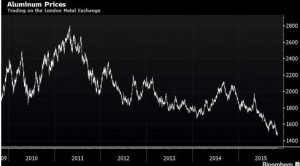
Aluminum is down 19 percent this year to $1,501 a ton on the London Metal Exchange. The metal touched $1,460 last week, the lowest since 2009, and most American smelters can’t make money when prices are near $1,500 or below, Austin, Texas-based Harbor estimates. Plants overseas usually have the advantage of lower labor costs, cheaper energy expenses and weaker domestic currencies that favor exports to the U.S.

Aluminum Prices

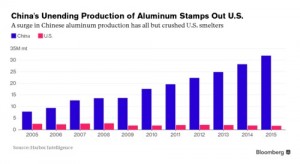
While output has been moving abroad for some time, the game changer in the past year has been the domination of China, where ballooning output has compounded a global surplus and driven prices so low that Bank of America estimates more than 50 percent of producers globally lose money. Smelters in the Asian country are still profitable, helped by higher physical premiums in the region.

China probably will account for 55 percent of global aluminum production this year, up from 24 percent in 2005, according to Harbor research. The U.S. has gone in the opposite direction: from 2.5 million tons in 2005 to 1.6 million in 2015, it said.

Still, not all U.S. smelters will benefit from closing down. Citigroup Inc. says some domestic operations with long-term energy contracts will have to pay regardless and are better off making the metal than simply paying the energy bill. Some plants also have access to cheap hydro power, said David Wilson, an analyst at Citigroup in London.

Aluminum

Banking Transparency: Progress?

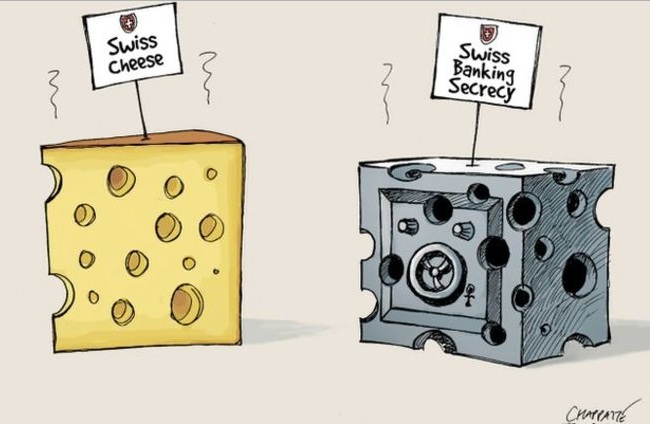
Most countries’ secrecy scores have improved – transparency has increased. . Real action is being taken to curb financial curb secrecy, as the OECD rolls out a system of automatic information exchange (AIE) where countries share relevant information to tackle tax evasion. The EU is starting to crack open shell companies by creating central registers of beneficial owners and making that information available to anyone with a legitimate interest. The EU is also requiring multinationals to provide country-by-country financial data.  But the U.S. is going the other way, rising to third on the list. Higher is bad and Switzerland tops the list, followed by Hong Kong.

Secrecy by country, listed from most to least.

l. Switzerland 2. Hong Kong  3. USA  4. Singapore 5. Cayman 6.  Luxembourg                7. Lebanon 8. Germany 9.  Bahrain 10. Dubai/UAE

Bank Secrecy

Gold: Giving the US Fed Competition?

Could a gold-based currency make the US Fed more responsible?

Sean Fieler writes:  History suggests that the only way to rein in the sprawling Federal Reserve is to end its money monopoly and restore the American people’s ability to use gold as a competing currency.

The legislative compromise that created the Fed in 1913 recognized that the power to print money, left unchecked, could corrupt both the government and the economy. Accordingly, the Federal Reserve Act created the Federal Reserve System without a centralized balance sheet, a central monetary-policy committee or even a central office.

The Fed’s regional banks were prohibited from buying government debt and required to maintain a 40% gold reserve against dollars in circulation. Moreover, each of the reserve banks was obligated to redeem dollars for gold at a fixed price in unlimited amounts.

Over the past century, every one of these constraints has been removed. Today the Fed has a centrally managed balance sheet of $4 trillion, and is the largest participant in the market for U.S. government bonds. The dollar is no longer fixed to gold, and the IRS assesses a 28% marginal tax on realized gains when gold is used as currency.

The largest increases in the Fed’s power have occurred at moments of financial stress. Federal Reserve banks first financed the purchase of government bonds during World War I. The gold-reserve requirement was dramatically reduced and a central monetary policy-committee was created during the Great Depression. President Richard Nixon broke the last link to gold to stave off a run on the dollar in 1971.

This same combination of crisis and expediency played out in 2008 as the Fed bailed out a series of nonbank financial institutions and initiated a massive balance-sheet expansion labeled “quantitative easing.” To end this cycle, Americans need an alternative to the Fed’s money monopoly.

A competing currency would not only offer people a monetary choice in a crisis. More important, it would give the Fed a clear incentive to anticipate and avoid such crises. In a competitive system, before it embraced another bout of monetary adventurism, the Fed would have to contemplate a decline in market share. For if the Fed were even perceived to be debasing the dollar, many would seek out a sounder alternative.

The continuing revolution in payment technology makes the introduction of competition not only possible, but practical. Bitgold, a Canadian company, is already offering gold-denominated transaction accounts with a debit card. The tag line on the company website reads: “Spend gold with the Bitgold prepaid card. Accepted anywhere globally that accepts credit cards, including ATM machines to withdraw local currency.”

With a gold-based currency up and running north of the border, why not offer Americans a monetary choice as well? The proposition is simple. Americans who prefer the incumbent monopoly provider of money are free to keep their accounts as is. Those who prefer gold are free to switch. And the Fed is free to defend its market share with sound monetary policy.

Return of Gold?

FATCA Drives More than Fatcats Out of the US?

Rocky Road to Globalization

Wall Street Journal editorial:   Few privileges in the world are greater than U.S. citizenship, so why are a record number of Americans giving it up these days? The U.S. Treasury Department reported this week that 1,426 Americans turned in their passports between July and September, more than in any previous quarter. The total for the year is on pace to far exceed last year’s all-time-high of 3,415.

As recently as the George W. Bush years, only about 480 Americans renounced their citizenship annually. But in 2010 the Pelosi Congress and Barack Obama enacted the Foreign Account Tax Compliance Act, or Fatca. Aimed at tax evaders, the law has mostly made financial life hellish for law-abiding Americans living overseas, of whom there are some eight million.

Fatca requires that foreign banks, brokers, insurers and other financial institutions give the U.S. Internal Revenue Service detailed asset and transaction records for any accounts held by Americans, including corporate accounts controlled by American employees. If a firm fails to comply, the IRS can slap it with a 30% withholding tax on transactions originating in the U.S. Facing such risks and compliance costs, many foreign firms have decided it’s easier to dump their American clients.

So Americans overseas are becoming increasingly unbankable. Not the wealthiest ones, of course, those “fat cat” potential tax evaders whom Democrats rail against. Much more vulnerable are sales reps, English teachers, lawyers, retirees—the overwhelming majority of American expatriates—whose modest finances make them unappealing clients amid Fatca’s compliance costs.

American expats in the Fatca age are also less attractive as employees and business partners, as any financial accounts they can access must now be exposed to government scrutiny—not only from the U.S. but potentially also from more than 100 other countries that have signed Fatca-related information-sharing agreements with Washington. Americans up for executive posts in Brazil, Singapore, Switzerland and elsewhere have been asked by their managers to renounce their U.S. citizenship or lose their promotion.

Little surprise, then, that renunciations are on the rise. A few thousand ex-Americans aren’t much of a political cause, but they’re a proxy for U.S. tax and regulatory policies that hamper the entire U.S. economy. For every American who renounces citizenship, there are many more foreigners refusing to do business with Yankee entrepreneurs or to invest money in U.S. businesses. That’s a problem for all Americans.

Fat Cats

Government Action Against Wrongdoing Bankers?

Reviewing John Coffee’s book “Entrepreneurial Legislation”  Judge Jed Rakoff suggests a possible solution to the government’s failure to prosecute in cases of bankers who have clearly violated the law.

Rakoff writes: Coffee, while also strongly advocating for more governmental action against individuals, proposes an interesting innovation that he thinks would make class actions more socially useful and less liable to abuse. Overall, he suggests making good on class action’s promise of a “third way” by combining its profit-seeking tendencies with oversight of the class actions themselves by public agencies. Specifically, he proposes, among other reforms, that government regulators in matters where class actions are common should employ private class action lawyers, on a contingent fee basis, to bring class actions supervised by the regulatory authority but for the benefit of the victims, to whom any recovery would be distributed.

It is hard to believe that the settlements in such cases have much of a deterrent effect on the individual executives who actually committed the alleged misconduct. This is why class actions may be no real substitute for criminal and regulatory prosecution of the individuals actually responsible for corporate misconduct.

Is it possible that enlightened regulators could vindicate the rights of individuals without the massive profit-seeking machinery of the current U.S. legal system, and without the cruel bias toward incarceration of the current U.S. criminal justice system?

Jail Bankers?


Bitcoin’s Blockchain Goes Mainstream

Blockchain technology may well be what remains of bitcoin technology.  At a conference sponsored by the New Yorker earlier this fall, all the participants agreed that bitcoin as an alternate currency had a questionable future.  Yet the blockchain technology that releases bitcoins into the market may work well for credit card companies and online banking.

Nine of the world’s biggest banks have thrown their weight behind blockchain,

Barclays, BBVA, Commonwealth Bank of Australia, Credit Suisse, JPMorgan, State Street, Royal Bank of Scotland, and UBS have all formed a partnership to draw up industry standards and protocols for using the blockchain in banking.

The partnership is being led by R3, a startup with offices in New York and London headed by David Rutter, the former CEO of ICAP Electronic Broking and a 32-year veteran of Wall Street.

Rutter’s plan is to build the “fabric” of blockchain technology for banking, as well as develop commercial applications for banks and financial firms.

The blockchain is the software that both powers and regulates cryptocurrency bitcoin. In its most basic form, it records ownership of bitcoin — money — and transactions — one person paying another.

Transactions are signed off by the parties involved using the software, then added to the blockchain, a long string of code that records all activity.

Once other transactions are added on in front of an exchange, the transaction is stuck there forever and can’t be changed, in the same way you can’t change a brick once it’s been built into a wall.

The software cuts out the need for a “trusted middleman” to sit in between parties in a transaction as it acts as that middleman. This makes transactions quicker, cheaper, and easier when compared to the current systems banks use.

Banks are therefore keen to see if it can be adapted for use with traditional currency, rather than just bitcoin.

The blockchain uses open ledger technology, meaning all of these transactions are free for anyone to look at and not stashed in some private data centre in Canary Wharf. Anyone can theoretically check to see if someone’s using stolen bitcoin and this adds a level of transparency to the system.

Rutter says R3 has drawn up a “wish list” of what its banking partners want to use blockchain technology for, which covers “everything from issuance, to clearing and settlement and smart contracts, where the code is the contract and it saves on back office costs.”

As part of the partnership, banks are investing in R3. Rutter said: “I can’t reveal that but it’s been reported that it’s several million. From my prospective of having the banks involved, the human element is more valuable.”

Blockchain