How to Make Bankers Accountable

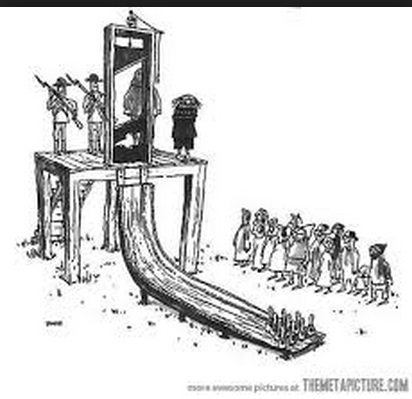
How can we put the barnkers’ necks on the block?

Matt Levine writes: A “financial crisis” means, roughly, “that someone borrows money from someone else and can’t pay it back, and it is socially or politically unacceptable that the people who loaned the money not get their money back.” So the way to avoid financial crises is to clearly define the classes of people whom it is socially and politically acceptable not to pay back.  The Fed’s new rules on “total loss-absorbing capacity,” which requires banks to fund themselves partly with long-term debt that would be, as the name implies, loss-absorbing. Banks issue debt that is explicitly government guaranteed (retail deposits, etc.), and other debt that is systemically important and disastrous not to pay back (repo, etc.), but that shouldn’t lull you into thinking that allbank debt is systemic and subject to implicit government guarantees. TLAC debt, with “loss” right in the name, shouldn’t lull anyone.

Free Fall for CHeaters

Manipulating Markets: Up and Down?

Should we look at who drives stock prices up as well as who helps them go down?

Matt Levine writes about Chinese markets:  When Chinese stock markets were crashing earlier this year, authorities were quick to blame short sellers and market manipulation. It’s reasonable to be skeptical. Sometimes markets go down because they are overvalued, not because a cabal of evil hedge fund managers is manipulating them.

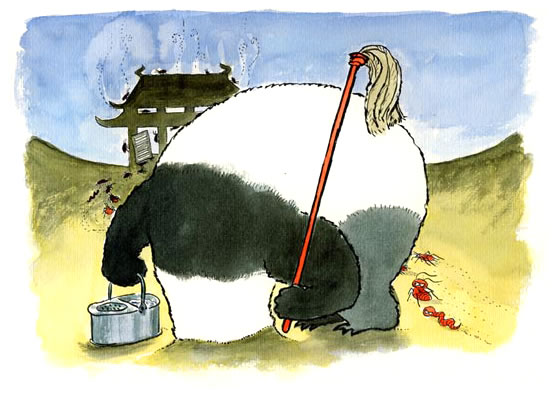
Chinese authorities have detained the leading light of the “Limit-up Kamikaze Squad”, a group of hedge fund managers known for their fearless speculation.

Xu Xiang, general manager of Zexi Investment Management, was apprehended on Sunday on suspicion of insider trading after a police manhunt.

He was “captain” of the loose collection of fund managers centred around the coastal city of Ningbo in eastern Zhejiang province who are known for pushing favoured stocks up by the 10 per cent daily limit on Chinese exchanges.

A frequent criticism of these sorts of crackdowns is that authorities are quick to blame manipulative short sellers when stocks go down, but are less concerned about manipulation on the way up. Pushing stocks up is just as manipulative as pushing them down. But in fact, while it’s not clear what exactly the charges against Xu are, they might well be related to upward manipulation.

Mr. Xu’s Zexi Investment, based in Shanghai, was the subject of intense market speculation in September, when a post on social media accused the company of market manipulation. The online post suggested that Zexi had told China’s biggest brokerage, Citic Securities, to buy shares of an unprofitable Shanghai clothing retailer to lift its price for one of its politically connected investors. At the time, Zexi said the attacks were “fabrications from nowhere and malicious attacks.”

Image by Claudio Munoz

Image by Claudio Munoz

Should All Bankers Have Skin in the Game?

Glenn Reynolds writes:   The financial crisis of 2008-09 is over but not gone. We passed laws and regulations that probably won’t help much. And despite a lot of harsh words aimed at Wall Street and the banks, President Obama pretty much let individual bankers escape unscathed — perhaps because Wall Street and the banks were among his biggest campaign contributors. (That phenomenon has led some to call him “President Goldman Sachs.”)

But relying on regulators to control banks and Wall Street is likely to fail anyway. Leaving aside their extensive political influence, financial types are likely to stay ahead of regulators because 1) they’re usually smarter; and 2) they understand their industry better. Plus, they can change approaches faster than regulators can amend regulations.

Even so, the apparent change in the financial community over the past few decades has been dramatic. The economic crisis brought the activities of investment bankers into the limelight, and suddenly it seemed the staid buttoned-up banker types of the popular imagination had been transformed into wild speculators risking billions on a single trade. What happened?

According to Claire Hill and Richard Painter in their new book, Better Bankers, Better Banks:Promoting Good Business through Contractual Commitment, the reason is that the billions they’re risking on a single trade aren’t their own but somebody else’s. Hill and Painter want to do something about it by requiring that financial operators have their own assets at stake.

This isn’t a new idea. Until fairly recently, big investment banks such as Goldman Sachs or Salomon Bros. operated as general partnerships. In a general partnership, the partners are liable — individually — for debts of the firm. With potentially unlimited liability if things went wrong, the partners had an incentive to be comparatively cautious. (With corporations, on the other hand, shareholders aren’t on the hook for the firm’s debts. The most they can lose is the value of their shares.) Without unlimited liability, incentives are different. As Hill and Painter note, Salomon’s culture changed very rapidly after it became a corporate entity in which the partners, now called “managing directors,” weren’t personally at risk. Within a few years it went from a staid, conservative business to the anything-goes entity described in Michael Lewis’ Liar’s Poker.

It’s easy to engage in risky schemes when success gets you a huge bonus, while failure just costs someone else some money. One solution would be to require investment banks to be organized as general partnerships.

Hill and Painter suggest “covenant banking,” in which bankers’ compensation is at risk for bad deals. Not only would they get bonuses when things go well, but they’d have to cough up past bonuses, and salary, when deals go badly for clients.

Such an approach might be required by law, but Hill and Painter think that banks might want to do it voluntarily. As a client, wouldn’t you rather deal with a banker who stands to lose money if you do? Shareholders might even demand that their companies do business with such banks, as a way of hedging against risk. Wouldn’t it be safer to do business with people whose incentives align with your goals? (I always say I’d like my life insurance company to be in charge of my health care because it would cost them a lot of money if I died; my actual health care company, on the other hand, might save money if I kicked off quickly.)

Many of our problems come from having people in charge who don’t feel the pain when their various schemes go bad. As a theme for the coming decade, we could do a lot worse than requiring skin in the game.

 Skin in the Game

Why the Russian Economy Continues to Tank?

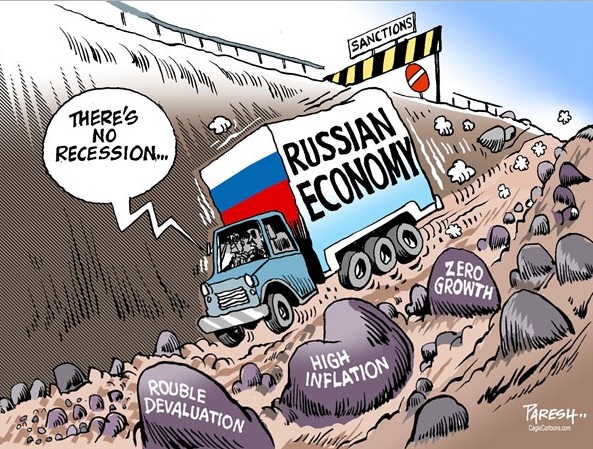
Bruegel writes:   The Russian economy grew rapidly between 2000 and 2007, but growth decelerated after the 2008-09 global financial crisis, and since mid-2014 Russia has moved into recession. A number of short-term factors have caused recession: lower oil prices, the conflict with Ukraine, European Union and United States sanctions against Russia and Russian counter-sanctions. However Russia’s negative output trends have deeper structural and institutional roots. They can be tracked back about a decade to when previous market-reform policies started to be reversed in favour of dirigisme, leading to further deterioration of the business and investment climate.

Russia must address its short-term problems, but in the medium-to-long term it must deal with its fundamental structural and institutional disadvantages: oil and commodity dependence and an unfriendly business and investment climate underpinned by poor governance. Compared to many other commodity producers, Russia is better placed to diversify its economy, mostly due to its excellent human capital. Ruble depreciation makes this task easier.

Recession in Russia has become a fact. Seasonally adjusted quarterly GDP peaked in the second quarter of 2014 and then started declining. In the third and fourth quarters of 2014, the pace of decline was very slow (Figure 1) and therefore growth for 2014 overall remained positive (+0.6 percent, Figure 2).

However, the first half of 2015 brought an acceleration of the negative trend. Real GDP declined by 2.2 percent in Q1 2015 and by 4.6 percent in Q2 2015, compared to the respective quarters of 2014.

Recession was no surprise.  After the global financial crisis of 2008-09 Russian growth did not resume its pre-crisis pattern. From 2010-12 growth was muted but reasonable, with annual GDP growth of 5.4 percent, 4.3 percent and 3.4 percent respectively (although from a low level in 2009). However, already in 2013 – well before the conflict with Ukraine and resulting international sanctions, and the oil-price decline – there was economic stagnation.

Russia was never a star reformer. Its economic transition in the 1990s was long and painful because of the complicated legacy of the Soviet system (structural distortions, macroeconomic imbalances and the absence of market institutions) and because of insufficient political support for radical, market-oriented reforms.  

Furthermore, the first years of Vladimir Putin’s presidency (2000-03) brought completion of many overdue reforms, such as land reform, simplification of the tax system (the flat 13 percent personal income tax rate), elimination of fiscal imbalances, continuing privatization, limited opening to foreign investors, deregulation and adoption of several pieces of market-oriented legislation. At that time, Russia could be considered a country that completed its basic transition agenda and managed to build a market economy based on private ownership, even if several distortions and imperfections continued to exist.

The turning point came in 2003 with politically motivated crackdown on the largest Russian private company, Yukos (its assets were subsequently taken over by the state-owned Rosneft). As result, the private sector share of GDP decreased from 70 to 65 percent between 2004 and 2005.   Depth of the Russian Recession

Russian Recession

Positive Wealth?

At a panel moderated by the Harvard Business Review at the Washington National Cathedral, Christine Lagarde tackles inequality.

Moderator Idi Ignatius, editor of the Harvard Business Review, posed this question: “Is Christian faith incompatible with vast wealth?”

Lagarde, who grew up Catholic in France, parried the question with aplomb.
“I think it’s how you use it, what you do with it, and what purpose you give to your life as a result which really matters.”

Those words echoed her June speech before a Catholic conference in Belgium in which she asserted, “It is not immoral to enjoy one’s financial success.”
Summers, who’s Jewish, drew laughs when he observed, “I hope this is the last time I’m asked to opine on Christian morality,” then agreed with Lagarde:

The discussion of public morality, sustainable economic growth and government policies that encourage redistribution of wealth included themes touched on by Pope Francis during his apostolic visit to the United States in September.

The pope, in fact, was the only religious leader quoted during the evening. Ignatius referred to the pope’s speech in Bolivia July 8: “Let us say ‘no’ to an economy of exclusion and inequality, where money rules, rather than service. That economy kills. That economy excludes. That economy destroys Mother Earth.”

The Rev. Gary Hall, dean of the cathedral, reached back farther in his introduction to the program, quoting from the pope’s apostolic exhortation of 2013, in which he called capitalism “a new tyranny” and called on political leaders to address income inequality.

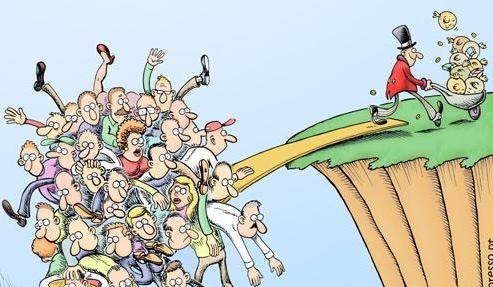
Lagarde avoided specific observations on the morality of income inequality. “As far as the IMF is concerned,” she said, “we’re not taking a political stand; we’re not taking an ideological stand.”  Instead, she said, “we have to ask ourselves, is that good for financial stability? Is that good for sustainable growth?”
She concluded that “excessive inequality is not good for sustainable growth,” adding, “We need to have a moral compass” in government economic policies.

Inequality

Larry Summers Has Trouble Getting Thru the Eye of a Needle

Larry Summers lobbying for a position in a potential Clinton administration and Christine Lagarde, the real deal among women in finance, address a camel passing through the eye of a needle.

The usually loquacious former U.S. Treasury Secretary Larry Summers is rarely a man at a loss for words, especially on economic matters. But he was stumped at a recent event—at least for a moment.

The Harvard University economist was asked to expound on Matthew 19:24, the Bible passage that says it’s harder for a rich man to enter heaven than a camel to pass through the eye of a needle.

In the airy halls of the National Cathedral, Mr. Summers and International Monetary Fund Managing Director Christine Lagarde this week were exploring “Capitalism and Morality: The Inequality Challenge” with Adi Ignatius, the editor-in-chief of Harvard Business Review.

Mr. Ignatius asked the two economic policy leaders whether the Christian faith is compatible with having vast wealth.

Ms. Lagarde quickly tapped her catechism of old, pointing to the “parable of the talents,” a biblical lesson on the use of personal resources. “It’s how you use it, what you do with it, and what purpose you give to your life as a result which really matters,” the head of the world’s emergency lender said.

All eyes in the cathedral turned to the man who had largely dominated the panel discussion for the previous hour. Mr. Summers had adopted a puzzled pose not too dissimilar from Rodin’s “The Thinker.”

“I really don’t know what to say,” he said.

“I’ve been on a lot of panels in my life–a lot of panels–and I have to say as a Jewish economics professor, this is the first occasion, and I frankly hope the last, on which I have been asked to opine on Christian morality.”

A few more “umms” later, however, Mr. Summers was able to regain his composure and his words. He proceeded to walk the congregation through Henry Ford’s revolution of the U.S. economic geography, iPad education, higher taxation on the wealthy and philanthropy.

Entrepreneur Alert: Opportunities in the Opening the World

New countries in the international decision-making mix will impact entrepreneurial opportunities across the globe.

Anne-Marie Slaughter writes:  Extending the list of countries involved in international policy meetings is crucial.  The other countries have plenty of motivation – and plenty to offer.

India – as well as Pakistan – has a great deal to gain from strengthening Southwest Asian trade, energy, and investment ties. Since the signing of the Iran nuclear deal, India has been contemplating renewing the plan for an Iran-Pakistan-India gas pipeline, with the participation of China and Russia. But that will be impossible without a settlement in Syria and a decision by Iran to stop supporting Hezbollah.

India has a strong relationship with Iran, underpinned by long-standing cultural, social, political, and economic ties, with India now funding an overhaul of the Iranian port of Chabahar, which will give it direct access to Afghanistan. This places India in a strong position to push Iran to put pressure on Assad. Likewise, India can leverage its relationship with Russia – it remains a major importer of Russian arms – to help drive progress.

Japan’s potential contribution also involves Iran, with which Japan has lately been pursuing a closer relationship – not least because Japan needs Iranian oil and gas. Earlier this month in Tehran, the Japanese and Iranian foreign ministers agreed to begin negotiations on a bilateral investment treaty. Japan also wants to speed up implementation of the Iran nuclear deal, so that it can take advantage of the business opportunities that will result when economic sanctions on the Islamic Republic are lifted.

But if Iran is truly to rejoin the international community, it must play a constructive role in its region. Japan, which now aspires to enhance its own role on the world stage, must not shy away from making that clear. A bonus here is that Japanese and Indian interest in the Syrian peace process could spur China to play an active role in reaching, rather than blocking, a solution.

Brazil, despite confronting plenty of domestic problems right now, is also in a position to help. Not only does it have substantial ties with Russia; it is also linked to Turkey, exemplified by the two countries’ 2010 effort to broker a deal with Iran over its nuclear program.

Moreover, in 2011, Brazil put forward a concept paper at the UN outlining how countries seeking to implement the “responsibility to protect” doctrine should behave. With the Syrian government – through its murder of tens of thousands of civilians with barrel bombs and poison gas – having more than fulfilled the criteria for triggering the international community’s obligation to intervene, Brazil could suggest what an intervention that reflected the principle of “responsibility while protecting” might look like.

Finally, Egypt – a perennial candidate for a permanent or rotating African seat in a reformed Security Council – has important relationships throughout the region, particularly with Saudi Arabia and other Gulf countries that are directly supporting some Syrian opposition groups. The government of Egyptian President Abdel Fattah el-Sisi, who has emphasized the need for a comprehensive political settlement, is tacitly supporting Assad, but is also deeply concerned about the Islamic State. Egyptian diplomats are thus excellent candidates to exert pressure for compromise.

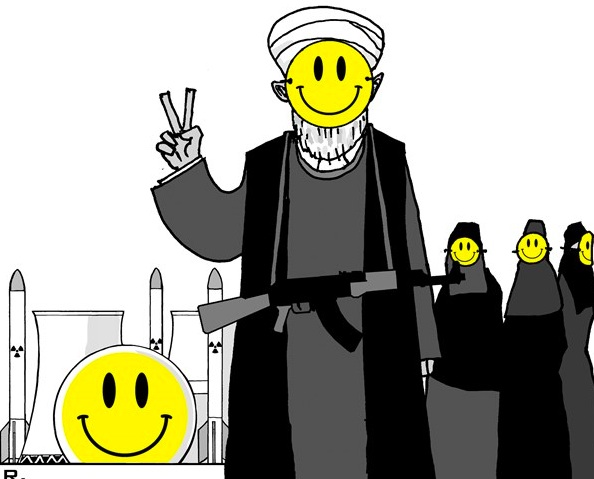
Greeting Iran


China Ends One-Child Policy

China has decided to end its decades-long one-child policy.  How will this impact women’s careers?  The one-child policy is often cited as a reason that women are equal to men in China’s financial industry.

Couples will now be allowed to have two children, it said, citing a statement from the Communist Party.

The controversial policy was introduced nationally in 1979, to slow the population growth rate.

It is estimated to have prevented about 400 million births. However concerns at China’s ageing population led to pressure for change.

Couples who violated the one-child policy faced a variety of punishments, from fines and the loss of employment to forced abortions.

Over time, the policy has been relaxed in some provinces, as demographers and sociologists raised concerns about rising social costs and falling worker numbers.

The Communist Party began formally relaxing national rules two years ago, allowing couples in which at least one of the pair is an only child to have a second child.

  • Introduced in 1979, the policy meant that many Chinese citizens – around a third, China claimed in 2007 – could not have a second child without incurring a fine
  • In rural areas, families were allowed to have two children if the first was a girl
  • Other exceptions included ethnic minorities and – since 2013 – couples where at least one was a single child
  • Campaigners say the policy led to forced abortions, female infanticide, and the under-reporting of female births
  • It was also implicated as a cause of China’s gender imbalance

The decision to allow families to have two children was designed “to improve the balanced development of population” and to deal with an aging population.  Currently about 30% of China’s population is over the age of 50.

Correspondents say that despite the relaxation of the rules, many couples may opt to only have one child, as one-child families have become the social norm.

“As long as the quotas and system of surveillance remains, women still do not enjoy reproductive rights,” Maya Wang of Human Rights Watch told AFP.

The announcement comes on the final day of a summit of the Chinese Communist Party’s policy-making Central Committee, known as the fifth plenum.

The party is also set to announce growth targets and its next five year plan.

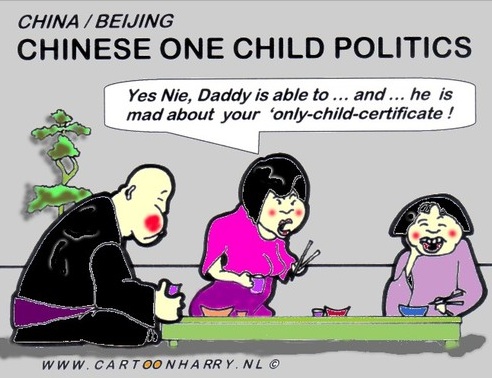
China's One Child Policy

Entrepreneur Alert: Saving Syria and Diversity

Barbara Slaver writes:   Outgoing UN High Commissioner for Refugees Antonio Guterres made an impassioned plea Oct. 27 for a political resolution to the Syrian civil war that includes key stakeholders Russia and Iran, and he expressed fears about the imminent disappearance of most Christians from the Middle East.

Guterres — a former Portuguese prime minister — also harshly criticized the European Union for its failure to respond effectively to the exodus of asylum seekers, primarily from Syria.

Noting that the EU countries have a total population of 550 million and that those seeking refuge there this year number about 700,000, Guterres said, “We are talking of a problem that could be managed … but what happened was total chaos.” Europe, he said, “has to [get] its act together.”


Guterres also called for countries around the world to accept more Syrian refugees, noting that Brazil has recently offered to take 20,000.


Guterres criticized the notion that terrorists could take advantage of the refugee resettlement process to infiltrate the United States. “The most stupid thing would be to apply for resettlement in the US,” he said, given the level of scrutiny and background checks.

As for Europe, Guterres said would-be terrorists “will fly … they will come in a much more comfortable way” rather than risk their lives in the hands of human smugglers on rubber dinghies and on long treks through the European countryside.   Ethnic Cleansing in the Middle East

The Last Christian

Horn of Africa Drying?

A new study finds that the Horn of Africa has become progressively drier over the past century and that it is drying at a rate that is both unusual in the context of the past 2,000 years and in step with human-influenced warming. The study also projects that the drying will continue as the region gets warmer. If the researchers are right, the trend could exacerbate tensions in one of the most unstable regions in the world.

“Right now, aid groups are expecting a wetter, greener future for the Horn of Africa, but our findings show that the exact opposite is occurring. The region is drying and will continue to do so with rising carbon emissions,” said study coauthor Peter deMenocal, who heads the Center for Climate and Life at Columbia University’s Lamont-Doherty Earth Observatory.

The study used a sediment core that deMenocal and his colleagues extracted from the pirate-ridden Gulf of Aden. They used the core to infer past changes in temperature and aridity. By pairing the paleoclimate record from the core with 20th century observations, the researchers determined that drying will probably continue across Somalia, Djibouti and Ethiopia. That contradicts more optimistic models that have suggested future warming might bring rainier weather patterns that could benefit the region.

Global-scale models used to predict future changes under global warming suggest that the region should become wetter, primarily during the “short rains” season from September to November. But the new study suggests that those gains may be offset by declining rainfall during the “long rains” season from March to May, on which the region’s rain-fed agriculture relies.)

The outcome has serious implications for a region that has been racked with political instability and violence as it has dried. The Horn of Africa has suffered deadly droughts every few years in recent decades, and with them humanitarian crises as famine and violence spread. It has also become one of the most unstable regions in the world. In Somalia, as the political situation deteriorated amid droughts of the 1980s and `90s, hundreds of thousands of refugees fled the country, and pirates began raiding ships off the coast.

That sediment core, which dates back about 40,000 years, has already provided new insights into Africa’s climate. In a 2013 study analyzing parts of the core, Tierney and deMenocal showed that the Sahara, which once bloomed with regular rainfall, suddenly dried out over the span of a century or two, during a warm period some 5,000 years ago—not more gradually, as many researchers had assumed. It provided evidence that climate shifts can happen quite suddenly, even if the forces driving them are gradual.

The new study uses isotopes from leaf waxes found in the sediment sample to compare rates of drying over the past 2,000 years. Plants reflect the environment that sustains them. When the climate is drier, leaf waxes are more enriched with deuterium, or heavy hydrogen isotopes; leaf waxes from wetter climates reflect the more abundant rainfall through the presence of the normal hydrogen isotopes. The researchers found an increasing shift toward heavy hydrogen in the last century as the climate, which had experienced a wet period during the Little Ice Age (1450—1850 AD), dried out.

The findings suggest that climate modeling, frequently done at a global scale, would benefit from region-specific studies with higher resolution results in high-impact areas such as the Horn of Africa,
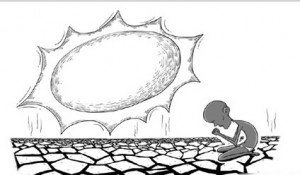
Horn of Africa Drying