End Fossil Fuel Subsidies?

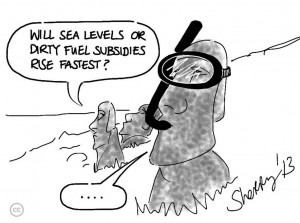
Bloomberg editorial writes:  Subsidies, as a rule, distort financial incentives and leave the economy less efficient. Subsidies on fossil fuels are doubly foolish: They also divert investment and consumption away from cleaner energy, and cost taxpayers a bundle.

Yet last year, for all the talk from world leaders about cutting greenhouse-gas emissions, the richest nations spent more on subsidies for coal, oil and natural gas than they did a decade ago. Those subsidies — a mix of direct spending and tax breaks — amounted to $65 billion among the 34 members of the Organization for Economic Cooperation and Development, and another $103 billion in China, India, Brazil and other large countries outside the OECD..

Developed countries have made some progress: Their fossil-fuel subsidies have inched downward for each of the past three years. But inertia remains a problem. About two-thirds of the individual subsidies have been in place since before 2000. Times change, and so should policies. When people and businesses need incentives to use less fossil fuels, it makes no sense for taxpayers to give them an advantage in the marketplace.

 Fossil Fuel Subsidies

Entpreneur Alert: The Streaming Business

Leonid Bershidsky writes:  Deezer, the Paris-based music streaming service, will be the first company in that budding industry to go public. Its initial public offering prospectus, for a share sale toward the end of the year, provides fascinating insight into how the streaming business works — or rather, how it could work.

The service is an important global player (though it isn’t well-known in the U.S., where it launched last year). It operates in 180 countries and boasts 3.8 million revenue-generating subscribers. Spotify, the streaming industry leader, claims “more than 20 million.” Apple Music has only reported 11 million trial subscribers so far. Thanks to the IPO filing, though, Deezer is the only company in the industry to provide validated numbers.

Of the 3.8 million, only 3 million actually listen to music from the Deezer catalog — the industry’s biggest, with 35 million tracks, 5 million more than Spotify or Apple Music. The rest are so-called “inactive bundle subscribers.” Deezer sells subscriptions bundled with various devices, such as audio equipment. About 1.5 million such customers use the service at least once a month. Another 1.5 million heard about the service or saw its advertising before subscribing.

This user base brings in about 96 percent of Deezer’s revenue. The rest comes from advertising, played to non-paying users. In the six months ended June 30, it made 93 million euros ($104 million) in revenue and paid back 76.4 percent of that to rights owners — a bit more than the 70 percent Spotify says it returns or the 71.5 percent claimed by Apple. The gross margin isn’t bad, but it’s easily eaten up by development, marketing and administrative expenses. For the six months ended June 30, Deezer reported a 12 million euro loss, practically unchanged from the same period last year, though revenue increased 41 percent.

This is standard for the industry. Spotify, too, loses money. Apple Music hasn’t even started charging subscribers yet. 

Both Deezer and Spotify hoped that their user bases eventually would be big enough for revenue growth to overtake increased development and marketing budgets. It’s not really happening, though: Costs are growing in step with revenue. So the services keep putting off their break-even point. In the IPO filing, Deezer uses these industry revenue projections from Enders Research:

It’s probably true that streaming revenues will surpass those from sales of CDs and vinyl records, as well as those from downloads from stores such as iTunes. In the U.S., streaming has already beaten physical sales, and downloads will probably yield leadership next year because they’re dropping. Streaming is growing even faster in Europe — in Sweden, Spotify’s home country, it accounts for 70 percent of recorded music revenue, and in France, Germany and the U.K., listeners also are switching to streaming services. So Enders’ prediction that streaming will become the leading channel for music sales globally in 2018 is probably conservative. It’s far from certain, though, that total music sales will start growing this year: They’ve been on their way down since 2012. 

Compared with popular music’s heyday, the industry is far less influential and less interesting. Larger-than-life stars are hard to come by — there’s no new Michael Jackson or Kurt Cobain, no new giant bands such as U2 or Radiohead. 

Yet Deezer is betting on that growth and, at the same time, hoping that people will subscribe to more than one service. It may be right: I now use three services because my favorite music — including Russian, Polish, Ukrainian, German and French groups — isn’t all available on any single outlet. Yet there is a tremendous amount of overlap between the biggest players’ catalogs: After all, they deal first with the same big record companies and then with smaller publishers if they have the resources left.

France is the biggest market for the Paris-based company, just as Spotify is especially popular in Scandinavia. It’s possible that, with the exception of Apple, which has a large user base throughout the world, successful companies will be strong in their home territories, providing access to the music that people there most enjoy. That, however, would limit user base growth.

Deezer hopes the IPO will value it at 1 billion euros. That’s a much more modest number than Spotify’s valuation of $8 billion from its latest funding round, and it should be achievable — streaming is clearly the music industry’s future, and Apple, despite its enormous power, won’t be able to eliminate all the competition.

The lack of great content that could boost interest in streaming, and in popular music in general, remains the biggest problem. Streaming may have contributed by making is next to impossible for new artists to make any money from recording their music. Deezer, Spotify, Apple Music and others are taking over a shrinking market, so profits will remain elusive.

Ubiquitous Streaming?

Abe Going Forward in Japan

In the wake of his reinstatement as leader of the Liberal Democratic Party for another three-year term, Prime Minister Shinzo Abe plans to reshuffle his Cabinet and LDP executive posts possibly in early October as part of efforts to push forward his economic program.

The Japan Post initial public offering could be just what the doctor ordered to enliven the country’s stagnant banking sector.

The Bank of Japan refrains from boosting stimulus even though the economy shrank in the last quarter.

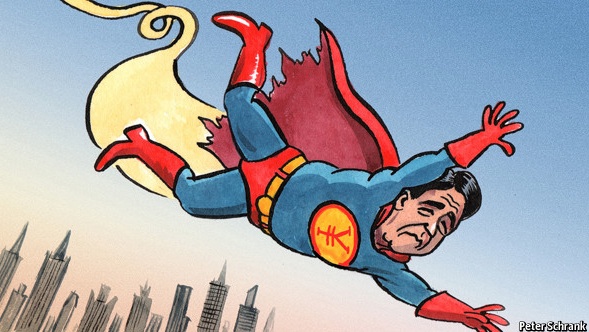
Standard & Poor’s has cut the nation’s long-term credit rating one level to A+, saying it sees little chance of the government’s current strategy accelerating growth and inflation over the next few years.  Downgrade not thought to matter much.

The Bank of Japan’s closely watched tankan survey of business sentiment, due out Oct. 1, is expected to show the first decline in three quarters.

Abe Going Forward

Emissions Scandal: Libor on Four Wheels

In the US, in important consumer areas like banking and automobiles, we pass legislation that protects consumers and keeps them safe.  In theory.  We have often discussed the problem of banking regulation on this site.  The ongoing Volkswagen emissions scandal is part and parcel with our failure to jail culpable bankers.

In this case, we regulate fuel emissions to improve the environment.  Often car manufacturers conduct the emissions tests.  If they don’t, the test are conducted in controlled venues.  Cr manufacturers have figured out how to make cars look like they are complying with emissions standards  under these tests.  When the car goes out on the road, the car no longer meets the standards.

In Europe and in the US, diesel cars are desirable because they burn less fuel.  However, with emissions standards, it is apparently difficult to make a profit with a fuel efficient, environmentally-sound vehicle.

What happened with VW was Libor on wheels.  There is no doubt that other car manufacturers will be outed.  Ford already made a deal with the government.

If we take the time to make rules and laws, shouldn’t we try hard to enforce them?   Slowly people like Senators Warren and Sherrod Brown are calling the public’s attention to banking irregularities that tear down economies.  Cars will be next.

Libor on Wheels


Tarnished: Made in Germany

The Volkswagen emissions scandal has rocked Germany’s business and political establishment and analysts warn the crisis at the car maker could develop into the biggest threat to Europe’s largest economy.

Volkswagen is the biggest of Germany’s car makers and one of the country’s largest employers, with more than 270,000 jobs in its home country and even more working for suppliers.

Volkswagen Chief Executive Martin Winterkorn paid the price for the scandal over rigged emissions tests when he resigned on Wednesday and economists are now assessing its impact on a previously healthy economy.

“All of a sudden, Volkswagen has become a bigger downside risk for the German economythan the Greek debt crisis,” ING chief economist Carsten Brzeski told Reuters.

“If Volkswagen’s sales were to plunge in North America in the coming months, this would not only have an impact on the company, but on the German economy as a whole,” he added.

Volkswagen sold nearly 600,000 cars in the United States last year, around 6 percent of its 9.5 million global sales.

The U.S. Environmental Protection Agency said the company could face penalties of up to $18 billion, more than its entire operating profit for last year.

Although such a fine would be more than covered by the 21 billion euros ($24 billion) the company now holds in cash, the scandal has raised fears of major job cuts.

The broader concern for the German government is that other car makers such as Daimler (DAIGn.DE) and BMW (BMWG.DE) could suffer fallout from the Volkswagen disaster. There is no indication of wrongdoing on the part of either company and some analysts said the wider impact would be limited.

The German government said on Wednesday that the auto industry would remain an “important pillar” for the economy despite the deepening crisis surrounding Volkswagen.

“It is a highly innovative and very successful industry for Germany, with lots of jobs,” a spokeswoman for the economy ministry said.

But analysts warn that it is exactly this dependency on the automobile sector that could become a threat to an economy forecast to grow at 1.8 percent this year. Germany is already having to face up to the slowdown in the Chinese economy.

“Should automobile sales go down, this could also hit suppliers and with them the wholeeconomy,” industry expert Martin Gornig from the Berlin-based DIW think tank told Reuters.

In 2014, roughly 775,000 people worked in the German automobile sector. This is nearly two percent of the whole workforce.

In addition, automobiles and car parts are Germany’s most successful export — the sector sold goods worth more than 200 billion euros ($225 billion) to customers abroad in 2014, accounting for nearly a fifth of total German exports.

The German BGA trade association also tried to calm the public by saying there were no signs that customers abroad were starting to doubt quality and reliability of German companies.

But he acknowledges there is a degree of concern among German companies that the scandal over cheating on U.S. diesel emission could have a domino effect on their businesses, eroding the cherished ‘Made in Germany’ label.

VW Emissions Deceit

Who Called for the Defeat Device at VW?

Volkswagen CEO Martin Winterkorn stepped down Wednesday over the scandal in which the German carmaker admitted to rigging its diesel cars’ emissions to pass U.S. tests.

In a statement, Winterkorn said he took responsibility for the “irregularities” found in diesel engines but that he was “not aware of any wrongdoing on my part.”

No replacement for the post of CEO was announced.

“Volkswagen needs a fresh start — also in terms of personnel,” he said. “I am clearing the way for this fresh start with my resignation.”

“This is the only way to win back trust. I am convinced that the Volkswagen Group and its team will overcome this grave crisis,” he added.

Following his statement, VW’s share price was up 8.7 percent at 121 euros.

Still, it has a long way to make up for the declines that saw nearly 25 billion euros (around $28 billion) wiped off the company’s market value.

Winterkorn had come under intense pressure since last Friday’s disclosure from the Environmental Protection Agency that the company had tried to dupe testers over emissions coming from its diesel cars.  His contract was scheduled to be extended by two years through 2018 at a meeting this Friday of the supervisory board.

The EPA has said Volkswagen could face fines of as much as $18 billion. Other countries, among them South Korea, have also ordered investigations into emission levels of VW cars and some law firms in North America have filed class-action suits.

On Tuesday, Volkswagen said 11 million of its vehicles worldwide contained the so-called “defeat device” that allowed the cars to beat the testers.

In April Winterkorn won a battle against the car executive of the 20th Century, Ferdinand Piech.  Piech is a member of the Porsche family, and the battle against Winterkorn may be the only one he lost in his legendary career.  One of these two men, but likely not both, is responsbile for the “defeat device.”

VW Emissions Deceit


VW Emissions: German Reported to Tip Off California Air Resources Board

Joanna Walters writes:   The emissions-fixing scandal that has engulfed Volkswagen in the US could extend to other companies and countries, one of the officials involved in uncovering the alleged behaviour has told the Guardian.

Billions of pounds have been wiped off the value of global carmakers amid growing concerns that emissions tests may have been rigged across the industry.

“We need to ask the question, is this happening in other countries and is this happening at other manufacturers? Some part of our reaction is not even understanding what has happened exactly,” said John German, one of the two co-leads on the US team of the International Council for Clean Transportation (ICCT), the European-based NGO that raised the alarm.

South Korea said on Tuesday it would investigate emissions of VW Jetta and Gold models and Audi A3 cars produced in 2014 and 2015. If problems are found, South Korea’s environment ministry said its probe could be expanded to all German diesel imports, which have surged in popularity in recent years in a market long dominated by local producers led by Hyundai.

US Congress confirmed it is investigating the scandal on Monday. House energy and commerce committee chairman Fred Upton and oversight and investigations subcommittee chairman Tim Murphy announced that the Oversight and Investigations Subcommittee will hold a hearing.

The US Justice Department is conducting a criminal investigation of Volkswagen admission.

VW shares fell by 19% in Frankfurt, wiping almost €15bn (£10.8bn) off its value.

The US Environmental Protection Agency (EPA) said on Friday that VW had installed illegal software to cheat emission tests, allowing its diesel cars to produce up to 40 times more pollution than allowed. The US government ordered VW to recall 482,000 VW and Audi cars produced since 2009.

In response, Martin Winterkorn, chief executive of VW, said on Sunday he was “deeply sorry” for breaking the trust of the public and ordered an external investigation.

German tipped off regulators at the California Air Resources Board (Carb) and the EPA after conducting tests that showed major discrepancies in the amount of toxic emissions some VW cars were pumping out compared with the legal limits.

VW Emissions Deceit

Path to EU Vitality?

Hans-Helmut Kotz,Eric Labaye, Sven Smit write:  With the third Greek loan program almost in place, it is time for European leaders to start focusing on the future. That does not mean concentrating on Greece’s debt-service schedule over the next few months. Rather, it means embarking on a broad economic-reform program that combines growth-enhancing supply-side reforms and demand-side efforts to support investment and job creation.

Low oil prices, a more competitive euro exchange rate, and the European Central Bank’s judicious use of its full suite of monetary-stabilization policies – not to mention the fact that the threat of Grexit has been averted, at least for now – provide a favorable backdrop for such ambitious reforms. Even the political environment may not be as inauspicious as is often believed: Despite the worrying rise of anti-European sentiment in many countries – especially those hit hardest by the crisis – there is a palpable yearning among Europeans to break out of the continent’s debilitating economic (and political) rut.

Indeed, a recent McKinsey survey revealed not only that Europeans aspire to a more vibrant economy, higher incomes, and better public services (especially health care and education), but also that they are prepared to accept tradeoffs, including longer hours and reduced social protection, to achieve them. A whopping 91% of the 16,000 respondents said that they would favor changes to the status quo, even if it required some sacrifice.

And the status quo is in urgent need of change. As it stands, European economic output per capita remains well below 2008 levels. In most European countries, gross sovereign debt exceeds the threshold (60% of GDP) established by the Stability and Growth Pact. Immovable adjustment constraints have caused eight countries to experience nominal wage deflation in at least two years since 2008. And unemployment remains stubbornly high.  EU’s Vitality

European-Youth-Unemployment-Cartoon

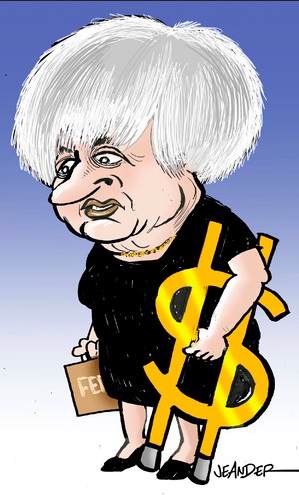
Yellen Ignores Inflation?

Anatole Kaletsky writes:  The US Federal Reserve’s decision to delay an increase in interest rates should have come as no surprise to anyone who has been paying attention to Fed Chair Janet Yellen’s comments. The Fed’s decision merely confirmed that it is not indifferent to international financial stress, and that its risk-management approach remains strongly biased in favor of “lower for longer.” So why did the markets and media behave as if the Fed’s action (or, more precisely, inaction) was unexpected?

What really shocked the markets was not the Fed’s decision to maintain zero interest rates for a few more months, but the statement that accompanied it. The Fed revealed that it was entirely unconcerned about the risks of higher inflation and was eager to push unemployment below what most economists regard as its “natural” rate of around 5%.

It is this relationship – between inflation and unemployment – that lies at the heart of all controversies about monetary policy and central banking. And almost all modern economic models, including those used by the Fed, are based on the monetarist theory of interest rates pioneered by Milton Friedman in his 1967 presidential address to the American Economic Association.

Friedman’s theory asserted that inflation would automatically accelerate without limit once unemployment fell below a minimum safe level, which he described as the “natural” unemployment rate. In Friedman’s original work, the natural unemployment rate was a purely theoretical conjecture, founded on an assumption described as “rational expectations,” even though it ran counter to any normal definition of rational behavior.

The theory’s publication at a time of worldwide alarm about double-digit inflation offered central bankers exactly the pretext they needed for desperately unpopular actions. By dramatically increasing interest rates to fight inflation, policymakers broke the power of organized labor, while avoiding blame for the mass unemployment that monetary austerity was bound to produce.

A few years later, Friedman’s “natural” rate was replaced with the less value-laden and more erudite-sounding “non-accelerating inflation rate of unemployment” (NAIRU). But the basic idea was always the same. If monetary policy is used to try to push unemployment below some pre-determined level, inflation will accelerate without limit and destroy jobs. A monetary policy aiming for sub-NAIRU unemployment must therefore be avoided at all costs.

A more extreme version of the theory asserts that there is no lasting tradeoff between inflation and unemployment. All efforts to stimulate job creation or economic growth with easy money will merely boost price growth, offsetting any effect on unemployment. Monetary policy must therefore focus solely on hitting inflation targets, and central bankers should be exonerated of any blame for unemployment.

The monetarist theory that justified narrowing central banks’ responsibilities to inflation targeting had very little empirical backing when Friedman proposed it. Since then, it has been refuted both by political experience and statistical testing. But, despite empirical refutation, the ideological attractiveness of monetarism, supported by the supposed authority of “rational” expectations, proved overwhelming. As a result, the purely inflation-oriented approach to monetary policy gained total dominance in both central banking and academic economics.  Inflation Over?

Yellen and Inflation

VW Emissions Deceit

Jerry Hirsch writes:  Volkkswagen called them “clean diesels,” branding them as the fun-to-drive alternatives to hybrids as it dominated the U.S. market for the engine technology.

Turns out the increasingly eco-conscious buyers of the sporty German cars have been unwittingly pumping smog into the air — because of software VW installed to cheat on U.S. emissions tests.

The world’s largest automaker has admitted selling 482,000 such diesels since 2009, California and U.S. regulators announced Friday. The scandal could cost the company billions of dollars in fines and lawsuit judgments and threatens to stunt the development of all diesel vehicles.

Autos editor Brian Thevenot explains how Volkswagen used a software trick to hide illegal pollution levels in half a million diesel cars.   VW’s software trick allows the cars to emit up to 40 times the legally allowed amount of nitrogen oxide, environmental officials said.

Nitrogen oxide is among the auto pollutants that put more smog into California’s skies.

Many owners of VW diesels — who tend to be enthusiasts — were enraged at being deceived.

The affected diesel models include: Jetta (model years 2009-15), Beetle (model years 2009-15), Audi A3 (model years 2009-15), Golf (model years 2009-15), and Passat (model years 2012-15).

The EPA made its charges by sending Volksagen a notice of violation of the Clean Air Act. It covers models equipped with 2.0-liter, four-cylinder diesel engines. The California Air Resources Board issued a similar letter for violations of state regulations.

Volkswagen admitted that the cars contained “defeat devices,” after EPA and the state air regulator demanded an explanation for the emission problems.

Volkswagen is the world’s biggest auto company, outselling Toyota and General Motors this year. The automaker issued a statement saying it is cooperating with the investigation and declined further comment.

Air board investigators started testing the vehicles on a special dynamometer — a kind of treadmill for vehicle testing — and on the open road using portable equipment.

VW programmed the engines to detect certification tests over many years and through three generations of engines, said Dave Sullivan, manager of product analysis at consulting firm AutoPacific Inc.

In addition to fines, VW will likely face consumer lawsuits.  Other vehicle manufacturers don’t appear to be doing the same thing, but still get good performance from diesel vehicles,” Tonachel said.

Consumers should not read VW’s action as an indictment of all diesel cars, said Don Anair, research director for the Clean Vehicles Program at the Union of Concerned Scientists.

Consumer Reports on Friday suspended its recommendation for two of the diesels, the Jetta and Passat.

VW Emissions Deceit