Cleaning Up Italy?

Italy has a new president, Segio Mattarella, a 73-year-old constitutional judge from Sicily.

The president of Italy has limited powers: he or she guarantees that politics complies with the Italian constitution, but real political responsibility remains with the government. However, the election of Mattarella is important for both the centre-left prime minister Matteo Renzi and his Democratic Party. Mattarella represents integrity, and has made no secret of his contempt for the kind of politics that has bolstered the interests of former prime minister Silvio Berlusconi over the years..

Italians were expecting Renzi to agree with Berlusconi on the nomination of a candidate who had the blessing of both leaders. However, Renzi opted for a candidate who would be viewed positively by all the members of his own Democratic Party, including those who disagreed with the Berlusconi pact.

Renzi has succeeded in severely weakening Berlusconi’s Forza Italia. In early January 2015, opinion polls put national support for the party at just 13%, and now around 40 out of 142 Forza Italia members of parliament voted for Mattarella as president, despite Berlusconi. Forza Italia members are clearly starting to realise that Berlusconi no longer has a future in Italian politics.

Sergio Mattarella is an incredibly bold choice for Italy. He is most commonly associated with his firm stance against organised crime and corruption. He fought the mafia and even resigned from his post as an education minister in the Democratic Christian government of Giulio Andreotti in 1990 when a law that would enable Berlusconi to further expand his media empire was passed.

Mattarella’s father Bernardo, an anti-fascist who opposed Benito Mussolini, was one of the founders of the Christian Democratic party. But Sergio only entered politics after the murder of his brother Piersanti Mattarella at the hands of the mafia in 1980, when he was president of the regional government of Sicily.

He went on to promote the “Palermo Spring”, which encouraged citizens to promote a culture of legality and rebellion against the mafia.

For these reasons and more, Mattarella represents the fight against corruption in Italy. His election follows that of Pietro Grasso, head of the National Anti-mafia Directorate, as president of the Senate in 2013.

According to the Corruption Perception Index of 2014 which measures the perceived levels of public sector corruption worldwide, Italy was the most corrupt state in the European Union – and it was ranked 69th worldwide. And in 2014, a corruption ring was exposed in Rome, involving dozens of administrators and civil servants who now stand accused of criminal activities such as vote rigging, usury, extortion and embezzlement.

On his first day in the Italian parliament, Mattarella received a standing ovation. He said: “In the fight against mafia, we have had many heros. I would like us to remember Giovanni Falcone and Paolo Borsellino”, both anti-mafia Sicilian magistrates killed by the mafia in 1992.
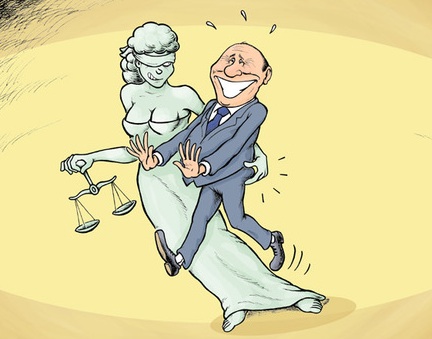
Berlosconi's Ways on Way Out?

Does the Punishment Fit the Crime?

Jed. S. Rakoff reviews Too Big to Jail by Brandon L. Garrett:  So-called “deferred prosecutions” were developed in the 1930s as a way of helping juvenile offenders. A juvenile who had been charged with a crime would agree with the prosecutor to have his prosecution deferred while he entered a program designed to rehabilitate such offenders.

The analogy of a Fortune 500 company to a juvenile delinquent is, perhaps, less than obvious. Nonetheless, beginning in the early 1990s and with increasing frequency thereafter, federal prosecutors began entering into “deferred prosecution” agreements with major corporations and large financial institutions. In the typical arrangement, the government agreed to defer prosecuting the company for various federal felonies if the company, in addition to paying a financial penalty, agreed to introduce various “prophylactic” measures designed to prevent future such crimes and to “rehabilitate” the company’s “culture.”

Speaking of corporate culture in an even broader way, it is worth remembering that any reasonable shareholder wants his or her company’s executives to be highly energetic, characterized by initiative, competitiveness, innovativeness, and even aggressiveness, all in a quest for profitability. It may be that these lauded qualities, essential to success in any competitive company, may in some cases encourage questionable behavior.

At bottom, corporate fraud amounts to little more than executives lying for business purposes, and prosecution depends on proving that the lies were intentional.

The preference for deferred prosecutions reflects some less laudable motives, such as the political advantages of a settlement that makes for a good press release, the avoidance of unpredictable courtroom battles with skilled, highly paid adversaries, and even the dubious benefit to the Department of Justice and the defendant of crafting a settlement that limits, or eliminates entirely, judicial oversight of implementation of the agreement.

When it comes to criminal violations involving corporations, “neither individuals nor corporations should be left off the hook.” One might argue that the two should not be equated and that the prosecution of high-level individuals for high-level crimes is a far more appropriate use of the criminal law than prosecution of the companies that served as their fields of operation.  For the past decade or more, as a result of the shift from prosecuting high-level individuals to entering into “cosmetic” prosecution agreements with their companies, the punishment and deterrence of corporate crime has, for all the government’s rhetoric, effectively been reduced.  Deferred Prosecution

Deferred Prosecution


Whistleblowers of the World Unite?

In the original case against UBS there was one indispensible person:  Bradley Birkenfeld.  He had to do time, in jail and then at home with an electronic bracelet.  But he also received $104 million from the Internal Revenue Service for making possible the collection of billions of dollars in unpaid taxes.

Why haven’t more people become whistleblowers?  They are often the difference between prosecuting a case and not starting an action.  They are certainly instrumental in winning cases.  And people who blow the whistle can make huge sums of money.

It is a frightening action to take.  You are going up against big companies and often ending your chance of being employed in your business of choice.  The prospect of prison is also a deterrent.

Should governments consider amnesty for people who are willing to step up and expose the criminal cultures of the institutions in which they work?  Transparency International writes: Whistleblowers are invaluable in exposing corruption, fraud and mismanagement. Early disclosure of wrongdoing or the risk of wrongdoing can protect human rights, help to save lives and preserve the rule of law.

Safeguards also protect and encourage people willing to take the risk of speaking out about corruption. We must push countries to introduce comprehensive whistleblower legislation to protect those that speak out and ensure that their claims are properly investigated. Companies, public bodies and non-profit organisations should introduce mechanisms for internal reporting. And workplace reprisals against whistleblowers should be seen as another form of corruption.

Public education is also essential to de-stigmatise whistleblowing, so that citizens understand how disclosing wrongdoing benefits the public good. When witnesses of corruption are confident about their ability to report it, corrupt individuals cannot hide behind the wall of silence.

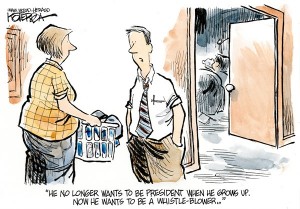
Jeff Koterba cartoon for June 18, 2013 "Whistle Blower"

Oppenheimer, a Little Guilty?

What one hand takes away, the other hand gives.  The Securities and Exchange Commission (SEC) has voted to give Oppenheimer Holdings Inc. (NYSE:OPY) & Company a break from further enforcement action after a “bad actor” ban was triggered and then subsequently waived by an SEC commissioner’s vote.

Two of five SEC commissioners, however, are speaking out against the waiver for what they see as repeated offenses, placing law and order credentials of SEC Chairwoman Mary Jo White, a Democrat and former prosecutor, into question.   White cast the deciding vote with two Republican commissioners in favor of Oppenheimer.

Here’s the problem:  We have rules and when they are ignored, we wink and let the offending party continue doing buisness as was and is.  We are following the US Department of Labor’s decision on whether or not to waive the criminal charges levied against Credit Suisse so they can continue with their 2 billion dollar pension business in the US, despite admitting to aiding and abetting US tax evaders.

The Securities and Exchange Commission charged Oppenheimer & Co. with violating federal securities laws while improperly selling penny stocks in unregistered offerings on behalf of customers.  Oppenheimer agreed to admit wrongdoing and pay $10 million to settle the SEC’s charges. Oppenheimer will pay an additional $10 million to settle a parallel action by the Treasury Department’s Financial Crimes Enforcement Network (FinCEN).

According to the SEC’s order instituting a settled administrative proceeding, Oppenheimer engaged in two courses of misconduct. The first involved aiding and abetting illegal activity by a customer and ignoring red flags that business was being conducted without an applicable exemption from the broker-dealer registration requirements of the federal securities laws. The customer was Gibraltar Global Securities, a brokerage firm in the Bahamas that is not registered to do business in the U.S. Oppenheimer executed sales of billions of shares of penny stocks for a supposed proprietary account in Gibraltar’s name while knowing or being reckless in not knowing that Gibraltar was actually executing transactions and providing brokerage services for its underlying customers, including many in the U.S. The SEC separately charged Gibraltar in 2013 for its alleged misconduct.

The SEC’s order finds that Oppenheimer failed to file Suspicious Activity Reports (SARs) as required under the Bank Secrecy Act to report potential misconduct by Gibraltar and its customers, and the firm failed to properly report, withhold, and remit more than $3 million in backup withholding taxes from sales proceeds in Gibraltar’s account. Oppenheimer also failed to recognize the resulting liabilities and expenses in violation of the books-and-records requirements, and improperly recorded transactions for Gibraltar’s customers in Oppenheimer’s books and records.

SEC Press Release:  According to the SEC’s order, the second course of misconduct involved Oppenheimer again engaging on behalf of another customer in unregistered sales of billions of shares of penny stocks. The SEC’s investigation, which is continuing, found that the sales generated approximately $12 million in profits of which Oppenheimer was paid $588,400 in commissions. The firm’s liability stems from its failure to respond to red flags and conduct a searching inquiry into whether the sales were exempt from registration requirements of the federal securities laws, and its failure reasonably to supervise with a view toward detecting and preventing violations of the registration provisions.

The SEC’s order requires Oppenheimer to cease and desist from committing or causing any violations and any future violations of Section 15(a) and 17(a) of the Securities Exchange Act of 1934 and Rules 17a-3 and 17a-8, and of Section 5 of the Securities Act of 1933. In addition to the monetary remedies, Oppenheimer agreed to be censured and undertake such remedial measures as retaining an independent consultant to review its policies and procedures over a five-year period.  Oppenheimer Case

Design Rachel Gold

Design Rachel Gold


UBS Still Aids and Abets US Tax Evaders

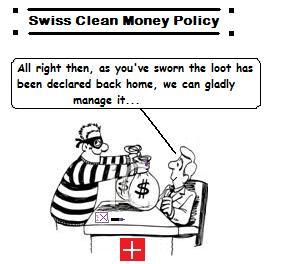
U.S. federal prosecutors have launched a new probe into whether Swiss bank UBS AG helped Americans evade taxes through investments banned in the United States.  UBS, which paid $780 million in 2009 to settle a separate Justice Department tax-evasion probe, is now under investigation for allegedly helping wealthy clients hide assets through so-called bearer securities.

Corruption in Indonesia?

Banyan writes:  In October Joko Widodo was inaugurated as Indonesia’s president, with parliament controlled by an opposition of bad losers threatening to thwart all his plans. Yet by this week, when Jokowi, as he is known, marked 100 days in office, his biggest headaches were caused by his own party, the PDI-P. It has stoked a confrontation between the notoriously corrupt police force and a popular anti-corruption body. The row risks blunting the great political weapon Jokowi has so far wielded to cow friend and foe alike: his personal popularity.

At the centre of it is Budi Gunawan. The policeman had been under a cloud since 2010 because his bank balance bulged suspiciously for a humble cop’s.  On January 23rd, the police arrested a KPK commissioner, Bambang Widjojanto, on flimsy-looking charges of encouraging perjury in 2010, when he was a campaigning private lawyer. He has resigned. To many, the arrest seemed like retaliation by the police. The three other KPK commissioners are also under investigation. The KPK needs a quorum of three to function, so it risks paralysis.

The affair undermines faith in his commitment to wiping out corruption. Like his predecessor, Susilo Bambang Yudhoyono, in other ways his polar opposite, Jokowi is respected as honest and a doughty fighter against graft. Many Indonesians know from personal experience that the police cannot be trusted.

Mr Budi’s appointment also mocked hopes that Jokowi would make promotions on merit. A businessman from a humble background, Jokowi worked his way to power through winning direct elections, first as mayor of his Javanese hometown, Solo, then as governor of the capital, Jakarta.

Perhaps Jokowi is not his own boss, and Ms Megawati still calls the important shots.

At home, these hardline policies are popular. Mr Jokowi appealed to voters not as a soft-centred liberal but as a no-nonsense small-town mayor who gets things done. And that is another reason why his deliberate, letter-of-the-law handling of the crisis over the KPK is so damaging.

It is also distracting attention from his rapid achievement of some economic-policy goals: starting the distribution of smartcards to poor Indonesians, entitling them to free health care and education, and removing fuel subsidies. Greatly helped by the plunge in the oil price, this last measure has freed billions of dollars for investment in infrastructure and social welfare. Environmentalists also give the president grudging credit for making a start on another crying need: affording better protection to Indonesia’s forests.

Transparency at the US Fed?

Why is the Federal Reserve so reluctant to become transparent.  Kevin CIrilli writesL The Federal Reserve is lashing out at Sen. Rand Paul’s plan to give Congress more oversight over the central bank, a proposal that could gain traction in the new Republican-led Congress.

The Kentucky Republican reintroduced his “Audit the Fed” legislation last month with 30 co-sponsors, including other potential 2016 GOP hopefuls, Sens. Ted Cruz (Texas) and Marco Rubio (Fla.).

The proposal — once championed by his father, former Rep. Ron Paul (R-Texas) —would subject the central bank to an audit by the Government Accountability Office (GAO).

Regional bank presidents from around the country are decrying the plan, which they argue could damage the economy.  “Who in their right mind would ask the Congress of the United States — who can’t cobble together a fiscal policy — to assume control of monetary policy?” Richard Fisher, retiring president of the Federal Reserve Bank of Dallas/

Fed Chairwoman Janet Yellen has already vowed to fight the legislation, and President Obama would likely veto it.

Still, Fed watchers note that Paul has become emboldened by the new Republican majority in Congress. And he possesses an ever louder national microphone, as he moves closer to a 2016 presidential run.

Together, those factors could elevate the issue in the coming months, a prospect that has spurred strong words from bank officials.

Retiring Philadelphia Fed President Charles Plosser told The Hill that financial auditing “already exists” for the Fed, and warned that Paul’s plan would empower Congress “to audit and question monetary policy decisions in real time.”

Paul pushed back against the criticism, saying Fed officials “will say and do anything to keep their business hidden from the American people.”

What the press has not made clear in reporting the Great Recession and quantitatie easing is the assets bought by the Fed and who they benetied.  An audit by the rerpresentatives of the Ameican people might provide insights into exactly what happened and why the ordinary American citicen is still having a tough time.

Fed Chair Janet Yellen, who met with Senate Democrats last week on Capitol Hill, is scheduled to testify before Congress later this month. The appearance will be her first since Republicans seized control of the Senate, and she will likely face questions on the legislation.

Senate Banking Committee Chairman Richard Shelby (R-Ala.), whose panel has jurisdiction on the bill, has also said he is interested in holding hearings on the issue.

Transparent Fed?

Private Investors for Bank Risk?

Sheila Bair writes: As Chairman of the Federal Deposit Insurance Corporation from 2006 to 2011, I have front line experience with the problems and havoc that can ensue when large, interconnected financial institutions take excessive risks.  I am committed to protecting American taxpayers from any future bailout of these so-called “too big to fail” institutions.  The best way to do that is to ensure these institutions have adequate private investment to absorb the losses when they fail. That allows markets to work as they should – with private investors accepting the risks and taking the losses, rather than the “heads I win, tails the public loses” practices we saw during the financial crisis where some large banks and other “systemic” institutions were allowed to reap the profits of their risk taking, but turn to taxpayers for help when those risks turned sour.

Big financial institutions profit by relying primarily on borrowed money – instead of shareholder equity – to fund their loans and investments. Because the market views them as implicitly backed by the government, it is cheaper for them to fund themselves with debt instead of equity. Through high levels of leverage, executives are able to increase their returns on equity – and their bonuses which are frequently tied to shareholder returns. Prior to the financial crisis, some of our biggest Wall Street banks were borrowing an incredible $30 to $40 for every dollar of hard cash they had from shareholders.

Big financial organizations have strong financial incentives to increase leverage. This is why it is essential for global and U.S. regulators to take a firm line on the amount of borrowing they are allowed to do.  U.S. banking regulators have already moved to limit big bank borrowing to less than $20 for each dollar of shareholder capital, and just last month proposed further borrowing limits for the largest U.S. banks that exceed the minimums set by international regulators. But behind the scenes, they’re facing intense resistance from many Wall Street banks, who are lobbying them to roll back and weaken their rules.

In the long run, better capitalized banks are in the interests of shareholders, creditors, and the public at large.  Though tougher capital rules may impact returns on equity in the short-term, in the long-term, thick cushions of capital protect investors against unforeseen risks and position the bank to continue lending during downturns. Numerous studies have shown that well capitalized banks do a better job of lending through cycles. This helps guarantee sustainable profits for shareholders, and reduces the risk of default for creditors. Most importantly, well-capitalized banks are in a stronger position to lend during times of economic distress when the economy needs them the most.

roi-bankrisk

Corporate Rehabilitation?

Jed S. Rakoff writes:  In Too Big to Jail, Brandon Garrett, a highly regarded law professor at the University of Virginia, presents for a lay readership a detailed and comprehensive examination of deferred corporate prosecutions, and corporate criminal prosecutions generally, and concludes that they have been, on the whole, ineffective. According to Garrett, “the big story of the twenty-first century” in corporate prosecutions is that “prosecutors now try to rehabilitate a company by helping it to put systems in place to detect and prevent crime among its employees and, more broadly, to foster a culture of ethics and integrity inside the company.”

But Garrett—on the basis of his own painstaking gathering of evidence (for neither the Department of Justice nor any other governmental entity keeps detailed and complete records of how such agreements are implemented over time)—finds that many, perhaps most such agreements, while often obscuring who was personally responsible for the company’s misconduct, fail to achieve meaningful structural or ethical reform within the company itself (a good example being the Pfizer cases described below). Nonetheless, Garrett does not urge the abandonment of deferred prosecution agreements, or of comparable non-prosecution agreements and corporate guilty plea agreements, but recommends instead that various steps be taken to improve their efficacy, including greater judicial oversight, greater use of court-appointed monitors, and greater attention to breaches of the agreements.   Does Corporate Rehabilitation Work

Corporate Rehab?