Laundering Money?

Nicolas Hirst writes:  Members of the public will have the right to find out who is behind complex corporate structures, shell companies and letterbox firms, under new rules to combat money laundering and tax avoidance agreed by European Union lawmakers.

Under the deal, member states will be required to maintain central registers with details of the owners of all companies based in their territory. The registers will be accessible to any member of the public who can show a “legitimate public interest”.

Although member states will have to compile registers of the beneficial owners of trusts, these will not be accessible to the public.

The reforms follow on from the ‘Lux Leaks’ revelations earlier this year that laid bare the tax affairs of hundreds of companies that moved to Luxembourg to enjoy sweetheart tax deals.

Central registers will also make it much more difficult for criminals to launder money within the EU.

Krišjānis Kariņš, a Latvian centre-right MEP, who led negotiations along with Sargentini, said: “For years, criminals in Europe have used the anonymity of offshore companies and accounts to obscure their financial dealings. Creating registers of beneficial ownership will help to lift the veil of secrecy of offshore accounts and greatly aid the fight against money laundering and blatant tax evasion.”

The European Parliament estimates that money laundering affects between 2%-5% of global gross domestic product each year.

Although campaigners welcomed the creation of centralised registers, some expressed concern that they would not be freely available to all members of the public.

“Requiring the public to prove a ‘legitimate interest’ is contradictory to the idea of transparency, and places all the burden on the public, rather than the potential criminals who are treating the European financial system like their personal launderette,” said Nienke Palstra, a policy officer at Transparency International.

There is also doubt about whether the register will be accessible to non-EU citizens wishing to trace funds hidden by corrupt political leaders.

One motivation for creating the central registers had been the revelation that the son of Viktor Yanukovych, president of Ukraine in 2010-14, had hidden money in a company in the Netherlands – transfers that were revealed because of a detailed investigation by a Ukrainian civil society organisation.

Ukrainian prosecutors have since charged Oleksandr Yanukovych with embezzlement.

The proposal to introduce public registers faced opposition from several member states, in particular Germany. France and the United Kingdom were strong proponents of public registers, although the UK fought hard to ensure that these did not include trusts.

Under the deal, the centralised registers will give details of the owners’ names, country of residence, nationality, month and year of birth, and the nature and extent of the beneficial interest held.

Bank Transparency

Warren Puts Banks on Notice

Who cares about relaxing Dodd Frank?  …the swaps push-out rule — section 716 of Dodd-Frank, which would require banks to book their derivatives in subsidiaries that are not their insured depository institutions was killed as part of the new deal to fund the government.

Why put financial regulation in an unrelated spending bill? Why rewrite financial regulation based on a draft by Citigroup lobbyists? – but let’s spend a minute on why it’s not worth caring about.
First: The rule doesn’t apply to most derivatives. Federal Deposit Insurance Corporation Vice Chairman Tom Hoenig:  “In fact, under 716, most derivatives — almost 95% — would not be pushed out of the bank. That is because interest rate swaps, foreign exchange and cleared credit derivatives can remain within the bank. In addition, derivatives that are used for hedging can remain in the bank. The main items that must be pushed out under 716 are uncleared credit default swaps (CDS), equity derivatives and commodities derivatives. These are, in relative terms, much smaller and where the greater risks and capital subsidy is most useful to these banking firms.”

Can equity derivatives bring down a bank?  Uncleared CDS has a rough track record, though the market is slowly moving away from it in general. But the big derivatives risks were going to be allowed to remain in the depository banks anyway.

Pushing out derivatives into non-insured subsidiaries doesn’t make them go away. Defenders of the rule cite the example of AIG, which foundered on uncleared CDS and brought down the financial system. AIG: not an insured bank! Neither was Lehman! The people arguing for the swaps push-out rules are not people who, in other contexts, would say that only insured depository banks get any government support. They’d say that “too big to fail” banks (you know: derivatives dealers) pose risks to the financial system even in their non-bank subsidiaries, risks that lead to an implicit expectation of government support beyond the explicit FDIC insurance. Here, they are right. If JPMorgan blows itself up trading CDS, that will be a problem for everyone, whether it happens in the insured bank or some uninsured subsidiary. The rule won’t stop that. The rule is (was?) fine, but it’s not worth getting upset about. This is all theater.

Credit Default Swaps

Interest Rates to 17% in Russia

Olga Tanas and Anna Adrianova wirite: The Russian central bank said it would raise its key interest rate to 17 percent from 10.5 percent, effective today. The move was the largest single increase since 1998, when Russian rates soared past 100 percent and the government defaulted on debt.

The ruble lost 2.5 percent to 66.0985 against the dollar as of 12:53 p.m., reversing an early gain prompted by the news.

The announcement, as well as its timing, underscored the financial straits in which Russia now finds itself. If sustained, the new higher rates would squeeze an economy that is already being hurt by sanctions led by the U.S. and European Union, and by a collapse in oil pirces.. Some analysts said they doubted the economy could withstand such high rates for long.

The ruble, which has depreciated 50 percent this year against the dollar, is the worst performer among more than 170 currencies tracked by Bloomberg. It gained almost 11 percent today, before weakening to a record.

“In order to limit the negative effects of such depreciation of the national currency on the Russian economy, we decided to increase the key rate,” Russian central bank Governor Elvira Nabiullina said on state TV channel Rossiya 24. “We really must learn to live in the ruble zone, rely to a large extent on our own sources of financing.”

So far this year, Russia has spent $80 billion of its foreign-exchange reserves in an unsuccessful attempt to prop up the ruble. Brent, the grade of oil traders look at for pricing Russia’s main export blend, lost as much as 3.3 percent to $59.02 on the London-based ICE Futures Europe exchange, trading below $60 a barrel for the first time since July 2009.

The economy may shrink 4.5 percent to 4.7 percent next year, the most since 2009, if oil averages $60 a barrel under a “stress scenario,” the central bank said yesterday. Net capital outflow may reach $134 billion this year, more than double last year’s total.

Others were more optimistic, saying the action was big enough to arrest the ruble’s record decline. “The central bank is trying to stop the avalanche, and such a massive hike may be sufficient,” said Slava Breusov, an analyst at Alliance Bernstein in New York.   “No one seems to be thinking what it will do to the economy, as the priority is to stop the ruble plunge.”

Russian Economy

Elizabeth Warren, Smart and Courageous

Warren took on President Obama and her party’s leadership, and appeared to inspire an uprising in the House.
The fight earned her comparisons to Texas firebrand Republican Sen. Ted Cruz, another relative newcomer to the Senate who has shown outsized clout in his party.

Warren lost the battle, but if  she continues to fight hard she may be in a battle with Sen. Charles Schumer (D-N.Y.), the third-ranking member of the Democratic leadership who represents New York’s powerful financial industry.

Peter Ubertaccio, a political science professor at Stonehill College in Massachusetts, sais, “If she’s able to succeed at the expense of her own leadership team — the team that she’s on — it will have the practical impact of moving the center of power away from folks like Schumer and toward her,” he said. “That’s pretty significant for a freshman senator that’s been brought into the leadership.

It could also reverberate in the 2016 presidential race, which liberal Democrats are dying for Warren to enter as a rival to former Secretary of State Hillary Clinton.

Warren is now a national figure in a tradition of influential Massachusetts politicians who have run for president such as former Sen. Ted Kennedy (D), former Gov. Michael Dukakis (D), former Gov. Mitt Romney (R), former Sen. John Kerry (D) and former Sen. Paul Tsongas (D).

Warren’s efforts also carried risks, and rubbed some Democrats the wrong way. Warren exhorted fellow Democrats to defeat the spending bill because it repealed a key provision of the 2010 Dodd-Frank Wall Street reform law. She lost, but the battle was important.

House Minority Leader Nancy Pelosi’s (D-Calif.) position appeared to harden .  She harshly criticized the White House.

Sen. Warren has recognized an opportunity to be the voice of the progressive side of the Democratic coalition and she’s taken full advantage.

Ending ‘too big to fail’ is far from over. Before Congress starts handing out Christmas presents to the megabanks and Wall Street, beware.

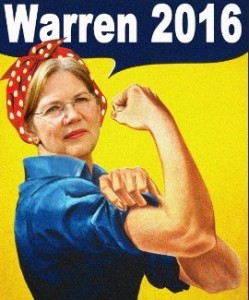
Warren 2016?

No Taxpayer Insurance for Derivatives?

Mark Whitehouse writes:   In the US, the congressional wrangling to avoid a government shutdown  has brought useful attention to some unfinished business of financial reform: loosening the largest U.S. banks’ grip on the derivatives market.

Six years after the 2008 financial crisis, these institutions still dominate a market that had a starring role in that disastrous episode. As of June, the three top banks — JPMorgan Chase, Citigroup and Goldman Sachs — had written derivatives contracts on the equivalent of about $182 trillion in assets, up from $158 trillion in 2008, according to the Comptroller of the Currency. Here’s a chart:

DerivsA20141211

And here are the 10 bank holding companies with the largest derivatives positions as of June:

DerivsB20141211

Why might this be a problem? Derivatives allow banks and investors to make bets on the performance of assets such as stocks, bonds and currencies without putting much money down. Such leveraged positions can quickly generate big gains or losses, and can trigger sudden, large demands for added cash collateral.  These events are not particularly desirable for institutions crucial to the functioning of the economy. The banks typically provide a sort of bookmaking service, taking bets that more or less cancel each other out. But not always: JPMorgan lost more than $6 billion on credit derivatives bets in 2012, and several big banks — including Goldman Sachs and Citigroup — required a government bailout after insurance giant AIG couldn’t meet collateral demands on its souring mortgage bets in 2008.

The banks have remained so dominant in large part thanks to a special advantage: They are able to finance their derivatives positions cheaply, because their creditors assume the government will rescue them in an emergency. Their central role in derivatives trading, in turn, serves to reinforce their too-big-to-fail status.Put another way, the banks can take federally insured deposits and use the cash to post collateral on derivatives bets. That’s according to the Federal Deposit Insurance Corp.

The Dodd-Frank Act of 2010 gave regulators a number of tools to rein in the derivatives operations. They can reduce the value of government support by requiring banks to have ample capital to absorb potential losses, and cash on hand to meet collateral calls. They are setting up central counterparties and trading hubs aimed in part at encouraging investors to do business directly with one another, rather than going through the big banks. In both areas, they have a long way to go.

Which brings us to the swaps push-out rule, a piece of Dodd-Frank that would require the banks to move a small but risky portion of their derivatives out of their deposit-taking subsidiaries and thus remove them from explicit federal support. If you’ve read this far, you’ll understand why this is sensible policy. Bank lobbyists have long been trying to kill the rule.

Banks’ assertion that the swaps push-out would be unduly complicated isn’t convincing. When their survival was at stake back in late 2008, both Goldman Sachs and Morgan Stanley managed to transform themselves into traditional bank holding companies in short order.

The swaps rule wouldn’t  eliminate the banks’ advantages or make their derivatives operations safe on its own. But it would be a useful part of a broader financial reform.

Derivatives.  Weapons of Mass Destruction?

Is Putin’s End Near?

David Russell writes: Even though Putin continues to be widely popular in his own country, there are several reasons why he could be brought down. The principle ones are the fall in oil prices and the financial crisis brought on by the sanctions imposed by the West. There are many others: a 40 percent decline in the value of Russian currency; an impending recession; the cost of defending his expansionist foreign policy; inflation rising by 9 percent; slowing or postponement of domestic goals of higher wages, better healthcare and cheaper housing (he has already closed 28 clinics and dismissed 10,000 medical staff in Moscow alone); and his personal failings. The last of these combines hubris with an inability to flexibly adapt to hardship.

Putin’s popularity soared domestically as average salaries increased tenfold from 2000 to 2013 and oil production and oil prices kept rising in an economy where 60 percent of exports were oil and gas and these accounted for 50 percent of the burgeoning government’s revenues. The prosperity enabled the reconstruction of a credible military and more goods and services for citizens. The U.S. and European allies’ pugilistic approach to post-Cold War territorial issues allowed Putin to call upon the nationalistic fervor.

Putin has blasted the West for what he feels is a U.S.-Saudi alliance to depress oil prices and place pressure on him to step away from the expansionist stance he has taken in Ukraine; the implied threats to Finland, Latvia, Lithuania, Bulgaria and Estonia; and naval excursions into the North Sea, the Atlantic and the Caribbean.

While his reserves may allow for some staying power for government budgets (the current estimate is two years), it will not protect vital industries.  Nearly $700 billion is owed to Western banks,  much of it by the giant state-run companies that constitute the heart of the Russian economy. But sanctions imposed by the United States and Europe over Russia’s annexation of Crimea and adventurism in southeastern Ukraine have blocked access to Western financing.”

While these industries can default on debt in defiance of Western sanctions, the West will be able to garnish oil payments and disrupt virtually every type of financial transaction of Russian oligarchs if they attempt to interact with the West. The prospects of refinancing major Russian companies could and mostly likely will cause an international financial crisis, causing further declines in the ruble and disruptions in oil exports.

It is widely speculated that the financial elements of Putin’s problems will create the greatest difficulty as he does or doesn’t adapt to Russia’s shifting circumstances. Since 66 percent of Russian assets are owned by the 1 percent, it is only a matter of time before Putin’s allies begin questioning his leadership. The easiest move for Putin would be to step back from his aggressive foreign policy.

The other adjustment would be to cut government spending by as much as 30 percent to address the reality of falling oil prices.

To achieve either or both of those moves requires a certain level of humility as Russia adjusts to a period of hardship unlike any that Putin has had to face the in the 16 years of his control.

Oil price declines were a principle contributor to the fall of the Soviet Union in 1991. There is gleeful speculation that falling prices will do the same for Putin. Where would threats to his control come from? Most likely it will be his oligarchic friends.

There is no question that the combined forces of economics and financial sanctions have weakened the Russian leader. The White House can hasten his departure by consciously encouraging the continuation of the oil surpluses.

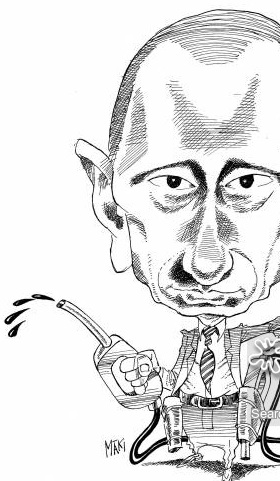
Putin's Oil

Italy’s Corruption Rating

Eleonora Casuela notes that perception of corruption in Italy is prevalent, especially in public administration.  Italy is tied with six other states, four of which are European. The NGO Transparency International in its new ranking on corruption sees Italy steady at sixty-ninth place in a ranking that includes 175 states.

Although ranked the same as Brazil, Bulgaria, Greece, Romania, Senegal and Swaziland, with 43 points, Italy did in fact record a potential value lower (34 points). This places it on the top rung of the ladder of the eurozone countries and the whole of Europe. The index of Transparency should be stated, is based on perception, not on a register of cases certified. The ranking does not necessarily reflect the real value of corruption cases certificates.

According to the report, however, the level of perceived corruption is increasing especially in countries with the highest rate of economic growth. These include Turkey, in particular, followed by Brazil, Russia, India and China. But at the center of the criticism by Transparency International, there are also important financial centers.  In some countries where the level of corruption is low, the multinational banks and major financial centers such as Frankfurt, London and New York are often corrupt.

This year Denmark defended his first place, followed by New Zealand and Finland.

North Korea and Somalia are tied for last place.  Germany isl twelfth and fourteenth is Britain. France is twenty-sixth, with the US seventeenth.

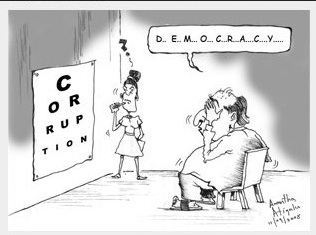
Corruption Index

80 Million Dollars to Develop Torture Tactics?

The United States government paid two military psychologists $80 million to develop torture tactics that were used against suspected terrorists in the wake of the September 11 attacks on the Pentagon and the World Trade Center.

In 2002, two former Air Force psychologists, James Mitchell and Bruce Jessen, became the masterminds of the CIA’s torture program, according to a report released by the Senate Select Committee on Intelligence. The two men, identified in the report under the pseudonyms Grayson Swigert and Hammond Dunbar, devised and performed torture tactics–including waterboarding and mock burial on some of the CIA’s most significant detainees.”

The report noted that neither of the men had previous experience as professional interrogators, nor did they have “specialized knowledge of al Qaeda, counterterrorism or any relevant cultural or linguistic experience.”
Even if one could get past the idea of paying someone to come up with new ways to torture people, the outrageous amount of taxpayer dollars spent on two individuals is simply unacceptable—especially when they didn’t seem to “invent” anything.

Still, they were in charge of developing the techniques and analyzing their effectiveness.


Torture Techniques

Corruption in the Ukraine

While the war in Ukraine’s east again threatens to explode into open conflict, Kiev is simultaneously fighting an even greater impediment to Ukraine’s long-term stability: endemic corruption.

According to the most recent figures from international corruption watchdog Transparency International, Ukraine was ranked 144 out of 177 countries on its Corruption Perceptions Index, placing Ukraine at the bottom of the rankings — tied with Cameroon, Papua New Guinea, Nigeria and others.

While Ukrainian government graft is widespread, public procurement corruption tops the list of challenges that the government in Kiev must confront. Ukrainian Prime Minister Arseniy Yatsenyuk has stated that Ukraine’s government makes about $25 billion in purchases in state purchases yearly, 40 percent of which — or $10 billion — is lost through graft.

“Public procurement is the most problematic sector where corruption is rife. Sometimes for certain things, the level of corruption in a tender can be up to 40 to 50 percent,” said Sergiy Gula, a government procurement expert at Transparency International Ukraine.

“The most common type of corruption in government tenders is either unlawful use of a single party or an associated company — a fictional competition or tender is won by a predetermined firm, even with the worst and most expensive proposal,” Gula said.

Corruption in the purchase of drugs for HIV/AIDs uncovered by the Anti-Corruption Action Center in Kiev supports Gula’s point. In a typical scheme, several companies controlled by one owner “compete” with each other to win millions of public funds. The end result of drug corruption procurement is that only 43 percent of HIV-infected patients obtain the drugs they need.   Corruption in Ukraine

Corruption in Ukraine

Grassroots Reform in Mexico?

While Mexico continues to struggle with organized crime, the government has adopted some strategies that seem to be slowly working and worth noting.  Drug-related homicides are down.  Economic reforms have been approved.  Local gangs still remain a problem.

One slow down may come from the failure of local business leaders and civil activists to join hands to change culture and politics.

Since democracy was restored in 2000, citizens have access to information about public decision making.  Accountablity is measurably greater.  Citizen who have experienced positive outcomes in turn hold their leaders more accountable for decisions.