Overzealous Prosecutor in Bank of Tokyo Case?

Matt Levine of Bloomberg, a tough and fair-minded appraiser, assesses the meaning of the New York State Department of FInance’s settlement with PriceWaterhouseCoopers in their consultancy on the Bank of Tokyo’s illegal dealings in Iran and Sudan:

Levine writes:  There’s much that is strange about this story of PricewaterhouseCoopers’s consulting work for Bank of Tokyo-Mitsubishi UFJ, starting with the fact that PwC is accused of “lacking the objectivity and integrity expected of consultants but not actually breaking the law.” There are some pretty big assumptions in that sentence! What objectivity and integrity do you expect from consultants?

Bank of Tokyo-Mitsubishi had done some illegal transactions with Iran and Sudan and so forth, and it hired PwC to do a historical transaction review of all those illegal transactions. The idea was that PwC would write a report, and the bank would submit it to the New York Department of Financial Services as part of its plea for leniency for, you know, doing all those illegal transactions. PwC wrote the report, and the bank sent some edits to basically make it sound less bad.   Facts and Non-Facts

A Problem of Tone


Are Sanctions Against Russia Working?

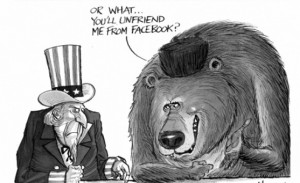
Marcel Fratzcher writes:  With the crisis in Ukraine intensifying, the United States and the European Union are locked in a battle of wills – and sanctions – with Russia. Indeed, in retaliation for the intensification of Western financial sanctions, Russia has announced a ban on food and agricultural imports from the US and the EU. But the real threat to the West lies in the potential impact of a financial crisis sparked by its own sanctions against Russia.

Consider Russia’s 1998 financial crisis. In August of that year, then-President Boris Yeltsin declared, “There will be no devaluation – that is firm and definite.” Three days later, the ruble was devalued, and Russian financial markets went into a tailspin. With capital pouring out of the country, the Russian government was forced to restructure its debt, and the economy entered a deep recession.

Though Russia was relatively insignificant financially, its crisis had far-reaching consequences. Among the worst affected was Argentina; the Russian crisis exacerbated a decline in investors’ confidence in emerging markets that culminated in Argentina’s sovereign default less than four years later. Even the US and Europe were not immune, with the collapse of the major hedge fund Long-Term Capital Management (LTCM) fueling anxiety about the viability of many other financial institutions.

Today’s financial dramas bear a striking resemblance to this experience. Argentina has technically defaulted; American and European financial institutions and markets are jittery; and Russia is promising that the sanctions it faces will have no impact on its economy.

The most obvious similarity is Russian President Vladimir Putin’s assertions that his country can weather any and all Western sanctions. That may be wishful thinking. In fact, barring most major Russian banks from operating freely in Western capital markets could affect the entire Russian economy, not just the banks themselves. And the central bank’s decisioin to raise interest rates to buttress the ruble may lead to much tighter credit conditions for companies and households, pushing the Russian economy into recession this year and next.

The problem with financial sanctions is that no one knows precisely how they will unfold – especially in an economy as large as Russia’s. If they prove to be more effective than intended, they will pose a serious threat to global financial stability.

Europe’s banks have extended almost €200 billion ($268 billion) in loans to Russian institutions and firms, and hold a significant share of Russia’s euro-denominated assets, making them especially vulnerable. Having just emerged from a deep recession, financial disruptions could easily cause Europe to slide back into recession.

Compounding the problem, no one truly understands the precise connections among Russian and European institutions and markets. The collapse of LTCM in 1998 was completely unexpected. Is Europe today prepared to deal with a similar failure of an important financial institution?

The financial sanctions on Russia are not targeted, temporary, or fully credible. If they affect Russia’s entire economy, hitting ordinary citizens the hardest, popular support for Putin’s regime may solidify further. Of course, an economic slowdown could erode Putin’s popular support, which is based on the gains in living standards made under his leadership. In that case, Putin’s response could be even more damaging.

Another problem is that implementing sanctions that cannot be reversed quickly removes the incentive for Russia to return to the negotiating table, especially because the threat of an escalation of financial sanctions lacks credibility, given the risk to European and US financial stability.

Once these sanctions begin to bite, no one can say who will be hurt – or how badly. And, as Russia’s experience in 1998, and Argentina’s after 2002, demonstrated, the process of restoring confidence among market participants is a long and painful one.

These concerns do not mean that the US and the EU should not impose sanctions on Russia for its illegal annexation of Crimea and continuing efforts to destabilize eastern Ukraine. But sanctions that hit the real side of the Russian economy – such as energy, natural resources, and the military – could provide a better solution. Though such sanctions may not work as quickly, they would be targeted, temporary, and credible, enabling the US and Europe to control – and adjust – the impact on the Russian leadership and economy.

In any case, US and European leaders must recognize that all sanctions will have costs – many of them unexpected – for both sides. If they are not willing to risk global financial stability in an unpredictable game of chicken with Putin, perhaps it would be wise to re-think the composition of the sanctions that they impose.

Sanctions

What Happened to Wall Street’s Tobacco Deals?


Politicians wanted upfront cash from a legal victory over Big Tobacco, and bankers happily obliged. The price? A handful of states promised to repay $64 billion on just $3 billion advanced.

In November 1998, attorneys general from across the country sealed a historic deal with the tobacco industry to pay for the health care costs of smoking. Going forward, nearly every cigarette sold would provide money to the states, territories and other governments involved – more than $200 billion in just the first 25 years of a legal settlement that required payments to be made in perpetuity.  What happened?  What Did Tobacco Companies Pay

Wall Street Seduction by Tobacco Bond


Bank of America Fines Total $70 Billion

BofA rewarded Mairone for creating Countrywide’s “Hustle” fraud by hiring her. So far that woman’s criminal expertise contributed toward mounting costs to BofA of $70 billion. Quite an accomplishment!
Her portrait ought to hang right next to CEO Ken Lewis’s at corporate headquarters as among the bank’s most costly mistakes in its history. As CEO, Lewis bought Countrywide for $4 billion, but the $70 billion of fines directly related to that purchase bring the direct cost up to $74 billion and counting.

As Bloomberg notes, Moraine’s Hustle program:

“lasted only nine months yet managed to write almost 30,000 subprime mortgages, which Fannie Mae and Freddie Mac bought for about $5 billion. Defect rates on stated-income loans (in which the borrower’s income isn’t verified) reached 70 percent.”

Mairone is now at JPMorgan, and one must wonder how much she’s going to cost that bank.

A Bloomberg editorial notes that these settlements provide no incentive to the Banksters to change behavior. First, they’ve insured themselves against their frauds, so insurance companies pay much of the fine. Second, while the fines sound big, they are peanuts compared to what the banks raked-in as they sucked wealth out of the housing sector. Banksters view this as a cost of doing (fraudulent) business. Third, at worst, stockholders suffer, not top management. Fourth, the Attorney General refuses to go after the top management, so none of those who actually benefited from the control frauds have been prosecuted for criminal activity. Indeed, they haven’t even been held personally liable for civil fines. And Fifth, all these negotiations and the settlement details are Top Secret-so no one really knows what was admitted. That is no way to make an example of fraudsters.

Mairone was the exception, and the judge in the case clearly meant to make an example of her. As Bloomberg reports:

“[Judge] Rakoff said the Countrywide loan-approval program was ‘the vehicle for a brazen fraud by the defendants, driven by a hunger for profits and oblivious to the harms thereby visited, not just on the immediate victims but also on the financial system as a whole.'”

Bloomberg goes on to argue that this case against BofA and Mairone disproves all the conventional arguments against prosecuting the fraudsters. It is often claimed that the cases will be too hard to win: they are too complex for juries to understand; or it is too hard to prove that individuals are culpable.

Bloomberg rejects all that:

“This case is the only one in which a large bank has had to defend its conduct in the housing boom, and it challenges the idea that bringing fraud prosecutions in this area is a hopeless endeavor. Apparently juries can cope with financial complexity after all. An assistant U.S. attorney explained what went on at Countrywide without needing to dwell on the arcana of collateralized mortgage obligations….

Other reasons, aside from complexity, have been advanced to justify the lack of prosecutions. One is that the U.S. government was itself involved because of its housing policies. The trial showed it was Countrywide, not a U.S. official, who told loan officers not to screen out risky borrowers and to fill their quota of applications before going home at night. It was Countrywide that rewarded bankers with the speediest approval rates, no matter how poorly underwritten their loans.

The idea that well-shielded executives can’t be implicated also got debunked. Testimony emerged that Mairone silenced and penalized bankers who complained about the quality of hustle loans. Rakoff is requiring Mairone to personally pay her $1 million penalty. Perhaps most important, the case suggests that midlevel employees could have been persuaded to give evidence against their seniors, enabling prosecutors to move up the chain….

The jurors in last year’s trial sent out a note during deliberations asking why more senior Countrywide executives weren’t being sued with Mairone. Many American taxpayers, homeowners and investors cannot be blamed for wondering the same thing.”

Exactly. Why isn’t Eric Holder going after the senior executives? Start with Bob Rubin, Hank Paulson, Bryan Moynihan, Ken Lewis, and Jamie Dimon. Seek prison terms on conviction. That would incentivize the banks.

How to Stop Fraud in Banking?


Should Shareholders Be Only One Stakeholder in a Corporation

Robert Reich writes: In recent weeks, the managers, employees, and customers of a New England chain of supermarkets called “Market Basket” have joined together to oppose the board of director’s decision earlier in the year to oust the chain’s popular chief executive, Arthur T. Demoulas.  Their demonstrations and boycotts have emptied most of the chain’s seventy stores.

What was so special about Arthur T., as he’s known? Mainly, his business model. He kept prices lower than his competitors, paid his employees more, and gave them and his managers more authority.  Late last year he offered customers an additional 4 percent discount, arguing they could use the money more than the shareholders.

In other words, Arthur T. viewed the company as a joint enterprise from which everyone should benefit, not just shareholders. Which is why the board fired him.

The Arthur T. business model pop up all over the place.  Pantagonia, a large apparel manufacturer based in Ventura, California, has organized itself as a “B-corporation.” That’s a for-profit company whose articles of incorporation require it to take into account the interests of workers, the community, and the environment, as well as shareholders.  The performance of B-corporations according to this measure is regularly reviewed and certified by a nonprofit entity called B Lab.

To date, over 500 companies in sixty industries have been certified as B-corporations, including the household products firm “Seventh Generation.”  In addition, 27 states have passed laws allowing companies to incorporate as “benefit corporations.” This gives directors legal protection to consider the interests of all stakeholders rather than just the shareholders who elected them.

We may be witnessing the beginning of a return to a form of capitalism that was taken for granted in America sixty years ago.  Then, most CEOs assumed they were responsible for all their stakeholders.

“The job of management,” proclaimed Frank Abrams, chairman of Standard Oil of New Jersey, in 1951, “is to maintain an equitable and working balance among the claims of the various directly interested groups … stockholders, employees, customers, and the public at large.”  Johnson & Johnson publicly stated that its “first responsibility” was to patients, doctors, and nurses, and not to investors.

What changed? In the 1980s, corporate raiders began mounting unfriendly takeovers of companies that could deliver higher returns to their shareholders – if they abandoned their other stakeholders.

The raiders figured profits would be higher if the companies fought unions, cut workers’ pay or fired them, automated as many jobs as possible or moved jobs abroad, shuttered factories, abandoned their communities, and squeezed their customers.

Although the law didn’t require companies to maximize shareholder value, shareholders had the legal right to replace directors. The raiders pushed them to vote out directors who wouldn’t make these changes and vote in directors who would (or else sell their shares to the raiders, who’d do the dirty work).

Since then, shareholder capitalism has replaced stakeholder capitalism. Corporate raiders have morphed into private equity managers, and unfriendly takeovers are rare. But it’s now assumed corporations exist only to maximize shareholder returns.

In retrospect, shareholder capitalism wasn’t all it was cracked up to be. Look at the flat or declining wages of most Americans, their growing economic insecurity, and the abandoned communities that litter the nation.

Then look at the record corporate profits, CEO pay that’s soared into the stratosphere, but the near meltdown in 2008 imposed collateral damage on most Americans).

You might conclude we went a bit overboard with shareholder capitalism.
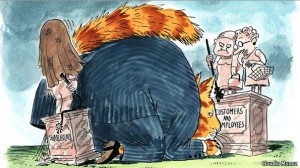
Stakeholder Capitalism


Goldman Sachs Investigated for Alternative Trading

Goldman Sachs Group Inc. said it was being investigated for its U.S. alternative trading system and for the potential misuse and circulation of non-public information related to its corporate developments.

New York’s attorney general is investigating the alternative trading systems, also known as “dark pools,” run by Goldman and Morgan Stanley.  Goldman, in a filing on Thursday, did not specify who was conducting the investigation.

A unit of Goldman Sachs was fined in July over pricing rule violations stemming from its dark pool SIGMA-X.  Dark pools are broker-run trading venues that let investors trade shares anonymously and only make trading data available afterwards, reducing the chance of information leaking about trade orders.

Goldman also lowered its unreserved legal costs to $3.2 billion at the end of June from $3.7 billion at the end of March, it said in the filing.

 Dark Pool Trading

Fighting Corruption in China

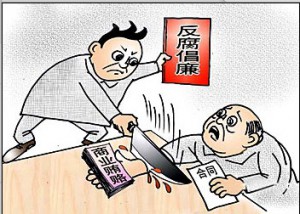
Chinese President Xi Jinping’s anti-corruption campaign is the broadest and deepest effort to purge, reorganize and rectify the Communist Party leadership since the death of Mao Zedong in 1976 and the rise of Deng Xiaoping two years later. It has already probed more than 182,000 officials across numerous regions and at all levels of government. It has ensnared low-level cadres, mid-level functionaries and chiefs of major state-owned enterprises and ministries. It has deposed top military officials and even a former member of the hitherto immune Politburo Standing Committee, China’s highest governing body. More than a year after its formal commencement and more than two years since its unofficial start with the downfall of Chongping Party Secretary Bo Xlia, the campaign shows no sign of relenting.  Fighting Corruption in China

Fighting Corruption in CHina

Anti Corruption Movement in Ghana

Ms Mary Addah, a Program Manager of Ghana Integrity Initiative (GII), a local Chapter of Transparency International, has urged Ghanaians to collectively stand up against corruption by going to anti-corruption institutions to report cases.  Speaking at a public symposium organized by Citizens’ Movement against Corruption (CMaC) in Accra, she mentioned the consequences of corruption to include lack of development, poverty, widening of the gap between the poor and rich.

According to her, in instances where citizens have been up and doing, there had been accountability and transparency on the part of leaders.  She expressed regrets over the low number of corruption cases lodged since the promulgation of the Whistle Blowers Act in 2006.  People often decline to report corrupt cases because they are of the view that less or no actions would be taken or they would be victimized.

Ms Addah was not happy with Ghana’s rating on the Corruption Index, pointing out that, whiles some countries were scoring 9.6  out of 10; Ghana was only scoring four.  Incentives for corruption are high because the society entertains the acts of corruption hence allow people to act with impunity.

Ms Addah called for more education on corruption and transparency on the part of leadership from homes to the presidency.

Mr. Edem Senanu, Co–Chairman of CMaC, noted that, corruption had been termed as the abuse of entrusted power for personal gains.  The CMaC is a movement rallying support and unifying all efforts of the citizenry to fight corruption. It also seeks to serve as an alliance between civil society organizations and the private sector to address corruption and its negative impact on national development.

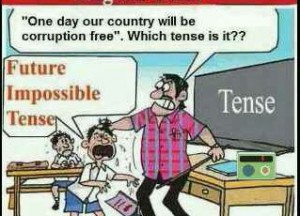
Corruption Lesson


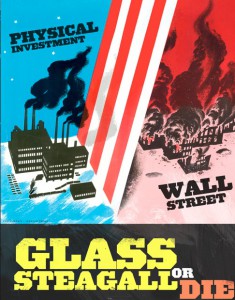
Bringing Back Glass Steagall in the US

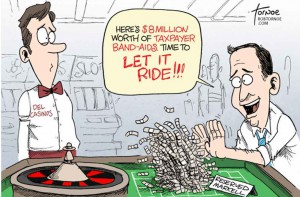
For over half a century, the Depression-era law known as Glass-Steagall kept traditional banks separate from the high-risk world of investment banks and hedge funds. Uncle Sam agreed to insure our deposits. And the banks, in return, agreed not to use these deposits for gambling in the Wall Street casino. That all changed with the industry-backed deregulation of the 1980s and ‘90s. Once again, banks gained the ability to play risky games with government-backed funds, setting the stage for the financial and economic meltdown of 2008.

After Senators Elizabeth Warren, John McCain, Maria Cantwell, and Angus King introduced their bill to bring back Glass-Steagall, AFR and our allies wanted to show the strength of the support for making the biggest banks simpler and smaller and once again ending the public subsidy to Wall Street speculation.

Return to Glass Steagall