Multinational Companies Bribing Chinese Officials

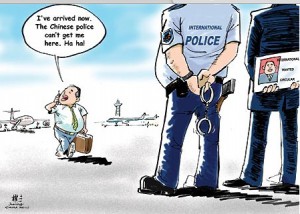
Zhang Yan writes:  Prosecuting departments have been handling an increasing number of cases involving bribery offered by multinational companies to government officials or State-owned enterprises, according to the Supreme People’s Procuratorate.  “The worst-hit areas in terms of corruption are pharmaceuticals, the electric power sector and software,” Song Hansong, director of the procuratorate’s corruption prevention department, told China Daily.

The number of bribery cases being prosecuted has risen markedly across the country, Song said, but he declined to give further details.  Because State-owned companies often need to purchase equipment and components from foreign firms, some multinational enterprises saw this as an opportunity to offer huge bribes to senior managers in State-owned companies or government officials to promote their products, Song said.

Zhao Wu’an, also a senior member of the corruption prevention department, highlighted some common methods of bribery.  “Rather than directly offering cash, they usually hire agents in China to offer the bribe by other means, including supporting overseas study for their children, arranging expensive foreign holidays and, of course, depositing money in a foreign bank account.”

In some cases, he said, corrupt officials in State-owned enterprises sent their children or spouses overseas to study or invest in businesses as a disguise to get passports and visas to launder money ahead of their own departure, he said.
Last year, Chinese police accused GlaxoSmithKline China, a British pharmaceutical giant, of offering huge bribes to officials and doctors to boost their product sales.
The company also faced accusations that it transferred up to 3 billion yuan ($489 million) to 700 middlemen over six years to facilitate the corruption.

Four senior Chinese executives at the company were detained, and Abbas Hussain, president of Europe, emerging markets and the Asia-Pacific for GlaxoSmithKline in Beijing, made a public apology and said the company will fully cooperate with police in the investigation.  Song said prosecuting departments face a number of practical difficulties when investigating corruption since getting their hands on evidence can be difficult as there is no paper trail.

Companies will also take more steps themselves to combat the scourge, he said.
The most effective measure, he said, is to “tighten supervision of ‘naked officials’ in State-owned companies”.  This term refers to officials who have sent their children and spouses overseas to pave the way for their own departure. Greater supervision over State-owned companies, especially those involved in high-cost projects, is required.

Foreign Bribes in China

Walgreens the Latest US Company to Relocate to Switzerland

Walgreens plans to merge with Swiss-based pharmacy chain Alliance Boots. Walgreens will then claim that it’s now a Swiss company, just to be able to pay Switzerland’s lower tax rate.

Walgreens is planning to create a massive new corporate tax loophole. They don’t want to pay their fair share of taxes.  This reflects the massive problems with the US corporate tax structure.  In many ways it is unfair to corporations and we are driving companies away from responsibilities they incur in the US because they use the US roads and bridges, a workforce educated in the US and our legal system.

Their stores are staying put. Walgreens will still depend on US citizens to shop there and make the company profitable.  Thanks to American shoppers Walgreens made $72 billion in profit in 2013. Nearly a quarter of those sales were from services like Medicare and Medicaid that are paid for by our tax dollars.

Walgreens wants all the benefits of being an American company. It should be asked to pay its fair share of taxes here.  Our representatives have not come up with an answer to this dilemma.

Walgreens Around every Corner

Water: Public or Private

Shayda Edwards Naficy writesLast month, 1,500 organizers in Thessaloniki, Greece risked arrest, placing unofficial ballot boxes by nightfall on street corners throughout the city. Their bravery paid off, as the next day more than 200,000 residents cast a vote on the pending privatization of their water system. Hundreds of volunteers worked around the clock to tally votes under the watchful eye of international observers. As morning dawned, a crowd gathered to hear the results. Before long, a huge cry of victory rose up: the “no” vote won by a resounding 98 percent. Once again, the people’s choice was clear: keep our water in public hands!

You see, in the face of Greece’s flailing economy, global lenders have put enormous pressure on Thessaloniki to privatize its water supply, arguing that doing so would save the city money through promises of cost-cutting and efficiency measures. And Thessaloniki isn’t alone — communities around the world are feeling the heavy hand of lenders (primarily the World Bank) pushing private water as the answer to their water woes. But the residents of Thessaloniki — like those in Jakarta, Indonesia and Nagpur, India — know that with privatization come rate hikes, empty taps, mass worker layoffs and dangerous health and safety violations.

Indeed, though Thessaloniki’s local government continues to doggedly pursue the private water contract, its efforts were recently dealt a critical blow. Just a few weeks ago, Greece’s highest court made a landmark ruling that private water violates the government’s constitutional obligations to protect peoples’ health and well-being. Campaigners in Thessaloniki are expected to launch a new legal action immediately, seizing this precedent to save their water from a corporate takeover.

Such successes are part of the growing wave of grassroots resistance to the threat posed by global water corporations and the institutions – namely, the World Bank — that support them. And Corporate Accountability International is in the thick of it: helping pull back the shiny veneer of the World Bank’s “success” stories to expose the truth. We are providing tools, platforms and resources to help communities protect their most basic precious resource from corporate control.

Successes in Greece and Indonesia demonstrate that civil society wants to keep water in public hands. And yet the World Bank continues its dogmatic promotion of privatization as the solution to our global water crisis — even when evidence clearly shows otherwise.  For instance, it is heavily promoting its project in Nagpur, India as a “success” to be replicated in communities elsewhere in India and throughout the world. This is astounding, given the dire reality on the ground. From extraordinary fees charged to those who can least afford them — and the threat of water cut-offs when they can’t pay the price — to pumping in dirty water from a reservoir filled with waste, and lengthy delays and sky-high cost overruns, the project has been a failure any way you look at it.

Fortunately, there are many groups and people in India who are exposing the truth behind the World Bank’s PR spin. We are working with our allies in India to debunk the World Bank’s claims of success. For example, we’ve partnered with Jammu Anand at the Nagpur Municipal Corporation Employees Union to shine a light on the true cost of the World Bank’s Nagpur project. Together, we launched a joint media release reaching more than 2 million people in over a dozen major press outlets in India and beyond. This media attention ensures that communities targeted by the World Bank for privatization have the information they need to resist the World Bank’s efforts. It also ensures that those who can influence the World Bank to change course on water are gaining a deeper understanding of the full scope of harm caused by poster-child projects like Nagpur.

Should people – or global corporations – control our water?

Water

Germany Fines UBS $300 Million

Our correspondent Andreas Frank writes:  UBS AG booked a near $300 million charge in the second quarter mainly to settle claims it helped wealthy Germans to dodge taxes, the latest in a string of lawsuits that have targeted its private banking business.

Back in late 2012, German state prosecutors in the city of Bochum begun an investigation into UBS clients on suspicion of personal tax evasion. UBS were just one of several Swiss banks that formed part of the probe and it took the opportunity in its latest quarter to finally settle with the German authorities and resolve the issue.
The Zurich-based lender’s offices in Germany were searched last year as part of a probe sparked by a CD with details of UBS clients that was purchased by the German state of North Rhine-Westphalia (NRW).

UBS, which faces a separate probe in Germany and similar probes in Belgium and France, took a 254 million Swiss franc charge and said it aimed to have all its German clients come clean by year-end, from more than 95 percent.

Yet the charge is only one of a slew of legal issues with which the bank is contending. It hiked its provisions against future litigation to nearly 2 billion francs but warned this might still not be enough to cover possible fines and charges.

The bank has taken a strategic decision to scale back its risky investment banking operations in favour of private banking and asset management, but remains under threat from possible past market transgressions.

The settlement in the German tax case comes less than a week after a 15-month French inquiry into UBS escalated, with the bank put under formal investigation on allegations it laundered the proceeds of tax evasion.

UBS was ordered to stump up a 1.1 billion euro ($1.5 billion) guarantee payment, which it called “unprecedented and unwarranted” and will appeal.

Switzerland effectively ended its long-cherished banking secrecy in May by agreeing to join other countries in sharing tax information, once a standard method of sharing is agreed.

Meanwhile, Swiss banks have spent years attempting to clear their accounts of undeclared accounts under massive international crackdowns on tax evaders.
The legal problems have overshadowed a near two-year overhaul to shrink UBS’ investment bank, abandoning riskier activities in its bond trading arm.  The ultimate goal of its restructuring drive is bigger dividends. UBS aims to return at least half of its profits to shareholders if it can maintain capital – which stands at 13.5 percent under new global rules – at or above current levels through to the end of 2014 and achieve a ratio of 10 percent when applying its own stress tests.

Profit at its private bank plunged 43 percent on the cost of the German settlement. The unit, which is measured by its ability to win fresh funds from new and existing clients, took in 10.7 billion francs in net new money.

Swiss bank UBS saw 15.4 percent growth in its wealth management business for 2013, firmly securing its position as world leader in the sector, with close to $2 trillion of assets under management.

If growth continues at its current rate, the bank – which currently runs $1.96 trillion – will become the first wealth manager to hit the $2 trillion “milestone”. This would mark a transition in the scale of global wealth management.
Database UBS Fined

Why the Netherlands Response to the MH17 Crash is Measured

There are good reasons for Russian companies to locate in the Netherlands. The first is well known: taxes. Netherlands has tax treaties with more than ninety countries and a tax regime that allows tax-free money to flow through the Netherlands.

The Netherlands is also attractive because their legal system provides unique protection against the wrath of Putin. This was particularly evident in recent years in the settlement of the bankruptcy of what was once Russia’s largest oil company was: Yukos Oil.

Between 2006 and 2013 an obscure legal conflict between the Dutch branch of Yukos and its Russian curator was fought in the Dutch courts. The Supreme Court decided this conflict end of 2013 in favor of Yukos Oil.

Yukos Oil was the oil company of Russian oligarch Mikhail Khodorkovsky. Khodorkovsky was one of the richest Russians in the nineties, when Russia was known as the Wild East. He had received oil concessions after the fall of communism.  His bank Menatep was supposed to organize the state auctions for oil concessions, but strangely enough, only one bidder appeared at the auction.

When Putin came to power, Khodorkovsky accused the new president – ironically – corruption. In 2003, Khodorkovsky was arrested on suspicion of tax fraud. Eventually, he was sentenced to eight years in prison and was Yukos Oil – or what was left of it – was declared bankrupt in Russia.  But a significant portion of the assets of Yukos Oil was still stuck in a Dutch company: Yukos Finance BV.  The Russian administrator tried to sell these Dutch possessions.

The Yukos bankruptcy court and the Dutch were, according to tax expert Ronald Holtkamp JDsupra,  ‘a great stimulus for the influx of Russian companies in the Netherlands.”

The presence of so many shell companies also creates opportunities for stronger sanctions. Since so many assets of Russian companies are structured in the Netherlands, freezing of assets or other financial measures would disrupt finance in the Netherlands.

The U.S. sanctions were still significantly more stringent. For example, on the U.S. list were all the names of the largest oil producer Rosneft, the second largest gas producer Novatek and the third largest bank Gazprombank. All companies allies of Putin lead. In addition, the U.S. also focused on people like Timchenko, who are not yet on the European list.

For the U.S. it is easier to sanction because they have a limited economic relationship with Russia. But vervlochtendheid of Netherlands and other continental countries, Russia is huge. In particular, the dependence on Russian gas makes a confrontation with Russia economically painful.

The European foreign ministers nonetheless accelerated expansion of the sanctions list with more people and businesses.  The European ministers also threatening further sanctions which certain sectors of the Russian economy, such as defense and financial markets if Russia takes enough away from the Ukrainian separatists.

That is no idle threat. The European economy may be economically dependent on Russia, Russian companies can be crippled due to their mailbox operations at a financial blockade Netherlands. Not for nothing did the German newspaper Die Welt noted that ‘if there is one country on which sanctions can cause pain it is the Netherlands.”

The Netherlands Reluctant to Impose Sanctions on Russia


The Latest on High Speed Trading

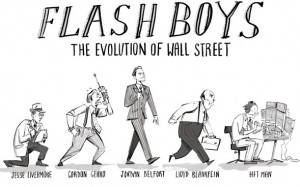
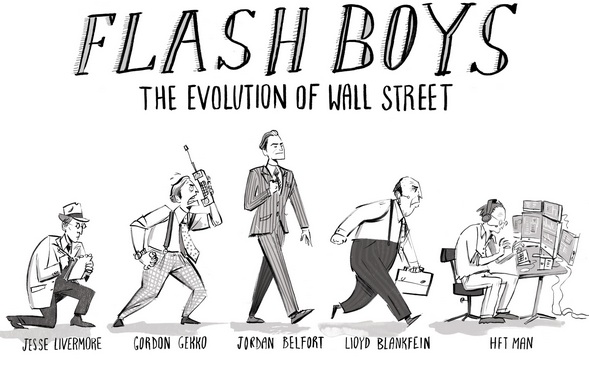
Matt Levine comments:  Coincidence or not, ever since “Flash Boys” came out four months ago, alleging that U.S. equity markets are rigged by high-frequency traders and crooked dark-pool operators, there’s been a whole lot of regulatory attention paid to high-frequency traders and crooked dark-pool operators in U.S. equity markets.1 New York Attorney General Eric Schneiderman has been on quite a tear.  The Securities and Exchange Commission has upped its game, fining Liquidnet for using dark-pool customer data to pitch issuer business. Even Finra has gotten involved.

The SEC settled for 5 million dollars with LavaFlow Inc., a big stock trading venue owned by Citigroup. LavaFlow is not a dark pool; it’s an electronic communications network (ECN) that displays orders. (Basically: It’s a stock exchange within Citigroup.) But it allows subscribers to submit various sorts of non-displayed orders,2which are, you know, not supposed to be displayed. And the problem was with those non-displayed orders.

LavaFlow had an affiliate called Lava Trading,3 whose main business was running a smart order router called ColorBook. An excerpt from the LavaFlow order::

Lava Trading’s flagship product was ColorBook, which was software that provided smart order routing services to over 100 registered broker-dealers that principally used ColorBook to route their customers’ orders to execution venues. … An “order router” is an application that generally allows an end user to submit an order to an execution venue. A “smart order router” applies preprogrammed analytics that carry out an execution strategy for order flow provided to the smart order router.

The point here is that, if you just want to buy some stock, that’s a weirdly hard thing to do. You can’t just go to the New York Stock Exchange and say “buy 100 shares of IBM,” because IBM shares are traded on a bunch of different exchanges and ECNs and dark pools, and you want to buy them at the lowest price offered on any of those venues. Or maybe you don’t — maybe you prefer convenience to getting the lowest price.

A human trader at a big bank, Brad Katsuyama, had trouble buying shares because he was a human, and the price kept moving. So he built a smart order router (and named it “Thor”). Smart order routers are (1) computers, so they’re fast, and (2) smart, so they break up your order and send it to the places where it’s most likely to execute quickly at the best possible price.5 Some brokers have their own order routers; others will rent someone else’s, because building one is hard. ColorBook is an order router that Citi uses, and that other brokers can rent.

One thing that made ColorBook smart was that it remembered where it sent orders. So not only could it see all the displayed orders on all the displayed exchanges and ECNs, but it also could see all theundisplayed orders — dark pool orders, or hidden orders sent to exchanges or ECNs — that it had sent there. So if you came to ColorBook asking to buy 100 shares of IBM, and the best offer for IBM displayed anywhere was $195, but ColorBook remembered sending an undisplayed order to LavaFlow to sell at $194.95, then ColorBook would route your buy order to LavaFlow to get the better price. As the SEC puts it, “ColorBook considered its historical knowledge of non-displayed resting orders to make future routing decisions.”6

If you used ColorBook, that was part of the deal: It would remember your secret orders and use them to route its future orders, though it wouldn’t tell anyone about them.

But as it turns out, if you just used the LavaFlow ECN without using ColorBook — as a “direct subscriber” — then ColorBook remembered and made use of your orders anyway:

From March 2008 until March 2011, LavaFlow allowed ColorBook to access and use its knowledge of the LavaFlow ECN direct subscriber non-displayed order flow when making smart order routing decisions for those smart order routing customers who also were subscribers of the LavaFlow ECN.

What ColorBook did with the hidden orders is route its customers to those hidden orders. What it didn’t do was tell them about the hidden orders.8 So the ColorBook customers couldn’t use the hidden orders to make pricing decisions, or to decide whether or not to trade, or to “front-run” the hidden orders. All they could do was trade with the hidden orders: Once they submitted an order to buy X shares at Y price, ColorBook would send it toward the hidden orders. That’s exactly what you want when you submit a hidden order! That’s not bad! If you’re a LavaFlow direct subscriber, you might be annoyed that ColorBook used your data without telling you, but I don’t think you were harmed by it. You might even have been helped: Your orders were more likely to execute, and more quickly.9

The victims were the LavaFlow direct subscribers, who did not use ColorBook, and who left hidden orders on LavaFlow. Who subscribes directly to Citi’s ECN, without using Citi’s order router? I think the answer is basically:

  • other big broker-dealers (and their routers), who feel obligated to connect everywhere, and who do their own routing, and
  • high-frequency traders, who want to trade everywhere, and who also do their own routing.

Other banks and brokers probably subscribe to LavaFlow, but it seems unlikely that they’d leave a lot of hidden orders there. (Why leave orders with your competitor?10 ) The LavaFlow direct subscribers who were actually leaving hidden orders there were … probably mostly high-frequency traders?

So this case looks a lot like: Citi took information from high-frequency traders and used it to improve the outcomes of regular customers.
Flash boys

Elizabeth Warren on the Hustings for 2014 Elections

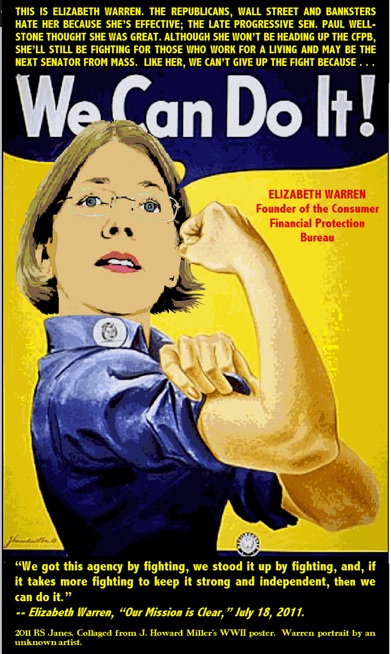
Make no mistake.  Elizabeth Warren is a middle of the road progressive.  Her central mantra is clear and uncontroversial:  if you work hard and play by the rules you should be able to succeed.  Given the PIketty formula,  r>g, it is unlikely that this can happen.  Warren wants to make sure America returns to its origins as a land of opportunity. Here she is in a recent article.  Reining in Big Banks

Warren

Zephyr Teachout, Anti-Corruption Expert, Runs for Governor of New York

We interviewed Teachout over two years ago  and her article on the idea of corruption in the US constitution is available on the site. The Anti-Corruption Principle.

Teachout originally supported Governor Cuomo, but has been deeply disappointed.  While it is unlikely that she can win, she casts light on issues important to many Americans.  Elizabeth Warren may serve this function too.  Or perhaps she will play a bigger role in 2016.  Both women are extremely concerned with banks that are too big to fail.  Teachout for Governor of New York

Corruption

Illegal Bank Transactions Rampant in Italy


Last year, the Financial Intelligence Unit of the Bank of Italy received nearly 65,000 reports of suspicious transactions, worth approximately 84 billion Euros, relating almost exclusively (99.7%) to the recycling of money.  This is reported by the FIU, the national intelligence unit established in 2007 to fight money laundering and financing of terrorism.  Numerous reports have focused on the laundering of proceeds of crime “attributable to politically exposed persons”.

They have detected, in particular, the inappropriate use of public funds, defaults in the application of rules on traceability of financial flows in the area of ​​public procurement, embezzlement of funds pertaining to political parties, corrupt situations.”

From 2007 to 2013, the transactions reported to the FIU increased five-fold, from 12,500 to 64,601 (with a peak of over 67,000 in 2012), 10% of which are classified as “high risk.”

In the first half of this year, reports were received over 38,000, an increase of 23% compared to the same period of 2013.

On more than 50% of the reports received, the report said, there have been findings of investigation. Whereas in general – according to FIU – half of the cases on which they are carried out further investigations end up in court, 25% of reports gives rise to legal proceedings.

“This shows an ability of obligated parties to identify at-risk behaviors. Even in the difficulty of making accurate comparisons with the reality of other countries, these are definitely values ​​that place us in the most virtuous,” says the report by the Director of FIU Claudio Clemente.  As indicated by a recent study of the European Central Bank, in Italy, the volume of retail transactions settled in cash is significantly higher than the EU average.”

The analysis indicates that the use of cash is more concentrated in areas of southern Italy where it is a strong presence of organized crime, although there are “points of care” in some areas of Central and North-West, especially near the border.

Mafia Cash


Organized Crime Triggered a Bank Run in the EU Member State Bulgaria

Our correspondent Andreas Frank writes:  If anybody still had doubts that the European Union gets undermined by organized crime – here is more evidence.

On 29 June 2014, Bulgaria asked the Commission to authorise the provision of a credit line of 3.3 bn BGN ($2.3bn) to be provided by Bulgaria to the banking system in order to respond to speculative attacks that occurred over the past week.

With EU’s support, the Bulgarian National Bank overcame a run on deposits caused by an “organized criminal attack” against several banks, it said in a statement.

Earlier, queues formed outside some Sofia branches of First Investment Bank AD, which paid 800 million lev to clients on June 27. Bulgaria asked the European Commission to support the credit line a week after the central bank put fourth-largest Corporate Commercial Bank AD under administration after a big depositor withdrew funds.

“Last week, it transpired that certain individuals have been targeting the third-largest bank, urging customers to withdraw their deposits,” the European Commission said in an e-mailed statement. “This created concerns about the liquidity of the bank in question and risked spilling over to some other institutions, despite the fact that the Bulgarian banking system is well capitalized and has high levels of liquidity.”

Bulgaria’s ruling Socialists are under pressure to resign following a poor showing in European Parliament elections on May 25. The government, which took office a year ago, is fighting to keep the banking system stable as opposition politicians say the current leadership has brought the country to the brink of ruin. President Rosen Plevneliev called early elections yesterday for Oct. 5 and will dissolve Parliament Aug. 6.

The country of 7.5 million, which is the European Union’s poorest state by economic output per capita, joined the 28-nation bloc in 2007 along with neighboring Romania. The EU has repeatedly criticized both countries for failing to curb corruption among senior government officials and sever their links with organized crime.

The banking crisis has stoked tensions on the political scene. Speaking on National Television on June 28, Finance Minister Petar Chobanov accused former prime minister and opposition Gerb party leader Boiko Borissov of causing “panic” by making “uncontrollable and incompetent statements on such sensitive subjects as the financial security.”

Chobanov was responding to a statement made by Borissov, who was toppled from power by street protests 14 months ago, in a June 28 television interview that Bulgaria’s “finances and bank system are in a catastrophic state as a result of this government’s rule.”

While the credit line “should stabilize the situation in the short run,” questions remain over political stability, Peter Attard Montalto, an emerging-market economist at Nomura Holdings Plc, said by e-mail today.

The central bank said it will use cash from the Bulgarian Development Bank and the Deposit Guarantee Fund, both state-owned, to recapitalize Corporate Bank. Corporate Bank and FIB account for 18.5 percent of assets held by lenders, according to the central bank.
EU PressRelease
BNB PressRelease
Organized Crime