China Will Build a Modern Financial System

China will endeavor to build a comprehensive, transparent and efficient fiscal and tax system by deepening reforms in the coming years, the central leadership of the Communist Party of China (CPC) said on Monday.

Priorities include improving management and supervision of government budgets, facilitating the building of a comprehensive, well-regulated and transparent modern budget system and optimizing the tax system, said a statement released after a meeting of the Political Bureau of the CPC Central Committee, presided over by its general secretary, Xi Jinping.

High priority will also be given to adjusting power and spending responsibilities between central and local governments in a rational manner, adjusting distribution of revenue between them while keeping the current division of financial resources between them stable, it added.
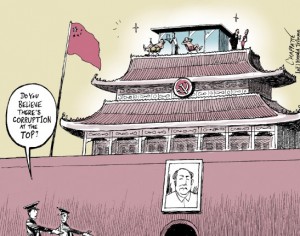
Can China Modernize?

.
The goal of the reforms is to set up a unified, comprehensive, well-regulated, open, transparent and efficient modern fiscal system that is conducive to better resources allocation, social equality and national stability, according to the statement.
It noted that China aims to fulfill key tasks in the new round of fiscal and tax reforms by 2016, and basically establish a modern fiscal system by 2020.
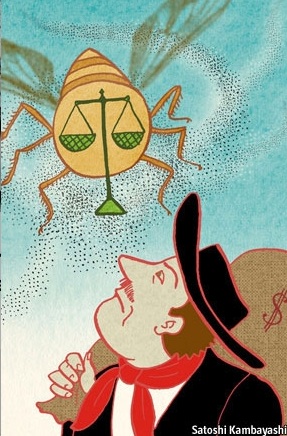
Gouging the Gauchos

Noriel Roubini writes:

Though 93% of Argentina’s creditors accepted new terms for their bonds in 2005 and 2010 in two exchange offers, a small group of holdouts sued Argentina in the United States, and, with the US Supreme Court recently ruling on the issue, have now won the right to be paid in full.
The US court decision is dangerous for two reasons. First, the court ruled for the first time that a country cannot continue to pay those creditors who accepted a big reduction (or “haircut”) on their claims until the holdouts are paid in full. So, why would any future creditor who benefits from an orderly restructuring vote for it if its new claims can be blocked by even a single holdout creditor?
Second, if the holdouts are paid in full, the majority of creditors who accepted a haircut can request to be paid in full, too. If that happens, the country’s debt burden will surge again, become unsustainable, and force the government – in this case Argentina, which is servicing most of its debt – to default again on all creditors.

Argentinian Debt

Is This the Reason a Woman is Head of GM?

Women tend to get tough jobs in tough times.  Why would a man risk his reputation?

General Motors announced recalls of more than 8.4 million vehicles worldwide, most of those for faulty ignition switches.

That amounts to the company’s largest single day of recalls this year. In addition to the ignition-switch recalls, the automaker is recalling vehicles for faulty wiring and fasteners.

GM offered at least $1 million Monday to the families of those who died as a result of a defect in GM cars. The company has come under criticism for a decade-long delay in publicly revealing an ignition-switch flaw.

A Woman as Leader?

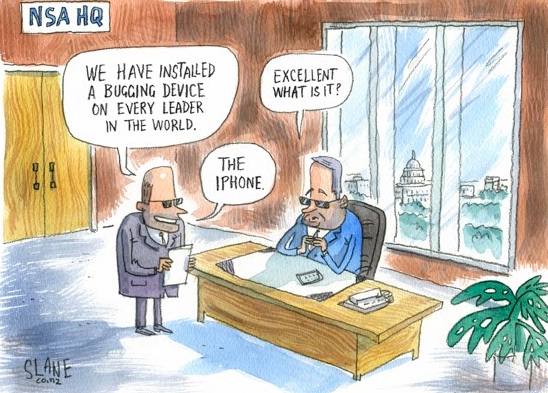
National Security Activity in One Chart

Pro Publica has prepared National Security Revelations in One Convenient Chart.

Julia Angwin and Jeff Larson, ProPublica, illustrations by Alberto Cairo, special to ProPublica

NSA Revelations


Monitoring Systemic Risk

Simon Johnson writes:  Kara Stein, a commissioner at the Securities and Exchange Commission (SEC). Stein delivered a far-reaching speech in June, in which she argued that systemic risk must become a more central responsibility for financial-market regulators.

More broadly, however, her point is that we need the FSOC to be able to do its job – to look for and assess all kinds of potential systemic risks. This needs to be done as a technical matter, not as part of the political process.

Not everyone at the SEC is as sensible as Stein. There is also some friction among the various regulators in the US, and we surely need more coordination across national borders – including with Europe. But the real danger is that powerful lobbies, working through members of Congress, are pushing back hard against the FSOC and its mandate.

No one likes scrutiny, of course. And everyone in the asset-management industry seems to fear being put under the Fed’s microscope, which is what happens if the FSOC determines that a business is systemically important.
The nature of externalities means that financial firms do not care about the costs that they may create for others. Big and small firms can create a wide variety of externalities, and these have to be examined carefully and dispassionately – exactly as Stein is recommending.

And yet, though assessing systemic risk is a technical matter, there is ultimately and inevitably a political question. The FSOC can figure out where the risks are lurking, but will it be allowed to do its job? If not, when the next crisis comes, those who opposed the FSOC’s proper functioning will bear the lion’s share of the responsibility.   Systemic Risk

Systemic Risk


US Supreme Court Impacts International Finance


Felix Salmon for Foreign Affairs reporting:  There aren’t many institutions powerful enough to bring a sovereign nation to its knees. Most of those that are wield their power with great care; the rest are dangerous fundamentalists. Last week, the U.S. Supreme Court placed itself — and the rest of the U.S. federal judicial system — squarely in the latter camp when it refused to accept an appeal by Argentina against a lower-court decision. The consequences are certain to be dreadful for Argentina. More broadly, the ruling will make it more difficult for countries to free themselves from the burden of over-indebtedness. It will be very bad for international capital markets. Oh — and it will also diminish national sovereignty.

The case involved Argentina and a group of so-called vulture funds, led by the deep-pocketed and highly litigious hedge fund Elliott Associates, which was demanding repayment in full on old Argentine debt. Elliott had first come to broad public attention in 2000, when it brought — and won — a similar case against Peru. That unprecedented victory against a sovereign government, although worth a mere $90 million, so deeply shocked the international financial community that it prompted the International Monetary Fund to undertake a messy and protracted attempt to create a brand-new sovereign bankruptcy court. The Argentina case is much, much bigger — Argentina owes Elliott over a billion dollars. The total amount that it owes “holdout creditors,” as the vulture funds are more formally known, is some $15 billion. Given that other holdout firms will immediately demand any terms awarded to Elliott, Argentina is not lying when it says that it simply can’t afford to do what the U.S. courts are demanding of it — which is to pay all the holdouts in full. Already the IMF is talking about setting up a bankruptcy court.  A Vulture Fund v Argentina

Vulture Funds Win in US Supreme Court


Demanding Higher Equity Ratios in Big US Banks

Anat Admati and Martin Hellwig, whose seminal book “The Banker’s New Clothes” outlines with clarity why the banks prefer using debt to using equity, make the case for using equity ratios as the criterion for solidity, not the Basel asset percentages. This easily grasped scenario dramatically suggests the implications for the ordinary banking customer and for our country.

If you buy a $100,000 home and put down $3000, if your home’s value increases by $4,000 you will have made a 133% return on your investment. If you funded the home with more equity, say a down payment of $20,000, your return would be only 20%.  If your home decreases in value, it would take only a $4000 decrease to put you underwater.

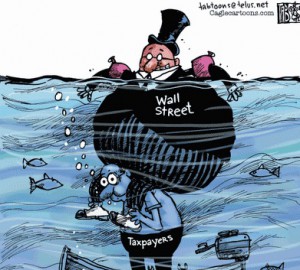
This is the gift to banks given by the Dodd Frank legislation. Depositors are induced to place their money in the bank, where it is safe. Depositors can also go out to third parties with a presumed guarantee of backed up money. The banks do what they want with that money. In the past decades that has involved incredibly risky propositions like securitized mortgages and plays on interest rates.   Federally guaranteed deposits up to $250,000 protect the depositor and the bank. Taxpayers pay for the banks follies, however. In TARP, the taxpayers were left holding the bag. Depositors in Cyprus paid a particularly high price.

The Admati-Hellwig proposal for demanding higher bank equity ratios to make these institutions more secure has been met with fear and scorn by the big banks. The banking lobby courted legislators creating the Dodd Frank bill assiduously to insure that only the Basel ratios would be implemented.

Banks have always argued that they would be forced to lend less if equity ratios were higher.  But this is only marginally so, and seems a small price to pay for the soundness of our banking institutions.

Interestingly, Admati had lunch with President Obama this week. While the President is no master of economics, as he begins to craft his legacy, he may be looking for bold and yet sensible moves that will help the economy.  If explained from the bully pulpit of the Presidency, equity ratios could  bathe the President in a gold aura. Let’s hope so.

Note:  Hillary Clinton, frontrunner for the Democratic Presidential ticket in 2016 is very much a captive of the banks.

Bank Bailouts

Mafia in Italy Survives the Financial Crisis

Avvenire.it reports:  The prosecutor in Reggio Calabria has mounted operation “‘Ndrangheta banking” focusing on a bank which financed firms in Calabria and Lombardy.  While many factories closed, those in Mafia hands grew.  Assets totaling 110 million were seized in Naples from accounts that appear to be drug money from Camorra.

Corruption involving companies, administrators and politicians confirms the Mafia’s ability to infiltrate the construction business.  Fifty-five companies related to ‘Ndranghela’ were about to begin work on post earthquake projects.

Ninety percent of the businesses run by the Mafia and then taken over by the State fail.  A supermarket let 500 employees go after the State takeover.  The unemployed say, “The Mafia gave us work.  The State takes it away.”

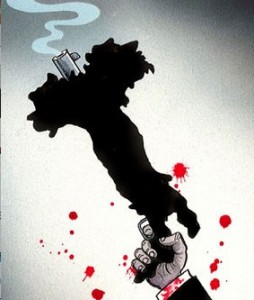
Everywhere, from traditional sectors such as construction to innovative renewable energy, waste from supermarkets, from health care to welfare, dall’agroalimentare to tourism and gambling, you find the Mafia.  This Mafia no longer operates with gun shots and blasts of Kalashnikovs, although no one forgets them.  Instead they use dirty money,  corruption and apparently clean business support:  The financial and managerial face of the mafia.

The Clean face is only a mask, warns the prosecutor of Reggio Calabria, Federico Cafiero de Raho, long at the head of the DDA in Naples, a great connoisseur of the new dynamics of the Mafia businesswomen. He speaks of the “gauntlet of credit” provided by the clans.  Entrepreneurs must understand that they not only lose their money but also their safety and freedom.  The Mafia is here among us, manages business, finances, does the friendly face, and there are those who think to take advantage of. We never tire of quoting the words of a businessman from Calabria years under escort, “Here, there are entrepreneurs who pay protection money and others that are raking it in.”  When the Mafia arrive before judges it is always too late.

Mafia in Italy

Bank Regulation: Why?

With the Assange dcoument about bank regulations being released, it is good to go back to Elizabeth Warren.  Here she is discussing her role on COP, the Congressional Oversight Panel to which Harry Reid, Speaker of the Senate,  appointed he when she was teaching at Harvard.

We forget what the difference between banks and insurance companies and other public companies is.   Banks handle other peoples’ money. Not theirs.

Oversight of banks is in the interest of the public good.  Because bankers act like they do not have the public responsibility, they reset oversight.

Here is Warren on the nerve this comimittee was sriking when they asked members of th ebaning community to tesify. (COP did not have subpoena power, so people could come or not as theywished.)

Hank Greenberg, by then the fromer CEO of AIG, called Warren and demanded to see her in her offices at Harvard. He did not dispute the conclusions of the COP: the wild risk-taking at AIG and its risk to the entire economy. Instead he wanted to talk about why he was under-appreciated as a great CEO.

When he was unable to persuade Warren that AIG had been a messy risk tangle under his leadership, he turned his anger on Eliot Spitzer, the former Atotrney General of New York State. When that didn’t get him anywhere where gave up.

Warren’s conclusion: executives of large financial institutions have very different world views than other people.  If these companies did not have in trust so much money that was not theirs, this egocentrism might not be so consequential.   But we have given banks an advantage. They get, manage and profit from other peoples’ money and they are considered so indispensable to the economy that we will not let them fail when they deserve to. At least if we don’t let them fail, we should put some fo their leaders in jail.

Bankers Behind Bars?

Assange Releases Document Showing How Bank Regulation is Being Stifled


Deal among 50 countries would help prevent added regulation of financial services, website says.  WikiLeaks-secret-tisa-financial-annex

WikiLeaks has published what it calls “the secret draft text for the Trade in Services Agreement (TISA) Financial Services Annex,” apparently covering 50 countries and most of the world’s trade in services.

“The draft Financial Services Annex sets rules which would assist the expansion of financial multinationals — mainly headquartered in New York, London, Paris and Frankfurt — into other nations by preventing regulatory barriers,” the website says in a statement.

The draft deal is seen as a way to prevent more regulation of financial services, despite calls for tighter regulatory measures that followed the 2007-08 world financial crisis. That market meltdown set the world’s biggest banks up against critics who said governments needed to rein them in.  Canada is among the countries named as being partner to the negotiations. The last round of TISA talks took place April 28 to May 2 in Geneva.

WikiLeaks also alleged in its statement that the U.S. is “particularly keen on boosting cross-border data flow” and that this would include personal and financial data.

On Wednesday, WikiLeaks founder Julian Assange promised the release of a massive cache of documents Thursday, involving 50 countries, including Canada.

Trade om Services Agreement