Swiss Want to Keep Their Paradise

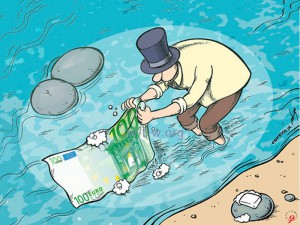
The Swiss National Council is the lower house of Parliament. They are debating compliance with internationl law on money laundering.

The Swiss Government (Bundesrat) had forwarded the bill to modify the Swiss money laundering act to Federal Council, implementing the revised Financial Action Task Force (FATF) recommendations.

Lawmakers increased the tax threshold for a case of tax evasion to be deemed to be a serious tax offence, from CHF200,000 (USD229,164) to CHF300,00. Furthermore, they did not agree to limit cash payments to CHF100,000.

Swiss business federation (Economiesuisse) had claimed that the bill had needlessly surpassed the FATF requirements. In its current form, the proposed legislation would burden banks with excessive bureaucracy, and places undue restrictions on businesses, the group said.

Economiesuisse said that as well as raising the qualifying threshold for a major tax offence, lawmakers should add a further criterion – multiple offences, to give financial intermediaries greater certainty when reporting their clients to the tax authority.

Economiesuisse also said that limiting cash payments is both unnecessary and arbitrary. It called on the National Council to improve the bill.

In its current version the bill would fall short of the FATF’s recommendation with the consequence that Switzerland could be blacklisted by the FATF, according to the Swiss finance minister Evelyn Widmer-Schlumpf. Parl_PressRelease_19.6.14 / German

The Senate or upper house approves submission to international standards, but the National Council is steadfast in its rejection of transparency and cash.

Rodrigo Matos www.w-t-w.org/en/rodrigo-de-matos www.rodrigocartoon.com

Rodrigo Matos

Schweiz möchte Paradies für Geldwäscher bleiben

US CFTC Fines 44 Million for Fraud and Misappropriation

The US Commodity Futures Trading Commission fines Commodity Trading Companies for Pool Fraud and Misappropriation.  

CFTC release:  Federal Court in Utah Imposes over $44 Million in Sanctions against Robert Andres and His Company, Winsome Investment Trust, and Robert Holloway and His Company, US Ventures, for Commodity Pool Fraud and Misappropriation

The U.S. Attorney’s Office for the District of Utah Filed Parallel Criminal Actions against Andres and Holloway

Washington, DC — The U.S. Commodity Futures Trading Commission (CFTC) obtained a federal court Order requiring Defendants Robert J. Andres of Houston, Texas, his company, Winsome Investment Trust (Winsome), Robert L. Holloway of San Diego, California, and his company US Ventures LC (USV), to pay a civil monetary penalty of $32,370,000 and restitution for defrauded customers totaling $12 million. The court’s Order also imposes permanent trading and registration bans against Andres, Winsome, Holloway, and USV and prohibits them from violating provisions of the Commodity Exchange Act, as charged.

The default judgment Order stems from a CFTC civil enforcement action filed on January 24, 2011, that charged the Defendants with fraud in the operation of a commodity futures pool (see CFTC Press Release 5976-11). The Order (see Related Link) was entered by the Honorable Bruce S. Jenkins of the U.S. District Court for the District of Utah on June 6, 2014.

Specifically, the Order finds that:

• From at least May 2005 through November 2008, Andres and Winsome fraudulently solicited and accepted at least $50.2 million from at least 243 individuals to invest in a commodity futures pool operated by Holloway and USV.  In their solicitations, Andres and Winsome falsely claimed a successful track record and guaranteed the return of participants’ principal and profits; however, contrary to Andres’s and Winsome’s claims of consistently profitable trading, USV’s and Holloway’s futures trading was not successful, sustaining overall net losses of approximately $10.7 million.

• The Defendants allegedly traded only a portion of Winsome’s pool’s funds and misappropriated the majority of participant funds to pay purported “profits” to pool participants in a manner akin to a Ponzi scheme, to provide money to Andres’ wife, and to invest in various unrelated and undisclosed businesses, including using $4.2 million of participant funds to purchase an aerospace consulting business. 

• Holloway used participant funds to pay personal and unrelated business expenses, and to pay for houses, cars, home furnishings, jewelry, lawn and maid services, and credit card bills in the name of his wife.  Holloway also used participant funds to finance his wife’s eBay business, Alcoy Enterprises, LLC.

• Andres and Holloway attempted to conceal the fraud by directing employees to falsify participants’ account records and by providing e-mailed account statements to participants falsely representing that Holloway profitably traded pool funds -– sustaining virtually no losses during the relevant period.

In a parallel criminal actions brought by the U.S. Attorney’s Office for the District of Utah, Andres was indicted on five counts of wire fraud, and Holloway was indicted on four counts of wire fraud and one count of making and filing a false income tax return. Holloway’s trial date is currently set for July 8, 2014. Andres pleaded guilty to one count of wire fraud, and he is scheduled to be sentenced on August 20, 2014.

The CFTC appreciates the assistance of the Comisión Nacional del Mercado de Valores (Spain), the Dubai Financial Services Authority, and the British Virgin Islands Financial Services Commission.

Commodity Trading Fines


Pervasive Global Corruption Leaves Boards Struggling To Cope

Our correspondent Andreas Frank writes: As an illustration of the prevalence of fraud globally, 1 in 5 CEOs report they have been asked to pay a bribe. Another finding that should be a concern to general counsels and other in-house attorneys is that one in five businesses participating in the survey did not have an anti-bribery/anti-corruption policy in place.

In a statement, Ernst & Young (EY) said it is “imperative” for companies to have a “robust” strategy to respond to incidents.

The EY survey of over 2,700 executives located in 59 nations show that close to 40 percent of executives saw that bribery and corruption were widespread in their nations. Yet, some 48 percent of those surveyed, saw cyber-crime to be a very low risk or fairly low risk to their business. EY says the respondents apparently underestimate risk from organized crime and foreign governments.

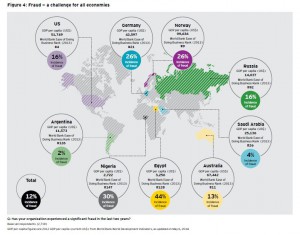
More than 1 in 10 executives surveyed reported their company as having experienced a significant fraud in the past two years. In fact, the level of fraud reported by respondents has remained largely unchanged over the past six years: from 13% in 2008 to 12% in 2014.

At a country level, results are evenly split between those countries reporting an increased incidence of fraud and those reporting a decrease since our last survey.

Ten countries recorded a significant increase, including the US (16% in 2014, up from 8% in 2012), China (8%, up from 4%), Japan (10%, up from 6%) and Russia (16%, up from 10%).

In six countries, more than 25% of respondents reported experiencing a significant fraud in the past two years. These included Egypt (the highest level at 44%), but also Germany and Norway (26%).  Respondents also reported personal experiences of fraud risks. For example, 17% of respondents have been asked to pre-date or post-date contracts.

In a statement sent to Inside Counsel, Loughman said the survey data “suggests there is much work to be done in compliance because only 38% of c-suite executives responded they had been through ABAC [anti-bribery/anti-corruption] training.”

“To the extent compliance reports to legal there is an opportunity for improved advocacy by general counsels to strengthen the ‘tone at the top,’” he added.

The survey comes as cybercrime is becoming more prevalent, and the U.S. Securities and Exchange Commission (SEC) is increasingly focusing on cyber risks, Loughman said. As a result, company boards and their audit committees “need to be vigilant in monitoring these risks,” Loughman said.
Global Fraud Survey – Overcoming Compliance Fatigue – Reinforcing
The Commitment To Ethical Growth
Has Your Organisation Experienced A Significant Fraud In the Last Two YearsAnti Corruption Reports

Citibank Shareholders To Fight Big DoJ Fines

Bank of America and JP Morgan Chase were more deeply involved in subprime mortgages than Citibank. JP Morgan settled because they assessed the risk of going to court with a possible criminal indictment too great for the bank to take…and survive.

An institutional Citibank shareholder said, “There’s no good PR to go through what your underwriting practices were and the losses that resulted.”

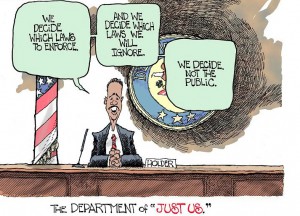
Why is Citi’s penalty so much greater than JP Morgan Chase’s.  Presidential politics?

DoJ and Citi Bank

Chicago: Drug Central USA?

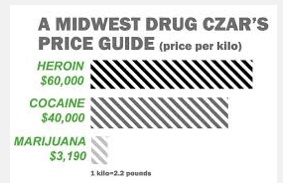
Our correspondent Andreas Frank writes:  A joint federal and local task force that includes the DEA, FBI, Chicago police and other law enforcement agencies arrested and charged more than two dozen gang members who allegedly supplied a significant amount of heroin to customers coming from the city and suburbs.

The increasingly easy availability and lower street cost of heroin has led to a surge of not only in the Chicago area but in many parts of the country show how readily accessible the drug can be and give a glimpse into gang culture in Chicago, a city with a notoriously bad street gang problem.

Among those arrested Thursday was 47-year-old Kenneth Shoulders, also known as Kenny Shannon, who federal prosecutors say is a high-ranking leader of the Conservative Vice Lords street gang.  According to federal prosecutors, Shoulders controlled the drug trade in a 12-block area on Chicago’s West Side, just off what’s known as the “heroin highway” – the I-290 Eisenhower Expressway.

Authorities say Shoulders’ operation used several stash houses as distribution centers and corners as retail locations to sell heroin quickly to customers getting off the expressway. Those customers, many of them from the western suburbs, could exit, pay at one location, pick up the heroin at another and be back on the expressway in a matter of minutes, as if it were a fast-food drive-through.

In making the arrests, authorities also seized several weapons – including an AR-15 assault rifle –approximately $140,000 in cash, nearly a half-kilogram of heroin and some cocaine.

Also among the 27 people arrested and charged by federal and local authorities were Shoulders’ 49-year-old sister, Sandra “Penny” Shoulders, and his 29-year-old son, Kenneth Williams, aka “Lil’ Kenny.”

While Kenneth Shoulders reportedly controlled all Vice Lord members in the area known as “12th Street,” prosecutors say he controlled the drug operation by forming a new faction called the 12th Street Vice Lords, which included members of other gangs and gang factions, including the Traveling Vice Lords, the Black Souls Nation, the New Breed and the Gangster Disciples street gangs.

Authorities say they’ve also seen a recent trend of gangs aligning to form new drug-dealing factions when it is lucrative to do so.

But just as the gangs pulled together to corner the drug market, so, too, did law enforcement. Authorities recently created a Chicago Strike Force, in which several local, state and federal law enforcement agencies team up to combat gangs, drugs and gun violence.  “We are working together, both here in the city and on a regional basis, because this is truly the new face of organized crime,” said Jack Riley of the DEA.

Drugs

EU Investigates Unfair Advantages to Apple, Starbucks and Fiat

The European Union’s antitrust regulator has launched an investigation into tax deals that Apple, Starbucks and Fiat struck with some European countries, the start of a wider push to keep multinationals from taking advantage of loopholes.  EU antitrust commissioner Joaquin Almunia said Wednesday a preliminary probe by his office has found the arrangements are improper, though the companies as well as the countries involved — Ireland, the Netherlands and Luxembourg — must be given a chance to respond.

“We have reason to believe at this stage that indeed in these specific cases the national authorities have (failed) to tax part of these multinationals’ profits,” Almunia said at a press conference in Brussels.

Apple has a deal with tax authorities in Ireland, Starbucks has one in the Netherlands and Fiat’s financing arm has one in Luxembourg as part of their strategy to minimize the taxes they pay.

Almunia said that while such agreements are permissible in theory, they would be improper if they give the companies an advantage over competitors who can’t benefit from the same deal.  “Aggressive” tax planning by multinationals erodes countries’ tax bases.  Nine other countries are under preliminary investigation.

The countries named Wednesday have been criticized — Ireland for its low tax rates, the Netherlands and Luxembourg as homes for shell companies, and all three for a lack of transparency.

Three investigations involve ‘transfer pricing’ — where a company allows one part of its operations to charge another for goods or services in one country in order to shift profits where it wants.

For instance, if Starbucks were to sell its coffee beans to subsidiaries around Europe at a higher than market price, that would increase profits in the Netherlands and decrease them elsewhere. If it receives a tax break in the Netherlands, it would have an unfair competitive advantage.

The Commission said transfer pricing is permissible if the prices a company charges its subsidiaries conform to market rates.

Picking Your Most Favorable Country

Dirty Money in the Seychelles


Seychelles, a thousand miles from anywhere, is an offshore magnet for money launderers and tax dodgers. A look at this corruption-haunted archipelago shows how the offshore secrecy system has grown — and where it’s going.

In the fall of 2012, two strangers from Africa showed up in Seychelles, an emerald-green archipelago in the Indian Ocean nearly a thousand miles east of Somalia. Unlike Prince William and Kate Middleton and other A-list celebrities who favor Seychelles as a getaway, these visitors didn’t come to enjoy the islands’ natural beauty and luxury accommodations. They were there, they said, to conduct business in Seychelles’ bustling offshore financial center.

Eventually they made their way to the offices of Zen Offshore, one of dozens of firms on the islands that set up hard-to-trace “shell companies” for clients around the world. They explained that they represented an individual who served as a “liaison officer between the Zimbabwean government and the rich diamond mines.”

For anyone who understands the nexus of corruption and money laundering in resource-rich, economically poor countries, this statement should have raised suspicions. But before they could go further, a Zen Offshore representative cut them off.

“Yep, we don’t want to know that,” he said, chuckling. “If we have knowledge of that, we have to put it forwards. So I haven’t heard a word you said in the last couple of minutes.”

The operative went on to explain how the pair could set up a company in Seychelles and hide the identity of who was really behind it by creating a labyrinthine ownership structure, putting “a company inside a company inside a company.”

The Seychellois company would be controlled by a company in Dominica, which would be controlled by a company in Belize, and so on. Anyone trying to discover the real owner would never be able to follow the paper trail around the world.

“It’s just impossible,” the Zen Offshore man said. “No one is going to try and chase that sort of information.”

The islands are a  magnet for Arab princes, Chinese investors, pirates, fugitives, mercenaries, mobsters — and outlanders who want to hide their money or disguise their business activi

Thanks to its offshore industry, Seychelles, an island nation with a population smaller than Davenport, Iowa, maintains a Zelig-like presence in the annals of international corruption and money laundering. Where there’s an odor of financial scandal, there’s often a good chance Seychelles is involved.

Dirty Money


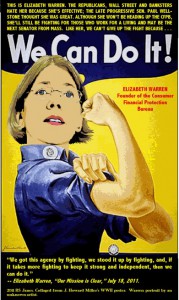
Meet Elizabeth Warren, Warrior


U.S. Sen. Elizabeth Warren talks real pocketbook issues, as in, why yours is empty.

And she means what she says, writes Margery Eagan in the Boston Herald.  In barely a year in the Senate, she’s turned into a Robin Hood for the “hammered” middle class, her endlessly repeated line. But are you in the middle class? Then you know: You are hammered. Can’t afford to retire. Can’t afford the mortgage, taxes, car repairs, college. If you’ve just finished college you can’t afford to move from mom’s basement. Why? The four-figure college loan payments you owe each month.

This is not how it’s supposed to be if you work hard and play by the rules in America. But this is how it is.

Who’s talking about this mess nonstop?

Elizabeth Warren.

The rich keep getting richer, she says, while the poor get poorer and the middle class, let me repeat, gets “hammered.” The banks that were too big to fail in 2008 are even bigger now. Soon we’ll get taxed to bail them out, again.

Rant about EBT cards all you want. If every one disappeared tomorrow, you’d still be hammered. The real money’s in big corporations and on Wall Street. And they own most of our pols. “Meet the Woman who Stood Up to Wall Street.” So reads a huge headline in a fawning article about Warren in young ladies’ favorite sex-tip magazine, “Cosmopolitan.” That’s the magazine that featured a near-nude young Scott Brown, the penny stock investor — whoops! — whom Warren vanquished. Now “Cosmo” features a fetching young Warren in thigh-hugging jeans and details her rise from divorced mother to the country’s most powerful financial reformer.

Has she reformed anything yet? No.

Is she making progress? Yes — from trashing federal regulators for refusing to regulate banks to crusading for a higher minimum wage. Just yesterday, President Obama praised her for introducing a bill that would let college graduates refinance loans at lower rates. Because it’d be paid for by ending a tax break for millionaires, it will likely fail in a Republican House that takes care of millionaires instead of the “hammered.”

But since it’s finally dawning on the “hammered” millions that the system is indeed rigged, Warren, eventually, could prevail. Says Marty Walsh adviser Michael Goldman, “For politicians, the hardest thing to get is the perception that you actually, deep down, believe in what you’re saying.”

Apparently more and more of us not only believe Warren believes what she says. We also believe she’s right.

Warren works step by step on individual issues.  She is graceful, calm and forceful. Watch her take down the big boys with a cool insistence.  Is she ready for the big time?  Maybe yes, maybe no.  Interestingly, Mrs. Clinton is bringing what she knows about global politics to the front of her speeches.  Is this what Americans are thinking about?

With Thomas Piketty

Taking down Timothy Geithner

Warren


Economic Crime on the Rise in Australia

Our correspondent Andreas Frank writes: A new research reveals the extent of corruption in Australian organisations and highlights the insidious crimes committed by white collar criminals.

All forms of economic crime are up with 57 per cent of Australian organisations reporting an incident in the past two years, compared to 45 per cent in the last survey. Globally, the number of incidents reported was lower at 32 per cent and in the Asia Pacific region only 37 per cent.

“Typically Australian organisations have always reported more incidents of economic crime but that doesn’t mean we have more, quite the opposite. Results from this year’s survey confirmed what we suspected; Australian organisations take a more serious approach to detecting, investigating and reporting economic crime than other countries,” PwC Partner and Forensic Services Leader, Malcolm Shackell explained.

Over the past two years, two thirds of Australian organisations (67%) reported an incident committed by an external party to regulatory bodies including law enforcement. In the same period two-fifths (39%) reported an incident committed by an internal party to regulators including law enforcement.

The ‘big five’ crimes include asset misappropriation, cybercrime, procurement fraud, accounting fraud, bribery and corruption, according to the report.

Cybercrime:

Cybercrime continues to be of concern to Australian organisations with one in 10 reporting financial losses of more than AUD $1 million from cybercrime in the past two years.

Close to half (43%)of the organisations surveyed ranked the theft or loss of personal identifiable information as the number one concern should a cybercrime attack occur, while a third (33%) were most concerned about the theft of intellectual property and data in general.

PwC Partner Richard Bergman said, “Cybercrime is not just an IT issue. Recent high profile data breaches such as the US Target breach have increased the level of awareness and concern among senior management and the Board. But, the majority of cybercrime incidents still don’t make the headlines.”

“Information is valuable and attackers are determined to get it. Many of the attacks we’ve recently investigated have targeted merger and acquisition information and what surprises many organisations is how long attackers are inside their networks before the attack occurs.”

Procurement Fraud:

Procurement is a risky business according to a PwC survey released today which found that one third of Australian organisations (33%) experienced procurement fraud during the past two years with the mining, construction and energy sectors reporting the most incidences during that period.

According to the Australian edition of PwC’s 2014 Global Economic Crime Survey, procurement fraud was the third most frequent economic crime experienced by organisations in Australia and around the globe during the two year survey period. Asset misappropriation was number one followed by cybercrime.

Mr Shackell said most of the crime occurs where money leaves a business with a surprisingly high amount in the procurement process of awarding contracts to companies.

A common example is inappropriate relationships between a middle management insider who can authorise payments and an external contractor. The outsider might inflate invoices which are paid by the company, with the pair pocketing the extra.

Malcolm Shackell said, “Detecting and responding to any type of economic crime is challenging but procurement fraud is probably one of the more complex and difficult.”

“Procurement supply chains have many links. All of the links are susceptible to weakness and offer opportunities for employees and external providers to exploit. We see this type of fraud in contracting, inappropriate supplier relationships and the supply and disposal of goods and assets – anywhere the money is flowing.”

According to the survey results, Australian organisations are experiencing procurement fraud mostly around vendor contracts and maintenance. Globally, vendor selection is where it is most prevalent.

To stop or at least reduce procurement fraud which in turn will improve productivity, Mr Shackell suggests organisations have a greater focus on scrutinising contractors and relationships with other third parties.

“Organisations need to understand the profile of the people they are most at risk from, internally and externally, to ensure they have the right preventative controls in place,” he said.

According to the survey the majority of fraud is committed by someone internally (51%) with the following characteristics:

Increasingly in middle management roles (65% in 2014 up from 45% in 2012),

Aged between 31-40 years old (52% in 2014 down from 55% in 2012),

Predominantly male (57%); and

Increasingly qualified graduates (30% in 2014 up from 10% in 2012).

For companies acting overseas, the biggest risks include corruption, money laundering and antitrust behaviour.

Australia has also seen a rash of insider trading cases recently — where people seek to profit on the stock market through insider information.

One high profile example saw an Australian Bureau of Statisctics worker who allegedly leaked market-sensitive information to a former university friend, netting the pair $7 million according to police. ABS acting statistician Jonathan Palmer told a Senate hearing into the issue the breach was unprecedented but “it’s a very difficult threat to counter.”

“If someone has a trusted need to access the number and they only have to leak an aggregate number or communicate in some obscure way that the number is contrary to market expectations, there’s no requirement for them to take [numbers] out of the building,” Mr Palmer said.
PwC’s 2014 Global Economic Crime Survey: The Australian Story –
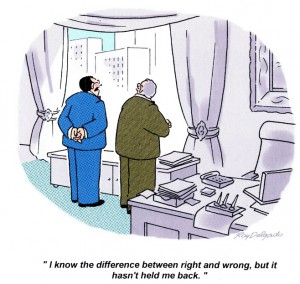
Corruption: From the backroom to the boardroom
Derek Easterby www.w-t-w.org/en/cartoon/derek-easterby @Ybretsae
Derek Easterby