Big Data Big Pharma

Charles Ornstein Reporting:   Need another reminder of how much drugmakers spend to discover what doctors are prescribing? Look no further than new documents from the leading keeper of such data.

IMS Health Holdings Inc. says it pulled in nearly $2 billion in the first nine months of 2013, much of it from sweeping up data from pharmacies and selling it to pharmaceutical and biotech companies. The firm’s revenues in 2012 reached $2.4 billion, about 60 percent of it from selling such information.

The numbers became public because IMS, currently in private hands, recently filed to make a public offering.   The company’s prospectus gives fresh insight into the huge dollars – and huge volumes of data – flowing through a little-watched industry.

IMS and its competitors are known as prescription drug information intermediaries. Drug company sales representatives, using data these companies supply, can know before entering a doctor’s office if he or she favors their products or those of a competitor. The industry is controversial, with some doctors and patient groups saying it threatens the privacy of private medical information.

The data maintained by the industry is huge. IMS, based in Danbury, Conn., says its collection includes “over 85 percent of the world’s prescriptions by sales revenue,” as well as comprehensive, anonymous medical records for 400 million patients.

All of this adds up to 10 petabytes worth of material — or about 10 million gigabytes, a figure roughly equal to all of the websites and online books, movies, music and TV shows that have been stored by the nonprofit Internet Archive.    Big Data  Big Pharma
Big Data Big Pharma

Crime, Corruption And Tax Evasion Still Out Of Controll

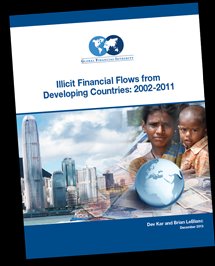
Crime, corruption and tax evasion drained USD 946.7 billion from the Gfintegritydeveloping world in 2011, up more than 13.7 percent from 2010, when illicit financial outflows totalled USD 832.4 billion – a dramatic increase from 2002, when illicit outflows totaled just USD 270.3 billion.

Cumulative illicit financial outflows from developing countries added up to € 5.9 trillion between 2002 and 2011.

“As the world economy sputters along in the wake of the global financial crisis, the illicit underworld is thriving… siphoning more and more money from developing countries each year,” GFI said.

Anonymous shell companies, tax haven secrecy, and trade-based money laundering techniques drained nearly a trillion dollars from the world’s poorest in 2011, at a time when rich and poor nations alike are struggling to spur economic growth.

The report said six of the top 15 exporters of illicit capital are in Asia (China, Malaysia, India, Indonesia, Thailand and the Philippines), two are in Africa (Nigeria and South Africa), four in Europe (Russia, Belarus, Poland and Serbia), two are in the Western Hemisphere (Mexico and Brazil) and one is in the MENA region (Iraq). In the last 10 years, China topped the list with USD 1.08 trillion in black money outflow, followed by Russia (USD 880.96 billion), Mexico (USD 461.86 billion) and Malaysia (USD 370.38 billion). “It’s extremely troubling to note just how fast illicit flows are growing,” said GFI Chief Economist Dev Kar.

Over the past decade, illicit outflows from developing countries increased by 10.2 per cent each year in real terms-significantly outpacing GDP growth. This underscores the urgency with which policymakers should address illicit financial flows.
“While global momentum has been building over the past year to curtail this problem, more must be done. This study should serve as a wake-up call to world leaders: the time to act is now,” GFI said.

Disputing the GFI figures, critics say the estimates of illicit outflow was overstated as the estimates in the report of trade mispricing had not been taken into consideration. The GFI estimates were essentially unrecorded financial flows, which were not necessarily synonymous with illicit financial outflows.

GFI chief economist Dev Kar said they had taken all data into consideration and made the necessary adjustments before calculating the estimated illicit outflows.
“The estimates provided by our methodology are still very conservative. They do not include trade ‘misinvoicing’ in services, same invoice trade ‘misinvoicing’, ‘hawala’ transactions or bulk cash transactions.

“This means that much of the proceeds from drug trafficking, human smuggling and other criminal activities, which are often settled in cash, are not included in these estimates.”
Press Release – Illicit Financial Flows from Developing Countries
GFI IFF Developing Countries

Crime, Coruption And Tax Evasion Still Out Of Controll

Banking Worldwide: Monte Paschi

Monte Paschi needs the funds to help repay state aid and avert nationalization, and management was pushing for a January stock sale to get ahead of other Italian banks that might need to raise capital. The main shareholder, Fondazione Monte dei Paschi di Siena, vowed to oppose the offering unless it was delayed until after the first quarter to give the investor more time to repair its own finances. Monte Paschi Nationalized?

Monte Paschi Bank

Cassandra : The World in 2014

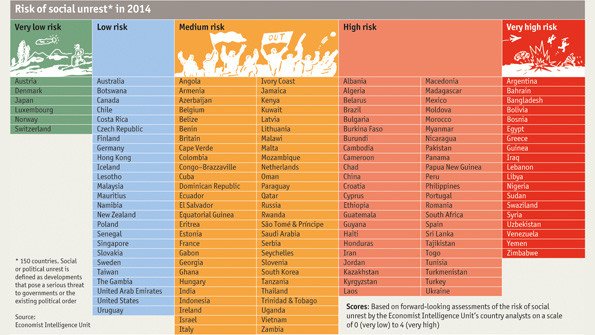
Social unrest in 2014
Protesting predictions

UKRAINE, Bulgaria, Brazil, Argentina, Mexico, Tunisia, Egypt and Turkey are all countries in which protests have erupted in the past twelve months. Even places traditionally more muted, such as Japan and Singapore, have seen demonstrators in the streets. Social inequalities and political discontent have spurred citizens to gather. Resistance can be co-ordinated with greater ease than ever in the age of the smartphone.
Social unrest in 2014

Risk of social unrest in 2014More about Cassandra


Has Wall Street Changed for Women?

In a survey of Wall Street professionals taken last summer, a majority said they believed their competitors engaged in illegal or unethical practices. Some 24% believe colleagues at their own firms had engaged in misconduct — the same percentage that said they would engage in insider trading themselves, if they could get away with it. The survey, by law firm Labaton Sucharow, also found that more than a third of younger respondents (those with 10 years or less experience) believe financial professionals need to behave unethically or illegally in order to be successful. Interestingly enough, the women surveyed felt that things are even worse. More women than men believe that colleagues as well as competitors are engaged in misconduct, and more believe their own firm’s top management would ignore wrongdoing from a top performer. Strikingly, women are almost twice as likely as men to fear retribution if they report wrongdoing.  The Wolves of Wall Street and Women

Wall Street Wolves


Computer Chaos Congress Celebrates 30th Anniversary

Freelance journalist Glenn Greenwald spoke at the opening day of the 30th annual Chaos Computer Club meeting, which is being called “30C3,” a short form for “30th Chaos Communication Congress.” Organizers attributed record attendance of around 8,000 people to this year’s revelations from Greenwald’s most famous source, former National Security Agency (NSA) contractor Edward Snowden.

Greenwald, one of the people with access to some of Snowden’s leaked documents, appealed to other governments “who have been the biggest beneficiaries of his revelations” to offer him asylum.   Computer Chaos Congress

Glenn Greenwald

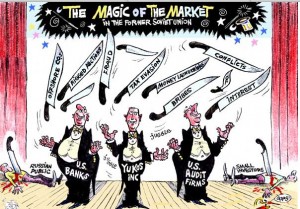
Trailing the Yukos Money from Russia to the World

President Vladimir Putin’s Russia waged an all-out war against  President Vladimir Putin’s Russia waged an all-out war against him and his partners, and if they managed to hold on to their substantial resources, that is an encouraging sign for other wealthy Russians fearing that the state might confiscate their assets. It is also a strong argument for continued capital flight from Russia: Much of Khodorkovsky’s hypothetical remaining wealth would come from the foreign investments of his now-defunct oil company, Yukos, once Russia’s biggest oil company.  Khodorkovsky and his partners, and if they managed to hold on to their substantial resources, that is an encouraging sign for other wealthy Russians fearing that the state might confiscate their assets. It is also a strong argument for continued capital flight from Russia: Much of Khodorkovsky’s hypothetical remaining wealth would come from the foreign investments of his now-defunct oil company, Yukos, once Russia’s biggest oil company.  Follow the Yukos Oil Money

Yukos

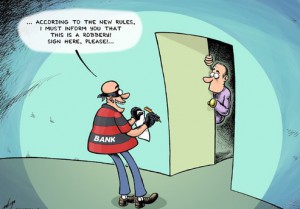
Important Regulator Leaves Washington with this Insight about the Financial Industry: Theft

In a recent interview, Chilton said that, despite years of hard work by financial regulators to put the 2010 Dodd-Frank law into force (witness the 882 pages required to explain a 71-page Volcker Rule), their efforts will be futile in the face of Wall Street’s money and power. “The lesson for me is: The financial sector is so powerful that they will roll things back over time,” Chilton says. “The Wall Street firms have tremendous influence, and they can impact policy to a greater degree than any one regulator or a small group of regulators can.” Bart Chilton’s Parting Salvo

Banks are Robbers