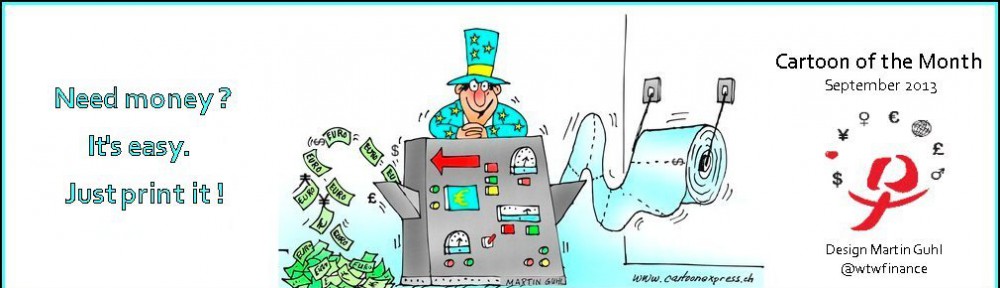
Can the World Economy Turn Up?

Ross Finley writes:  The world economy may be set for another year like 2015, with modest growth in developed economies offsetting persistent weakness elsewhere but generating very little inflation and keeping interest rates low.

The U.S. Federal Reserve’s long-awaited rise in rates from zero showed confidence in the world’s largest economy, but rival China is still struggling for a foothold with rate cuts.

Although some countries, such as Brazil, have mainly home-grown inflation troubles, the Fed’s first post-crisis rate hike is an unlikely cure for what ails the rest of the world.  With exchange rates dominating the policy debate in many countries, what happens to the dollar will matter a lot.

Along with an abrupt downturn in the volume of global trade and a continuing fall in commodity prices, the dollar’s rise this year has brought U.S. industrial growth to a near-standstill, keeping a lid on inflation pressures from abroad.

The other extreme is that the United States, via a strong U.S. dollar, will simply become the latest victim of the deflationary pass-the-parcel which has plagued the global economy for a decade, and find itself following all of the other developed market central banks which raised rates but soon found they had to reverse course.

“The outcome, we believe, is likely to be somewhere in between.”

A Reuters poll of 120 economists on Friday forecast the Fed would hike rates again in March, but probably won’t move as quickly next year as policymakers have suggested.

Other recent Reuters surveys of hundreds of analysts worldwide do not offer hope for a pickup in inflation, even in the United States where the central bank says it is reasonably confident this will happen. Even the most optimistic core inflation forecasts are not far above 2 percent.

The polls point to global growth averaging only 3.4 percent next year with scant prospect of touching 4 percent given the slowdown in China and the gloom surrounding emerging markets.

Nor is it easy to find analysts expecting broad weakness in the dollar, with the most aggressive views suggesting the euro could even fall below parity.

China’s renminbi, now a reserve currency, has fallen each day for most of the past two weeks, with many bracing for further devaluation by Chinese authorities still looking for ways to stimulate the debt-laden economy.

The U.S. growth and inflation outlook is bleaker than forecast this time last year, even after a sharp fall in unemployment. Wage inflation has picked up, but by less than many had thought it would.

Wall Street stock indexes are trading near their levels of a year ago, confounding predictions of a solid rise in 2015, with strategists still expecting them to climb despite downward pressure on earnings.

Over the past year, global fund managers have cut their recommendations for equity holdings to near their lowest since the financial crisis, even as they ramped up bond holdings.

U.S. Treasury yields are not far from where they were this time last year either, but they too are expected to climb, as has been the forecast for many years now, although by less this year than one might expect. reuters://realtime/verb=Open/url=cpurl://apps.cp./Apps/mm-bondyield-polls

Since crude oil prices began falling sharply 18 months ago from above $100 a barrel to below $40 now, the number of analysts predicting a rebound has dwindled. Some are now saying $20 is more likely than a sizeable move higher.

But there are some bright spots.  Underpinned by the European Central Bank’s 60 billion euros a month of bond purchases, the euro zone is finally generating modest growth and unemployment has begun to fall.

Inflation remains well below target, however, and so ECB stimulus, including the negative deposit rate, will remain in place for all of next year. That puts the world’s largest trading bloc — and most other central banks — on an opposite policy path to the Fed.

India is forecast to grow at a decent clip, underpinned by rate cuts earlier this year during a window of low inflation. And optimism about Mexico has grown as it slowly starts to take advantage of a recent historic reform in the energy sector.

But much can still go wrong. Food prices have already pushed Brazil’s inflation above 10 percent during a deep recession and could rise further.
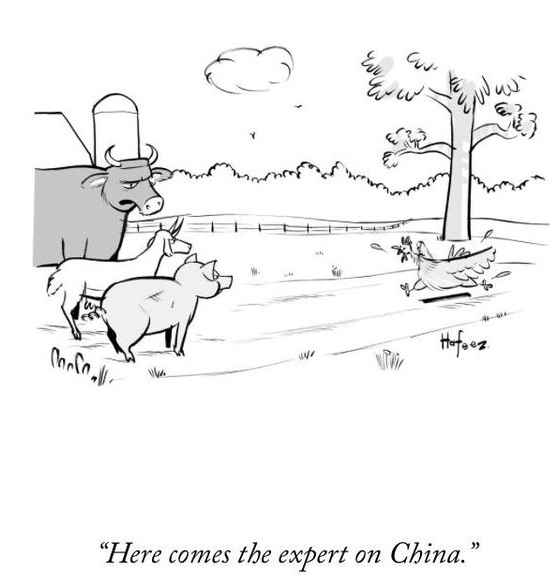
 

Lagarde Hopeful About China’s Economy

The head of the International Monetary Fund, Christine Lagarde, has said the outlook for China’s economy is not all “doom and gloom”. “I would say that it’s a recovery that is decelerating a bit,”, but it is expected to gain momentum next year. “We are seeing massive transitions at the moment,” she said.

After double-digit growth for decades, China’s economy slowed to 7.4% last year. The government has said it expected growth to slow further to about 7% this year. However, the IMF has forecast growth of just 6.8%. Ms Lagarde said that changes around the world were producing new situations, including emerging market economies having to cope with much lower commodity prices. “Whether you look at China transitioning from one growth model to the other, from one exchange currency method to another, and we have to adjust as a result.

On China’s efforts to shift from an export-led economy to a consumer-led one, Ms Lagarde said the IMF was “very supportive of the transition that is taking place at the moment”.

She noted China’s efforts towards better management of its currency exchange rate and interest rates movements and expected the country’s government to better communicate to the world what was going on in its economy “over the course of time”.

“You don’t move just overnight from being heavily controlled to being market determined, with massive market expectations that suddenly the situation should be the same across the world,” Ms Lagarde said.

“It just doesn’t happen that way.”

China's Economy

Impact of the Price of Oil

Oil has for decades been perceived as a necessary and highly addictive energy commodity, fueling the world economy. It is a crucial input good for most of the net-oil consumer countries, and it is an important source of revenue for the net-oil supplier countries. This means that any changes in the oil price will affect the entire world economy. Chloé Le Coq and Zorica Trkulja from Stockholm Institute of Transition Economics have written a policy brief that explains to what extent the oil-price fluctuations matter for the economy.

Oil market can be viewed as a global and liquid market, therefore the world market price for oil is the reference price for many market participants. This implies that many non-oil, but oil-related, markets are interlinked. A change in one of them is therefore likely to affect the others. The oil market’s dynamics have the tendency to change dramatically due to technological changes and political events, resulting in price fluctuations affecting the entire world economy.

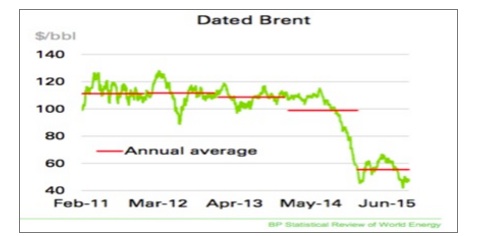
It is important to note that there are two different aspects of oil-price changes. As seen in Figure 1, besides a sharp fall in the price level from May 2014 and onwards, the oil price tends to be highly volatile and unstable throughout the year.   Price of Oil

Oil Price Level vs Variability

P2P Lending Important in China

Liu Mengkang writes:   Last month, China’s leaders revealed details of the 13th Five-Year Plan, which will guide the economy’s trajectory until 2020. Gone are the directives to expand industrial production at a breakneck pace that characterized previous five-year plans. Now, the focus is on achieving sustainable long-term growth, underpinned by domestic consumption, a stronger services sector, entrepreneurship, and innovation.

The Internet – which already has more than 680 million active users in China – will play a key role in facilitating this shift. In particular, online peer-to-peer (P2P) lending, a streamlined approach to credit allocation, may hold the key to expanding and deepening China’s financial sector, enabling firms to grow and innovate, and bolstering domestic consumption.   P2P Lending in China


Updating the Social Safety Net

Laura Tyson and Lenny Mendonca write:  Today’s labor markets are undergoing radical change, as digital platforms transform how they operate and revolutionize the nature of work. In many ways, this is a positive development, one that has the potential to match workers with jobs more efficiently and transparently than ever before. But the increasing digitization of the labor market also has at least one very worrying drawback: it is undermining the traditional employer-employee relationships that have been the primary channel through which worker benefits and protections have been provided.

The ecosystem of digital labor platforms is still in its infancy, but it is developing rapidly. Large popular platforms like LinkedIn have so far mainly been used to match high-skill workers with high-end jobs. But these platforms are already expanding to accommodate middle-skill workers and jobs. Nearly 400 million people have posted their resumes on LinkedIn, and in 2014 the site facilitated more than one million new hires worldwide.

Meanwhile, other types of digital platforms are emerging, linking workers with customers or companies for specific tasks or services. Such platforms play a growing role in the market for “contingent” or “on-demand” workers, broadly defined as workers whose jobs are temporary and who do not have standard part-time or full-time contracts with employers. Well-known digital platforms that link contingent workers directly to customers include Lyft, TaskRabbit, Uber, and Angie’s List. Freelancer.com and Upwork are examples of platforms that help companies find and hire contingent workers for a range of specialized tasks such as software or website development. Freelancer.com has more than 17 million users worldwide.

The trouble is that even as these sites provide new opportunities for workers and companies, they are bypassing the traditional channels through which the US and many countries deliver benefits and protections to their workforce. In the US, in particular, the “social contract” has long relied on employers to deliver unemployment insurance, disability insurance, pensions and retirement plans, worker’s compensation for job-related injuries, paid time off, and protections under the Fair Labor Standards Act. Although the Affordable Care Act has made it easier for workers to acquire health insurance on their own, most workers continue to receive health insurance through their employers.  How To Reweave the Social Safety Net in the Age of Digital Platforms

Stimulating Global Growth?

Michael Spence writes:  The global economy is settling into a slow-growth rut, steered there by policymakers’ inability or unwillingness to address major impediments at a global level. Indeed, even the current anemic pace of growth is probably unsustainable. The question is whether an honest assessment of the impediments to economic performance worldwide will spur policymakers into action.

For starters, governments must recognize that central banks, however well they have served their economies, cannot go it alone. Complementary reforms are needed to maintain and improve the transmission channels of monetary policy and avoid adverse side effects. In several countries – such as France, Italy, and Spain – reforms designed to increase structural flexibility are also crucial.

Furthermore, impediments to higher and more efficient public- and private-sector investment must be removed. And governments must implement measures to redistribute income, improve the provision of basic services, and equip the labor force to take advantage of ongoing shifts in the economic structure.

Generating the political will to get even some of this done will be no easy feat. But an honest look at the sorry state – and unpromising trajectory – of the global economy will, one hopes, help policymakers do what’s needed.  Stimulating Global Growth


Putin Addresses the Economy

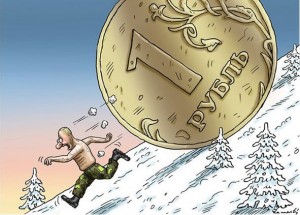
The Russian economy is the G-20’s worst performer, contracting by 3.8%.  President Vladimir Putin claims that his economic policies remain consistent; in fact, he has wisely changed course, limiting the damage that could have been done had he not.

Anders Aslund writes:  At the end of 2014, Russia was seized by financial panic. The Central Bank of Russia (CBR) responded to collapsing oil prices by floating the ruble, which immediately lost half its value. Desperate Russians rushed to buy whatever they could before their money became worthless. Inflation shot up to 16%.

In 2008-2009, the Russian Central Bank CBR pursued a policy of gradual devaluation, bailing out all big state-owned and private corporations, regardless of their performance. This time, Russia has maintained a floating exchange rate, conserving its reserves. The CBR stabilized the market by shock-hiking its interest rate, and has since reduced it gradually, as any sound central bank would.

Russia did adopt an anti-crisis stimulus package; but, at 3.5% of GDP, it was just one-third the size of the 2008 package. And while the Russian government singled out some enterprises as “strategic,” it actually gave them very little money. Many big companies, most notably in the construction and aviation sectors, were forced into bankruptcy. Creative destruction  has been revived somewhat. Life is a little less secure for Russia’s rich.

Since the expropriation of Yukos Oil Company in 2004, Putin’s policy had been highly benevolent to large state-owned firms. The state financed their purchases and investment projects with seemingly inexhaustible oil revenues. But now, with oil prices down sharply, Russia’s export revenue has plummeted by 30% this year, and state funds have become very scarce.

Something had to give, and, to Putin’s credit, it was not fiscal conservatism. This year, Russia’s budget deficit is expected to be just 2% of GDP, rising to 3.5% in 2016 – a remarkably strong performance given that the country has had to weather a trade shock and international financial sanctions. Next year, the government is set to use $40-45 billion of its reserve fund for budget financing.

Accomplishing this has required Putin to abandon some of his regime’s taboos. For the first 15 years of Putin’s rule, Russians’ standard of living rose steadily; but it has fallen sharply since November 2014. Real wages are set to plummet by 10% this year. Real pensions are also declining, and spending on health care and education is set to fall by 8% next year.

State-owned firms have been affected as well. Gazprom, Rosneft (which absorbed Yukos), and Russian Railways have been publicly begging for government money. Last December, Putin accepted a complex financing scheme for Rosneft. But by August, it was clear that all three corporate giants would receive only a small share of what they wanted.

Given Western financial sanctions, Putin’s effort to conserve state funds is entirely sensible. Still, the significance of these changes should not be exaggerated. Their macroeconomic impact is substantial, but no systemic reforms are on the agenda. Unlike China, Russia has made no attempt to rein in rampant corruption at the top. Nor has anything been done to strengthen the rule of law. Tens of thousands of presumably innocent Russian businessmen sit in pretrial detention because security officials want to seize their companies. Protectionism proliferates as Russia imposes ever more trade sanctions.

The big question is how Russians will respond when they realize that the decline in their standard of living is not temporary, as it was in 1998. In 2014, Russia’s GDP was $2.1 trillion (at the current exchange rate). It has plunged to $1.1 trillion. These numbers do not reflect purchasing power, but the Russian middle class measure their salaries in dollars. So far, public reaction has been muted, but a two-week protest by Russia’s truck drivers over a new highway toll suggests that popular quiescence may not last.

Russia’s economy was stagnating even before the bottom fell out of global oil prices, and most experts expect energy prices to remain low for years. This confronts Putin with a challenge he has never faced: leading Russia at a time when there is no light visible at the end of the tunnel.

Russian Economy?

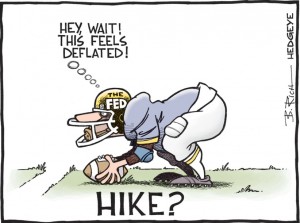
We Watch the Fed. Everyone Watches the Fed, So We Watch the Fed.

History is no guide to the impact of the anticipated rate hike by the Federal Reserve.   But why do we watch this activity anyway?   We watch the Fed because everyone watches the Fed  because we watch the Fed.  Circles.

It has been so long since the Federal Reserve raised interest rates that US stock market investors probably should not look to past rate hike cycles for clues about potential winners and losers.  But investors do expect more rapid-fire moves from one stock market sector to another, based on what happened throughout 2015 when comments from Janet Yellen or other Fed officials changed expectations of central bank moves multiple times.

Stock market investors are ready for the first U.S. Federal Reserve interest rate hike in nearly a decade next week, but they may not be fully prepared for all of the nuanced remarks likely to accompany that announcement.

If the Fed lays out an aggressive schedule of future rate increases, stock markets could become very volatile and even plummet, say strategists who expect a market-calming central bank announcement detailing the patience of policymakers.

Activity in the options market suggests stock traders are being cautious ahead of the Fed policy meeting and options expiring at the end of next week could amplify volatility in either direction.

Traders hoping to profit on the Fed’s expected statement lack a playbook. The markets haven’t been through the current scenario of a rate lift-off after years in which the central bank’s short-term interest rates have been locked near zero.

That could partly explain the jittery trading on Wall Street,during which volatility has risen and the benchmark S&P 500 dropped 3.5 percent.

A slew of economic data due to be released before the Fed meeting, including readings on growth in manufacturing, industrial production and consumer prices, could cause some choppiness if traders take any robust data as a sign that the Fed may be more aggressive with future rate increases.

Furthermore, markets could face an interruption next week if Congress and President Barack Obama trigger a government shutdown by failing to finish work on a $1.5 trillion government funding bill.

That uncertainty has helped trigger bets in the options market by investors trying to cover themselves against a wide array of outcomes in stocks, and similar uncertainty has been apparent across other asset classes as well.

Crude oil futures fell to seven-year lows while the euro, expected to decline against the dollar as the Fed tightens, rallied after many covered those bets.  Positioning is leaning more heavily toward seeking protection against a broad stock market move lower, said traders who expect volatility to spike after the Fed meeting..

The CBOE Volatility Index .VIX, the market’s favored barometer of trader angst, has crept over its long-term average of 20, after having stayed mostly below that level since early October. On Friday, it was up 28 percent at 24.72.

That level is higher than futures show the VIX going forward, signifying that traders are more worried about near-term volatility than they are about a long-term breakdown.

But a sharp move to the downside could be amplified since the Fed decision comes just two days ahead of “quadruple-witching,” when options on stocks and indexes and futures on indexes and single-stocks all expire, making the index particularly prone to a jump in volatility.

Fed Rate Hike

Giant Step Forward to Halt Global Warming

Over two hundred countries gathered for a conference on global warming in Paris.  Earlier in the week 50 countries and the EU countries made a preliminary agreement.

Now all the participating nations agreed to an ambitious goal of halting average global warming at no more than 2 degrees Celsius (3.6 degrees Fahrenheit) above pre-industrial temperatures — and of striving for a limit of 1.5 degrees Celsius if possible.

The agreement still faces hurdles. It will go into effect only if 55 countries that account for 55% of total global greenhouse gas emissions ratify it.  A giant step forward for mankind and womankind.

Not a Drop to Drink Susan Rennie

Not a Drop to Drink
Susan Rennie

Is China Ready for the Big Time in Finance?

Does China Belong at the Grownups table in international finance?

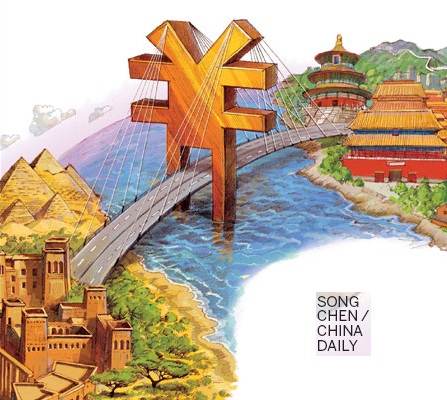
Paola Subacch writes:  The IMF has given a huge vote of confidence in China’s capacity to play a major role in international finance.

Many market participants, however, remain skeptical about the decision. Does the renminbi really belong in the same category as the US dollar, the euro, the Japanese yen, and the British pound in the international monetary system?

No doubt, China has made remarkable progress over a relatively short period. Since 2009, the share of China’s trade settled in renminbi has increased from less than 1% to more than 20%. And the renminbi now ranks fourth among the world’s currencies used for international payments.

But the renminbi’s 3% share in global payments lags far behind that of the dollar (45%) and the euro (27%). Moreover, growth in the use of the renminbi to settle trade has been concentrated largely in the Asia-Pacific region, and specifically in transactions between China and its neighbors. And demand for renminbi-denominated assets remains relatively low, with a mere 1.5% of total renminbi bank deposits held outside China.

The contrast between the renminbi and its SDR counterparts is stark. The renminbi offshore bond market amounts to just 0.5% of the world’s total, with 40% issued in dollars, 41% in euros, nearly 10% in pounds, and 2% in yen. The value of loans denominated in renminbi – CN¥188 billion ($29.2 billion) – is tiny, especially when one considers that almost 50% of total international banking liabilities are denominated in dollars, approximately 30% in euros, 5% in pounds, and about 3% in yen. And the renminbi accounts for 0.6-1% of global foreign-exchange reserves held by central banks, whereas the dollar and the euro account for 62% and 23%, respectively.

In short, unlike the rest of the currencies in the SDR basket, the renminbi is an international currency in the making, just as China is an economic and financial power in the making. Indeed, like most developing countries, China remains an “immature creditor” that lends mainly in dollars; and if it needed to borrow in international markets, it would have to issue most of its debt in dollars, not renminbi. Clearly, China’s standing in international finance does not match its status in international trade.

Nonetheless, there is a distinct sense that the renminbi will become a key player in global financial markets. After all, unlike other developing countries – even large ones like Brazil, India, and Russia – China has an economy that is large enough to provide critical mass to its currency’s development.

Furthermore, Chinese leaders are determined to push through reforms – especially of the banking sector and state-owned enterprises – that will help drive forward this development. They have made it clear that one of their key goals for the next five years is to narrow the gap between the international standing of the renminbi and that of the world’s “great currencies,” as they promote use of the renminbi far beyond the Asia-Pacific region.

It is important to note, however, that China’s leaders do not seem to be angling for the renminbi to replace the dollar as the dominant international currency. Their approach – based on the belief that a more diversified, and thus more liquid, international monetary system would contribute to a more balanced and less volatile global economy – is more pragmatic. Anticipating a shift from a dollar-based (and, more broadly, US-dominated) system toward a multi-currency, multipolar system, China’s leaders are laying the groundwork for their country (and its currency) to grasp one of the positions at the top, alongside other great powers.

While some countries – the United States and Japan, in particular – are far from enthusiastic about that, it is difficult to deny what seems inevitable (neither country formally opposed the SDR decision when it came). And, as China gains more financial clout, its role in global economic governance will undoubtedly grow as well.

Given all of this, it is unsurprising that the reform of the international monetary system and its governance will feature prominently at next year’s G-20 summit, hosted by China, which will hold the group’s rotating presidency. It is not yet clear how China will shape the debate. But the mere fact that it will happen at the G-20, rather than at the long-dominant G-7, sends a clear message that the global economic and monetary system is changing for good.

Remninbi