The Greeks Say No

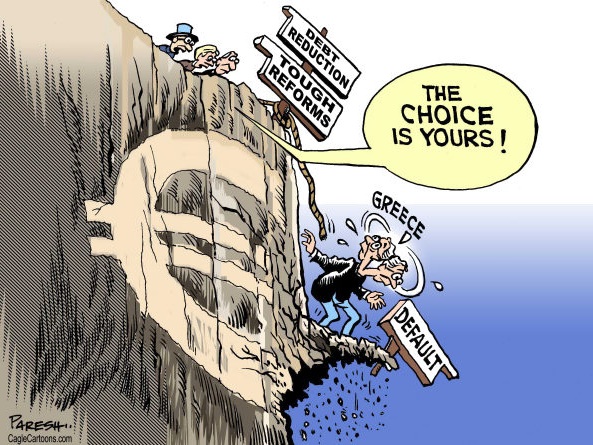
Greeks overwhelmingly rejected conditions of a rescue package from creditors on Sunday, throwing the future of the country’s euro zone membership into further doubt and deepening a standoff with lenders.

As the euro slid more than 1 percent against the dollar and European stock and bond markets were poised to take a sharp hit with the resumption of trade on Monday, stunned European leaders called a summit for Tuesday to discuss their next move.

Thousands of jubilant Greeks waving flags and bursting fire crackers poured into Athens’ central square as official figures showed 61 percent of Greeks had rejected a deal that would have imposed more austerity measures on an already ravaged economy.

The surprisingly strong victory by the ‘No’ camp defied opinion polls that had predicted a tight contest after a week of rising desperation as banks shut and cash machines ran dry.

The vote leaves Greece in uncharted waters: risking a banking collapse that could force it out of the euro. Without more emergency funding from the European Central Bank, Greece’s banks could run out of cash within days. That might force the government to issue another currency to pay pensions and wages.

For millions of Greeks the outcome was an angry message to creditors that Greece can no longer accept repeated rounds of austerity that, in five years, had left one in four without a job and that shrank the economy by a quarter. Tsipras has denounced the price paid for aid as “blackmail”, a national “humiliation”.

Officials from the Greek government, which had argued that a ‘No’ vote would strengthen its hand to secure a better deal from international creditors after months of wrangling, immediately said they would try to restart talks with European partners.

But euro zone officials shot down any prospect of a quick resumption of talks, even though finance ministers were planning to meet during the week to discuss the fallout from the vote.

Many of Athens’ partners have warned over the past week that a ‘No’ vote would mean cutting bridges with Europe and driving Greece’s crippled financial system into outright bankruptcy.

The result delivers a hammer blow to the European Union’s grand single currency project. Intended to be permanent and unbreakable when it was created 15 years ago, the euro zone could now be on the point of losing its first member with the risk of further unraveling to come.
Greeks Say No for Now

A Greek Deal in the Offing?

The ultimate goal is to keep Greece within the eurozone, according to German spokesman Martin Jaeger.

A Greek exit from the euro would be hugely painful for the country.

Talks over the Greek debt issue have been in deadlock for five months.

The proposals put forward by Athens aim to raise €8bn, mostly through new taxes on the wealthy and businesses, early retirement restrictions, VAT increases and a cut in defence spending.

We should also be very cautious of rumours today as these can cause significant turbulence in the markets and if denied – which they usually are – can cause a sizeable swing in the opposite direction. The official spoke only on condition of anonymity because the talks were ongoing.

Greece should not limit its proposals to promises of more tax revenue and must present “credible” reform plans, said International Monetary Fund chief Christine Lagarde in an interview published by French magazine Challenges on Wednesday.

In spite of the standoff, many analysts and economists think a deal that would release €7.2-billion in loans left over from the current bailout, which expires on Tuesday, is still likely.

Greek prime minister Alexis Tsipras was under pressure to seal a deal before facing other European Union leaders at the summit.

But the International Monetary Fund was cautious about the mix of reforms Greece proposed, saying they rely too heavily on tax increases that can hurt the economy.

Talk of a default is “all speculation, because we’re expecting the payment to be made on June 30th and that’s what the Greek authorities have said publicly”, fund spokesman Gerry Rice said.

Penions and taxes remain the sticking points. Nowhere! This odd stance may be due to two reasons. “Are they doing this for growth or (to serve) interests?”

For its part, the ECB’s governing council is holding daily conference calls to decide whether to increase the emergency liquidity assistance (ELA) available to the Greek banking sector. Greece is in talks with creditors this week to get more bailout loans to avoid bankruptcy next week.

But Greece was still not on board, and wanted to stick to a previous plan it has offered.

The key European Union policymakers including German Chancellor Angela Merkel said they hope a final deal would be reached at Saturday’s meeting of the eurozone finance ministers that are scheduled to start at 15:00 GMT.

Merkel and Tsipras

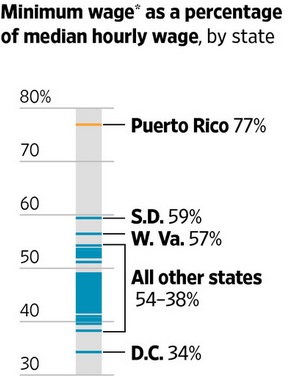
US Minimum Wages Impact Puerto Rico

Nick Timiraos writes: With the Puerto Rican economy in decline, Luis Acevedo, a 31-year-old chemist, decided to get a degree in chemical engineering to give him a better chance at boosting his earnings. Even with the degree, he has had no luck finding a job after five months, and he said competition is fierce given a high unemployment rate, about 12%. “The way things are going I’m starting to apply abroad,” Mr. Acevedo said.

Weak job prospects have prompted Puerto Ricans, who are U.S. citizens, to seek employment in places like Florida, New York and New Jersey. Since 2000, total employment is down 11% in Puerto Rico, while it is 7% higher in the U.S. The island was projected to post one of the largest population declines in the world last year, according to U.S. government figures.

More than 27% of Puerto Ricans between 15 and 24 years old who were in the labor force were unemployed in 2013, compared to nearly 16% in the U.S.
Andrew Bary of Barron’s tells Jack Otter what just happened in San Juan, and what it means for municipal bond investors.

Labor unions on the mainland pushed for the federal minimum wage to cover Puerto Rico in the 1970s amid concerns that the island would create low-wage competition for mainland jobs. The move eliminated a comparative economic advantage for the island, while tax breaks designed to lure multinationals did little to establish permanent job growth, said Barry Bosworth, an economist at the Brookings Institution in Washington.

Congress mandated two U.S. territories in the Pacific, American Samoa and the Commonwealth of the Northern Mariana Islands, to increase their minimum wages in 2007 by 50 cents annually until meeting the federal level this year, but it delayed those increases in 2010 amid concerns about economic growth.

“They are begging the government to stop the onwards march of raising the minimum wage,” said Mr. Porzecanski. “It’s better to be hired at $5 than not to be hired at $7.25.” Minimum wages in American Samoa, which range from $4.18 to $4.76 an hour, are set to rise by 50 cents at the end of September.

Labor dynamics are only part of the problem with Puerto Rico’s economy, which also faces poor business investment, high tax evasion, and unusually expensive electricity and other costs of living.

The Jones Act, a law that requires most shipping between U.S. ports to rely on a small and specific fleet of U.S.-flagged vessels, means that just a handful of ships serve Puerto Rico, limiting competition and increasing costs of basic goods. The Krueger Report recommends that Congress exempt Puerto Rico from the Jones Act, following similar exemptions for the U.S. Virgin Islands.

In Puerto Rico, broad use of government benefit programs have further damped workforce participation. Transfer payments, such as food stamps and disability benefits, account for roughly 40% of personal income in Puerto Rico, double the share on the U.S. mainland, according to the New York Fed.

Those payments tend to be generous relative to local incomes because payments are indexed to conditions on the mainland. Moreover, because they decline as wages rise, they can create a disincentive to work. The Krueger report recommends providing lower benefit payments to a larger number of people, which would maintain the social safety net while encouraging more labor-force participation.

At the same time, economists say other local labor laws, including more generous overtime pay and vacation rules, plus laws that make it harder to fire workers, have made employers reluctant to hire.

While it would make sense to exempt Puerto Rico from future increases in the federal minimum wage, cutting wages “will just accelerate the exit from the island,” Mr. Bosworth said. “The fundamental problem in Puerto Rico is the lack of jobs.

Minimum Wages


Greek Crisis Impacts the EU

The Econmist editorializes:   European Union has never seen the like of the past eight days in Greece: barred banks, capital controls, the first IMF default by a developed country, the collapse of a multi-billion-euro bail-out, plans for a referendum that may hasten Greece’s ejection from the single currency, and the beggary of the people. Were the stakes not so high, all those emergency summits and last-minute demands would count as farce.

Instead it is a tragedy, where an outcome that all sides say they do not want—Greece’s exit from the euro—seems increasingly likely. The chaos is evidence that leaving the euro would be disastrous for Greece, not least because modest gains from default and devaluation would be overwhelmed by political and economic instability. For the rest of Europe, too, “Grexit” has well-rehearsed risks, notably that of a failing state on the continent’s south-eastern flank. But as the drama has become more desperate, so Europeans seem less worried. They take comfort from the fact that Greece is uniquely dysfunctional. Game-playing and repeated miscalculation have poisoned the negotiations (see article). Without Greece, many now conclude, the euro zone might actually be more stable.    Facing up to the Euros Contradictions

How the Greek Crisis Impacts the EU

China or Russia to Aid Greece?

Joshua Keating writes:  If you want some perspective on Europe’s current debt crisis, consider the fact that Chinese stocks have fallen by a value 10 times Greece’s entire GDP, with nary a peep from the Greek-obsessed international media..

But even if the scale of Greece’s woes seem small by Chinese standards, Beijing is still concerned with what happens this weekend, particularly due to concerns that if the situation isn’t resolved, it could drag down economies throughout the EU, China’s largest trading partner. By coincidence, Prime Minister Le Keqiang was in Brussels this week for an annual China-EU summit and said that China is hoping for a resolution that keeps Greece within the eurozone, saying it concerns not just Europe but “world financial stability and economic recovery.”

Still, the prospect of a Greek exit from Europe and a collapse of the bailout has led to some speculation about whether China could turn the situation to its advantage. China has leant money to countries that have defaulted on their debts before, notably in Latin America, and it may see a political advantage in stepping in when Europe failed to.

If history is a guide, China would be less interested than the EU in reforming Greece’s governance and domestic economic policies, so long as Greece committed to policies that provide advantages for Chinese trade and, perhaps, a reliably pro-China foreign policy.

There’s been even more speculation about the prospect of Russia stepping in to bail Greece out. The Kremlin has helped out debt-addled the Mediterranean before, granting a 2.5 billion euro emergency loan to Cyprus in 2011.

Greece’s ruling Syriza party is fairly pro-Russian, opposing EU sanctions against Vladimir Putin’s government.

The Russians have left open the possibility of further economic cooperation in exchange for concessions to Russian business. Finance Minister Anton Siluanov said back in January that Russia would “definitely consider” a Greek request for aid.

Despite these hints, a Russian lifeline for Greece is probably still unlikely. Battered by both low oil prices and western economic sanctions, Russia is burning through its reserves fast without much relief in sight.

It would be a mistake for Greece’s government to count on help from Russia (or China for that matter) if things take a turn for the worse with Europe. But it’s probably still advantageous for Greece and Russia if the lenders in Brussels think it’s a possibility.

Aid to Greece?


After the Greek Crisis

George Friedman writes: The Greek situation – having perhaps outlived the term “crisis,” now that it has taken so long to unfold – appears to have finally reached its terminal point. This is, of course, an illusion: It has been at its terminal point for a long time.

The terminal point is the juncture where neither the Greeks nor the Germans can make any more concessions. In Greece itself, the terminal point is long past. Unemployment is at 26 percent, and more than 50 percent of youths under 25 are unemployed. Slashed wages, particularly in the state sector, affecting professions including physicians and engineers, have led to massive underemployment. Meanwhile, most new economic activity is occurring in the untaxable illegal markets. The Greeks owe money to EU institutions and the International Monetary Fund, all of which acquired bad Greek debts from banks that initially lent funds to Greece in order to stabilize its banking sector. No one ever really thought the Greeks could pay back these loans.

The problem is simple. The core institutions of the European Union have functioned not as adjudicators but as collection agents, and the Greeks have learned how ruthless those agents can be when aided by collaborative governments like Cyprus. The rest of the Europeans have also realized as much, which is why Euroskeptic parties are on the rise across the union. Germany, the country most threatened by growing anti-EU sentiment, wants to make clear that debtors face a high price for defiance. And if resistance is confined to Greece, the Germans will have succeeded. But if resistance spreads to other countries, the revolt of the debtor states against the union will cause major problems for Germany, threatening the economic powerhouse’s relationship with the rest of Europe.  After the Greek Crisis

Greek Default

Time for Democracy in Africa

James Kellman writes: For the first time in the history of Africa’s largest country, a challenger defeated a sitting Nigerian president via the ballot box. The losing incumbent in the March 28 election, Goodluck Jonathan, graciously conceded defeat to Muhammadu Buhari, offered his best wishes, and urged supporters to follow due process. Nigeria’s accomplishment is all the more remarkable in the face of terrorist threats from Boko Haram.

Yet in much of Africa, democracy remains an empty word. The phrase that U.S. diplomat Edward Djerejian coined in 1992 — “one person, one vote, one time” – is the more established rule. Leaders, once elected, to contrive to stick around for decades, defying term limits, and rigging elections. For example, the president of Burundi, Pierre Nkrunziza, is standing for election to a third term on July 15, in defiance of constitutional limits. The European Union has withheld funds to conduct the election, and, already, violence has broken out at polling stations.

In Togo recently, President Faure Gnassingbe won a third term. He and his late father have been running the country now for 48 years. Indeed, nine African countries have a leader who has been in power for 21 years or more.

Only one African country, Mauritius, qualifies as a “full democracy.” Some 27 sub-Saharan nations are “ruled by an authoritarian regime or nominal democracy,” and 13 countries have no presidential term limits.  Time for Democracy in Africa

Entrepreneur Alert: Elizabeth Warren’s Boosts

Senator Elizabeth Warren told an audience of Worcester entrepreneurs  that they are the future of the United States and more must be done to promote small business start-ups when policies are being pass down from Washington, D.C.

In Worcester, Warren visited the robotics technology incubator Technocopia and its Prescott Street neighbor, the co-working space Running Start.

“There are a lot of opportunities if you are already big to get bigger,” Warren said. “But, where the real innovation in this country comes from is the folks who have a good idea, but they have to start right down at the base. You’re creating that here.

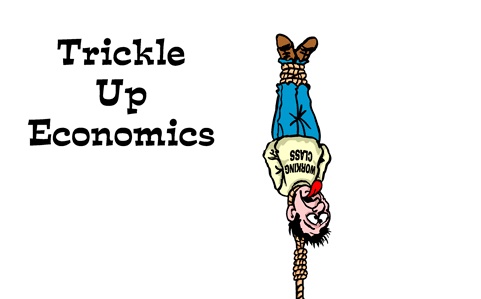
Warren said much of the country’s current woes date back to 1980 and the start of trickle-down economics. Those policies have favored large corporations, and created an atmosphere where college graduates are buried in so much debt that they cannot afford to start small businesses, she said.

Kevin Harrington, of Technocopia, asked about the possibility for a small business deferment on student loans.

For her part, Warren said it was a good idea that needs to be considered among many others to help promote start-ups.

The visit to Worcester incubators highlights Worcester’s recent successes.

Making Trickle Up Economics Work

Lagarde Opposed Greek Loans; Now Stuck with Default

As French Finance Minister in 2010, Christine Lagarde opposed the involvement of the International Monetary Fund in Greece.

Now Lagarde’s tenure at the head of the IMF since 2011 will be shaped by Greece, which holds a referendum on Sunday that could pave the way to its exit from the euro.

By its own admission the Washington-based institution broke many of its rules in lending to Greece. It ended up endorsing austerity measures proposed by the European Commission and European Central Bank, its partners in the troika of Greece’s lenders.

That the IMF lent to Greece at the behest of Europe, which has nominated every IMF Managing Director since the inception of the Fund in 1946, may expose the institution to greater scrutiny, especially as it has $24 billion in loans outstanding to Greece in its largest-ever program.

The involvement of the Fund in Greece and its continued support for decisions driven by eurozone governments caused a deep split in the institution.

Some IMF economists had misgivings about lending to Greece in 2010 within the constraints of the so-called “troika” of lenders, where the Fund would be the junior partner to the European Central Bank and the European Commission.

IMF board members also protested the “exceptional” size of the program, as Athens did not meet the Fund’s criteria for debt sustainability, meaning it would have trouble repaying.

Yet swayed by the fear that contagion in Athens could spread to French and German banks, the IMF agreed to participate in a joint 110-billion-euro bailout of Greece with the Europeans.

Later, the Fund admitted that its projections for the Greek economy had been overly optimistic. Instead of growing after a year of austerity, Greece’s economy plunged into one of the worst recessions to ever hit a country in peacetime, with output falling 22 percent from 2008 to 2012.

While the eurozone’s insistence on drawing a direct link between euro membership and Greece’s debt sustainability and the negotiating tactics of the Greek government have exposed both to questions of credibility, the Fund stands charged as well.

Greek default on all $24 billion it owes to the IMF dwarfs previous delinquincies from countries like Sudan, Zimbabwe and Somalia.

While the IMF was worried about contagion when it made the loans, it also had institutional incentives for wanting to bail out troubled countries.

The IMF’s heavy involvement in large bailouts for euro zone countries, which included Ireland and Portugal, have enabled it to build up its reserve buffers in recent years. It is now aiming to store away some $28 billion by 2018.

From interest and charges on the Greek program alone, the IMF has earned some $3.9 billion since 2010.

Greek Default

Leading Shock Absorbers

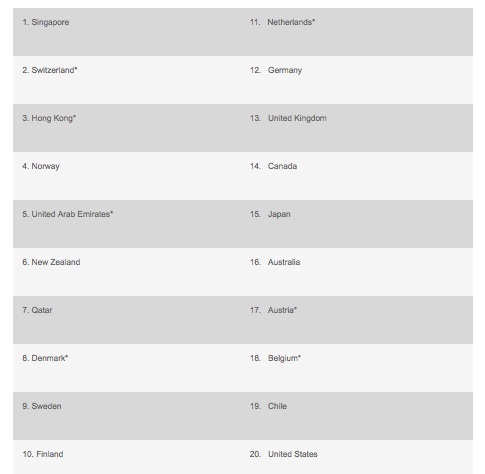
Top five countries prepared for economic and political charts are: Singapore, Switzerland, Hong Kong, Norway and the UAE.

When it comes to dealing with change brought about by everything, from economic and political shocks, to long term trends such as technologies and demographics, the UAE is the most prepared in the Arab world.

It is the only Arab country that made it to the top five. Qatar, however, is trailing behind in the seventh place.

Produced in partnership with Oxford Economics, the index rated 127 countries for their capability to prepare for or respond to change caused by financial crises, political shocks and natural disasters.

It looked at the business environment, technology access, as well as fiscal, regulatory and security capabilities, among several other indicators, of 127 countries.

Global Readiness Index