Alibaba’s Ma Takes Over the Rockefeller’s Adirondacks

Brandon Park, the 28,100-acre former estate of William A. Rockefeller, Jr. (a co-founder of Standard Oil with his brother John D. Rockefeller), has been purchased by Alibaba co-founder Jack Ma of China for $23 million according to the Wall Street Journal.

Alibaba is the world’s largest e-commerce company. He reportedly bought the property principally for conservation purposes, but may also use it as a personal retreat.  Ma is chairman of the China board of the Nature Conservancy and is a member of the global board. The Nature Conservancy introduced Ma to the property, according to The Wall Street Journal.  Ma has extensive experience in conservation projects in China, including co-founding the Sichuan Nature Conservation Foundation and the Laohegou Nature Reserve in Sichuan, which protects giant panda habitat and is the first protected area managed by a non-governmental organization in China.  This is his first conservation project outside of China.

Ma Conserves the Adirondacks


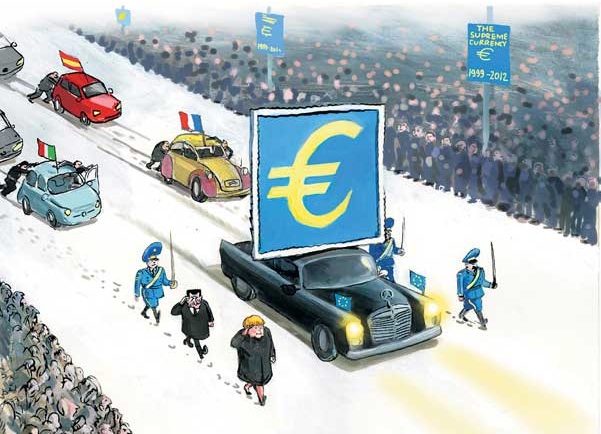
Have Press Leaks Killed the Euro?

Frances Coppola writes:  The creditors have once more rejected Greece’s proposal and put forward their own version including tax and pension changes that Greece had already said it would not accept.

In the early hours of Saturday morning, June 27th, the Greek Prime Minister Alexis Tsipras announced that the people of Greece would be asked to decide whether they wished to accept the creditors’ proposal. A referendum will be held on July 5th.

The question that will be put to the Greek people is only about the creditors’ proposal, not about Greece’s membership of the Euro. But this referendum has huge historical and emotional resonances, deliberately created by the Greek government in a manner reminiscent of Alex Salmond’s linking of the Scottish independence referendum to the historic victory of the Scots over the English in 1314.   Similarly, Tsipras’s subtle attempt to link this referendum to Greece’s rejection of Benito Mussolini’s ultimatum in October 1940 may not be enough to overcome Greek fears.

But the creditor side and the world’s media quickly decided that the referendum was actually about Euro membership. A “No” vote would result in Greek exit from the Eurozone. A “Yes” vote would mean the fall of the Syriza government. Not surprisingly, the Greek opposition parties called for a “Yes” vote.

A press release says that this proposal was under discussion until the Greeks walked out:

Discussions on this text were ongoing with the Greek authorities on Friday night in view of the Eurogroup of 27 June 2015. The understanding of all parties involved was that this Eurogroup meeting should achieve a comprehensive deal for Greece, one that would have included not just the measures to be jointly agreed, but would also have addressed future financing needs and the sustainability of the Greek debt. It also included support for a Commission-led package for a new start for jobs and growth in Greece, boosting recovery of and investment in the real economy, which was discussed and endorsed by the College of Commissioners on Wednesday 24 June 2015.

However, neither this latest version of the document, nor an outline of a comprehensive deal could be formally finalised and presented to the Eurogroup due to the unilateral decision of the Greek authorities to abandon the process on the evening of 26 June 2015.

The Greek people are being asked to vote on the proposal put to the Eurogroup. The release of a new version of the proposal, and the suggestion that debt relief would have been up for discussion too, is thus clearly intended to invalidate the referendum.

The world’s media, supported by a succession of leaks from “unnamed sources”, was speculating that the imminent expiry of the existing bailout program would force the ECB to end ELA funding of Greece’s banks, resulting in closure of the banks and capital controls. Unsurprisingly, withdrawals from Greek ATMs increased.   Frances Coppola on the Euro

Death of the Euro

European Markets Plunge

European stocks started the day with losses of 4% or more as investors reflected on the weekend news from Greece: of the planned referendum, bank closures and capital controls. The Portuguese stockmarket was one of the worst affected, falling almost 6% at the open on fears that the economy would be dragged into the crisis (the Athens stock exchange is closed).

Contagion was seen in the bond markets too, with Spanish and Italian 10-year bond yields rising around 18 basis points, while the German equivalent fell 15 points; a spread widening of around a third of a percentage point. The euro was slighly lower on the news, falling less than 1% against the dollar. While uncertainty over Greece’s future is bad news for the European economy, traders had been using the euro as the basis for a “carry trade”; borrowing euros and investing the proceeds in higher-yielding risky assets. As those traders pulled back from their risky bets, they would have paid back the euros they borrowed, limiting the currency’s fall.

Traders had three other factors to consider, which might limit losses as the day proceeds. The European Central Bank could step into the market to buy bonds, particularly in places like Portugal, Spain and Italy, and limit the contagion. In addition, a yes vote in the Greek referendum might lead to a deal with creditors, and might see the departure of a Syriza-led government. And then there is the sheer chaos in Greece, which has ended up in the situation all other governments bent over backwards to avoid in 2008—its ATMs running out of money. Some commentators believe the referendum, which asks voters to approve a deal which will not even be on the table by July 5th, may yet be called off.

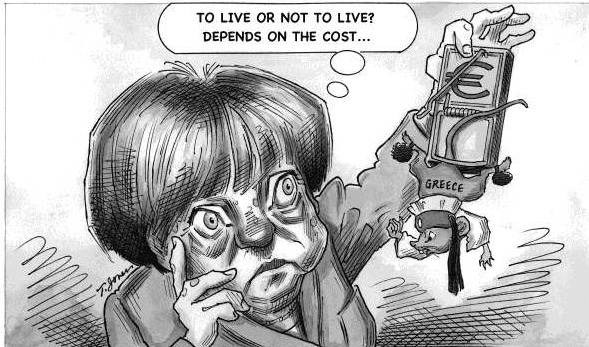
Greek Default?

Entrepreneurs: Leaders of the Future

One of the country’s few remaining independent media outlets, analyzed the impact of American inventor Elon Musk’s inventions on the global economy, and on Russia in particular. She specifically singled out Musk’s recently unveiled solar battery:

Yulia Latinina of Novaya Gazeta writes:  First, car exhaust is really poisonous of the environment.  Second, his battery ensures that the house can be truly autonomous – after the invention of electricity, the house seized being an independent entity throughout the world. And third, this battery will change the world as much as shale gas could, and much more than the results of any election and any revolution.

Latinina feels that Musk’s breakthrough – along with other creations such as the hyperloop – will shift power away from presidencies and official heads of state, and move us toward a world where entrepreneurs have bigger sway and greater influence on international affairs. She is clearly impressed with the influence America’s top high-tech companies have, both at home and around the world. While she may overstate that influence, she importantly laments the absence of like initiatives in Russia, where major inventors and entrepreneurs must toe the government line:

President Putin is seriously waiting for the United States to finally come to its senses and to sit down to negotiate with him, as with Joseph Stalin at Yalta in 1945 and divide the world into spheres of influence … The problem is that the ‘zone of influence’ of the United States in the modern world is not established by Barack Obama, but by Sergey Brin, Elon Musk, and Steve Jobs. But since Putin’s policy is not to allow a Musk or a Jobs in Russia  – since every independent entrepreneur is a potential threat to the authorities –  the underlying principle for such negations practically does not exit.

Entrepreneur Alert: How Lobbying Helps

Karen Weize writes: Over the past year, Uber built one of the largest and most successful lobbying forces in the country, with a presence in almost every statehouse. It has 250 lobbyists and 29 lobbying firms registered in capitols around the nation, at least a third more than Wal-Mart Stores. That doesn’t count municipal lobbyists. In Portland, the 28th-largest city in the U.S., 10 people would ultimately register to lobby on Uber’s behalf. They’d become a constant force in City Hall. City officials say they’d never seen anything on this scale.

If you’re starting up a business that fits into a large niche, you might well consider joining forces with your allies and competitors to influence City Hall.

Effective Lobbying

Greece Shutters Banks for Six Days

Greek leaders planned to shutter their banks for six business days starting Monday and impose strict limits on ATM withdrawals amid rising global concerns about the nation’s economic future.

Sunday’s decision to declare a bank holiday was a signal that Greece’s five-year battle to stay in the shared euro currency may swiftly be coming to an end, as leaders elsewhere urged steps to find a way to avoid that. Panicked citizens tried to pull their money from their accounts while they still could. ATMs in Athens were running out of money, and tensions were running high as Greeks stood in line for hours to scrape together cash for basic supplies. Lines mounted at gas stations as worried residents topped off their tanks for what could be a protracted period of time in a cashless nation.

“The decision not to prolong financial aid to Greece is offensive, and it’s a disgrace for Europe in general,” Prime Minister Alexis Tsipras said in a brief Sunday evening address broadcast across Greek television networks. He said he was seeking an extended and enlarged bailout from European lenders that would carry the country past Tuesday, when it will otherwise face default.

There were signs that Greece’s creditors — the International Monetary Fund and euro-zone governments — were leaving the door open to negotiations. But it remained unclear ahead of Tuesday’s IMF repayment deadline how Greece would be able to satisfactorily arrange its finances.

Tsipras said that the threat by European Union leaders to hold Greece to the deadline and not extend further assistance amounts to “blackmail.” But he gave no concrete indications that he had made any concessions that would change their minds.

Greek Crisis Calendar

High quality global journalism requires investment. Please share this article with others using the link below, do not cut & paste the article. See our Ts&Cs and Copyright Policy for more detail. Email ftsales.support@ft.com to buy additional rights. http://www.ft.com/cms/s/2/8b960548-143b-11e5-9bc5-00144feabdc0.html#ixzz3eLevbuxS

June 29: Recalling the Bundestag

The primary reason a deal must be concluded by June 25 is so there is enough time for eurozone parliaments to approve an extension of the existing bailout programme.

Jeroen Dijsselbloem, the Dutch finance minister who heads the negotiations for his 17 eurozone counterparts, has said there is simply no longer time for Greece to legislate and pass all the “prior actions” needed to win bailout money before the rescue programme runs out at the end of the month. So it will have to be extended for a third time in seven months.

Under national laws, any extension must be approved by a handful of eurozone parliaments — most importantly the German Bundestag, which is due to be on recess next week. Although the centre-right bloc of Chancellor Angela Merkel has become increasingly restless over Greece, they are likely to back any extension she endorses — even if they have to return from holiday to do so. But the vote must be held either the 29th or 30th, giving legislators precious little time to review the agreement.

June 30: Expiration date

The date Greece’s bailout expires and when it is due to repay €1.5bn in loan repayments to the International Monetary Fund. Even if a deal is in place before the deadline expires, it remains unclear how — or whether — Greece will find the money to pay the IMF, since there is not enough time for Athens to pass all the economic reforms necessary to gain access to any of the €7.2bn in bailout funds.

One option to quickly raise funds would be for the ECB to lift its existing cap on the amount of short-term debt the Greek government can issue by about €2bn. This would enable Athens to quickly raise cash to make the IMF payment.

The ECB imposed the cap in February because of signs Greek banks were the only buyers of such Treasury bills. Because Greek banks are only staying open through ECB-approved emergency loans, increasing the t-bill cap would essentially mean central bank money was being used to fund the Greek state — a violation of EU law.

But the ECB could decide that an agreement on a new economic reform plan means that new money, in the form of bailout aid, is on its way to Athens, meaning T-bill sales to Greek banks are not directly funding government operations. That would allow them to raise the cap.

It is also possible Athens just misses the payment. Although technically this is not a default, since IMF rules consider a non-payment “arrears”, Greece would join a motley crew of developing countries — Somalia, Cuba and Zimbabwe — that have current or former “overdue obligations” to the IMF.

But credit rating agencies have said that non-payment to the IMF is not formally a default, and the ECB is unlikely to decide it means Greece is bankrupt. If it did, much of the collateral used by Greek banks to obtain their emergency loans — particularly Greek government bonds — would be worthless. That would mean the ECB having to cut off emergency funding, probably forcing a Grexit.

July 1: The extended bailout

If a deal is reached and all the legislative approvals are voted in time, Greece’s bailout would be extended for anywhere from three to nine months. For the EU’s portion of the bailout, the extension is expected to include a bit more money as well.

Of the €7.2bn in the current bailout tranche, the eurozone is due to contribute about half (the other half would come from the IMF). On top of that, €10.9bn in rescue funds that had been set aside to recapitalise Greece’s banks remains unused and eurozone leaders are likely to approve a “repurposing” of those funds as general bailout aid.

In addition, another €1.5bn in profits on Greek bonds held by the ECB — which are to be refunded to Athens as part of a deal reached three years ago — come online July 1. All told, that’s about €16bn in EU aid available to Athens as part of the extension. The length of the extension will depend largely on how long officials determine that money can last.

There is also about €16.4bn remaining in the IMF’s portion of the bailout, which runs through March 2016.

July 20: Drop-dead deadline

This may be the real drop-dead deadline: the date two bonds totalling €3.5bn fall due to the ECB.

Although credit rating agency Standard & Poor’s said recently it would not consider a failure to pay these bonds a full default — it said only non-payment on bonds held by private creditors constitutes a default in their books — it would be virtually impossible for Greece to survive inside the eurozone if it defaulted on the ECB.

That means Greece must legislate for and implement the entire reform programme before this date so that it ensures it has bailout funding in time to repay the ECB. Another €3.2bn is due for two more bonds held by the ECB on August 20.

Courtesy Financial Times
Greece: End of the Month Accounting

IThe current extension of the Greek bailout money expires on June 30th.  If the extension is not granted, Grece will have to rely on tax money to. Operate.   Greece has a lot of trouble collecting taxes.

Also, if the bailout monies are not extended, Grece will be unable to pay ht emoney it owed the IMF.

Although Greece has always had trouble filling the public coffers, they have in the past made their IMF payments.   This would be the first time they have failed to pay.    It might kick off a series of actions leading to their exodus from the euro zone and ultimately the EU .

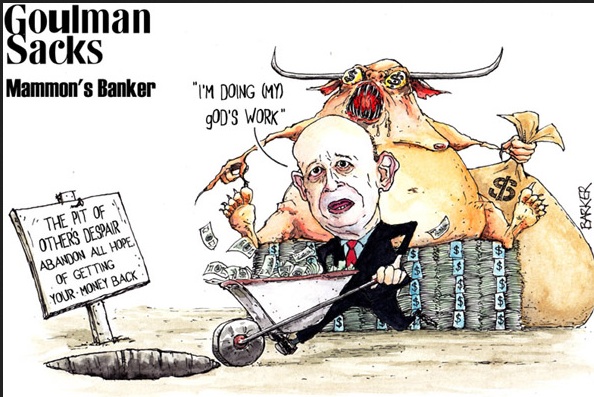
Dark Side of Goldman Sachs Gets Darker

When sanctions against Libya were lifted, Goldman Sachs among others rushed in to take advanatage of the40 billion dollar investment opportunity offered by Libyan Investmnent Authority.

Now there is a court case in London which reveals that in exchange for $350 billion in fees, Goldman lost about a billion dollars of its cients’ dolllars.

Goldman claims this is a is not true.  The Libyan Invesmtment Authority pleas financial illieracy

A high court judge has ordered Goldman Sachs to reveal how much profit it made on a deal that lost Libya’s government more than $1bn when financial bets turned sour.

The Libyan Investment Authority, created in 2006 to look after the country’s oil riches, accused the Wall Street bank of duping it into making investments that its “naive” staff didn’t understand.

A judge in the high court’s chancery division ordered the US investment bank to disclose how much money it had made on the deal. She asked Goldman to provide documents showing its profits on the disputed trades and how they were calculated.

Roger Masefield QC, acting for the Libyan investment fund, told the court that Goldman Sachs had made “substantial and unusually high” profits on the deal.

The dispute centres on nine financial products the Libyan sovereign wealth fund bought from Goldman Sachs in early 2008. These derivative investments were essentially bets on the future share price of a host of western companies, such as financial firm Citigroup and the energy group EDF.

The Libyan fund said it thought it was buying shares in the companies and alleges Goldman Sachs showered gifts on “naive” staff to induce them to buy products they didn’t understand. But Goldman argues the trades were not difficult for the fund’s “financially sophisticated” senior bankers to understand and has dismissed the claim as “a paradigm of buyer’s remorse”.

The case is proving to be an unwelcome spotlight on the workings of a Wall Street bank that prefers to keep a low profile.

The legal action against Goldman Sachs was launched in January, in the wake of new management being brought in at the sovereign wealth fund after the 2011 civil war, when Libyan dictator Muammar Gaddafi was toppled from power and killed.

As the loss-making deals of the Gaddafi era have come under the microscope, the fund has launched separate legal action against France’s third-largest bank, Société Générale, alleging bribery. It has rebutted the claims as without merit.

Goldman Sachs and Libya


Greece in Sum

In Greece we are looking at a variety of fundamental issues.   First of all, the taxation system is difficult to implement.  Value Added Taxes vary enormously depending on political connections.  They can range from almost nothing to 23 per cent.  High or low, they’re difficult tto collect.

The pension system is also unduly complicated and Ned’s to be sinplieiied so that appropriate policies can be put in place.

Privitization of businesses was supposed to yield the government more than 30 billion euros.  To date, it has brought in somewhere between 2 and 3 billion.

The problem is not so much a lack of willingness on the part of theGreek government as a lack of understanding of what can be done.

Gareece inability to grapple successfully with the economy for five years makes lenders wary.

Greece?