Regulating Wall Street?

Erica Orden writes:  The search to replace New York’s former top financial regulator,Benjamin Lawsky, has attracted the involvement of one of the banking industry’s harshest critics: U.S. Senator Elizabeth Warren (D., Mass.).

In recent weeks, Ms. Warren has placed calls to top staffers for New York Gov. Andrew Cuomo and others assigned to identify a successor to Mr. Lawsky, according to a person with direct knowledge of the search process. Ms. Warren’s advice: Tap Rohit Chopra, the student loan ombudsman and assistant director of the Consumer Financial Protection Bureau, which she helped start up and initially ran.

On Wednesday, the CFPB said Mr. Chopra would be leaving the bureau next week. Neither the bureau, nor Mr. Chopra, in a letter to the Treasury secretary, said what he planned to do next.

A spokeswoman for Ms. Warren didn’t comment on whether the senator has placed calls to the Cuomo administration or others on Mr. Chopra’s behalf, but pointed to a Facebook post from June 1 in which Ms. Warren endorsed the notion of Mr. Chopra succeeding Mr. Lawsky.

“He is smart as a whip, independent, hard-working, and loaded with integrity,” Ms. Warren wrote. “The New York banking superintendent is an important overseer of Wall Street, and I think Rohit would be phenomenal in that role.”

Cuomo and Wall Street

Restructuring Debt

Joseph E. Stiglitz and Martin Guzman write:  Governments sometimes need to restructure their debts. Otherwise, a country’s economic and political stability may be threatened. But, in the absence of an international rule of law for resolving sovereign defaults, the world pays a higher price than it should for such restructurings. The result is a poorly functioning sovereign-debt market, marked by unnecessary strife and costly delays in addressing problems when they arise.

So the question of how to manage sovereign-debt restructuring – to reduce debt to levels that are sustainable – is more pressing than ever. The current system puts excessive faith in the “virtues” of markets. Disputes are generally resolved not on the basis of rules that ensure fair resolution, but by bargaining among unequals, with the rich and powerful usually imposing their will on others. The resulting outcomes are generally not only inequitable, but also inefficient.

Greece’s debt restructuring in 2012 is a case in point. Excessive penalties lead to negative-sum games, in which the debtor cannot recover and creditors do not benefit from the larger repayment capacity that recovery would entail.

The absence of a rule of law for debt restructuring delays fresh starts and can lead to chaos. Sovereign-debt restructurings are even more complicated than domestic bankruptcy, plagued as they are by problems of multiple jurisdictions, implicit as well as explicit claimants, and ill-defined assets upon which claimants can draw.

A new framework should include clauses providing for stays of litigation while the restructuring is being carried out. It should also contain provisions for lending into arrears: lenders willing to provide credit to a country going through a restructuring would receive priority treatment. Such lenders would thus have an incentive to provide fresh resources to countries when they need them the most.

There should be agreement, too, that no country can sign away its basic rights. T

This is particularly important because of the tendency of financial markets to induce short-sighted politicians to loosen today’s budget constraints, or to lend to flagrantly corrupt governments such as the fallen Yanukovych regime in Ukraine, at the expense of future generations.

This means that regulation of sovereign-debt restructuring cannot be based at the International Monetary Fund, which is too closely affiliated with creditors (and is a creditor itself). To minimize the potential for conflicts of interest, the framework could be implemented by the United Nations.

The crisis in Europe is just the latest example of the high costs – for creditors and debtors alike – entailed by the absence of an international rule of law for resolving sovereign-debt crises.

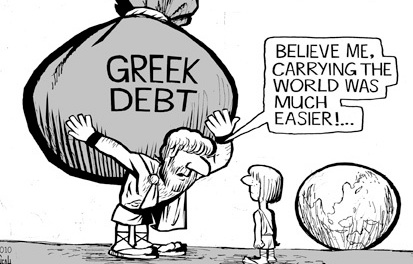
Greek Debt

Greece: Debtors and Creditors

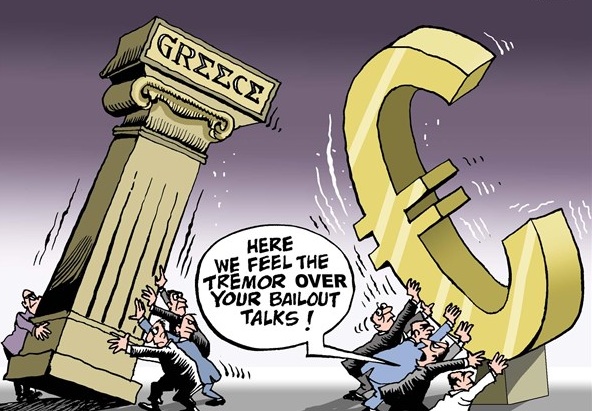
James Galbraith writes:  The International Monetary Fund’s chief economist, Olivier Blanchard, recently asked a simple and important question: “How much of an adjustment has to be made by Greece, how much has to be made by its official creditors?” But that raises two more questions: How much of an adjustment has Greece already made? And have its creditors given anything at all?

The IMF initially projected that Greece’s real (inflation-adjusted) GDP would contract by around 5% over the 2010-2011 period, stabilize in 2012, and grow thereafter. In fact, real GDP fell 25%, and did not recover. And, because nominal GDP fell in 2014 and continues to fall, the debt/GDP ratio, which was supposed to stabilize three years ago, continues to rise.

Greece agreed “to generate enough of a primary surplus to limit its indebtedness” and to implement “a number of reforms which should lead to higher growth.” Those so-called reforms included sharply lower public spending, minimum-wage reductions, fire-sale privatizations, an end to collective bargaining, and deep pension cuts. Greece followed through, but the depression continued.

The IMF and Greece’s other creditors have assumed that massive fiscal contraction has only a temporary effect on economic activity, employment, and taxes, and that slashing wages, pensions, and public jobs has a magical effect on growth. This has proved false. Indeed, Greece’s post-2010 adjustment led to economic disaster – and the IMF’s worst predictive failure ever.

Blanchard should know better than to persist with this fiasco. Once the link between “reform” and growth is broken – as it has been in Greece – his argument collapses.

Apart from pensions and wages, spending has already been “cut to the bone.” And remember: the effect of this approach on growth was negative. So, in defiance of overwhelming evidence, the IMF now wants to target the remaining sector, pensions, where massive cuts – more than 40% in many cases – have already been made. The new cuts being demanded would hit the poor very hard.

Pension payments now account for 16% of Greek GDP precisely because Greece’s economy is 25% smaller than it was in 2009.

To get pensions down by one percentage point of GDP, nominal economic growth of just 4% per year for two years would suffice – with no further cuts. Why not have “credible measures” to achieve that goal?

This brings us to Greek debt. As everyone at the IMF knows, a debt overhang is a vast unfunded tax liability.

Greece’s debt has not been sustainable at any point during the last five years, and that it is not sustainable now. On this point, Greece and the IMF agree.

In fact, Greece has a credible debt proposal. First, let the European Stabilization Mechanism (ESM) lend €27 billion ($30 billion), at long maturities, to retire the Greek bonds that the European Central Bank foolishly bought in 2010. Second, use the profits on those bonds to pay off the IMF. Third, include Greece in the ECB’s program of quantitative easing, which would let it return to the markets.

Now it is the IMF’s turn, beginning with the decision to admit that the policies it has imposed for five long years created a disaster. For the other creditors, the toughest choice is to admit – as the IMF knows – that their Greek debts must be restructured. New loans for failed policies – the current joint creditor proposal – is, for them, no adjustment at all.

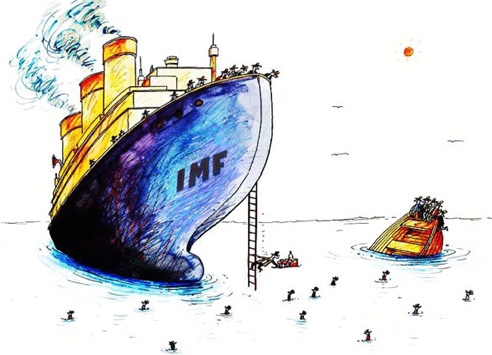
IMF to Greece


How to Adjudicate Disputes in Global Trade

On the rocky road to globalization

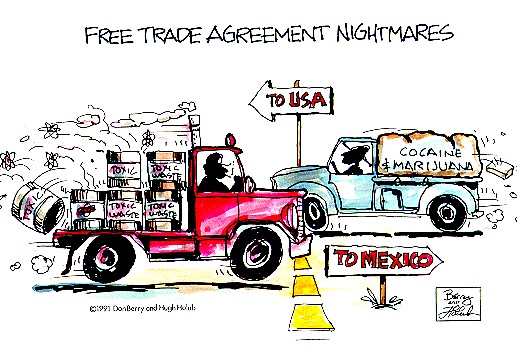
James Surowiecki targets the problems with the Trade Agreement, which in part arise from lack of transparency, and the failure of anyone to stand up and explain the deal.  Surowiecki targets the Investor State Dispute Settlement created to resolve issues when a foreign company does business in a local country.  Disputes are currently settled not in the country where business is being conducted, but rather by a panel of three international lawyers.  This has become such a popular way to resolve matters that law schools now teach courses on the subject.

Lise Johnson, the head of inbestment law and policy at the Columbia Center on Sustainable Investment said, “ISDS was originally meant to protect investors against seizure of their assets by foreign governments.  Now ISDS lawsuits go after things like cancelled licenses, unapproved permits, and unwelcome regulations.”

Practically speaking, the ISDS style provisions may have made sense at one time.  Now they are outdated and unnecssary.  Including them in trade agreements undermines the broader case for free trade by “making it look like exctly what people fear–a system desgined to put corporate interests above public ones.”

Gunboats used to achieve what ISDS may have achieved for a time.  Neither are necessary today.

Trade

Warren v Dimon: Warren Wins Hands Down

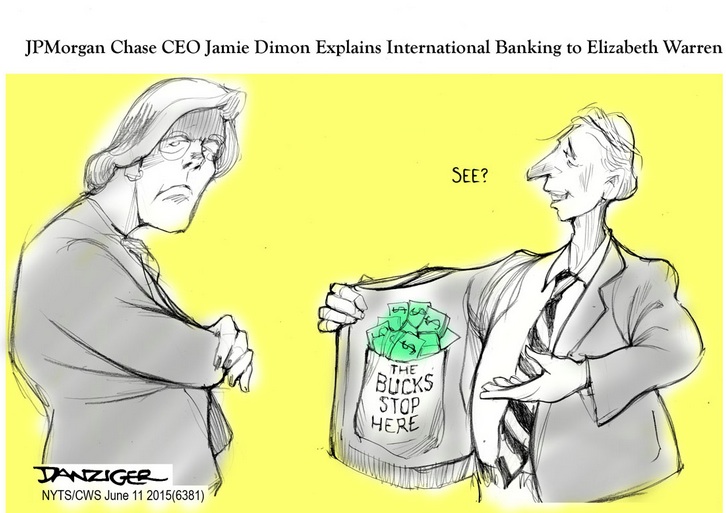
Charles Gasparino writes:  The problem isn’t Dimon’s mansplaining. It’s that Warren is telling a truth no one else will tell: Big banks aren’t free-market at all.

Warren says these big bank institutions should be broken up by the government out of fear that the system could implode as it did in 2008.

Dimon says the good senator should stick to making sure the Community Redevelopment Act is enforced and other pet lefty projects because she doesn’t “fully [understand] the global banking system.”

For once we have a leader in Washington, namely Warren, telling us what most of the political class and the bankers won’t: The banks are not free-market at all. They are big, government-protected entities that will be bailed out the next time a 2008 scenario comes around.

And the best way to make sure they don’t end up costing the taxpayers more money will be to make them smaller, which is about as close to a free-market statement as you might find on this subject, courtesy of Sen. Warren.

The dirty secret in Washington and Wall Street that Warren is exposing is that banks like JP Morgan, Citi, and B of A will always be on the government’s protected-species list because of a little thing known as deposit insurance, which covers bank deposits up to $250,000.

These banks just don’t take in deposits and lend them out so people can buy homes and so on anymore. Thanks in large part to Hillary Clinton’s husband, banks combine these commercial banking activities with Wall Street risk-taking.

Meanwhile, JP Morgan has a whopping $1.4 trillion in deposits. A massive screwup on its trading desk or some 2008-like event that leads to insolvency could mean the taxpayer is on the hook for a chunk of that money—a number, I might add, that could dwarf the $800 billion stimulus package President Obama  blew through during the Great Recession.

What free-marketer would allow the American taxpayer to subsidize Jamie Dimon’s risk-taking?

Again, the Dodd-Frank Act was supposed to get rid of Too Big to Fail, but the reality that Warren is at least honest about is that it hasn’t:

What’s great about the Warren vs. Dimon feud is that it both exposes Wall Street’s real crony capitalism roots and the hypocrisy of Hillary Clinton remaking herself in the Elizabeth Warren class-warrior mode. Yes it was Bill Clinton who enacted one of the least thought-out banking laws back in 1999 that made it legal to combine commercial-banking activities with Wall Street-style risk-taking.

The result of what was known as the Gramm-Leach-Bliley Financial Services Modernization Act was the permanent dismantling of the Glass-Steagall Act, which made it illegal to mix bond trading with deposit-taking.

The law paved the way for the creation of the financial supermarket known as Citigroup, which would go on to hire Clinton Treasury Secretary Robert Rubin as one of its top executives and board members. Hillary Clinton has collected hundreds of thousands of dollars in speaking fees from bankers.

She won’t of course, but Warren should be given credit for explaining just how protected and coddled banks still are in many ways, thanks to the Clintons and their unholy alliance with Wall Street. Dimon’s comments about Warren are shocking only because they were made honestly and publicly.

Why should taxpayers subsidize his paycheck, which goes up with every successful trade? My advice: If Jamie Dimon wants to roll the dice in the derivatives markets, he should first be forced to give up his access to FDIC insurance on JP Morgan’s deposits.

I’m pretty sure Adam Smith and Elizabeth Warren would agree.
Warren v Dimon

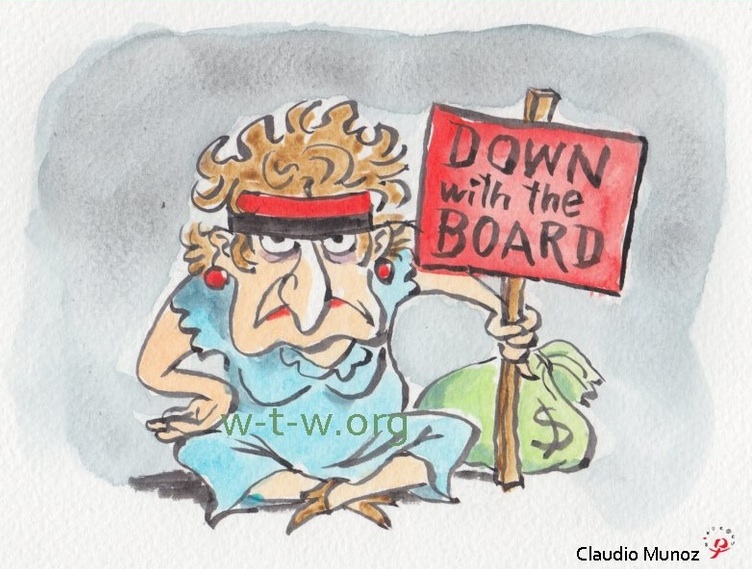
How Do Women Get On Board?

An interesting study on the policy of getting women on has been published.  Women on Boards

Women on Boards

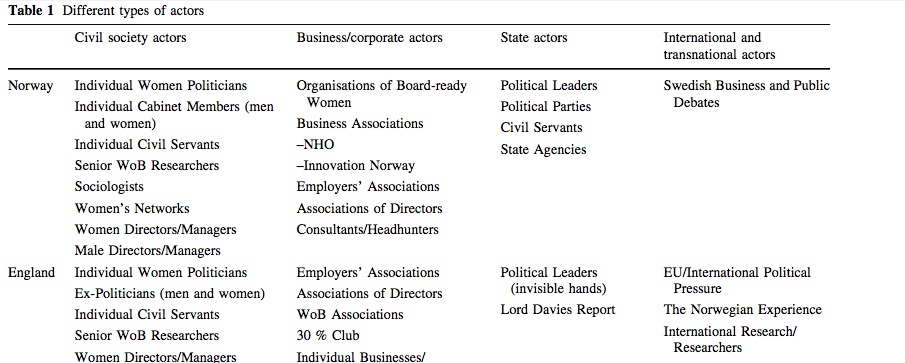
The study introduces the actors who make the implementation of this policy possibile.  Here are the four crucial elements:

1.  Women mobilize for quotas to be instituted for women’s representation on boards.

2.  Political elites recognize the strategic advanages for pursuing quotas.

3. Quotas are consistent with existing or emerging notions of equality.

4.  Quotas are supported by international norms and spread through transnational sharing.

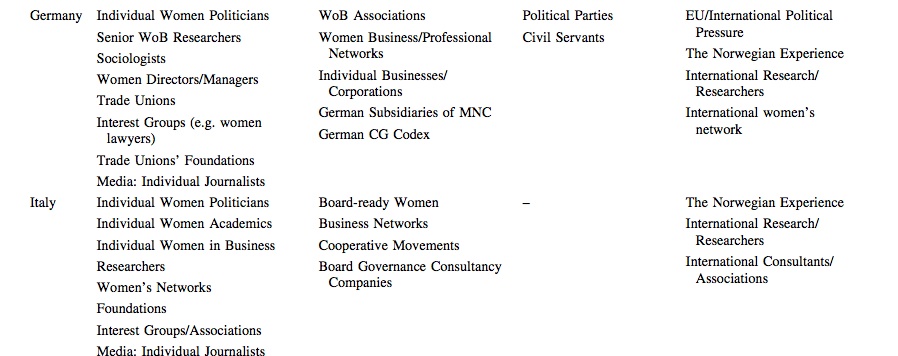
The study is dynamic.  Actors who participate in the process are shown at work.  What determines national public policy initatives to increase the presence of women on boards?

Women on Board  Types of Actors

 Actors in Four European Countries

Greece’s Choice?

Two extreme scenarios face Greece: accept the creditors’ final offer or leave the eurozone. By accepting the offer, Grrece would have to agree to a fiscal adjustment of 1.7 per cent of gross domestic product within six months.

Martin Sandbu calculated how an adjustment of such scale would affect the Greek growth rate. I have now extended that calculation to incorporate the entire four-year fiscal adjustment programme, as demanded by the creditors. Based on the same assumptions he makes about how fiscal policy and GDP interact, a two-way process, The Greek debt-to-GDP ratio would start approaching 200 per cent. The acceptance of the troika’s programme would constitute a dual suicide — for the Greek economy, and for the political career of the Greek prime minister.

Would the opposite extreme, Grexit, achieve a better outcome? You bet it would, for three reasons. The most important effect is for Greece to be able to get rid of lunatic fiscal adjustments. Greece would still need to run a small primary surplus, which may require a one-off adjustment, but this is it.

Greece would default on all official creditors — the International Monetary Fund, the European Central Bank and the European Stability Mechanism, and on the bilateral loans from its European creditors. But it would service all private loans with the strategic objective to regain market access a few years later.

The second reason is a reduction of risk. After Grexit, nobody would need to fear a currency redenomination risk. And the chance of an outright default would be much reduced, as Greece would already have defaulted on its official creditors and would be very keen to regain trust among private investors.

The third reason is the impact on the economy’s external position. Unlike the small economies of northern Europe, Greece is a relatively closed economy. About three quarters of its GDP is domestic. Of the quarter that is not, most comes from tourism, which would benefit from devaluation. The total effect of devaluation would not be nearly as strong as it would be for an open economy such as Ireland, but it would be beneficial nonetheless. Of the three effects, the first is the most important in the short term, while the second and third will dominate in the long run .

A sudden introduction of a new currency would be chaotic. The government might have to impose capital controls and close the borders. Those year-one losses would be substantial, but after the chaos subsides the economy would quickly recover.

So if this were the choice, the Greeks would have a rational reason to prefer Grexit. This will, however, not be the choice to be taken this week. The choice is between accepting or rejecting the creditors’ offer.

The eurozone creditors may well decide that it is in their own interest to talk about debt relief for Greece at that point. Just consider their position. If Greece were to default on all of its official-sector debt, France and Germany alone would stand to lose some €160bn. Angela Merkel and François Hollande would go down as the biggest financial losers in history. The creditors are rejecting any talks about debt relief now, but that may be different once Greece starts to default. If they negotiate, everybody would benefit.

The bottom line is that Greece cannot really lose by rejecting this week’s offer.

Grexit?

Is Grexit Inevitable?

IMF chief Christine Lagarde couldn’t “preclude” a Greek exit, after four months of tortuous bail-out talks that have failed to get both sides closer to a deal to release aid to the country.

But Greece didn’t come up at all during a formal symposium session when finance ministers and central bank chiefs listened to short speeches by leading economists on how to boost growth momentum, a German G7 delegation source said.

A so-called “Grexit” was not a scenario that Moscovici thought likely, however, and he said the Commission was “dedicated” to keep Greece in the euro zone.

Tsakalotos, who has infused a more measured tone into the talks, blamed some of the lack of headway on the hardened stance of the IMF.

“The IMF is being very, very tough on all the issues and not really engaging in proper discussion”, Tsakalotos said.

The United States dollar on Thursday hit its highest against the yen since 2002 while stocks fell after Chinese brokerages tightened margin rules and the IMF head played down talk of an imminent deal to keep Greece afloat.  But “one won’t happen without the other”, he insisted.

The Greek government was warned on Thursday that it only had a few days to reach a deal otherwise there wouldn’t be enough time for eurozone parliaments to agree to the disbursal of new loans before the end of the month, when the current program extension ends.  “The Greek government has still not made it clear how it intends to make the 1.6-billion-euro repayment, the first tranche of which falls due next Friday”.

‘Any country that doesn’t meet its commitment with the Fund…is declared in arrears and they have no access to IMF funding, ‘ he said, adding that he expected Athens wouldn’t miss any payments.

Greece’s conservative opposition criticized the government’s handling of the negotiation. “We are going into these negotiations with the aim to have an agreement with our partners by Sunday”. But it looks increasingly likely that it will have to compromise.

“In the absence of a quick agreement on structural implementation needs, the risk of an upward adjustment of the risk premia demanded on vulnerable euro area sovereigns could materialise” noted the ECB’s bi-annual financial stability report.

He called for agreement quickly on the broad terms of a deal to avoid the risk of stumbling on hard details at the last moment: “I think waiting until the day or two before whatever the deadline is, is just a way of courting an accident”.

Grexit?

IMF to Help Ukraine

Triple C rated Ukraine will keep getting money from the International Monetary Fund even as bond lords fret over whether or not they’ll ever see a dime for lending to them.

IMF chief Christine Lagarde said in an open letter to the financial community that the the bailout fund was standing by. Lagarde said that the National Bank of Ukraine (NBU) cannot be counted on to use its reserves to pay for interest on bonds. Most emerging markets keep foreign reserves in order to lower credit risk. Lenders often use reserves as a gauge to a government’s ability to service its debt.

“The NBU’s international reserves cannot be used for sovereign debt service without the government incurring new debt,” she said in a statement to the market. “Ukraine’s debt repayment capacity is limited by its fiscal capacity. Since Ukraine lacks the resources under the program to fully service its debts…in the event that a negotiated settlement with private creditors is not reached and the country determines that it cannot service its debt, the Fund can lend to Ukraine.”

In other words, IMF member states will help Ukraine pay emerging market bond fund managers and banks. They will undoubtedly receive a haircut on the principal amount.

Ukraine owes the IMF $18 billion over the next four years. Defaulting on the its debts will plug the $15 billion hole in the funding the IMF is providing Ukraine.

 IMF to Ukraine

Expanding the Suez

Egypt will inaugurate a “new Suez canal” shipping route in August aimed at speeding up traffic along the existing waterway and boosting revenues.  Dubbed the Suez Canal Axis, the new 72-kilometre (45 mile) project will run part of the way alongside the existing canal that connects the Red Sea to the Mediterranean.  It involves 37 kilometres of dry digging and 35 kilometres of expansion and deepening of the Suez Canal, in a bid to help speed up the movement of vessels.

Once the president inaugurates it, vessels will start moving through the new waterway,.  Eighty-five percent of the project that is being executed by the army has been completed so far.

President Abdel Fattah al-Sisi launched the project in August and set an ambitious target of digging the new canal in one year.

The project is part of an ambitious plan to develop the zone around the canal into an industrial and commercial hub, that would include the construction of ports and provide shipping services.

Authorities raised $9 billion (7.9 billion euros) to build the new canal by selling shares in the project to domestic investors, with private Egyptian companies tasked with its construction.

The new canal is expected to more than double Suez revenues from $5.3 billion expected at the end of 2015 to $13.2 billion in 2023, according to official estimates.

The new canal is considered a “national project” that aims to kick-start an economy battered by years of political turmoil since the ouster of president Hosni Mubarak in 2011   About 250 million cubic metres (8.8 billion cubic feet) of soil that had to be dredged, 219 million had already been dealt with.

The main idea behind the expansion is to reduce the waiting period of vessels.  By building this new canal, we are serving the whole world and international trade… By bringing the waiting hours down to 11 from 22… this makes it one of the fastest waterways in the world.

Built 146 years ago, the existing Suez Canal is one of the world’s most heavily used shipping lanes and has been a key source of international trade, earning Egypt billions of dollars in annual revenues.

The canal is a symbol of prestige and national pride for Egypt, apart from being vital for its economic stability.

Suez Canal