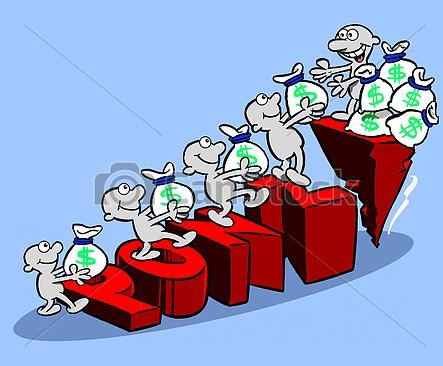
Ponzi Schemes in India?

Reserve Bank of India (RBI) Deputy Governor S S Mundra stressed on the need for a stronger regulatory framework to deal with the menace of Ponzi schemes across the country. He agreed the system also needs to shoulder the blame for such fraudulent investment schemes.

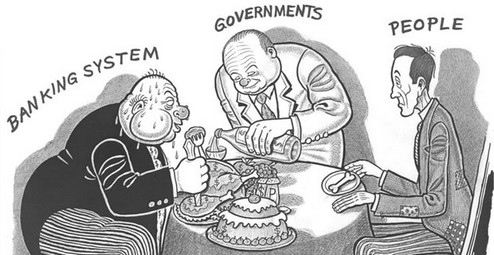
“The banking system plays a very important role and it has to share a fair share of the blame as ultimately, whatever the shape and size of the scheme, ultimately, the money goes through the banking system,” said Mundra at the Multidisciplinary School of Economic Intelligence at National Academy of Customs, Excise and Narcotics.

He added the new small and payments banks will help in furthering the case of financial inclusion, which will reduce the number of people falling prey to such schemes. The increased reliance on business correspondents in reaching out to people has also helped in expanding the ambit of people who can bank through authorised channels.
The need for a stronger regulatory framework to ensure such schemes can be nipped in the initial days was also stressed.

“One important thing we have seen in recent deliberations is that many Ponzi schemes are falling under a regulatory vacuum, as there is no clarity on whose regulatory turf it falls in, and therefore remains a grey area,” said Mundra.
In April, Anil Sinha, director, Central Bureau of Investigation (CBI) had said around Rs 80,000 crore of public money was locked in only those Ponzi scams that was being investigated by CBI.

Financial illiteracy, apart from greed, was another important factor that has led people to invest in Ponzi schemes. In order to correct this, the regulator has been reaching out to people via advertisements and workshops. He added there was a case for strengthening the State Level Coordination Committee (SLCCs).
“There is a need to make the SLCCs more active and effective. The project is already underway whereby a website within the overall website of RBI for the SLCCs members will be there. The idea is that it should be interactive, so that anything that comes to someone’s notice can be reported on the site and then action can be taken,” added Mundra.

Ponzi Scheme

Loans or Subsidies for Sugar in India

Sanjay Jog writes: The cooperative sugar industry in Maharashtra is not amused by the Centre’s decision to provide interest-free loans of Rs 6,000 crore.
Mills have instead made a fresh appeal to the Centre to provide financial support of Rs 850 a ton, create a buffer stock of five million tons, and extend till 2019-20 the Rs 4,000 a ton raw sugar incentive announced recently.

Cooperative sugar industry leaders, belonging to the Congress and the Nationalist Congress Party, argued the interest-free loan of Rs 6,000 crore would not address the issue of cane arrears to farmers and repayment of debts and working capital for the crushing season 2014-15.

Maharashtra’s sugar mills have Rs 3,400 crore of cane arrears. Of this, cooperative factories owe Rs 1,900 crore. They have blamed their condition on the fact that the prevailing sugar price is Rs 2,100-2,300 a quintal against a cost of production of Rs 3,200-3,400 a quintal.

Maha co-operative sugar factories to meet CM on June 10 for aid In all, 178 sugar factories participated in the crushing season 2014-15 and produced more than 10.5 million tonnes of sugar.  “The government’s decision to provide an interest-free loan of Rs 6,000 crore will not provide much relief to cooperative sugar mills. The balance sheet of the most of these mills will continue to be in the red. The government needs to provide financial support of Rs 850 a tonne and also take steps for restructuring of loans,” Sanjeev Babar, managing director of the Federation of Cooperative Sugar Factories in Maharashtra, told Business Standard.

He added a large number of cooperative sugar mills feared banks would not lend them money because of their negative net worth.

Meanwhile, cooperative sugar mills await the release of Rs 2,000 crore interest-free loans announced by Maharashtra Chief Minister Devendra Fadnavis in April. The state government has indicated that the sugar industry should not expect further subsidy from it.

Sugar Cane

Noise in Finance?

Philip Pilkington writes: The financial economist Fischer Black – a mathematics PhD and founder of the popular Black-Scholes model of options-pricing that is much used today. In 1986 Black published a paper entitled simple “Noise” that is well-nigh unreadable. One gets the sense that “noise” for Black is a sort of ontological category that disturbs his sense of reality. “Noise” for Black is the equivalent to what “Sin” is to Christians. Everything bad in the otherwise harmonious world can be attributed to this ontological category “noise”. In this regard it is worth quoting from the abstract – which, it will be seen, is so poorly written as to be barely readable.

The effects of noise on the world, and on our view of the world, are profound… Noise in the form of expectations that need not follow rational rules causes inflation to be what it is… Most generally, noise makes it very difficult to test either practical or academic theories about the way that financial or economic markets work. We are forced to act largely in the dark.   Noise in Finance

Finance?

Why US Doesn’t Prosecute US Banks?

We have known from the beginning that Lanny Breuer, who the Obama administration chose as its head of the Criminal Division in order to ensure that there would be no prosecutions of the banksters that led, and were enriched by the fraud epidemics that drove the crisis, would be a national embarrassment.

Breuer publicly admitted that what caused him to lose sleep was not the world’s most destructive fraud epidemics that ruined our economy or his grant of effective immunity to the banksters who led and became wealthy through those frauds. He lost sleep solely over his fear that if he held them accountable for the frauds that had bankrupted their corrupt banks those banks might be placed in receivership and honest managers appointed. (Of course, that isn’t how he phrased it, but that is what he was actually saying.)  Prosecuting Banks

Prosecuting Banks


Japan’s GDP

The change in the first quarter estimate (first graph below) was not enough for Japan’s GDP to rise above the level it had in the second half of 2013 and after the first quarter of 2014 (see second graph below).

japan.gdp.quarterly.growth.rate.2015.june.08

japan.real.gdp.2015.june.08

Sources:

Merkel and Finance Minister Schaeuble Quarrel over Greece

A split between German Chancellor Angela Merkel and Finance Minister Wolfgang Schaeuble is widening over Greece as the funding standoff goes down to the wire, said people familiar with the matter.

Merkel is ready to make concessions to keep Greece in the euro because of geopolitical concerns, while Schaeuble is willing to let the country exit the euro unless its government takes measures to ensure the country’s long-term survival in the monetary union.

That divide is also reflected in Merkel’s parliamentary caucus, which is increasingly uneasy with letting the 41-member budget committee decide on disbursing any aid to Greece and is looking instead at a vote of the lower house of parliament on a deal that includes changes to previous agreements.

While Merkel has repeatedly said she’ll keep working to allow Greece to stay in the euro area, Schaeuble has emphasized that the contagion risk from the country possibly exiting the bloc is “marginal.”
Merkel and Schaeuble Rush to Greece


China’s Debt Bubble?

On 22 March 2015, Christine Lagarde — the managing director of the International Monetary Fund (IMF) — made an important speech in Beijing. Madame Lagarde outlined the dangers of US Federal Reserve tightening for emerging markets. Her warning was stark:

‘The world has yet to achieve full economic recovery. Global growth continues to be weighed down by high debt, high unemployment and lacklustre investment…

‘The recovery remains fragile because of significant risks. One such risk emanates from the expected tightening…of US monetary policy at a time when many other countries are easing…

‘The divergence of monetary policy paths has already led to a significant strengthening of the US dollar. Emerging markets could be vulnerable, because many of their banks and companies have sharply increased their borrowing in dollars…

‘The potential spillovers would affect China mostly through its trade relationships with other emerging markets…Chinese exports would certainly be affected.’.

The problem is that Madame Lagarde has only addressed half the problem for China — the impact on trade. She has glossed over the more dangerous half of the problem — the impact on China’s debt.

The analysis is straightforward. The Federal Reserve has been flirting with tightening policy since Ben Bernanke’s May 2013 speech in which he introduced the idea of reducing, or ‘tapering’, Fed bond purchases.

This led to the infamous taper tantrum of May–July 2013 in which leveraged investors involved with the dollar carry trade dumped stocks and currencies in emerging markets and repaid dollar-denominated debt.

Through late 2013 and all of 2014, the Fed did follow through with its tapering plans, but borrowers in emerging markets did not reduce their dollar debts. The problem now was not US-based leveraged traders, but the emerging-market borrowers themselves. They borrowed US dollars even though their central banks had no ability to print dollars — only the Fed can do that.

The result was what I call the ‘New Big Short’. Emerging-market borrowers are ‘short’ over US$9 trillion…with no ability to print.

A dangerous picture
Lagarde’s point was that when the Fed does raise rates, there will be enormous capital flight and financial distress in emerging markets around the world. This distress will hurt the ability of these countries to buy Chinese exports, which will have some negative impact on the Chinese economy.

That’s half right. Distress in emerging markets will hit Chinese exports. But Lagarde ignored the fact that China is itself an emerging market and has one of the most highly leveraged economies in the world, including the largest amount of dollar-denominated debt of any emerging-market borrower.

Here’s a chart showing the recent increase in private leverage in China:

When you add government leverage to private leverage, the picture is even more dangerous:

As the Fed prepares to raise rates, a dual crisis confronts China. Its export markets will dry up, exactly as Lagarde suggests, but it will also face a debt crisis. Blind to the risks


HSBC Shrink and Pivot East?

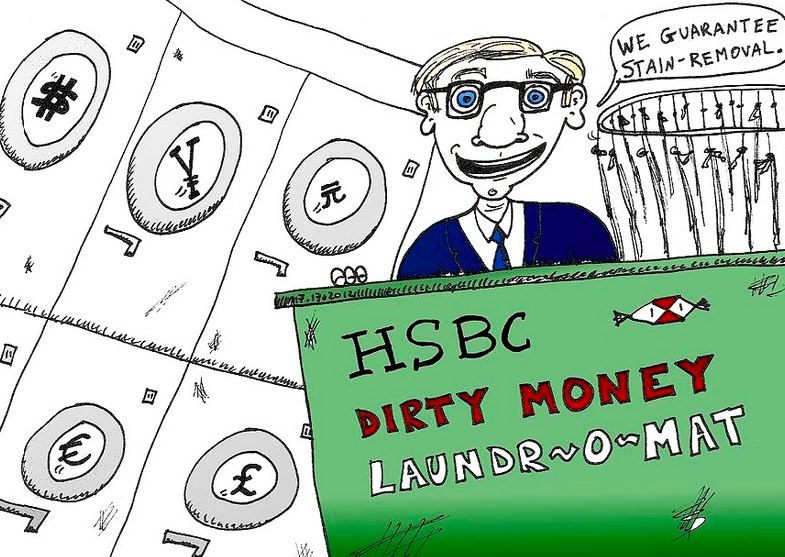
HSBC began in Hong Kong during the colonial period.  Pummelled by regulators in the UK where its headquarters are now located and looking at drramatic rises in GNP in Asia, HSBC is contemplating a move back to its roots in Hong Kong.

Deutsche Some and  other big banks having probelm in thier home countries are looking to retrench.  Few have HSBC’s history.

With the exception of CItibank in the US, most of the big banks weathered the most recent financial crisis well.  Part of this came from their presence across the globe.

Where bigs will operate and how big they will be are questions on the table now.

HSBC Pivot?


Should We Decriminalize Drugs?

Christopher Ingraham writes:  Portugal decriminalized the use of all drugs in 2001. Weed, cocaine, heroin, you name it — Portugal decided to treat possession and use of small quantities of these drugs as a public health issue, not a criminal one. The drugs were still illegal, of course. But now getting caught with them meant a small fine and maybe a referral to a treatment program — not jail time and a criminal record.

Whenever we debate similar measures in the U.S. — marijuana decriminalization, for instance — many drug-policy makers predict dire consequences. “If you make any attractive commodity available at lower cost, you will have more users,” former Office of National Drug Control Policy deputy director Thomas McLellan once said of Portugal’s policies.

But in Portugal, the numbers paint a different story. The prevalence of past-year and past-month drug use among young adults has fallen since 2001, according to statistics compiled by the Transform Drug Policy Foundation, which advocates on behalf of ending the war on drugs. Overall adult use is down slightly too. And new HIV cases among drug users are way down.

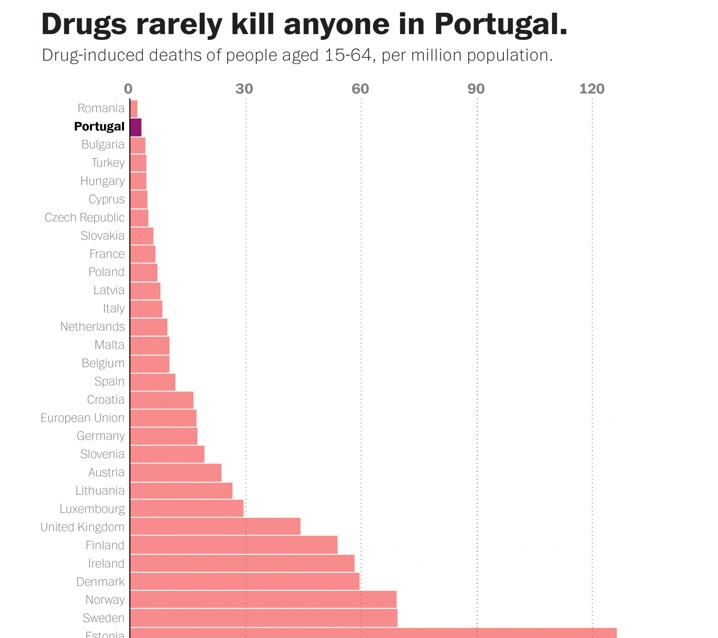
Now, numbers just released from the European Monitoring Centre for Drugs and Drug Addiction paint an even more vivid picture of life under decriminalization: drug overdose deaths in Portugal are the second-lowest in the European Union.

Among Portuguese adults, there are 3 drug overdose deaths for every 1,000,000 citizens. Comparable numbers in other countries range from 10.2 per million in the Netherlands to 44.6 per million in the U.K., all the way up to 126.8 per million in Estonia. The E.U. average is 17.3 per million.

Perhaps more significantly, the report notes that the use of “legal highs” — like so-called “synthetic” marijuana, “bath salts” and the like — is lower in Portugal than in any of the other countries for which reliable data exists.

Drug use and drug deaths are complicated phenomena. They have many underlying causes. Portugal’s low death rate can’t be attributable solely to decriminalization.

The reality is that Portugal’s drug situation has improved significantly in several key areas. Most notably, HIV infections and drug-related deaths have decreased, while the dramatic rise in use feared by some has failed to materialise.

As state legislatures debate with issues like marijuana legalization and decriminalization in the coming years, Portugal’s 15-year experience may be informative.

Drug Deaths

Poverty and the Developing Brain

Madeline Ostrander writes: The brain’s foundation, frame, and walls are built in the womb. As an embryo grows into a fetus, some of its dividing cells turn into neurons, arranging themselves into layers and forming the first synapses, the organ’s electrical wiring. Four or five months into gestation, the brain’s outermost layer, the cerebral cortex, begins to develop its characteristic wrinkles, which deepen further after birth. It isn’t until a child’s infant and toddler years that the structures underlying higher-level cognition—will power, emotional self-control, decision-making—begin to flourish; some of them continue to be fine-tuned throughout adolescence and into the first decade of adulthood.

Pat Levitt, a developmental neuroscientist at Children’s Hospital Los Angeles, has spent much of his career studying the setbacks and accidents that can make this construction process go awry. In the nineteen-nineties, during the media panic over “crack babies,” he was among a number of scientists who questioned whether the danger of cocaine exposure in utero was being overstated. (Levitt spent two decades examining the brains of rabbit mothers and their offspring that were dosed with the drug, and says that the alarm was “an exaggeration.”) More recently, as the science director of the National Scientific Council on the Developing Child, he has become interested in another sort of neurotoxin: poverty.

As it turns out, the conditions that attend poverty—what a National Scientific Council report summarized as “overcrowding, noise, substandard housing, separation from parent(s), exposure to violence, family turmoil,” and other forms of extreme stress—can be toxic to the developing brain, just like drug or alcohol abuse.  Poverty and the Developing Brain

Poverty and the Developing Brain