Russia: A Failed State?

Ivan Suhkov writes in the Moscow Times:  Crimea symbolizes revenge — in the Soviet, political and negative sense of the word. A more accurate word is “restoration” — a restoration of the state and its rights that were allegedly violated.

By reinstating the Soviet anthem, imposing a power vertical, giving greater social and political importance to siloviki structures — particularly the secret police — and reintroducing Crimea into the country’s daily weather forecasts, Yeltsin’s successor, Vladimir Putin, has symbolically restored the Soviet Union.

However, advocates of restoration tend to miss one important point: both the Russian Empire and the Soviet Union ended in failure and collapse — the former in 1917, the latter less than a century later in 1991.

The search for a new doctrine did not end unsuccessfully because it never really began.

To appreciate that this process did not begin with the absurd ban on the “falsification of history” or the “new historiography” trumpeted by Culture Minister Vladimir Medinsky, just peruse the preamble of the Russian Constitution.

It speaks of “historically established state unity,” “revering the memory of ancestors who have passed on to us their love for the fatherland” and “reviving the sovereign statehood of Russia.”

On Nov. 19, an Investigative Committee task force teamed up with riot police in an attempt to detain a citizen allegedly involved in the criminal withdrawal of a huge sum of money. The person’s name is not as important as the fact that the police staged the operation in the center of Moscow in broad daylight against the backdrop of an unprecedented level of excitement over the revival of the Russian state.

The police operation was a complete failure.

To better understand the circumstances, note that the figure sought by police is Ramzan Tsitsulayev, whom Chechen leader Ramzan Kadyrov named one year ago as that republic’s envoy to Ukraine. The men who managed to thwart the sting operation were Chechens, and the region where Tsitsulayev is hiding out — and from where he mocks the Moscow police — is, of course, Chechnya.

That is the same republic where Moscow began operations 20 years ago to “restore constitutional order.”

Two weeks ago Moscow police detained and drove off with Magomed Aliyev, a young native of Dagestan who had come to visit his sister.  Aliyev resurfaced at a detention center in Stavropol, a regional center and a sort of outpost of the federal authorities in the North Caucasus. Aliyev was urgently hospitalized on Nov. 26 after he was repeatedly beaten and someone jabbed a pen in his eye.

Regardless of any crime the young man might have committed, the actions of the siloviki far overstep the bounds of legal procedure. It might seem that Stalinist terror and a failed state are at opposite ends of the spectrum. But terror, by definition, is an act that bypasses the rule of law and so indicates the failure of the state.

In one way or another, former Soviet leader Josef Stalin is the focus of many current leaders’ ideas concerning “restoration.” They erroneously quote Churchill — namely, that “Stalin came to power when Russia had only a wooden plow, and left it in possession of atomic weapons.”

It so happens that the world has never had to cope with a failed state holding a nuclear arsenal large enough to destroy all of humanity several times over. The world barely managed to avoid such a threat in 1991, but only with some intense diplomacy, significant financial outlays and a whole lot of nail-biting.

Russian fans of “reconstruction” would like a replay of those times. And despite blithe assurances from the Defense Ministry that the command and control structure of the country’s nuclear arsenal has been fully modernized, there is no guarantee that the final act in this dark drama will end as peacefully as it did the first time.
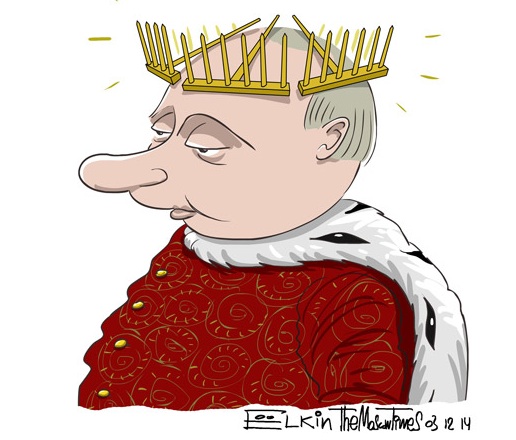
Putin


Kickbacks Rampant in Brazil

Paulo Roberto Costa, who is himself under investigation for his alleged involvement in a kickback scheme at Petrobras, said such practices happened “all over Brazil”.  He said corruption was an accepted way of doing business there.

The Petrobras scandal is believed to be one of the biggest in Brazil’s history.  Mr Costa was arrested in March.  As part of a plea bargain, he helped uncover a scheme that allegedly used inflated Petrobras contracts to funnel money to parties of the governing coalition.

President Dilma Rousseff, a former Petrobras chair, denies any knowledge of bribery.

Mr Costa said he had given investigators the names of dozens of politicians who received payments in the Petrobras case.  But he said the practice went much further than Petrobras.  “What has been reported occurring at Petrobras happens all over Brazil in contracts for roads, railways, ports, airports, hydroelectric dams,” Mr Costa told the congressional committee.

Prosecutors are investigating a number of other state-run companies and police last month arrested more than 20 executives of some of the country’s largest construction and engineering firms in connection with the probe.

In the wake of the arrests, President Rousseff called the case “symbolic” and said it could change the country forever.  Petrobras is not only the largest but also one of the most internationally recognised firms in Latin America.

Kickbacks in Brazil


More Deposits, More Loans? Not Necessarily

Matthew Plosner, an economist with the New York Federal Reserve, asks why banks keep unexpected deposit money instead of paying down debt or lending it.

For banks in energy-producing areas, there are three major uses of the deposit windfall: they can make more loans, invest in liquid assets, and pay down debt. If loan demand falls, all else being equal, other uses of funds should increase. Therefore, I should see both increased allocations to liquid assets and increased paydown of debt. In the pre-recessionary period, 2003-07, 9 percent of the deposit inflow is allocated to debt paydown. However, when loan allocations fell during the recession, banksreduced debt paydown and increased liquid asset allocations. The pattern of activity is not consistent with the falling loan demand narrative.

Finally, if the cause is a shortage of demand for loans, larger banks with a wider footprint should be better able to find uses for funds. A test to see if banks operating in more counties exhibit a stronger lending propensity during this period does not detect a meaningful difference; banks with more than one branch lend slightly more, but the difference is small and not statistically significant.

The development of unconventional energy provides a unique laboratory to observe how banks allocate unsolicited deposits. The ability of affected banks to allocate deposits toward loans varied significantly over the business cycle. While loan demand may have declined in the crisis, it does not easily explain why banks reduced both debt paydown and lending in order to hold cash and securities. When I compare different types of banks, I observe banks that lack access to non-deposit financing and banks with less tolerance for risk are more sensitive to the business cycle, consistent with a heightened demand for precautionary liquidity. The results highlight heterogeneity in banks’ response to the business cycle that can impede capital reallocation during downturns.

Bank Deposits


Post Brisbane Black and Blues

Ellen Brown writes:  Did the G20 know what they were doing when they whisked into Brisbane, posed for their photo ops, approved some proposals, made a show of roundly disapproving of Russian President Vladimir Putin, and whisked out again. It was all so fast, they may not have known what they were endorsing when they rubber-stamped the Financial Stability Board’s “Adequacy of Loss-Absorbing Capacity of Global Systemically Important Banks in Resolution,” which completely changes the rules of banking.

Deposits are now “just part of commercial banks’ capital structure.” That means they can be “bailed in” or confiscated to save the megabanks from derivative bets gone wrong.

Rather than reining in the massive and risky derivatives casino, the new rules prioritize the payment of banks’ derivatives obligations to each other, ahead of everyone else. That includes not only depositors, public and private, but the pension funds that are the target market for the latest bail-in play, called “bail-inable” bonds.

“Bail in” has been sold as avoiding future government bailouts and eliminating too big to fail (TBTF). But it actually institutionalizes TBTF, since the big banks are kept in business by expropriating the funds of their creditors.

It is a neat solution for bankers and politicians, who don’t want to have to deal with another messy banking crisis and are happy to see it disposed of by statute. But a bail-in could have worse consequences than a bailout for the public. If your taxes go up, you will probably still be able to pay the bills. If your bank account or pension gets wiped out, you could wind up in the street or sharing food with your pets.

In theory, US deposits under $250,000 are protected by federal deposit insurance; but deposit insurance funds in both the US and Europe are woefully underfunded, particularly when derivative claims are factored in.

Kept inviolate and untouched in all this are the banks’ liabilities on their derivative bets, which represent by far the largest exposure of TBTF banks.  tt is estimated that American banks have some $280 trillion in derivatives on their books.

All this fancy footwork is to prevent a run on the TBTF banks, in order to keep their derivatives casino going with our money. Warren Buffett called derivatives “weapons of financial mass destruction,” and many commentators warn that they are a time bomb waiting to explode.  When that happens, our deposits, our pensions, and our public investment funds will all be subject to confiscation in a “bail in.”

Post Brisbane Black and Blues

Ruble in Free Fall

Prostitutes in the Russian port of Murmansk hiked their prices 40% as the value fo the ruble fell.  The ruble fell to 54.82 against the dollar and 67.82 to the euro before somewhat recovering.
The rouble has lost more than a third of its value against the dollar and euro since the start of the year.Western sanctions against Russia over Ukraine and the fall in oil prices are hurting the economy.

A decision by the oil producers’ group Opec not to rein in production – which would have bolstered crude prices – sparked a big fall in the rouble. The currency dropped by 9% on Monday – its biggest one-day decline since 1998.

Oil and gas revenues are the biggest single source of revenue for Moscow.

On Monday, Russia’s central bank spent about $700m to support the currency, according to official data.

There were unconfirmed reports on Wednesday that the bank was again intervening to prop up the ruble.

The bank indicated in early November that interventions would be less frequent as part of a plan to let it float freely on the currency markets.

Russian Call Girls Raising Prices

Turkey and Russia Dance

Moscow and Ankara do not really see eye to eye on politics, but despite that have big economic potential, with Turkey considering itself an in-between partner who would take gas from Russia to Europe writes Martin McCauley of the University of London,

From the political point of view Russia and Turkey are poles apart, but from the economic point of view the gas deal and the atomic power plant that is going to be built – that has been on the cards for quite a long time.  Turkey would like the gas pipeline to go through their country because then they collect the rent from it. And also Turkey would like to pipe natural gas from Iran through Turkey to the West. That is blocked by sanctions at present. So Turkey sees itself as the in-between partner who will take gas from Iran and Russia to Europe.

Europeans are softening on sanctions toward Russia. Sanctions are hitting German companies particularly hard. Russia needs thier gas to bring a hundred dollars a barrell.  For whatever reason, Saudi Arabia is not cutting production to get the price up.  TURKEY AND RUSSIA

Turkey and Russia Dance

ECB and QE

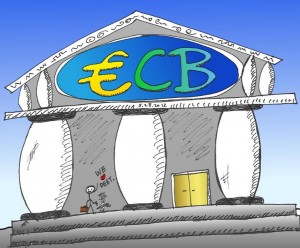
Central banks across the world are filling in where politicians fail.  Europe has an alaraming mix of low growth, high unemployment and shrinking potnetial writes Mohamed A. El=Erian.  The European Central Bank is trying to address issues.  What could be done to help?

Four areas that could be addressed:  Politicians in Italy and France could enhance competitiveness, growth and production.  Second, countries like Germany could increase demand by infrastructure expenditures.  A bigger effort could be made to decrease pockets of indebtedness like Greece.  Fourth, countries could work togehter to supplement monetary union with closer fiscal, banking and political integration.

ECB


New Railway Links Persian Gulf to Central Asia

Ceremony marks opening of the new railway in the Turkmenian village of Ak Yayla, Dec. 3, 2014. Turkmenistan, Kazakhstan and Iran on Wednesday inaugurated the new railway route that will improve resource-rich Central Asia’s access to markets in the Middle East and South Asia.

The the presidents of Iran, Kazakhstan and Turkmenistan attended the official opening of the line in the Turkmen frontier village of Ak-Yayla. Children handed white gloves to the leaders, together bolted a final golden-colored segment of track into place.

The 928-kilometer (577-mile) route, which runs from western Kazakhstan to the northern Iranian city of Gorgan, will substantially hasten transportation of cargo between a long-isolated region and markets in the Middle East and Asia.
The line is intended to transport cargo, although there are plans to eventually open it to passengers.

Central Asia to the Persian Gulf

Yemen’s Survival

Farea Al-Muslimi writes: If Yemenis want to save whatever and whomever remains in Yemen, they must adopt a new political and economic equation — a kind of Yemeni Noah’s Ark — leading to an intelligent, technical and economic Marshall Plan extending to 2025, during which time a state could be built. The plan should be similar to the one adopted for Germany after World War II in being an intelligent, nontraditional mechanism that intersects but remains unrelated to the plans of state institutions. In other words, it should employ permanent components, not piecemeal, expedient measures and committees.

A workable plan would embody a unified and genuine will to instill stability in Yemen and restore the conflict there to the previously espoused mechanism, which was based on fair political and economic competition as well as shared interests without the threat of force. That Yemen is wracked by great institutional and social destitution actually facilitates the adoption of state-building projects, as societies and institutions are less resistant to change in desperate times. A sustainable peace plan for Yemen cannot succeed, however, without the adoption of an economic and developmental Marshall Plan capable of enduring irrespective of the faction in power while remaining largely unaffected by the prevailing security conditions.

Yemen faces many challenges related to economic development, but it also has great potential. For example, why not transform the beautiful island of Socotra into a world-class international maritime trade route stop and tourist destination? It is far removed from the events in the rest of Yemen and would give the entire country a glimmer of hope of things to come when peace prevails. Why can’t Socotra become another Hong Kong or Hawaii? It possesses all the elements to transform it into a maritime or tourist attraction, with its location and unique, pristine environment. Knowing that Aden’s ports competed with Liverpool’s and New York’s in the 1950s, why not transform Aden into another Dubai or Singapore?

Yemen

\

Did North Korea Hack Sony?

US spies and Sony executives are speculating that North Korea hacked Sony to retalizate for a film opening in February 2015 in which the leader of North Korea is targeted for assassination.

Hacking doesn’t cost much; all it takes is some technical skill, readily available hardware and access to venues where hackers trade bits of code and information about vulnerabilities. The entry barriers are low; it’s possible to do billions of dollars of damage with an investment of tens of thousands.

That’s why it’s impossible to know whether it was a rogue government or a bunch of high-school students that brought down Sony’s network, distributed its unreleased films online and published its internal documents. We should ask ourselves how much of our vital information should be online at all. For North Korea, the answer is none, which gives it the advantage.

Hacking