Junker Juggles Commissioners and Portfolios

Juggling Commissioners and portfolios continues as Juncker takes over the EU Commission.

European Commission President-elect Jean-Claude Juncker confirmed he wants Slovakia’s Maroš Šefčovič to be his Vice-President for Energy Union, replacing Slovenia’s Alenka Bratušek, who quit after being rejected by MEPs.  Šefčovič was originally pencilled in as Juncker’s Transport Commissioner, a role that now goes to Violeta Bulc, Bratušek’s replacement as Slovenia’s candidate Commissioner.

Bulc, 50-year-old telecoms entrepreneur who joined the new government in Ljubljana only last month, replaced Bratušek after a humiliating vote last week  112 MEPs sitting in the Industry, Research and Energy Committee and the Environment Committee judged Bratušek unfit for the job. Only 13 votes were cast in her favour, after her confirmation hearing. Among other things, former prime minister Bratušek was criticised for having nominated herself.

For Šefčovič and for the Socialists and Democrats, with whom he is affiliated, the move seems to be a major victory. Šefčovič is a Commission Vice-President at present, responsible for interinstitutional relations and administration, and his assigned transport portfolio was largely seen as a disappointment.  Juncker issued a new mission letter to Šefčovič, in which he assigns him oversight of the transport commissioner, which means that Bulc would be subordinated to him. The move is seen as an appeasement move to the parliament’s committee responsible for transport, which reportedly isn’t happy about Bulc getting the respective portfolio.

In his mission letter to Bulc, Juncker makes no mention of space. Sarcastic comments in social media suggest that Juncker doesn’t want to assign the cosmos to someone who may fraternise with aliens.

Bulc’s colourful list of interests, ranging from her youthful prowess in basketball, and a black bein tae kwon do, to her training as a shaman, and promotion of fire-walking in her consultancy business, has attracted attention in Brussels.

It is believed that the reshuffle would obtain the support of the three major political groups in the European Parliament. For the centre-right European Peoples Party (EPP), it is important that their ‘Spitzenkandidat’ Juncker starts work as Commission President without further hurdles. The Socialists would be happy to have a second Vice-President, in addition to Federica Mogherini. The liberals would be happy if they can retain Bratušek’s seat for Bulc, another liberal.
Juncker Juggles

Tech Companies in US Will Pay for Freezing Women Employees’ Eggs

Tech companies are offering women an opportunity to freeze their eggs so that they can defer pregnancy into their forties and fifties.  Megan McArdle comments that women have less energy for child rearing as they age.

But there is another far more important question.  While breast cancer is manageable in many occurences today, women who have had hormone therapy to enable them to become pregnant as they enter menopause seem to die more often from the disease.

Of the 185 studies on cancer and hormone therapy in the US government’s cllnical trial program, no study asks the question:  what is the occurence of untreatable cancer in women who have had fertility treatments?  In 285 studies on ‘death from breast cancer” none ask this question.

It is said that doctors treating women for infertility tell their patients that there is a risk and that women either choose to take the risk, or do not hear information which might make them question a pregnancy.  This may well be so.  But Elizabeth Edwards case is a warning.  Anecdotally, many widowers whose wives have died of breat cancer afer underoing fertility treatments have come to the same conclusion.

Are tech companies encouraging women to take uncessary risks by freezing eggs?

Freezing Eggs, A Health Hazard?

Freezing Eggs, A Health Hazard?

Gas Tax for Infrastructure Repair in the US?

The Bloomberg editors are recommending an increase in the gas tax to fund infrastructure repairs.  Concern about infrastrucutre repair in the US is commendable, but we must begin to tackle the issue in a broader context.

W-T-W>org Women and FInance is recommending a twenty-year program funded by the federal government and administered by states in which tolls would pay for the repairs and money to be saved by new job creation would be factored into the costs and savings of the project.

The problem with gas taxes, which might be lievied as the cost of gas goes down, is that people who gas up to go to their jobs or trasnport goods may be disproportionately taxed.  The gas tax should also be legally pegged to infrastructure repair.

Gas Tax and Infrastructure


China: The World’s Leading Economic Power?

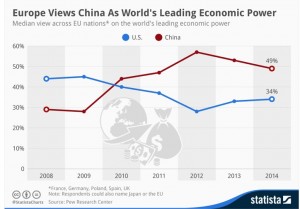
According to a survey by the Pew Research Center China lead the U.S.. Back in 2008, before the financial crisis, a European median of 44 percent considered the United States the leading economic powerhouse worldwide. In that year, 29 percent considered China the world’s leader.

China raced into the lead for the first time in 2010, and today, it’s viewed as the foremost economic power by 49 percent of Europeans compared to 34 percent for the United States. Interestingly, the shift in peception concerns America’s premier European allies – France Germany, Poland, Spain and the United Kingdom.

US investor Philip Anschutz is pulling out of China because it’s hard to him to collect the money he’s earned.  The US sees to it that peope get paid the money they are owed.  A factor to conisder in the concept of “economic power.”

This chart shows the median view across EU nations on the world’s leading economic power.

China- The World's Leading Economic Power?

Turkey’s Economic Forecasts Take a Hit with Kurdish Demonstrators Wrecking Havoc

Mehmet Cetingulec writes:  Rating time has come for the Turkish economy. Fitch Ratings was the first to announce its review. Contrary to the expectation that it would downgrade either the country’s credit rating or outlook, the agency kept both unchanged: the “stable” outlook and the BBB-investment grade.

The review, was expected to send the financial markets rallying. But when the markets reopened Oct. 8 after the holiday, the good news from Fitch was overshadowed by Kurdish demonstrators wreaking havoc across the country.  The main index of the Istanbul stock exchange shed 1,400 points in a single day, plunging to a five-month low of 72,943 points. The Turkish lira, which had been expected to gain ground, slid to 2.29 against the dollar, while bond yields reached 9.78%.

Then the Istanbul stock exchange made up for the losses over the Kobani protests, gaining 2,265 points to close the day at 75,208. The dollar slid from 2.29 to 2.25 Turkish lira, but moved back to 2.27 later in the day as the unrest continued. The bond yield fell to 9.48% before closing the day at 9.6%.

While affirming Turkey’s grade, Fitch welcomed “post-presidential election assurances that the current economic team will remain in place … as constructive.” The statement added that structural reforms, a lasting reduction in the current account deficit, a more stable inflation,  higher domestic savings and increased foreign investment could result in positive rating action.

In short, Turkey is walking a tightrope. Fitch’s favorable review prevented the unrest from taking a more serious toll on the markets. Pro-government media hailed Fitch’s decision as a “holiday present,” while the opposition press saw it as the “reward” of parliament’s approval of a government motion for possible Turkish military action in Syria and Iraq and the deployment of foreign forces in Turkey.

Fitch’s decision id not satisfy Economy Minister Nihat Zeybekci, who never misses a chance to slam ratings agencies.  “Turkey’s realities indicate the credit rating should have been much higher,” the minister said.

In sum, the following conclusion can be made: IS has begun to make an impact not only on Turkey’s exports but also on its politics and domestic security. In this climate, the good news from Fitch came as a “remedy” for the markets. But to get a similar good rating from Moody’s in December, Kobani’s shadow over the markets in particular should be removed.

In short, Turkey is walking a tightrope. Fitch’s favorable review prevented the unrest from taking a more serious toll on the markets. Pro-government media hailed Fitch’s decision as a “holiday present,” while the opposition press saw it as the “reward” of parliament’s approval of a government motion for possible Turkish military action in Syria and Iraq and the deployment of foreign forces in Turkey.

Turkey


Renewable Energy for the EU

Michael Grubb writes: EU based on coal as energy is an idea that is dead on arrival.

Poland now has a glowing opportunity to shape the energy transition, but without the economic and social upheaval experienced in the UK. For one thing, the technologies are all more mature. Renewables are becoming far more cost-competitive. Poland does not have to make the same investments that the UK, Germany and other ‘early adopters’ had to make.

Above all, the European Union stands ready to help. Through free allowances under the Emission Trading Scheme and other energy-related support mechanisms, the EU is giving Poland more than €10 billion to spend on energy and climate infrastructure.   European Energy Union

Renewable Energy

The Illusion of Global Regulation

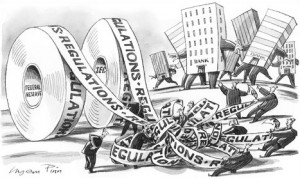
Howard Davies writes: The global system of financial regulation is extraordinarily complex. Partly for that reason, it is little understood.

Many people show some spark of recognition at the mention of the Basel Committee on Banking Supervision, which sets capital standards for banks. They may also have heard of the Bank for International Settlements, the central banks’ central bank, in which the Basel Committee sits. And the International Organization of Securities Commissions (IOSCO), which sets standards for exchanges and securities regulators, has name recognition in some quarters. But when you get to the International Association of Insurance Supervisors, brows furrow.  Financial Regulation

Global Financial Regulation

Domestic Banks Face Different Challenges than Global Banks

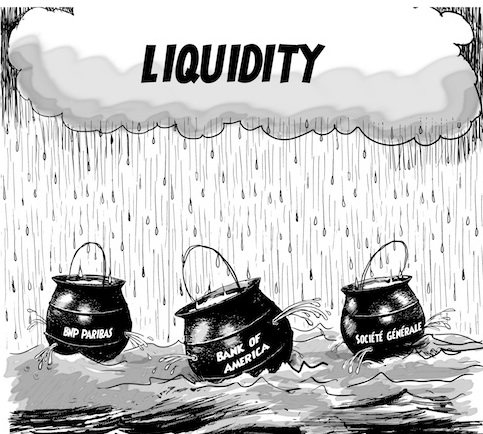
Economists at the New York Federal Reserve write: Large global U.S. banks—that is, those that have offices in foreign countries and are able to move liquidity from affiliates across borders have an advantage over large domestic U.S. banks, which have to rely on financing raised in capital markets and from depositors to extend credit and issue loans..  The internal liquidity management by global banks has, on average, mitigated the effects of aggregate liquidity shocks on domestic lending by these banks.

If a bank has stable deposit funding or maintains more liquid assets on its balance sheet, its lending might be less affected by aggregate liquidity shocks.

There also might be different responses to liquidity risk by U.S. banks that are domestically oriented compared with banks that are global.   Because these two types of banks have very different business models, the channels and magnitude of transmission of liquidity risks into bank lending may differ significantly. Small domestic banks have relatively strong lending responses to liquidity risks.  By contrast, banks with foreign affiliates, particularly large banks, move funds across their organizations to offset such risks, and potentially insulate lending in their home markets.  However, these same banks may decrease lending abroad as they move liquidity into their home country.

For both types of banks, changes in aggregate private liquidity are likely to influence lending differently in crisis than in normal periods, in part because of the availability of and willingness to use official sector liquidity facilities in periods of aggregate liquidity stress. When banks have access to central bank liquidity facilities priced at terms below private market rates, this might relax the constraints imposed by the composition of banks’ balance sheets on their access to external funding, leading to a different relationship between those balance sheet characteristics and the banks’ lending,  Is Liquidity a Measure of Stability

Bank Liquidity


Austerity in the Eurozone?

Germany cuts growth forecast as exports flag and geopoitical concerns loom large.   Other countries in the EU push Germany to start spending.

German Economics Minister Sigmar Gabriel said Berlin expected gross domestic product (GDP) to expand by only 1.2 percent in 2014, down from an earlier estimate of 1.8 percent.  Germany’s leading economists blame stalled recovery in the eurozone for Germany’s troubles.

In addition, the planned introduction of a national minimum wage and higher pensions outlays adopted by the government recently would further throttle growth, they said.

After robust growth of 0.8 percent in the first quarter of this year, the German economy slipped back, contracting by 0.2 percent between April and June. As the government is waiting for third-quarter growth figures, due to be released later this month, Economics Minister Gabriel said he did not expect the economy to contract again.

Pointing to the robust state of the German labor market, with its low unemployment, he said: “This is the foundation on which higher wages and increased household spending will continue to rest.”

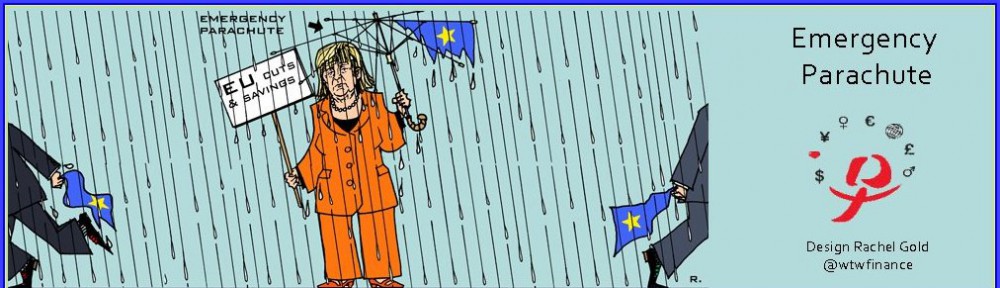
As Gabriel banks on rising consumption to prop up the German economy in the remaining months of 2014, some think the government should boost higher speniding for higher growth.  Finance Minister Wolfgang Schauble has resisted such calls.  But ther eurozone member want Germany to open the public purse and allow partners in the currency area higher budget deficits to spur growth..

Schaube