Japan to Double Investment in India in 5 years.

Japanese Prime Minister Shinzo Abe will tell his Indian counterpart Narendra Modi that Japan aims to double its direct investment in India in five years from some US$2 billion last year, the Nikkei business daily reported.

Modi, on his first major foreign visit since a landslide election win in May, arrived for a five-day trip aimed at capitalising on a personal affinity with Abe to bolster security and business ties in the face of an assertive China.

The two leaders are also likely to agree to speed up talks on a nuclear energy pact, the Nikkei said, although hopes of striking a similar accord to one reached with the United States in 2008 had faded in the run-up to the visit.

Japan wants explicit guarantees from India, which has not signed the nuclear non-proliferation treaty, to limit atomic tests and allow closer inspection of its facilities to ensure that spent fuel is not used to make bombs. Japanese firms also want clarity on nuclear disaster compensation, especially in the wake of the March 2011 Fukushima catastrophe.

In a sign of their close ties, the two leaders greeted each other with a bear hug when they met on Saturday in Japan’s ancient capital of Kyoto for an informal dinner. Modi is one of three people that Abe follows on Twitter, while the Indian leader admires Abe’s brand of nationalist politics.

Also under discussion will be a proposal to formalise a ‘two-plus-two’ format for talks bringing together the foreign and defence ministers of both countries, and the possible sale of an amphibious aircraft to the India navy.

India and Japan will also likely agree to hold regular joint training exercises in maritime defense, some of which will involve the United States as well, the Nikkei said.

India, Asia’s third-largest economy after China and Japan, needs faster economic growth to create work for the one million young people who enter the workforce every month.

In early steps, Modi has allowed foreign investors to own 100 percent of railway projects with an eye to drumming up interest in building India’s answer to Japan’s high-speed ‘bullet’ trains. He is also courting Japanese investment in an ambitious industrial “corridor” to run between Delhi and Mumbai.

Japan’s Honda Motor Co Ltd, Suzuki Co Ltd, Sony Corp and Toyota Motor Corp are household names in India. Yet, India accounts for only 1.2 percent of Japan’s total outward foreign direct investment.
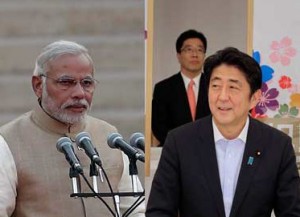
Modi and Abe

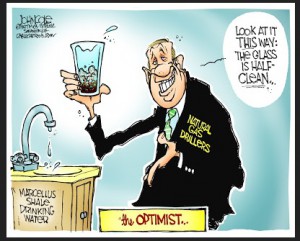
Is Energy the Real Force Behind Growth in the US?

Lee Adler writes:  Take away energy and the US economy is not doing that well.  In some ways, it’s not growing at all. What growth there is appears entirely due to the energy boom and its ripple effects. Thank goodness for that boom and the technological changes that led to it. Environmentalists may feel differently, but without that growth in energy the US economy would be in even deeper trouble than it is.

Energy's Contribution to the US EconomyEnergy's Impact on US Economy

Draghi’s Views

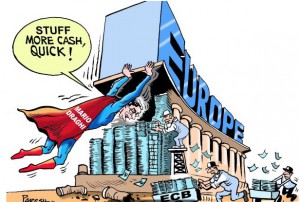
In a recent speech Draghi broke three taboos at once. First, he based his reasoning on the heterodox notion of a policy mix combining monetary and fiscal measures. Second, he explicitly mentioned the aggregate fiscal stance, whereas Europe has always looked at the fiscal situation exclusively on a country-by-country basis. Third, his claim that preventing the ECB from acting as a lender of last resort imposes a high price – making governments vulnerable and reducing their fiscal space – contradicts the tenet that the central bank must not provide support to government borrowing.  Draghi’s View

Draghi?

Crafting Beer in the US

The tasting room is packed at Orpheus Brewing. The heady aroma of hops and barley hangs in the warm evening air as casually dressed 20- and 30-somethings gather around highboy tables and spill out onto the wood-planked patio overlooking Atlanta’s Piedmont Park. Already there’s a gentle buzz, although it’s hard to tell whether the buzz is a side effect of the artisanal brews on tap or simply the excitement surrounding the latest addition to the city’s burgeoning craft beer market. Scenes like this are becoming more common across the Southeast as craft beer takes hold in a region long dominated by national brands and light lagers.  The Atlanta Fed report.  Atlanta Fed Report on Craft Beer

Craft Beer

EU Threatens More Sanctions Against Russia


The leaders of the European Union have instructed the European Commission and the EU’s diplomatic service to prepare further sanctions to be imposed on Russia, in reaction to its military action against Ukraine.

Herman Van Rompuy, the president of the European Council, said the EU was ready to take “significant further steps in light of the evolution of the situation on the ground”. He condemned the movement of Russian troops and weaponry into Ukraine. Angela Merkel, Germany’s chancellor, said that sanctions would be imposed “if the situation in the last days goes on”.  Merkel also committed money to help rebuild the damaged infrastructure in Ukraine.

The European Council adopted conclusions that called for a ceasefire and urged Russia to implement a peace plan prepared by Ukrainian president Petro Poroshenko, who attended the Council meeting.

Van Rompuy denounced “the presence of Russian armed forces on Ukrainian soil”. José Manuel Barroso, the president of the European Commission, said: “What is happening in the eastern part of Ukraine is war.”

It is unclear whether the mooted sanctions will be an intensification of existing measures affecting exports in the military, energy and the financial sectors, or will extend into new economic sectors.

The Council specifically instructed the Commission to include in its proposals a measure “on the basis of which every person and institution dealing with the separatists groups in the Donbass [region of eastern Ukraine] will be listed”.

Barroso said that at a meeting with Poroshenko he had said that the EU stood ready to provide “an additional €1 billion in loans to Ukraine”.

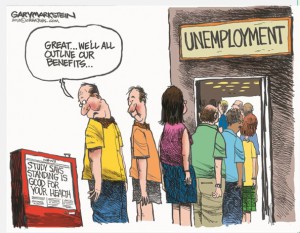
The EU leaders also discussed the worrying state of the European economy, in light of a very low level of inflation and extremely high unemployment. They agreed that the situation raises “significant concerns”.  “In recent weeks economic data have confirmed that the recovery, particularly in the euro area, is weak,” the conclusions state. The leaders agreed to hold a special summit on jobs and growth in Italy in early October, and a summit of government leaders from eurozone countries following the European Council in late October.

Speaking after the Council, Hollande said the situation was unacceptable. “The diagnosis is unquestionable. It’s a widespread situation, there are some countries in recession, and inflation has reached a historic low everywhere. Therefore there is a European problem, a lack of sufficient demand.”


How to Give Female Farmers A Voice

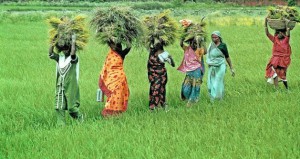
Jaqui Ashby writes:  Imagine a typical scene in agricultural research for development: a group of predominantly male researchers visit a group of male farmers whose views they take to inform their work.

The reality is that a large proportion of smallholder farmers – the majority in some parts of the sector – are female.   What can researchers do to make sure female farmers get their fair share of attention in agricultural research? Here are our top tips for implementing a successful gender strategy:

You may need to recruit specialised researchers who will make sure gender issues are addressed in technical fields like plant breeding. For example, to make sure CGIAR have the in-house expertise to tackle gender equality in research, we are forming a community of young gender researchers with a post-doctoral programme.

You could also try designing a programme which focuses explicitly on gender-related changes in farming systems. Our aquatic agricultural systems programme includes research focused on transforming gender roles and social norms that hold back the productivity of female farmers.

To give female farmers a fairer deal, research must look beyond the practical needs of women to tackle underlying constraints. This includes unequal land rights, restricted mobility or limited schooling that prevent fair access for women farmers to extension training, credit or markets. Often institutions and policies have to change before women can benefit from our technologies.

Tackling gender inequalities in farming means you need to think differently about agriculture. Instead of concentrating on crops and livestock, think about food systems that include minor crops and vegetables grown by women, and post-harvest processing, so much of which is done by women. Or about domestic use of farm resources, especially labour, but also water and fuel for cooking.

You’ll definitely need extra resources dedicated to tackling the gender inequalities which affect many aspects of how crops and livestock are raised, consumed, and sold, and who benefits from new research. So dedicated budget for this purpose in research plans, proposals and programmes are a must.

We try to ensure our technologies create opportunities for both women and men through the collection of data and evidence. This data should be disaggregated by sex, that is, analysed separately for males and females. This often involves asking questions such as “who is benefitting from you work?” which gives us a better idea of how women farmers specifically are benefiting from our technologies.

Indian Farmers


Ending Crony Capitalism in Hong Kong

Nisid Hajari writes:  When they meet on Sunday, legislators from China’s rubber-stamp National People’s Congress are expected to disregard even modest proposals to open up Hong Kong’s political system. In all likelihood the decision will provoke street protests, drive moderates into the more radical pro-democracy camp and call into question the former British colony’s standing as a global financial center and bastion of free enterprise. And for what? The good of Hong Kong, of course.

Wang Zhenmin, a Chinese law professor who sat on the committee overseeing Hong Kong’s constitution, laid out the case most blatantly on Thursday: the interests of the city’s powerful tycoons had to be safeguarded from unchecked democracy. “If we just ignore their interest, Hong Kong capitalism will stop,” he said. “Democracy is a political matter and it is also an economic matter.”

On the face of it, Beijing’s intransigence makes little sense. Pro-democracy groups proposed a system of open nominations with a much lower threshold — about 5 percent of the voting population. Even if some anti-Communist radical were able to get on the ballot, the chances of him or her winning would still be negligible. In addition, any victor would be sworn into office with an oath that acknowledges China’s suzerainty over Hong Kong; a leader could be ousted for violating it.

Compromise proposals supported by moderates would have entailed even less risk. For example, China could have expanded the nominating committee, adding more members directly elected by the public, while lowering the nominating threshold. Thus the choices available to voters would have expanded beyond a tight circle of pro-Beijing cronies without threatening China’s hold over Hong Kong.

According to Credit Suisse, a few wealthy businessmen now account for 60 percent of the city’s wealth. Those who have prospered most are engaged in sectors such as banking and real estate, where political connections matter. Hong Kong recently topped the Economist’s “crony capitalism index” just ahead of oligarch-ridden Russia. Frustration over Hong Kong’s yawning wealth gap is rising dangerously. While gross domestic product has grown about 50 percent in the past decade, median household income has only risen 10 percent.

The cost of defending the plutocrats is high. A Chinese government has raised doubts about the continued independence of Hong Kong’s judiciary and the city’s commitment to the rule of law, which have been pillars of its success.  Raids this week on high-profile opposition supporter Jimmy Lai were hardly more reassuring. Perhaps leaders in Beijing feel they are defending a principle greater than the pocketbooks of Hong Kong’s elite. They have long feared that showing leniency toward Hong Kong would encourage other disgruntled parts of China, such as Tibet and Xinjiang, to demand greater autonomy.

Sooner or later, Chinese leaders are going to have to get more comfortable with the idea of autonomy in outlying regions.  So far Beijing is failing.

Hong Kong Bright Lights Dim


Gender Balance on EU Commission

The EU member states are meeting to pick a new President and Foreign Minister.  Frederica Mogherini the possible pick to be Foreign MInister, is thought by some to be too close to Russia.  If Donald Tusk, President of Poland, is chosen as President, this may assuage fears.  Martin Schulz, the president of the European Parliament, made comments about the gender balance of the next Commission: “if there are fewer women elected to Commission than the current nine, there is a risk of receiving not enough support in the European Parliament.” Schulz also said he is a “Mogherini-fan”. “I know her very well and she is experienced enough for the job [of High Representative].”  Biography

Frederica Mogherini

Update:  Tusk and Mogherini Get the EU Jobs:

Donald Tusk is to leave the prime ministership of Poland to become president of the European Council in succession to Herman Van Rompuy.  His appointment balances the choice of Federica Mogherini, Italy’s foreign minister, as the European Union’s high representative for foreign policy. The decisions were announced by Van Rompuy, who said that they had “the full support of all” members of the European Council.

“You have the full endorsement of the European Council and this full endorsement was very important to me,” said Van Rompuy, adding that he had spoken several times to each government leader “to make sure we made the right choice”.

The announcement came two and a half hours into an EU summit that was convened specifically to discuss the appointments – after Van Rompuy deemed the matter not ripe for decision at an earlier summit on 16 July. Agreement on Tusk and Mogherini was apparently painless, and the greater work of the summit may prove to be discussion of how to respond to Russia’s incursions into Ukraine.

Tusk, who has been prime minister since 2007, will take up his EU post on 1 December for a two-and-a-half year term. Mogherini will take up her post – which also includes a vice-presidency of the European Commission – when the new Commission to be led by Jean-Claude Juncker takes up office, which is scheduled to be on 1 November for a five-year term.

At a press conference at which Van Rompuy presented the two anointed EU leaders to the television cameras, Tusk addressed directly questions about whether he has the linguistic skills necessary for the Council presidency, announcing (in English) that for the moment he would answer questions in Polish, but in December he would speak in English. “Nothing is good enough for Europe – including my English. I will polish my English. I will be ready in December – 100%.”

Mogherini was questioned about the charges that she lacked experience and that her candidacy had been supported by Vladimir Putin, the Russian president. She rejected the first charge, responding that she was the foreign minister of a G7 country and that she had been involved in European and foreign affairs for 20 years. She stressed her experience of parliamentary institutions and of politics.

On alleged sympathy towards Russia, she said that her first trip abroad after Italy took on the presidency of the EU’s Council of Ministers had been to Kiev. After two days there, she had gone on to Moscow. She had been trying, she said, “to co-ordinate efforts to facilitate a form of dialogue”. Tusk said he was confident that he and Mogherini would work well together. “I am very serene about our co-operation,” he said.

Van Rompuy, in his opening remarks, had identified three challenges that the new leaders of the EU would have to address: the EU’s stagnant economic performance; the Ukraine-Russia crisis; and “Britain’s place in Europe”.

Tusk picked up this reference to the UK, saying that he had discussed with Prime Minister David Cameron his ideas for reform of the EU.

“No reasonable person can imagine the EU without the UK and I cannot imagine it myself,” he said. He also stressed that he did not want divisions to open up between the eurozone and the rest of the EU. As well as being president of the European Council, Tusk will be president of the euro summit – the meetings of government leaders  of the eurozone – a post that was given formal recognition by the 2012 fiscal compact treaty. Such eurozone summits are to happen twice a year and some meetings may be attended by all countries that are signatories to the fiscal compact treaty (currently 25 member states). That Tusk comes from a country that does not belong to the eurozone was not a barrier to his taking the euro summit presidency, despite some earlier objections from France.


Is Constraining Debt Leverage Ratios the Answer in China?

Yu Yongding writes:  Earlier this year, rumors of China’s impending financial doom – triggered by either a housing-market crash or local-government debt defaults – were rampant. But, in recent months, the economy has stabilized, leaving few doubts about China’s ability to grow by more than 7% this year. Given that the Chinese government had ample scope for policy intervention, this turnaround should come as no surprise. But the moment of financial reckoning has merely been postponed, not averted.

The fundamental problems that triggered alarm bells in the first place – including real-estate bubbles, local-government debt, rapid growth in shadow-banking activity, and rising corporate leverage ratios – remain unresolved. Of these, the most immediate threat to China’s economic and financial stability is the combination of high borrowing costs, low profitability for nonfinancial corporations, and very high corporate leverage ratios.   Waiting for market-oriented reform in China

China's finances

How to Address Income Inequality

Michael Spence writes:  High-priority items are fairly clear. In the short run, the top priority is income support for the poor and the unemployed, who are the immediate victims of crises and the underlying imbalances and structural problems, which take time to remove. Second, especially with rising income inequality, universal access to high-quality public services, particularly education, is crucial.

Inclusion sustains social and political cohesion – and hence the very growth needed to help mitigate the effects of rising inequality. There are many ways for economies to fall short of their growth potential, but underinvestment, especially within the public sector, is one of the most potent and common.   Good and Bad Income Inequality

Equality of Opportunity?