Revving Up Stalled Economies Worldwide

Stephen A. Roach writes: The latest slowdown in developed countries is not so easily dismissed. Lacking cyclical vigor in the aftermath of severe recessions, today’s economies are finding it especially difficult to shrug off the impact of shocks and break out of anemic growth trajectories.  Consider the US. Though annual GPD growth is estimated to have rebounded to 4% in the second quarter of 2014, following the 2.1% first-quarter contraction, that still leaves average growth in the first half of the year at a measly 1%.

The problem is even worse in Japan, where consumers brought forward expenditures in anticipation of the sales-tax hike. The 6.1% first-quarter growth surge to which this gave rise was more than offset by a 6.8% second-quarter contraction. The net result in the first half of this year – an average decline of 0.3% – is broadly in line with the 0.2% contraction now estimated for the fourth quarter of 2013. With the trajectory of real (inflation-adjusted) growth having moved into negative territory, on average, for three consecutive quarters, Japan may once again be reverting to recessionary form.      Stalled Economies Need Fundamental Repair

Is a Stalled Economy Like a Stalled Car?

Why Banking is Boring in Japan

Dick Ehnts writes:   Unprecedented monetary stimulus has cut the spread between lending rates and deposit rates at Mitsubishi UFJ Financial Group Inc. to a record low in the first quarter. Cash and deposits at the nation’s biggest bank and its two closest rivals piled to 82 trillion yen last quarter. Citigroup is considering a retreat from Japan after pulling back from retail banking in markets with low returns, including Spain, Greece and Turkey.

Difficulties making money probably have something to do with the weak demand for loans in Japan. For the last 20 years, the private sector has been reducing its liabilities. To make up for the shortfall in effective demand, government spent hundreds of billions of yen to keep the economy at somewhere close to full employment. Compared with what Spain and Greece are going through it has so far been a resounding policy achievement.

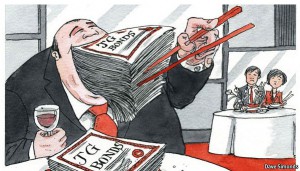
However, government bonds are boring for bankers, especially if the central bank buys them up and clearly fixes the prices (which it does anyway, but it is more obvious now in Japan then ever). There does not seem to be any indication that this will change in the near future, especially not after the unsurprising big dent to GDP growth after the latest tax hike.

George Soros has made almost $1 billion since November from bets that the yen would tumble, according to a person close to the billionaire’s $24 billion family office.

The Japanese wager helped the firm return about 10 percent last year and 5 percent so far this year. The yen has weakened 17 percent versus the dollar since about the start of the fourth quarter, the worst performance over a similar period since 1985.

With no further weakening of the yen in sight, bankers and central bankers in Japan might as well enjoy a vacation or two. Probably it would be their first since ‘the crisis’ which started in 1991. They could try to think about a new concept to describe what has happened to Japan and discuss existing economic theories in order to solve the countries economic woes. One hint: another tax hike is not a good idea. Another hint: it is not a problem of social justice or the budget.

Japanese Banking

China and Thailand Back on Track

Thailand is seeking more opportunities to collaborate with China, especially in the areas of rail transport, agricultural products and tourism, after months of political turmoil.

Phaichit Viboontanasarn, commercial minister at the Thai embassy in Beijing, said that plans for a high-speed rail line linking Chiangmai and Bangkok have been modified by the new Thai government, led by former army head Prayuth Chan-ocha.  The railway will instead be a conventional line connecting Nong Khai in northeast Thailand with the capital. Phaichit said the country will gradually improve its national railway network and work closely with Chinese companies that have mature technology at prices lower than those of many international competitors.

Many parts of Thailand’s rail network are still single-track lines, and the government wants to improve the basic rail system first by building double-track lines and related facilities.  Thailand is a large member economy of the Association of Southeast Asian Nations, which has 600 million consumers.

“With stable economic growth driven by tourism, modern manufacturing and agricultural development, Thailand will build its own high-speed railway system when the time is ripe, which will help us further enhance trade. China surely will be a big contributor to our high-speed railway sector,” Phaichit said.

Bilateral trade surged from $26 million in 1975 to $70 billion in 2013, and this growing trade has improved the service sectors including aviation, tourism and hotels.  Bangornrat Shinaprayoon, director of the Tourism Authority of Thailand’s Beijing office, said: “Thailand is doing its best to reduce the negative impact of the political chaos and has shifted the government’s top priority to economic development, especially the tourism, agricultural processing, transportation, electronics and vehicle industries.”  In the first seven months of this year, 2.22 million Chinese visited Thailand.

Bangornrat said that Thailand expects 4.3 million Chinese tourists this year.  “Thailand has waived visa fees for Chinese tourists from August 9 to November 8 and opened eight customs channels for Chinese visitors at airports in Thailand,” Bangornrat said.

Thailand Tourist Destinations

Chinese Anti-Trust Regulator Goes After Microsoft

A Chinese antitrust regulator said on Tuesday that Microsoft Corp has not been fully transparent with its sales data on the software it distributes in China, including information on sales of its media player and web browser software.
Zhang Mao, head of the State Administration for Industry and Commerce, said in Beijing that Microsoft has expressed willingness to cooperate with ongoing investigations.
“After multiple meetings, including at high levels, they’ve expressed a willingness to respect Chinese law and collaborate with investigating officials,” Zhang said.
The Microsoft investigation comes amid a series of antitrust probes into foreign firms in China, including mobile chipset maker Qualcomm and German carmaker Daimler’s luxury auto unit Mercedes-Benz.
The State Administration for Industry and Commerce said earlier this month that Microsoft is suspected of violating China’s anti-monopoly law.
This is in relation to problems with compatibility, bundling and document authentication for its Windows operating system and Microsoft Office software.
“The investigation is ongoing and we will disclose the results to the public in a timely fashion,” Zhang said, adding that the Microsoft probe is one of nine investigations opened this year that include the software, tobacco, telecommunications, insurance, tourism and utilities sectors.
The companies involved in the nine investigations comprise domestic, foreign, State-owned enterprises and trade associations, according to Zhang.
Microsoft China Chief Executive Ralph Haupter did not respond to Zhang’s comments, saying only that more work needs to be done on Chinese information safety protection.
An industry insider said on Tuesday that despite policy barriers, global tech giants can still enjoy great opportunities in China if they can find the right marketing strategy.
Derek Shen, China head of the United States social networking website LinkedIn, said foreign tech companies should understand Chinese requirements when doing business in the country.
“To survive in China, they have to figure out the strengths that are difficult for local rivals to replicate,” he said.  “It is a tough task even for Google, because its technological edge can be quickly overrun by Baidu or Tencent Holdings. Overseas tech giants seem unaccustomed to the Chinese marketing climate.”

Microsoft Not Transparent in China

Changing the US Corporate Tax System Might Help the US Economy

Martin Feldman writes:  America’s current tax system adversely affects the US economy in several ways. The extra tax that US firms pay if they repatriate profits raises their cost of capital, thus reducing their ability to compete in international markets. Foreign firms can also outbid their US counterparts in acquiring new high-tech firms in other countries. And when a foreign firm acquires a US company, it pays US tax on the profits earned in the US but not on the profits earned by that firm’s other foreign subsidiaries, thus lowering its total tax bill.

A shift to a territorial system of taxation would remove the disadvantages faced by American multinational corporations and encourage them to reinvest their overseas profits at home, increasing US employment and profits. Because only a small share of overseas profits is now repatriated, the US government would lose very little tax revenue by shifting to a territorial system. A few years ago, the US Treasury Department estimated that shifting to a territorial system would reduce corporate tax revenue by only $130 billion over ten years.   Keeping US Companies in the US

Keeping Companies in US

Are Apologies Enough to Change Big Banks’ Behavior?

Jesse Eisinger writes:  Admitting a problem, as the cliché has it, is the first step to solving it. But with the Justice Department and the Securities and Exchange Commission, admissions of wrongdoing have been the last step. There’s much work to be done to hold giant corporations accountable for their misdeeds.   Do Big Banks’ Apologies Change Behavior

Bankers

How China Will Take Anti-Graft Campaign Forward

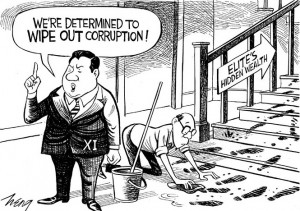
The Chinese media and the Internet are full of speculations on how the top leadership will continue the anti-corruption campaign after putting former security chief Zhou Yongkang under investigation. A former member of the Standing Committee of the Political Bureau of the Communist Party of China Central Committee, Zhou is the highest-ranking official facing investigation for corruption since the launch of reform in the late 1970s. As Chinese often say, Zhou is the “biggest tiger” to be trapped in the anti-corruption net.

Although people have welcomed the probe against Zhou, they are asking what turns will the anti-corruption campaign and the overall political development take now? Will the campaign taper off? And what long-term effects will the anti-corruption campaign leave?  The official press is busy trying to answer these questions. Shortly after Zhou was put under investigation, a commentary on gmw.cn went on to say hunting down a “big tiger” cannot be the ultimate goal of the crackdown on corruption. Instead, the goal should be to use the opportunity to deepen government reforms, and to wipe out bad officials’ influence in ways prescribed by the law. After hunting down Zhou, China still has three major battles to fight.

The first battle is to use the Fourth Plenum of the 18th CPC Central Committee, scheduled for October, to expedite the country’s legal development and strengthen the rule of law. In fact, the natural continuation of the anti-corruption campaign is to design effective institutions to prevent the distortion of law in implementation.
The second battle is to redress the inequality in wealth and status in the market, which can be done through reform of State-owned enterprises, which have de facto monopoly over of natural resources, and make them face effective competition.
The market should be strictly regulated to curb what the author of the article in People’s Daily calls “feudal capitalism”, or crony capitalism. Authorities must make serious efforts, even if they are not more serious than the anti-corruption drive, to encourage “true entrepreneurship” while battling “bureaucratic capitalism” and “barbarian capitalists”.  The third battle has to be fought on the international relations front to earn China a larger space for its peaceful rise.

It is still too early to claim victory over corruption. People could feel disappointed again if there aren’t more effective methods to deal with the problems mentioned above. Therefore, the leadership has to show more tangible results to the people.

Wiping Out Corruption in China

Most US Companies Still Pay US Taxes When They Move (Inversion)

Matt Levine makes brilliantly clear how the US tax system works when companies are international.

The most recent story on the Burger King press page remains “Burger King Restaurants Bring Back Chicken Fries,” but events have overtaken the chicken fries. After many media reports, Burger King and Tim Hortons have put out a press release confirming that they’ve been holding merger talks, and imagine what the catering is like. This announcement has set off a frenzy of condemnation, since any merger would be what is called an “inversion,” turning the combined Burger Tim into a Canadian company and thus freeing it from its harsh but patriotic duty to pay U.S. income taxes.

This condemnation is a bit confused, so I thought it might be helpful to explain very simply (too simply!) how the U.S. corporate income tax system works. There is nothing new here, lots of people know this, but weirdly lots of people don’t, too. It works like this.   Matt Levine Explains Inversion

US Tax Consequences of Inversion