Combining in-house research and work by leading academics, this report assesses how the crisis has impacted investment across the non-financial sector, in small and medium-sized enterprises (SMEs), in infrastructure, and in R&D and innovation. It explains why and where investment has declined, looking at the impact of structural imbalances, policy uncertainty, new capital requirements for banks and the fragmentation of Europe’s financial markets. In terms of policy options, it warns against poorly targeted responses and provides, instead, support for key policy interventions at the European level. Download: Free
Category Archives: News Blog
10 Women in Finance and Tech
to have made it onto Forbes’ top 30 under 30
Forbes has once again published its top 30 under 30 list. From Goldman Sachs to Pinterest, women have left a strong mark on today’s business and entrepreneurial world.
10 women in finance and tech to have made it onto Forbes’ top 30 under 30

India’s Central Bank Strong, but Questions Remain
India’s modernized central bank can’t do everything — and lately it has seemed that the rest of the government can’t do anything. The ruling United Progressive Alliance is mired in corruption scandals, with a leadership divided between an ineffective prime minister and an unaccountable Congress Party president.
Heightening the uncertainty is the rise of Narenda Modi, the charismatic leader of the main opposition — the pro-business, Hindu-nationalist, right-of-center Bharatiya Janata Party. Modi, chief minister of Gujarat (one of India’s most successful states), is an electrifying speaker and a hero to many business leaders. His followers can be fanatical — in both senses of the term. In the past, Modi has sided with anti-Muslim extremists. At the very least, he failed to prevent riots in 2002 that claimed more than 1,000 lives. The U.S. has revoked his visa as a result. India’s Central Bank and Narenda Modi
Pharmaceuticals for the Rich Only?
As the world divides more dramatically between the very rich and the very poor with fewer and fewer people in between, certain companies are thriving. Manufacturing for the rich is still highly profitable. This hit home when the CEO of Bayer said recently that Bayer’s new anti-cancer drug would cost $69,000 a year, over forty times the annual income of an Indian. Of course, remarked CEO Marjin Dekkers, this new drug was not developed for poor people.
In the US with attrition high in the middle class, manufacturers have given up making products that appeal to the average family, and are now pitching mostly to the upper end of the income scale.
How many companies will fail as they manufacture out of their comfort zone? Can any healthy economy survive without a middle class? Conventional wisdom says that the rich can only spend so much of their money and the poor can’t spend at all. Without the middle, the flow of goods and services becomes sluggish as best.
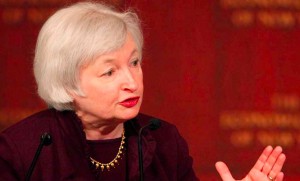
Can Janet Yellen Reverse the Damage of her Predecessors?
It took thirty years of guys running the Fed—Volcker, Greenspan, Bernanke—to create this messed-up economy. Now the woman has to clean up after them. From what we know about her, Yellen understands the challenge. She must undo the past. It took a generation of conservative Fed chairmen to tip the balance in one direction and accept the extreme inequalities of income and wealth. It might very well take another generation to correct the damage and restore equity. The Fed, of course, does not control every economic outcome, but, as Yellen knows, its policy levers can have decisive influence on jobs and wages. Can Janet Yellen Revitalize the Middle Class
First Anti-Corruption Report European Commission
Barclays CEO Gives up Bonus
Things are done a little differently in “The City” — London’s version of Wall Street on the other side of the Atlantic. For example, if a bank is hit with scandal after scandal over the course of a year, the CEO of the bank doesn’t take home a fat check for his work. In fact, he gives up his bonus all-together. That’s what Barclays CEO Antony Jenkins will do for the second year in a row, In Japan, CEO’s commit harikari and in the US they laugh all the way to the bank, their bank. Barclays CEO Gives Up Bonus
Obama to Saudi Arabia in March
As Middle Eastern countries go, Saudi Arabia is relatively easy to do business in, if you are a man. For women, it is far more difficult. But the country is opening up and has rare opportunities for entrepreneurs. Saudi Arabia in Brief
Doing Business in Saudi Arabia
The Women’s Entrepreneurship Initiative is encouraging small businesses in Saudi Arabia. Background information is provided in an IFC report.
The WEI gives an overview of the current climate and possible issues. Saudi Arabian Initiative
Digital Money?
from the Economist:
While a nightmare for numismatists, digital money makes payments faster, reduces the size of informal economies and makes flows of money more transparent. Even small increases in digital-money usage promises big benefits for governments and businesses, the report insists.
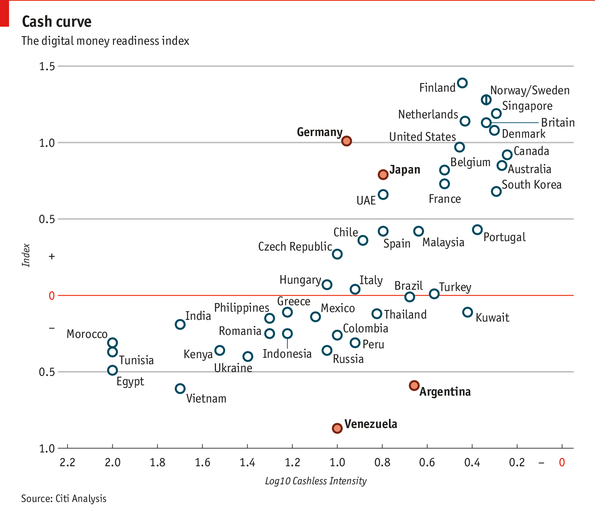
But that is not the most interesting part of the report. Generally speaking the countries that are best prepared for digital money tend to use less cash. In Belgium 93% of all consumer spending is by digital means, according to a report from Mastercard, another financial-services firm. Belgium also ranks highly on the Citi’s digital-money readiness index. Yet Citi’s report shows that even if a country is prepared to move to digital cash, its people may resist (see chart). For instance, although Germany’s digital money readiness is high, the “cashless intensity” of its economy is relatively low.

It is not just Germans love cash and coins: in Australia there are 166 ATMs per 100,000 people, according to World Bank data. Other countries, such as Finland, where there are only 35 ATMs per 100,000, are more high-tech financially. Venezuelans favour digital money due to security concerns and Argentinians because of inflation, whereas people in Japan are typically leery of credit-card debts. Japan, though miles more prepared for digital money than Venezuela, is actually a more cash-intensive economy than the Bolivarian Republic.
That cultural variety is rather nice. Moving to a cashless economy is sensible, at least in purely economic terms. Countries with big black economies and endemic corruption probably should not be sentimental about their dosh. But others’ attachment to their specie and notes should be welcomed. It can prompt public discussion about national heroes—see the debate last summer about who should be emblazoned on British money. And in some countries banknotes are little pieces of public art (see the lovely Swiss franc or the New Zealand dollar).