Financing Infrastructure

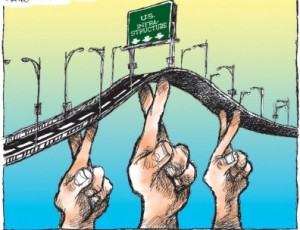
Financing infrastructure is one of the most important challenges faced by governments worldwide.

Thomas Maier writes: Infrastructure – from roads and railways to ports and bridges – and economic growth go together. That is why international financial institutions need to answer appeals for greater investment to help close a $1 trillion global “infrastructure gap.” Our best chance of meeting the world’s growing infrastructure needs is to use multilateral development banks’ unique relationships with governments and the private sector to coordinate our response.

Consider, for example, the progress already being felt in emerging markets. In the past year, the World Bank Group, the Asian Development Bank (ADB), the Inter-American Development Bank (IADB), the African Development Bank, the European Investment Bank, and the European Bank for Reconstruction and Development (EBRD) have all created “project preparation facilities” (PPFs) to improve the quality of project development, while also strengthening the local capacity needed to ensure lasting results.

The various PPFs that have been launched can act as a model for public officials in emerging markets to emulate. The Infrastructure Project Preparation Facility, launched by the EBRD last year, is one example: by using pre-selected “framework consultants,” the facility can accelerate high-quality project preparation for both public-sector projects and public-private partnerships (PPPs). This dual focus is important: private-sector finance is critical, but the public sector still finances some 90% of all infrastructure investment worldwide.

Another important innovation is the online “PPP Knowledge Lab,” launched in June with support from multilateral development banks

Then there is the International Infrastructure Support System (IISS), an online tool directly supported by a number of international financial institutions during its initial start-up phase in 2015 and early 2016.

But any system is only as good as its participants. Responding to the need for more systematic and “standardized” learning, the World Bank Group, supported by the ADB, IADB, EBRD, and the Islamic Development Bank, has commissioned a new Global Certification Program for PPP Professionals. Emerging-market officials will earn accreditation by demonstrating the ability to apply their knowledge practically.

One useful tool in the effort is “Infrascope,”a benchmarking index created by the Economist Intelligence Unit that assesses the capacity of emerging-market countries across the Asia-Pacific region, Latin America, Africa, Eastern Europe, and the former Soviet republics in the Commonwealth of Independent States to deliver sustainable PPPs.

Another is the G-20’s new Global Infrastructure Hub, which shares international good practice and comprehensive data on infrastructure. The Hub has a four-year mandate to focus on five main areas: a network to share information on infrastructure projects and financing; better data on infrastructure investment; the G-20’s recommendations for voluntary lending; government officials’ capacity to share best practices; and a database to match infrastructure projects with potential investors.

It is easy to be daunted by the vast sums needed to close the gap between the infrastructure the developing world has and the infrastructure it needs to support sustainable, inclusive economic growth. But compare the world today with the world a century or more ago, and it is clear that the gap is so much narrower than it was. What will narrow it still more, and so sustain the gains in global growth, will be the spread of infrastructure know-how at the local level in emerging markets. We and our fellow multilateral institutions have a clear duty not just to increase our expertise, but also to share it.
Infrastructure


Central Banks Fixated on Inflation?

A reason why the central banks should not have as big as role as they now do.  Their focus on inflation may well be mistaken.

Stephen S. Roach writes:  Targeting in a world without inflation, central banks have lost their way. With benchmark interest rates stuck at the dreaded zero bound, monetary policy has been transformed from an agent of price stability into an engine of financial instability. A new approach is desperately needed.

The US Federal Reserve exemplifies this policy dilemma. After the Federal Open Market Committee decided in September to defer yet again the start of its long-awaited normalization of monetary policy, its inflation doves are openly campaigning for another delay.

For the inflation-targeting purists, the argument seems impeccable. The headline consumer-price index (CPI) is near zero, and “core” or underlying inflation – the Fed’s favorite indicator – remains significantly below the seemingly sacrosanct 2% target. With a long-anemic recovery looking shaky again, the doves contend that there is no reason to rush ahead with interest-rate hikes.

Of course, there is more to it than that. Because monetary policy operates with lags, central banks must avoid fixating on the here and now, and instead use imperfect forecasts to anticipate the future effects of their decisions. In the Fed’s case, the presumption that the US will soon approach full employment has caused the so-called dual mandate to collapse into one target: getting inflation back to 2%.

Here, the Fed is making a fatal mistake, as it relies heavily on a timeworn inflation-forecasting methodology that filters out the “special factors” driving the often volatile prices of goods like food and energy. The logic is that the price fluctuations will eventually subside, and headline price indicators will converge on the core rate of inflation.

This approach failed spectacularly when it was adopted in the 1970s, causing the Fed to underestimate virulent inflation. And it is failing today, leading the Fed consistently to overestimate underlying inflation. Indeed, with oil prices having plunged by 50% over the past year, the Fed stubbornly maintains that faster price growth – and the precious inflation rate of 2% – is just around the corner.

Missing from this logic is an appreciation of the new and powerful global forces that are bearing down on inflation. According to the International Monetary Fund’s latest outlook, the price deflator for all advanced economies should increase by just 1.5% annually, on average, from now to 2020 – not much higher than the crisis-depressed 1.1% pace of the last six years. Moreover, most wholesale prices around the world remain in outright deflation.

But, rather than recognize the likely drivers of these developments – namely, a seemingly chronic shortfall of global aggregate demand amid a supply glut and a deflationary profusion of technological innovations and new supply chains – the Fed continues to minimize the deflationary impact of global forces. It would rather attribute low inflation to successful inflation targeting, and the Great Moderation that it presumably spawned.

This prideful interpretation amounted to the siren song of an extremely accommodative monetary policy. Unable to disentangle the global and domestic pressures suppressing inflation, a price-targeting Fed has erred consistently on the side of easy money.

This is apparent in the fact that, over the last 15 years, the real federal funds rate – the Fed’s benchmark policy rate, adjusted for inflation – has been in negative territory more than 60% of the time, averaging -0.6% since May 2001. From 1990 to 2000, by contrast, the real federal funds rate averaged 2.2%. In short, over the last decade and a half, the Fed has gone well beyond a powerful disinflation in setting its policy interest rate.

The consequences have been problematic, to say the least. Over the same 15-year period, financial markets have become unhinged, with a profusion of asset and credit bubbles leading to a series of crises that almost pushed the world economy into the abyss in 2008-2009. But rather than recognize, let alone respond to, pre-crisis excesses, the Fed has remained agnostic about them, pointing out that bubble-spotting is, at best, an imperfect science.

That is hardly a convincing reason for central banks to remain fixated on inflation targeting. Not only have they failed repeatedly to get the inflation forecast right; they now risk fueling renewed financial instability and sparking another crisis. Just as a few of us warned of impending crisis in the 2003-2006 period, some – including the Bank of International Settlements and the IMF– are sounding the alarm today, but to no avail.

To be sure, inflation targeting was once essential to limit runaway price growth. In today’s inflationless world, however, it is counterproductive. Yet the inflation targeters who dominate today’s major central banks insist on fighting yesterday’s war.

In this sense, modern central bankers resemble the British army in the Battle of Singapore in 1942. Convinced that the Japanese would attack from the sea, the British defenses were encased in impenetrable concrete bunkers, with fixed artillery that could fire only to the south. So when the Japanese emerged from the jungle and mangrove swamps of the Malay Peninsula in the north, the British were powerless to stop them. Singapore quickly fell, in what is widely considered Prime Minister Winston Churchill’s most ignominious military defeat.

Central bankers, like the British army in Singapore, are aiming their weapons in the wrong direction. It is time for them to turn their policy arsenal toward today’s enemy: financial instability. On that basis alone, the case for monetary-policy normalization has never been more compelling.

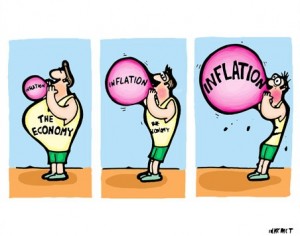
Measuring Inflation


Japan and the TPP

Considerations for Japan as they participate in TPP.

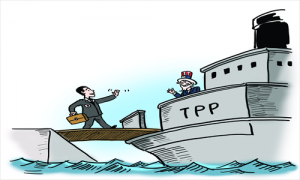
Yuriko Koiki writes:  After years of exhausting – and exhaustive – haggling, a dozen Pacific Rim countries finally signed up to the Trans-Pacific Partnership (TPP), an agreement that promises everything from more trade to a cleaner environment. The negotiations were such that the hair of Akira Amari, Japan’s economic and fiscal policy minister, turned completely grey. His solace, however, is that the TPP will prove to be a key foundation stone of the “Asian Century.”.

China’s exclusion was no accident. Its huge and complex economy would have injected insuperable problems.  In response, China has launched its “Silk Road” initiative to create an economic zone that will favor its own priorities. It is also seeking greater trade cooperation with European countries. One example is President Xi Jinping’s recent visit to the United Kingdom – which in essence is also an attempt to weaken Britain’s “special relationship” with the US by creating a cat’s cradle of trade, financial, and investment ties with Britain.

But, as Japanese Prime Minister Shinzo Abe’s recent call for talks with China on the issue confirm, the TPP is not off-limits to China – or to other Asian economies. South Korea is warming to the idea of the TPP, as is Indonesia, following President Joko Widodo’s recent visit to Washington, DC.

For Japan, the TPP is vital to achieve economic liberalization – the third arrow of “Abenomics,” the government’s program to revitalize the country’s ailing economy. The legislation to enact the TPP will simply push aside the lobbies and vested interests that have been so effective in slowing down or diverting piecemeal reforms.

The promise of greater exchange of goods, services, and capital across the Pacific, as well as the creation of international standards (for example, for intellectual-property rights), is simply too appealing to ignore. When Japan and other Asian countries weigh the risk of implementing the TPP against the risk of not participating, the risk of not participating is overwhelmingly higher.

Japan’s political challenge will be to sell the TPP to its voters, especially the farm lobby. The customs duty on beef imports, for example, is currently 38.5%. It will be 27.5% in the first year after the TPP takes effect, and will then be gradually lowered to 9% in the agreement’s 16th year.

That should surely provide more than enough time for Japanese beef ranchers to prepare themselves for foreign competition (of the 870,000 tons of beef imported annually, 520,000 tons come from Australia, the US, and New Zealand). And it will certainly be a boon for consumers, as the price of their beef-noodle soup and sukiyaki falls dramatically.

Japan’s ranchers do need time to adjust. Because they deal with animals, shortcuts cannot be taken, and there are limits to mechanization, particularly in creating the type of beef that Japanese consumers demand. Whereas ranchers in Australia and the US have huge herds of cattle, Japanese ranchers raise each individual cow on beer and massages.

The same applies to rice. Rumor has it that when the wife of a certain Chinese leader visited Japan, she bought a delicious variety of Japanese rice by the ton. Taking advantage of the worldwide sushi boom, Japan needs to emphasize that “real sushi requires Japanese rice,” branding it an exclusive product.

In fact, regardless of whether or not the TPP is implemented, Japan’s farmers must pursue this approach to secure their futures, rather than hoping that protective subsidies continue ad infinitum.

But now comes the truly hard part. The TPP has been signed – but it will not be implemented unless and until it is ratified by the legislatures of countries such as the US and Canada. That process could well be enough to turn Amari’s gray hair white.

Japan and TPP

Japan Post Undervalued?

Japan post sale may have been undervalued.  The people’s bank and insurance company shares rose 20 percent immediately.  The IPO was the biggest in the world this year and the largest since Alibaba’s record $25bn deal in 2014.

Shares in the parent company Japan Post Holdings closed up 20 percent. Shares of Japan Post Bank closed up 15% while Japan Post Insurance soared 56%.

The landmark debut marks the Japanese government’s largest asset sale in nearly three decades.

The listing is part of Prime Minister Shinzo Abe’s plans to boost the flagging economy by encouraging consumers to invest in the stock market.

About 10% of each company was sold to the public in the largest privatisation of a state-owned firm since Nippon Telegraph and Telephone in 1987.

The government allocated 80% of the shares to domestic investors, with the remaining 20% sold to international institutional investors.

The government plans to raise a total of 4tn yen in additional asset sales in the coming years.

It has said the funds will be used to help reconstruct areas hit by the 2011 earthquake and tsunami disaster.

Japan Post is headed up by Toru Takahashi, employs some 195,000 people, and has 24,000 post offices.

It also controls the country’s largest bank, Japan Post Bank, and Japan Post Insurance, the biggest insurer.

In February, the Japanese giant announced a $5.1bn offer for Australia’s Toll Holdings, the largest transport and logistics company in the Asia-Pacific region.

The deal, which went through for $4.6bn in May, has helped Japan Post become a leading global logistics player.

The Japan Post triple market debut, including its bank and insurance arms, is expected to occur in early November.

Japan Post employs some 195,000 people, and has 24,000 post offices.

It also controls the country’s largest bank, Japan Post Bank, and Japan Post Insurance, the biggest insurer.

Japan Post

Can VW Survive?

Volkswagen AG said it found faulty emissions readings for the first time in gasoline-powered vehicles, widening a scandal that so far had centered on diesel engines. Separately, the company’s Porsche unit said it’s halting North American sales of a model criticized by U.S. regulators.

Volkswagen said an internal probe showed 800,000 cars had “unexplained inconsistencies” concerning their carbon-dioxide output. Previously, the automaker estimated it would need to recall 11 million vehicles worldwide — more than Volkswagen sold last year.

The crisis that emerged after Volkswagen admitted in September to cheating U.S. pollution tests for years with illegal software has shaved more than one-third of the company’s stock price and led to a leadership change. Today’s revelation adds to the pressure on Volkswagen’s new chief executive officer, Matthias Mueller.

Most of the affected cars are in Europe and the 2 billion euros in possible costs are an initial estimate, according to the spokesman. The automaker will determine how much money to set aside once the probe has been finalized, he said.

The EPA said its new investigation centers on the Porsche Cayenne and VW Touareg sport utility vehicles and as well as larger sedans and the Q5 SUV from Audi.

But then late Tuesday, Porsche’s North American division said it would voluntarily discontinue sales of diesel-powered Cayennes from model years 2014 to 2016 until further notice. The Atlanta-based unit’s statement reiterated that the EPA notice was unexpected and that owners can operate their vehicles normally.

Mueller has pledged to overhaul the company’s corporate culture, which he said must change to create a more transparent environment that can discover possible faults.

“This is a painful process, but it is our only alternative,” Mueller said in an e-mailed statement. VW “deeply regrets this situation” and “will stop at nothing and nobody” to get to the bottom of the matter, he said.

The scandal has weighed heavily on Volkswagen’s earnings. The automaker reported its first quarterly loss last month in at least 15 years because of the reserve funds set aside to implement fixes.

Fixing VW

Entrepreneur Alert: Aluminum?

Alcoa Inc.’s latest aluminum-making cutback is signaling the end of the iconic American industry.

For 127 years, the New York-based company has been churning out the lightweight metal used in everything from beverage cans to airplanes, once making it a symbol of U.S. industrial might. Now, with prices languishing near six-year lows, it’s wiping out almost a third of domestic operating capacity, Harbor Intelligence estimates. If prices don’t recover, the researcher predicts almost all U.S. smelting plants will close by next year.

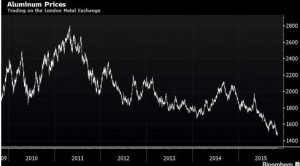
While that’s a big deal for the U.S. industry and the people it employs, it doesn’t mean much for global supplies. Alcoa’s decision to eliminate 503,000 metric tons of smelting capacity accounts for about 31 percent of the U.S. total for primary aluminum, but less than one percent of the global total, according to Harbor. For more than a decade, output has been moving to where it’s cheaper to produce: Russia, the Middle East and China. A global glut has driven prices down by 27 percent in the past year, rendering American operations unprofitable and accelerating the pace of the industry’s demise.

Jay Armstrong, the president of Trialco Inc. in Chicago Heights, Illinois, now buys about 80 percent of the supplies it turns into car wheels from overseas. That’s up from 40 percent five years ago.

Aluminum is down 19 percent this year to $1,501 a ton on the London Metal Exchange. The metal touched $1,460 last week, the lowest since 2009, and most American smelters can’t make money when prices are near $1,500 or below, Austin, Texas-based Harbor estimates. Plants overseas usually have the advantage of lower labor costs, cheaper energy expenses and weaker domestic currencies that favor exports to the U.S.

Aluminum Prices

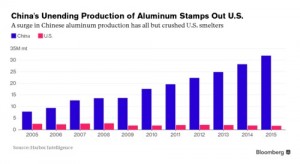
While output has been moving abroad for some time, the game changer in the past year has been the domination of China, where ballooning output has compounded a global surplus and driven prices so low that Bank of America estimates more than 50 percent of producers globally lose money. Smelters in the Asian country are still profitable, helped by higher physical premiums in the region.

China probably will account for 55 percent of global aluminum production this year, up from 24 percent in 2005, according to Harbor research. The U.S. has gone in the opposite direction: from 2.5 million tons in 2005 to 1.6 million in 2015, it said.

Still, not all U.S. smelters will benefit from closing down. Citigroup Inc. says some domestic operations with long-term energy contracts will have to pay regardless and are better off making the metal than simply paying the energy bill. Some plants also have access to cheap hydro power, said David Wilson, an analyst at Citigroup in London.

Aluminum

Banking Transparency: Progress?

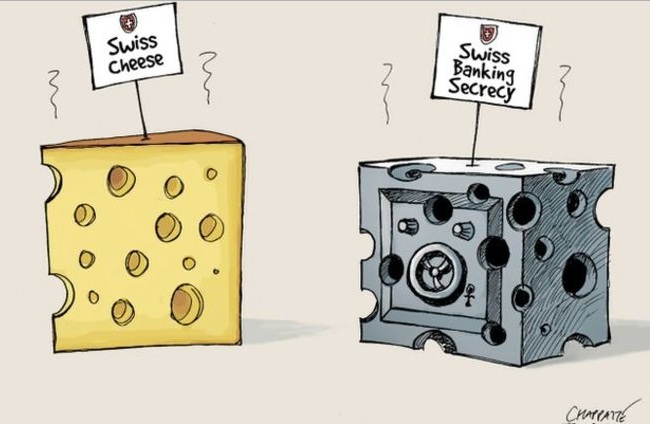
Most countries’ secrecy scores have improved – transparency has increased. . Real action is being taken to curb financial curb secrecy, as the OECD rolls out a system of automatic information exchange (AIE) where countries share relevant information to tackle tax evasion. The EU is starting to crack open shell companies by creating central registers of beneficial owners and making that information available to anyone with a legitimate interest. The EU is also requiring multinationals to provide country-by-country financial data.  But the U.S. is going the other way, rising to third on the list. Higher is bad and Switzerland tops the list, followed by Hong Kong.

Secrecy by country, listed from most to least.

l. Switzerland 2. Hong Kong  3. USA  4. Singapore 5. Cayman 6.  Luxembourg                7. Lebanon 8. Germany 9.  Bahrain 10. Dubai/UAE

Bank Secrecy

Gold: Giving the US Fed Competition?

Could a gold-based currency make the US Fed more responsible?

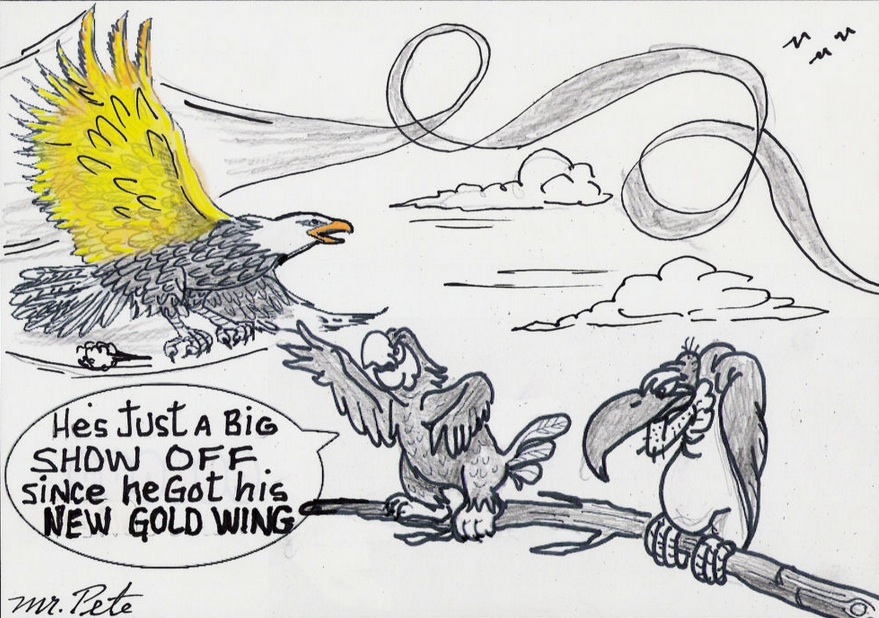
Sean Fieler writes:  History suggests that the only way to rein in the sprawling Federal Reserve is to end its money monopoly and restore the American people’s ability to use gold as a competing currency.

The legislative compromise that created the Fed in 1913 recognized that the power to print money, left unchecked, could corrupt both the government and the economy. Accordingly, the Federal Reserve Act created the Federal Reserve System without a centralized balance sheet, a central monetary-policy committee or even a central office.

The Fed’s regional banks were prohibited from buying government debt and required to maintain a 40% gold reserve against dollars in circulation. Moreover, each of the reserve banks was obligated to redeem dollars for gold at a fixed price in unlimited amounts.

Over the past century, every one of these constraints has been removed. Today the Fed has a centrally managed balance sheet of $4 trillion, and is the largest participant in the market for U.S. government bonds. The dollar is no longer fixed to gold, and the IRS assesses a 28% marginal tax on realized gains when gold is used as currency.

The largest increases in the Fed’s power have occurred at moments of financial stress. Federal Reserve banks first financed the purchase of government bonds during World War I. The gold-reserve requirement was dramatically reduced and a central monetary policy-committee was created during the Great Depression. President Richard Nixon broke the last link to gold to stave off a run on the dollar in 1971.

This same combination of crisis and expediency played out in 2008 as the Fed bailed out a series of nonbank financial institutions and initiated a massive balance-sheet expansion labeled “quantitative easing.” To end this cycle, Americans need an alternative to the Fed’s money monopoly.

A competing currency would not only offer people a monetary choice in a crisis. More important, it would give the Fed a clear incentive to anticipate and avoid such crises. In a competitive system, before it embraced another bout of monetary adventurism, the Fed would have to contemplate a decline in market share. For if the Fed were even perceived to be debasing the dollar, many would seek out a sounder alternative.

The continuing revolution in payment technology makes the introduction of competition not only possible, but practical. Bitgold, a Canadian company, is already offering gold-denominated transaction accounts with a debit card. The tag line on the company website reads: “Spend gold with the Bitgold prepaid card. Accepted anywhere globally that accepts credit cards, including ATM machines to withdraw local currency.”

With a gold-based currency up and running north of the border, why not offer Americans a monetary choice as well? The proposition is simple. Americans who prefer the incumbent monopoly provider of money are free to keep their accounts as is. Those who prefer gold are free to switch. And the Fed is free to defend its market share with sound monetary policy.

Return of Gold?

FATCA Drives More than Fatcats Out of the US?

Rocky Road to Globalization

Wall Street Journal editorial:   Few privileges in the world are greater than U.S. citizenship, so why are a record number of Americans giving it up these days? The U.S. Treasury Department reported this week that 1,426 Americans turned in their passports between July and September, more than in any previous quarter. The total for the year is on pace to far exceed last year’s all-time-high of 3,415.

As recently as the George W. Bush years, only about 480 Americans renounced their citizenship annually. But in 2010 the Pelosi Congress and Barack Obama enacted the Foreign Account Tax Compliance Act, or Fatca. Aimed at tax evaders, the law has mostly made financial life hellish for law-abiding Americans living overseas, of whom there are some eight million.

Fatca requires that foreign banks, brokers, insurers and other financial institutions give the U.S. Internal Revenue Service detailed asset and transaction records for any accounts held by Americans, including corporate accounts controlled by American employees. If a firm fails to comply, the IRS can slap it with a 30% withholding tax on transactions originating in the U.S. Facing such risks and compliance costs, many foreign firms have decided it’s easier to dump their American clients.

So Americans overseas are becoming increasingly unbankable. Not the wealthiest ones, of course, those “fat cat” potential tax evaders whom Democrats rail against. Much more vulnerable are sales reps, English teachers, lawyers, retirees—the overwhelming majority of American expatriates—whose modest finances make them unappealing clients amid Fatca’s compliance costs.

American expats in the Fatca age are also less attractive as employees and business partners, as any financial accounts they can access must now be exposed to government scrutiny—not only from the U.S. but potentially also from more than 100 other countries that have signed Fatca-related information-sharing agreements with Washington. Americans up for executive posts in Brazil, Singapore, Switzerland and elsewhere have been asked by their managers to renounce their U.S. citizenship or lose their promotion.

Little surprise, then, that renunciations are on the rise. A few thousand ex-Americans aren’t much of a political cause, but they’re a proxy for U.S. tax and regulatory policies that hamper the entire U.S. economy. For every American who renounces citizenship, there are many more foreigners refusing to do business with Yankee entrepreneurs or to invest money in U.S. businesses. That’s a problem for all Americans.

Fat Cats

Government Action Against Wrongdoing Bankers?

Reviewing John Coffee’s book “Entrepreneurial Legislation”  Judge Jed Rakoff suggests a possible solution to the government’s failure to prosecute in cases of bankers who have clearly violated the law.

Rakoff writes: Coffee, while also strongly advocating for more governmental action against individuals, proposes an interesting innovation that he thinks would make class actions more socially useful and less liable to abuse. Overall, he suggests making good on class action’s promise of a “third way” by combining its profit-seeking tendencies with oversight of the class actions themselves by public agencies. Specifically, he proposes, among other reforms, that government regulators in matters where class actions are common should employ private class action lawyers, on a contingent fee basis, to bring class actions supervised by the regulatory authority but for the benefit of the victims, to whom any recovery would be distributed.

It is hard to believe that the settlements in such cases have much of a deterrent effect on the individual executives who actually committed the alleged misconduct. This is why class actions may be no real substitute for criminal and regulatory prosecution of the individuals actually responsible for corporate misconduct.

Is it possible that enlightened regulators could vindicate the rights of individuals without the massive profit-seeking machinery of the current U.S. legal system, and without the cruel bias toward incarceration of the current U.S. criminal justice system?

Jail Bankers?