Poaching Wildlife Big Problem in Africa

Ed Stoddard writes:  The poaching of rhinos has risen in South Africa’s Kruger National Park this year but is on the decline elsewhere in the country, Environment Minister Edna Molewa said on Sunday.

The Kruger Park, South Africa’s main tourist draw, is on the frontlines of a surge in rhino poaching for the animal’s horn to meet demand in countries such as Vietnam, where it is a coveted ingredient in traditional medicine.

A record 1,215 rhino were poached in South Africa last year, almost triple the 448 killed in 2011.

Molewa said at a news briefing that as of Aug 27, 749 rhinos were known to have been illicitly killed in South Africa so far in 2015, 544 of them in Kruger. At this time last year, the nationwide total was 716, with 459 killed in Kruger.

Molewa said Kruger was still the epicentre of the crisis.

“Kruger remains a magnet because of numbers. You won’t walk 2 kms in Kruger without coming across a rhino,” she said.

Kruger has the largest concentration of rhinos on the planet, with an estimated 8,000 to 9,000 white rhinos, about half of South Africa’s population of the species.

South Africa has more than 80 percent of the world’s rhino population with about 18,000 white rhinos and close to 2,000 black rhinos.

Fundisile Mketeni, the chief executive of South African National Parks, also pointed to Kruger’s size and topography as attractions to poachers. Kruger is the size of Israel and much of its terrain is remote, making it tough to police.

The park also shares a 450 km (300 mile) border with Mozambique, from where many of the Kruger poachers come.

While incidents are falling elsewhere, the rhino war in Kruger is escalating.

So far in 2015, Molewa said there has been a “27 percent increase in poachers entering the Kruger National Park to attempt to kill rhino.”

There were 12 active poacher groups at any given time somewhere on the 2 million hectares of the Kruger National Park.

Arrests of suspected rhino poachers in the park are also up to 138 so far in 2015 compared to 81 in the same period last year.

US Trade deal could limit poaching..The pact would, for the first time, integrate species conservation with trade access by requiring the 12 countries that sign it to adopt conservation laws, or live up to commitments they’ve already made yet routinely ignore.

The TPP would also require international law enforcement agencies, customs and border patrol officials, and wildlife inspectors to coordinate more effectively. If an African country informs Vietnam that one of its citizens has paid a poacher for rhino horns, for example, the Vietnamese can’t ignore the tip-off.

Rhino Poaching

Stock Markets Still Boomeranging?

The Economist writes:   The ability to make stockmarkets boomerang is usually reserved for central bankers. But on August 24th, hours into a global market rout that had started in Asia and was sweeping its way through Europe and then America, Tim Cook, the boss of Apple, turned his hand to it. “I can tell you that we have continued to experience strong growth for our business in China through July and August,” he wrote in an e-mail to CNBC, a financial-news channel. “I continue to believe that China represents an unprecedented opportunity over the long term.”

By the time Mr Cook felt it necessary to opine on the state of the world’s second-biggest economy, plenty had started to question its prospects. Following weeks of wobbling, the Shanghai stock exchange had just cratered. A government once credited with near-magical powers to browbeat its economy into growth looked to have misplaced its wand. Suspicions abounded that a decades-long era of superlative—if recently softening—economic expansion might be coming to an end. So the news that Chinese consumers were still in the mood for new iPhones and whizzy watches did more to assuage nerves than reams of official pronouncements from Beijing ever could.

Apple shares reclaimed the $66 billion they had lost; the Dow Jones blue-chip index, having opened down a calamitous 1,000 points, rebounded. But that was a precursor for days of volatility. Many markets around the world crossed the line into “correction” territory, having fallen more than 10% from recent peaks.   China’s Market Impacts

Image by Claudio Munoz

Image by Claudio Munoz

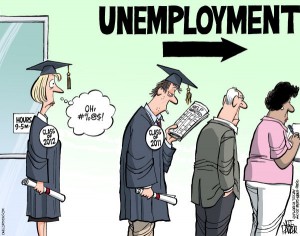
Is a 4-Year Liberal Arts College for Everyone

John Cassidy writes: Promoters of higher education have long emphasized its role in meeting civic needs.

In the fast-growing for-profit college sector, which now accounts for more than ten per cent of all students, vocational degrees are the norm.

No idea has had more influence on education policy than the notion that colleges teach their students specific, marketable skills, which they can use to get a good job. Economists refer to this as the “human capital” theory of education, and for the past twenty or thirty years it has gone largely unchallenged.

So what purpose does college really serve for students and employers?

And, while college graduates are still doing a lot better than nongraduates, some studies show that the earnings gap has stopped growing. The figures need careful parsing. If you lump college graduates in with people with advanced degrees, the picture looks brighter.

Many students and their families extend themselves to pay for a college education out of fear of falling into the low-wage economy. That’s perfectly understandable. But how sound an investment is it? One way to figure this out is to treat a college degree like a stock or a bond and compare the cost of obtaining one with the accumulated returns that it generates over the years. (In this case, the returns come in the form of wages over and above those earned by people who don’t hold degrees.)

So what purpose does college really serve for students and employers? Before the human-capital theory became so popular, there was another view of higher education—as, in part, a filter, or screening device, that sorted individuals according to their aptitudes and conveyed this information to businesses and other hiring institutions. By completing a four-year degree, students could signal to potential employers that they had a certain level of cognitive competence and could carry out assigned tasks and work in a group setting. But a college education didn’t necessarily imbue students with specific work skills that employers needed, or make them more productive.
Kenneth Arrow, one of the giants of twentieth-century economics, came up with this account, and if you take it seriously you can’t assume that it’s always a good thing to persuade more people to go to college. If almost everybody has a college degree, getting one doesn’t differentiate you from the pack. To get the job you want, you might have to go to a fancy (and expensive) college, or get a higher degree. Education turns into an arms race, which primarily benefits the arms manufacturers—in this case, colleges and universities.

Increasingly, the competition for jobs is taking place in areas of the labor market where college graduates didn’t previously tend to compete. As Beaudry, Green, and Sand put it, “having a B.A. is less about obtaining access to high paying managerial and technology jobs and more about beating out less educated workers for the Barista or clerical job.”
Obtaining a vocational degree or certificate is one strategy that many students employ to make themselves attractive to employers, and, on the face of it, this seems sensible. If you’d like to be a radiology technician, shouldn’t you get a B.A. in radiology? If you want to run a bakery, why not apply to Kansas State and sign up for that major in Bakery Science?

Perhaps the strongest argument for caring about higher education is that it can increase social mobility, regardless of whether the human-capital theory or the signalling theory is correct. A recent study by researchers at the Federal Reserve Bank of San Francisco showed that children who are born into households in the poorest fifth of the income distribution are six times as likely to reach the top fifth if they graduate from college. As the economist Lawrence Summers and two colleagues showed in a recent simulation, even if we magically summoned up college degrees for a tenth of all the working-age American men who don’t have them—by historical standards, a big boost in college-graduation rates—we’d scarcely change the existing concentration of income at the very top of the earnings distribution, where C.E.O.s and hedge-fund managers live.

Are College Degrees Worth It?

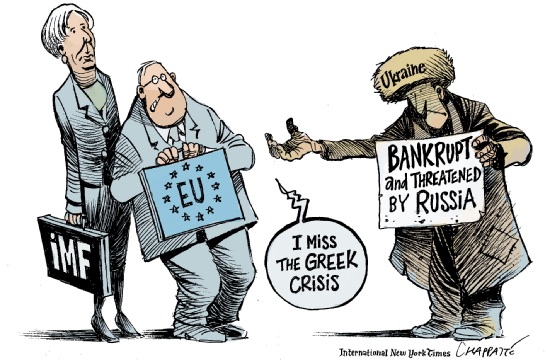
Solving Ukraine’s Debts?

Ukraine’s finance minister said a “win-win” deal for restructuring $18 billion of debt had been agreed with a group of its largest creditors. Poroshenko is looking to meet all the conditions of the emergency assistance from the International Monetary Fund.  Debt restructuring should save the country $15.3 billion through 2018, while attempting to end the worst recession of anywhere across Africa, Europe and the Middle East. The government will not have to make interest or principal payments until 2019.

The deal also includes a so-called GDP growth warrant that will kick in from 2021 through 2040.

Ukraine’s US-born finance minister Natalie Jaresko said she nailed the debt deal that pulled the ex-Soviet country back from the brink.

Ukraine agreed to raise its coupon rates to 7.75 per cent from 7.2 per cent while the lenders accepted slightly longer repayment terms.

German Chancellor Angela Merkel and French President Francois Hollande – co-sponsors of an increasingly tattered six-month-old truce – reaffirmed their support for the deal.

Ukraine started negotiations requesting a 40% haircut on the creditors’ holdings.

Franklin Templeton and three other global financial titans led to a 20-percent write-down or “haircut” to the face value of the bonds they hold, a deal that saves Ukraine 11.5 billion. The EU is brokering negotiations between Moscow and Kiev to secure gas supplies for the upcoming winter, but there has been little progress so far.

Still unresolved is the fate of the $3 billion Russian loan, given to prop up the regime of former president Viktor Yanukovych before he was ousted past year.

EU President Juncker  gave assurances on highly anticipated plans to lift visa requirements for citizens of Ukraine visiting the EU, and said he expects the commission to give a green light by the end of the year.

Moscow insists that the debt be treated as a sovereign obligation, while Kiev is treating it as a commercial debt.

Ukraine Debt


IMF Recommends Debt Structuring for Greece

The IMF is skirting the issue of actual cash to help relieve Greece’s debt burden.

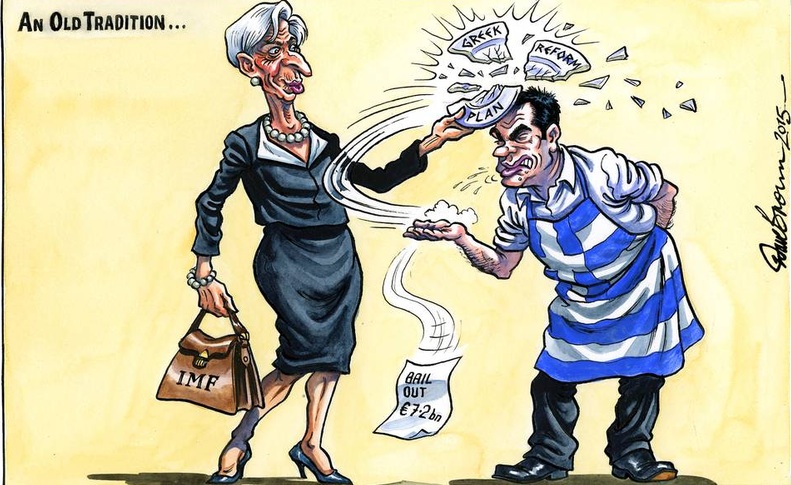
A form of debt restructuring rather than outright forgiveness should enable Greece to handle its “unviable” debt burden, the head of the International Monetary Fund was quoted as telling a Swiss newspaper.

The IMF has yet to make clear if it will participate in the third 86-billion-euro ($96 billion) international bailout that Greece signed up to in early August, having argued in favor of a partial writedown of a debt burden it considers unsustainable in its current form.

Greece’s euro zone creditors, notably Germany, have ruled out a writedown but are willing to consider other forms of restructuring such as a lengthening maturities.

Asked about those differences, IMF Managing Director Christine Lagarde told Saturday’s edition of Le Temps: “The debate on cancelling the debt has never been open I don’t think it is necessary to open it if things go well…

“We are talking about extending maturities, reducing rates, (making) exemptions for a certain period of time. We are not speaking about cancelling debt.”

Lagarde has said the IMF will make a decision by October.

IMF and Greece

Hyperinflation in Venezuela?

Megan McArdle writes: Venezuela seems to be hovering on the edge of tipping into hyperinflation. Or perhaps it has already fallen into the abyss. 

Using those rates, economist Steve Hanke recently wrote that annual cost-of-living increases are running at about 722 percent. To put that in some perspective, it means that a $400 monthly grocery bill would climb to $2,888 in a year. That may not approach the legendary status of Hungary’s postwar inflation, which reached 41.9 quadrillion percent in a single month, but it’s devastating for savers, or for people like pensioners whose incomes consist of fixed payments. It’s also pretty bad for the economy.

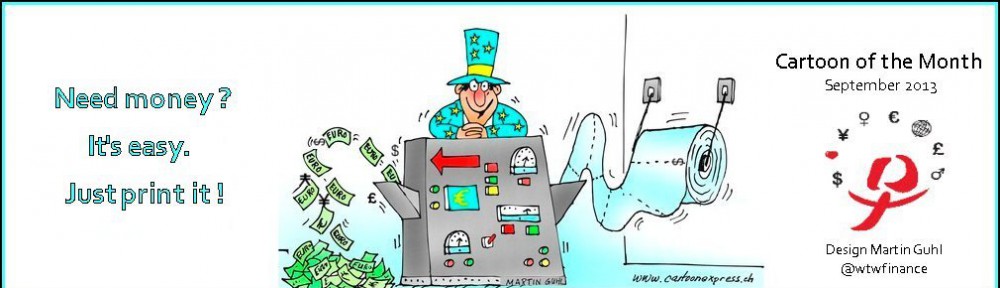
Or is it Seigniorage! That’s the fancy name for the profit a government makes by printing bills and minting coins. If you can buy more goods and services with the cash you made than it cost you to make it, you have essentially collected a stealthy sort of tax on the people who take the money from you and give you valuable stuff in exchange.

In general, seigniorage revenue is trivial — indeed, it costs the U.S. government more to make nickels and pennies than the coins themselves are worth. But even with higher-value bills, the revenues pale in comparison to, say, the income tax. 

Governments can try to jack up the amount of seigniorage revenue by stealthily inflating the currency. Basically, they exploit an information asymmetry between them and the people they trade the money to: The government knows how much money there is, and its citizens don’t. So they’ll probably accept fewer units of currency than they would if they knew the government was going to print extra money and thus cause prices to rise again.

But this is a terrible way to make money, which is why governments normally don’t resort to this one clever trick for raising government spending without raising taxes. 

The core thing to understand about inflation as a policy tool is that in general, steady-state inflation doesn’t do you any good; what you need is accelerating inflation.

Once inflation starts to accelerate, it’s kind of hard to stop because people also start pricing the acceleration into their expectations. Hyperinflation has all sorts of bad knock-on effects: It hurts your capital base and makes people unwilling to plan for the future because they have no idea what their money will be worth. But the supreme irony is that after a certain point, the government actually starts losing money.

Part of the answer is that in the early days, inflating does make the government a little more money, and the point at which it starts to lose money is also the point at which the freight train is traveling 120 miles an hour. 

The larger answer is that this is the end game of Chavismo. For about a decade, some sectors of the left hoped that Hugo Chavez represented an alternative to the neoliberal consensus on economic policy. 

In real terms, the price of a barrel of oil is barely higher than it was in August 2000, but Venezuela is producing something like 700,000 fewer barrels each day. Policies that looked great on the way up — more revenue and more social spending — became disastrous on the way down as the population was hit with the double whammy of lower production and lower prices.

Now falling oil prices are crushing government revenues at exactly the time the country most needs money to help the people who are suffering great misery as the oil cash drains out of their economy. In the beginning, printing money may have looked like the best of a lot of bad options. By the time it became clear that the country was not fudging its way out of a temporary hole, but making a bad situation worse, it was committed to a course that is extremely painful to reverse.

Venezuela may be able to pull back from the edge, though it can only do so with great pain. Or it may end up in a hyperinflationary spiral, which will ultimately mean even greater pain. I don’t envy the decisions it will have to make. Or the millions of Venezuelan people who will have to live with them.

End of Chavez

Gambling as Business?

Noah Feldman writes:   The New Jersey public, not to mention Governor Chris Christie, wants to reinstate sports gambling in Atlantic City in the hopes of reversing the trajectory of a place that has totally cratered.

The nominal justification for the federal law that effectively banned sports gambling in the U.S. was protecting professional and amateur sports against the taint of gambling, and hence of point-shaving or game-throwing.

The law exempted Nevada’s legalized sports gambling. It also grandfathered sports lotteries in three states. Finally, it gave New Jersey the option of reinstating sports gambling in Atlantic City — provided that it did so within a year from the passage of federal law. New Jersey didn’t take advantage of the option within the time limit.

Whatever its original motives, Paspa today serves as guarantor of Nevada’s pre-eminent position in the vast U.S. sports gambling industry. 

New Jersey’s efforts to allow sports gambling included a 2011 statewide referendum that endorsed a change in the laws; Christie signed a bill decriminalizing such betting in 2012. The 2013 decision blocking that initial effort grew out of litigation by the National Collegiate Athletic Association, as well as the National Football League, the National Hockey League and Major League Baseball to block  that law. 

In response, New Jersey argued that Paspa violates the Constitution. They put most of their eggs in the wrong basket, emphasizing the claim that Congress lacked the authority to “commandeer” state resources for federal objectives.

Roberts’s argument was that such differential treatment of states required a strong justification, which existed when the Voting Rights Act was passed in 1965 but no longer existed today. This claim was strongly criticized, and the eminent and acerbic Judge Richard Posner commented that he’d never heard of the “equal sovereignty” doctrine because it didn’t exist. But equal sovereignty is now the law of the land.

Paspa treats states differently from one another by enshrining Nevada’s special gambling preserve — and hence violates the equal sovereignty of New Jersey voters by denying them the right to do what Nevada does. This isn’t just a matter of constitutional doctrine. It also makes constitutional common sense. 

Many laws may have differential effects in the real world. A coal mining regulation will affect West Virginia more than it affects Hawaii. And the courts shouldn’t be in the business of reviewing every federal law to see whether it helps some states over others.

But a law that explicitly gives some states rights that others lack goes too far. And it’s worse when the public in one state wants to change its laws to compete with another state — and is denied that right by the federal law in question.

 Equal Gambling Rights

Interest Rates and the Markets

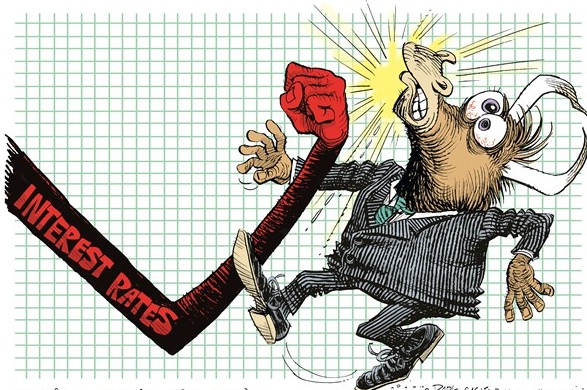
Barry Ritholts writes:  The Federal Reserve says the timing of its first interest rate hike in nine years depends on the data, but that doesn’t mean the Fed will be digging through the jobs, growth and inflation reports for the all-clear signal.

Instead, the Fed will be doing what millions of people have been doing for the past couple of weeks: Watching the stock market.

Many investors have assumed that the recent selloffs in markets from Shanghai to New York meant that the Fed definitely won’t pull the trigger on a rate hike at its Sept. 16-17 meeting.

From 1987 to today, the Fed has reacted to nearly every market hiccough and tantrum by flooding markets with liquidity and reassurances. They’ve given the markets rate cuts, quantitative easing and promises that easy-money policies will continue for a long time, if not forever.  This “Greenspan put” means investing in the stock market is a one-way bet.

New York Fed President Bill Dudley seemed to close the door on a September rate hike when he said that,a rate hike next month no longer seemed as “compelling” as it once did. 

What sort of additional information would make a rate hike more compelling? Dudley said the Fed is looking at more than the economic data, widening its scope to examine everything that might impact the economic outlook. They are looking at the value of the dollar, the price of commodities, the risk of contagion from Europe, from China, and from emerging markets. And, above all, the U.S. stock market.

The market selloff has made a September rate hike even more compelling than it was before, because it gives Fed Chair Janet Yellen the opportunity she needs to kill the “Greenspan put” once and for all.

End of the Greenspan Put?

Google Gets Tough with the EU

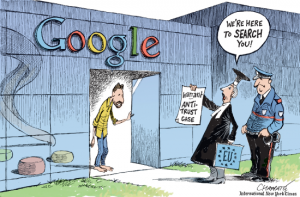
Leonid Bershidsky writes: Google has lost patience with its soft approach to the European Union’s bureaucracy in Brussels, showing a new fighting spirit in its answer to antitrust charges against the company. This is a path that led Microsoft nowhere and cost it more than a billion dollars in fines.

The company’s general counsel, Kent Walker defends the way Google prominently displays results from its own shopping comparison service, but not from its competitors — a practice at the heart of the European Commission’s case:  

Walker also reveals that Google hired Bo Vesterdorf, the former president of the General Court, part of the EU’s judicial branch, to write a separate response. This argues that Google has no duty to supply its own rivals, as if it controlled an input that was both essential and not available anywhere else. That just isn’t the case on the Internet, Vesterdorf said.

Before reaching this stage, Google had tried a more pliant approach, seeking to satisfy the antitrust commissioner and avoid the large fine that would come with an adverse ruling.

Last year, Google doubled its EU lobbying budget to 3.5 million euros ($3.9 million).  That isn’t much less than Deutsche Bank or ExxonMobil is spending. According to data on the same site, Google has held more meetings with EU officials than any other company since last November — 32 in all.

In the comparison shopping case, though, Google’s competitors and the European Commission remained unhappy. So the company stopped smiling and nodding and decided to get tough: It’s no longer proposing any compromises, just boldly stating that the way it displays offers from various online merchants is within the law and good for users. .

Older tech companies know it’s useless to tell the EU — and, inevitably for such a strategy, European courts — that they don’t understand what they’re doing. The bureaucrats and judges may be unable to produce another Google, but they are good at listening to experts and far from dumb. And they often hate what they see as American arrogance.

Microsoft can tell Google exactly what happens next; indeed, Google’s lawyers realize there will be other antitrust investigations. One, concerning the Android operating system and its links to Google services, is already in the works, although no official charges have been brought. Another may soon hit Google where it really hurts, challenging its dominance in online advertising. Google will fight and probably lose, because Europe doesn’t like big U.S. companies to dominate its markets. 

Lobbying and complying with whatever demands still can’t be avoided is a less painful path. Microsoft spent 4.5 million euros last year, a million more than Google, on efforts to get EU officials to see its points on issues such as data protection and cloud computing. 

It’s admirable that Google now wants to fight for its principles and against the dilution of its superior offering. It makes me cringe, however, to think of the time and money that will be burned in this hopeless battle.

Google versus the EU

US Corruption in Afghanistan

US dealings in Afghanistan fraught with fraud.

Jorge Scientific, now named Imperatis, received a sole source contract last year to help the Office of Personnel Management patch security holes in its network after hackers made off with sensitive government personnel information. The award has raised eyebrows, as the company had been in hot water after ABC released video of the company’s security personnel in Afghanistan, tasked with protecting American officials, incoherently drunk and high on drugs. A subsequent Inspector General investigation also found the company could not account for $135 million spent on a contract for training Afghan security forces.

Corruption in Afghanistan