Sharing Knowledge Good for Business

Sharing knowledge means that innovation spreads more quickly in clusters. A study of clusters conducted by the ETH in Zurich looked at clusters in the biotech and ICT sectors.

The study was conducted by Professor Georg von Krogh and doctoral student Nina Geilinger of the Federal Institute of Technology in Zurich (ETH), in collaboration with Canton Zurich’s Business and Economic Development Division of the Office for Economy and Labour. Von Krogh explained in aninterview on the ETH’s website that expertise from limited fields of knowledge was often insufficient to develop innovations. In this way clusters have an advantage.

Geilinger added that companies in Zurich’s biotech and ICT clusters would benefit from each other because they were prepared to swap knowledge. She said that many companies were aware that they could not survive in a vacuum. The exchange of ideas with universities is as important as it is with customers or competitors. Both are required in Zurich, which according to Geilinger is a key advantage of Canton Zurich’s “cluster eco-system”.

Von Krogh sees Zurich as the centre of the Swiss ICT industry. Here too, close proximity between companies and employees could speed up the innovation process.

Sharing Knowledge

How Does Concern About the Future Impact Economies?

David M. Smick writes:  Today the big thinkers are debating whether a growth strategy for Greece (if not the entire eurozone periphery) should entail further debt relief, this time from public creditors.  But here’s the thing: Are the smartest guys missing an even more important picture? The entire world’s public and private debt, depending on the means of measurement, now exceeds a whopping $180 trillion. What’s the significance of this massive debt? Is it sustainable? Is it one reason for the world’s subpar growth? Nobody knows. If a global deflation scenario unfolds, the level of the world’s real debt will grow to the point where massive rolling defaults could become a terrifying fact of life. In an aggressive inflation scenario, on the other hand, the debt’s value in real terms will shrink, but at a brutal cost to the livelihoods of working families if not to capitalism itself. The obvious solution is to control the growth of future debt while encouraging a global explosion in innovation and productivity growth. This is what the British did in dealing with their horrendous debt after the Napoleonic Wars.

In an environment of record-low global interest rates, in which a lot of economic activity has been moved forward, an explosion in innovation and higher productivity growth may be the only safe way eventually out of today’s low interest rate trap. But an explosion in innovation that leads to higher global growth entails the issue of human motivation. People have to believe the future will be better than the past. That’s not the case today. Yet in the period since the 2008 crisis, the smartest guys have consistently argued that money is the driver of human behavior.

In response to the crisis, for example, the world’s governments and central banks bet the farm on a giant money-driven rescue operation the size of which the world had never before seen. More than $17 trillion, or 25 percent of global GDP, went for stimulus, bailouts, and guarantees. The result: After an initial sugar rush of economic activity, global growth, trade, and cross-border financing since 2010 have all plummeted. Today’s slow-growth environment is helping spawn a geopolitical nightmare. It turns out the massive flood of money failed to drive human behavior, at least to a level expected by historic standards. The lesson here is that money is just a measuring tool. As Adam Davidson wrote in the New York Times, “What actually matters is what we make and do and feel and want.”

Stated in short: In achieving higher levels of economic growth, attitude matters. Record low interest rates and generous fiscal stimulus are meaningless if people have no confidence in the future. So where does this all end? The world faces a troubling nexus of unprecedented debt, record low interest rates, exploding central bank balance sheets, declining growth, worldwide asset prices that may or may not reflect true value because the policymakers have their thumbs pressing down on the scale, a global currency war against the dollar as dollar-denominated debt is approaching $15 trillion, all at a time when polls consistently show people believe their children’s future is in jeopardy. Does anybody know the end game to this bewildering scenario? Or should we get the smart guys on the line?   Confidence about the Future

Future?

Is Devaluation One-Off for China?

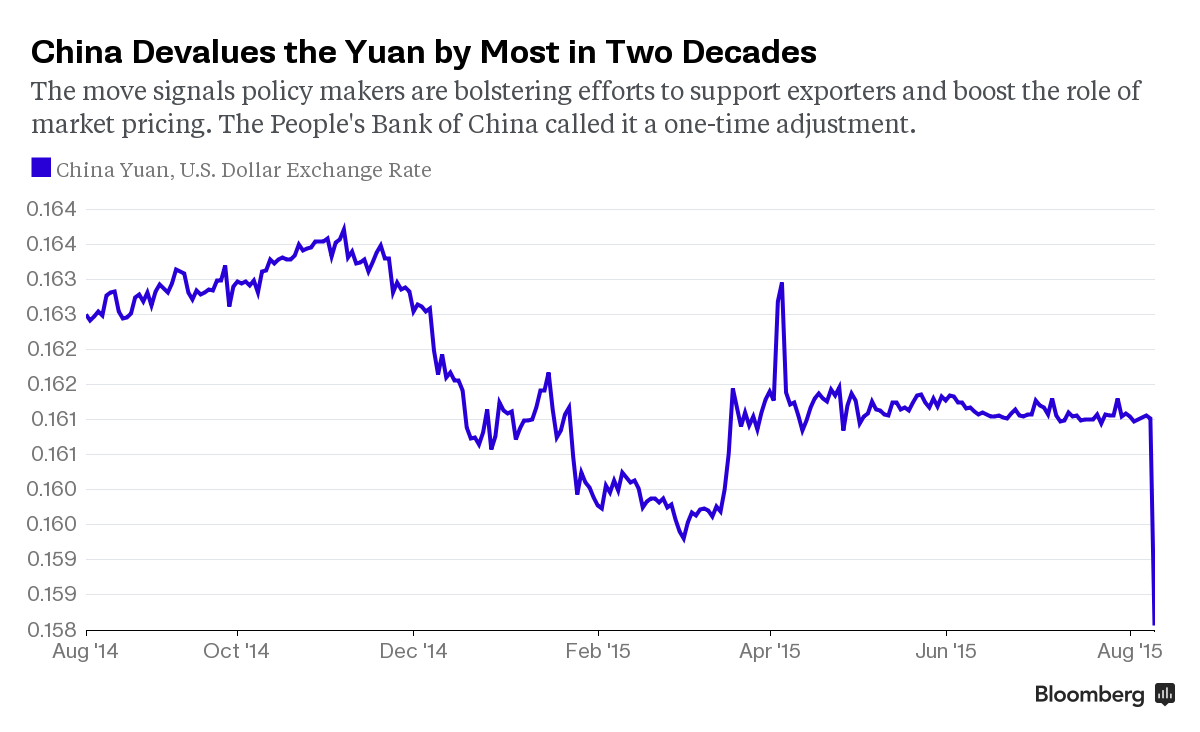
Yichio Wang writes: The People’s Bank of China (PBOC) has set its official guidance rate down by almost 3%, from 6.21 to 6.39 yuan per dollar, the lowest point in almost three years. Much of this was accomplished in one day with a decline of 1.9% (see chart below). It also changed the way it calculates the reference rate around which the yuan is allowed to trade in a two percentage point band. Last week, China’s currency dropped by a cumulative 4.4% against the U.S. dollar before recovering to trade very near the target.

This move has been explained by PBOC as a key reform that allows the currency’s value to be more responsive to market forces. China has been urging the IMF to include the yuan in the basket of the Special Drawing Rights (SDR), in order to boost international use of the yuan. As China is being accused of controlling its currency, this free-market reform can help China to have the yuan join the IMF reserve currency group.

The devaluation also suggests a growing worry about the growth after China’sexports tumbled 8.3 percent in July. A weaker currency can make Chinese exports cheaper and more competitive, while many other efforts to boost the economy seem useless.

Moreover, in order to keep the exchange rate stable, PBOC has to sell its dollar holdings to bolster the yuan’s value, which in turn offsets the effect of easing policies. As a result, China’s currency reserves have decreased $315 billion in the year to $3.65 trillion in July. Therefore, the currency devaluation could lower the cost of stabilizing the exchange rate and enhance the effect of monetary policies. One off for China?

Toxic Employees Poison Workplace

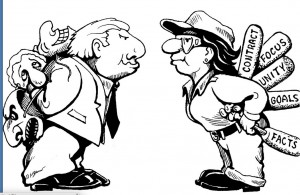
The daily life of the modern office worker is an ordeal with ever-changing trends. Sometimes workers are overstimulated to the point of burnout. At others they are understimulated to the point of boredom. Bookshelves are crowded with literature on employee psychopathology. But one phenomenon is often overlooked when people research the daily office life that takes place between the meetings and the water cooler: toxic workers who contaminate the workplace and make things a nightmare.

German psychologist Heidrun Schüler-Lubienetzki has now come up with a name for these types of people: “toxifiers.” For several years now, Schüler-Lubienetzki and her husband have been coaching office workers in a number of companies — employees ranging from average income workers right up to powerful executives. Soon the couple began noticing similar problems among their clients. Increasingly, similar types of people were being portrayed in their client’s stories; a type of person who utilizes all means in order to advance his or her career.

Schüler-Lubienetzki and her husband noticed a vast spread of this phenomenon, prompting them to publish a German-language book this year titled, “Difficult People in the Workplace.”

Based on her research, the psychologist assumes that five to 10 percent of all employees have a toxic nature. Women and men can be affected to the same degree. And anyone can turn into a victim — the colleague walking past in the hallway, the person in the meeting, even the boss.

The trouble with toxifiers is that they are difficult to detect. Often, toxifiers are even popular amongst colleagues, perceived as friendly and amiable. It’s only after a while that co-workers begin to notice that the toxifier is responsible for bullying an entire workplace. But it is possible to see signs.

“If a person starts to polarize — either by being extremely despised or being very loved by others — you could be dealing with a toxifier,” the authors say. Likewise, toxifiers can also often be unpredictable. One moment they can be charming and courteous, and the next they can swiftly switch into a mode of ruthless and inconsiderate behavior.

Often, they are sensitive people who are masters at the art of sniffing out the atmosphere around a team of co-workers and exploiting it. Every action — whether a performance review with a supervisor or a heart-to-heart talk with a co-worker — serves only one purpose: to execute both control and power. Toxifiers gather information in very calculating ways only to later ruthlessly exploit those insights. They deliberately bully and psychologically torture their colleagues. Indeed, the act of consciously harming others is part of the standard repertoire of the toxifier.

Surprisingly, the scheming colleague often remains undetected. Lubienetzki explains that toxifiers act in extremely skillful ways, often even establishing friendships with their victims. If they regard their supervisor as weakened, they often seek to gain control in the office through a kind of hostile takeover.

So what character traits can be found in a toxifier? He or she is not your occasional perpetrator who takes advantage of a situation only when opportunity knocks. Toxifiers act in premeditated, categorical ways with the sole goal of obtaining personal power and reaping its rewards: status, recognition, money and sometimes even sexual relations.

“Toxifiers are drawn to power like a moth to a flame,” Schüler-Lubienetzki says. This is what makes this type of person so successful and dangerous. Whenever arguments occur, the toxifier thrives. The subject matter of the dispute is unimportant because it is only the means to an end. Toxifiers enjoy it when conflicts escalate and they do not shy away from publicly humiliating their critics. Schüler-Lubienetzki describes a case in which a top manager threw his colleague’s mobile phone into the trash can because he got annoyed by the ringing. In truth, though, the episode had to do with power and submission.

Poor leadership provides the ideal breeding ground for toxifiers. If a supervisor shies away from conflict, it creates an open field in which the perpetrator can operate in scrupulous ways.

Schüler-Lubienetzki says that some fields are literally suffering from epidemics of toxifiers in the workplace. They include the political sector, the art market, financial markets and the media. In all of these areas, the authors conclude, “toxic skills are nearly essential for survival.
Toxic Employees

Global Cooperation Honored

Smoothing the Road to Globalization

Three vacationing Americans from Sacramento, one who had just completed a tour of duty in Afghanistan,  and a British business man instantly stepped up on a high speed train from Brussels to Paris when an armed man started shooting.  Within 48 hours these men had been awarded the French Legion of Honor award by France’s President Hollande.

In a world which is rapidly moving toward ‘one,’ this kind of action, without a thought to either the nationality of the helper or the nationality of who is being helped, is just what we need.

This website supports globalization in all its many forms.

Legion of Honor


How Financial Corruption Impacts Foreign Policy

Eva Fedderly writes: Sarah Chayes has become a key player in the attempt to bring about a sea change in US foreign policy by showing how what some see as an innocuous crime – corruption – is actually a serious threat to international security. She has seen it at work not only in Afghanistan but in other places with violent insurgencies, such as Syria, Nigeria, and Iraq.

Within the past two years, Chayes has influenced a paradigm shift in US foreign policy, Nathaniel Heller, cofounder of Global Integrity, an independent, nonprofit organization tracking governance and corruption trends around the world, told the Monitor. “She singlehandedly got a crucial dialogue going at the highest levels of government on corruption…. She opened up a space in politics for dialogue and debate regarding corruption as a serious threat to international security.”

According to several diplomats, Chayes also has affected the diplomatic rules of engagement.

Sarah Chayes


Nobel Prize Winner Yousafzai Gets As in School

Education for All:

Malala Yousafzai, the teen who was shot by the Taliban for advocating for girls’ education, will be celebrating a string of academic successes this week.

On Friday, Ms. Yousafzai’s father took to Twitter to announce that his award winning daughter had received excellent scores on her GCSEs, an important exam taken by all British teenagers. The 18-year-old who once dodged bullets in Pakistan to attend school, can now boast of a string of As, placing her within the top tier of students who took the exam.

Yousafzai has dedicated her young life to promoting the importance of girls’ education. Her story first garnered public recognition through her anonymous diary, which was published on the BBC’s Urdu website in 2009. In her diary Yousafzai described her desire for girls in Pakistan to have access to an education. At the time, many girls’ schools were being destroyed by militants in the Swat Valley where she is from..

After she was shot by the Taliban in 2012 in retaliation for her advocacy, Yousafzai was rushed to the United Kingdom for medical treatment. Following her recovery she and her family resettled in Birmingham, England, where Yousafzai now lives and studies in a private girls’ school. Her recovery, however, did cause some delays in her education, and Yousafzai took the GSCEs two years later than most British school children.

While catching up with her studies, she continued to campaign for girls’ education. That work earned her the Nobel Peace Prize in 2014.

“For her 18th birthday on July 12, 2015, also called Malala Day, the young activist continued to take action to make global education a worldwide priority. Instead of presents, Yousafzai asked her supporters on The Malala Fund website: ‘Post a photo of yourself holding up your favorite book and share why YOU choose #BooksNotBullets – and tell world leaders to fund the real weapon for change, education!’” Yousafzai’s biography reads.

But despite her international celebrity status, Yousafzai has consistently prioritized her education.   Inundated with invitations, she eventually began to refrain from attending a variety of events in order to focus on her schoolwork.

On Friday, people in Pakistan celebrated the test results of their local star.

“Nothing that Malala Yousafzai achieves seems startling any more but she continues to make Pakistan proud,” the Express Tribune reported.  

Note: The Nobel Peace Prize for 2014 is to be awarded to Kailash Satyarthi and Malala Yousafzay for their struggle against the suppression of children and young people and for the right of all children to education. Children must go to school and not be financially exploited. In the poor countries of the world, 60% of the present population is under 25 years of age. It is a prerequisite for peaceful global development that the rights of children and young people be respected. In conflict-ridden areas in particular, the violation of children leads to the continuation of violence from generation to generation.

Education First

Sanctions Toughened: France Cancels Sale of Warship to Russia

As France faces a financial hit for suspending its much-maligned sale of a Mistral warship to Russia, some observers have a suggestion to mitigate the pain: Let the European Union buy it.

“I would have liked to see the EU buy that warship instead of it going in some freezer compartment,” says Amanda Paul, an analyst at the European Policy Center in Brussels, even as she acknowledged it would be an unlikely move. “It would have been nicer to see the EU take that step, when they are supposed to be strengthening their foreign and defense policy.”

Such a move, she says, would have ensured the deal remains a done one. Otherwise, she says, “I’m sure at some point the Russians will get their hands on it.” !

The transaction, she notes, could have accomplished two goals with one move – at least for those who want to see the EU bolster its defense capabilities. That issue is front and center at the NATO summit in Wales, where both the amount and nature of NATO member spending are under intense debate.

French officials announced Wednesday that France would not deliver the Mistral-class ship, part of a $1.7 billion weapons deal, saying that the conditions “aren’t right,” despite a possible cease-fire in Ukraine. The statement left ambiguous whether the deal could move forward in the future and under what circumstances.

France was under intense pressure to scrap the deal, even though at home, many decried the loss of jobs and the hit the economy would take.

“It was simply extremely difficult to defend morally the contract,” says Paul Ivan, an expert on European sanctions also at the European Policy Center. And France had been facing the glare of other countries who have taken a bigger hit from EU sanctions imposed on Russia, and Russia’s subsequent retaliation.

In other words, this evens the score, as much as one can when it comes to comparing bilateral trade relationships.

France’s decision also sends an important message before the EU is expected to make a new announcement about toughening sanctions on Russia tomorrow.

There are still deep divides across Europe about how to punish Russia, and who stands to lose what. But with the Mistral deal out of the way – for now – it takes one more blemish off the record.

“No other country had such a big defense contract,” says Vivien Pertusot, head of the Brussels office of the French Institute of International Relations.  ”It was not small stuff. It was very, very visible, and very big.”

Mistral Warship

China’s Ying and Yang

The Rocky Road to Globalization

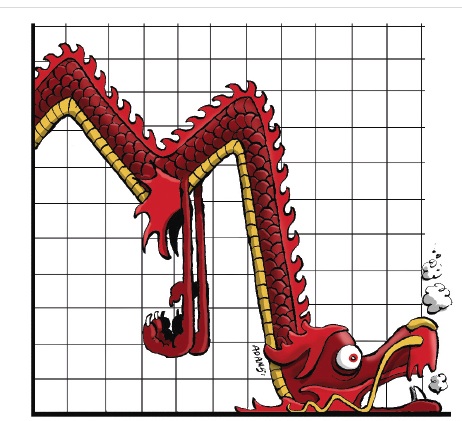
RIchard Haas writes:   Is China is best understood as a strong country, with a promising future despite some short-term difficulties, or as a country facing serious structural problems and uncertain long-term prospects. Two very different Chinas can now be glimpsed. But which one will prevail?

The question of China’s future has become unavoidable. Officially, economic growth has slowed to near 7%; but many believe the real number is below 5%. The slowdown should come as no surprise; all developing economies experience something similar as they grow and mature. Nonetheless, the speed and degree of change have caught the authorities off guard, and have stoked official fears that growth will fall short of the rate needed for the country to modernize as planned.

The government’s alarm at the sharper-than-expected economic slowdown was reflected in the freezing of stock markets in the midst of a dramatic price correction. That move was followed by a surprise devaluation of the renminbi, which suggests that the shift away from export-led growth is not working as hoped.

Corruption is pervasive, and Xi’s campaign remains broadly popular. But the wave of prosecutions that Xi has unleashed is discouraging Chinese officials from making decisions, owing to their fear that they could face criminal charges in the future.

Aside from slowing growth, there is severe environmental damage, one result of decades of rapid, coal-fueled industrialization. Air pollution may be killing 1.6 million Chinese per year.

China’s aging population, an unintended consequence of its draconian one-child policy, poses another threat to long-term prosperity. With the dependency ratio – the proportion of children and pensioners relative to working-age men and women – set to rise rapidly in the coming years, economic growth will remain subdued, while health-care and pension costs will increasingly strain government budgets.

What is increasingly apparent is that China’s leaders want the economic growth that capitalism produces, but without the downturns that come with it. They want the innovation that an open society generates, but without the intellectual freedom that defines it. Something has to give.

A slow-growth China would undermine the global economic recovery. It would be a less-willing partner in tackling global challenges such as climate change. Most dangerous of all, a struggling China could be tempted to turn to foreign adventurism to placate a public frustrated by slower economic growth and an absence of political freedom. Indeed, there are some signs that the authorities are doing just this in the South China Sea. Nationalism could become the primary source of legitimacy for a ruling party that can no longer point to a rapidly rising standard of living.

The US and others will need to push back to ensure that China does not act on such a temptation. But these countries would be equally wise to signal to China that it is welcome to take its place among the world’s leading countries if it acts responsibly and according to the rules set for all.

But the bigger policy choices will be China’s to make. The government will need to find the right balance between government interests and individual rights, between economic growth and environmental stewardship, and between the role of markets and that of the state.

China's Slowdown

Train to Treasure?

A city in south-western Poland is in a state of high suspense following claims made by two men that they have found a Nazi train packed with gold. Local authorities in Wałbrzych said they were investigating the reports, as fortune hunters from around Europe were making their way to the town in the hope of enjoying some of the potential spoils – or at least witnessing the discovery of what could yet turn out to be a spectacular historical find.

The men, reported to be a German and a Pole, have appointed a lawyer to negotiate with the authorities for a 10% finder’s fee for the train and its contents. Local news site Wiadomości Wałbrzyskie said the train contained up to 300 tonnes of gold, as well as a batch of diamonds, other gems and industrial equipment. The men said only once they have secured their fee in writing will they reveal the whereabouts of the train.

“This is a find of world significance, on a par with [discovering] the Titanic,” said Jarosław Chmielewski, the lawyer who has written to the parish council on the men’s behalf, to Radio Wroclaw.

Amber room treasures aboard?