Doing Well by Doing Good: Corporate Governance

Lucy P. Marcus writes:  Around the world, the corporate governance landscape is shifting, as efforts to improve business practices and policies gain support and momentum. The wave of reform has become visible everywhere – from tough new regulations in Japan to sovereign wealth funds like Norway’s Norges Bank Investment Management taking a more active approach to their investments – and it is certain to continue to rise.

Three factors are driving these developments. First, today’s deep economic uncertainty has broadened ordinary people’s awareness of the influence that companies have on politics, policy, and their own daily lives.

Second, there has been a burgeoning awareness among governments that economic growth requires a proactive regulatory approach.

In Japan, the Financial Services Agency enacted a Stewardship Code in 2014, with a Corporate Governance Code from the Tokyo Stock Exchange entering into force this June. By creating a more equal environment among shareholders, ensuring more disclosure and transparency, specifying the responsibilities of company boards, and requiring outside independent directors on company boards, the codes enshrine changes that make Japan more attractive for foreign investors.

In the United States, the Securities and Exchange Commission enacted a rule at the beginning of August requiring public companies to disclose the pay gap between workers and CEOs. Corporate behavior and governance has emerged as a campaign issue for US presidential candidates.

The European Union and its member states are also taking an increasingly active approach to corporate governance, including regulations concerning boardroom diversity. Italy, France, Spain, Norway, and others have all enacted boardroom gender quotas, with companies required to fill 30-40% of independent board seats with women.

The third, and perhaps most important, factor underpinning recent changes in corporate governance has been the sharp rise in cross-border investing. Sovereign wealth funds, pension funds, global investment banks, and hedge funds do not invest only in their own backyard. They scour the planet looking for places to put their money, and they expect companies that receive it to play by rational rules.

International investors are in a unique position to encourage, or even enforce, global best practices in corporate governance. If such investors show that they are willing to withdraw financing, they will gain real influence in bringing about sustainable change – to the benefit of us all.

Global funds that uphold high ethical standards concerning labor practices and environmental protections are safeguarding the global ecosystem on which they, and the rest of us, depend.

CalPERS (the California Public Employees’ Retirement System), a $300 billion pension fund, has published its corporate governance principles, which include boardroom diversity, fair labor practices, and environmental protection. Norges Bank Investment Management, Norway’s $870 billion sovereign wealth fund (the largest in the world), has also pushed for changing governance rules, including separating the role of chief executive and chairman and better reporting by companies on how they are addressing climate change.

The shift in emphasis on best-practice corporate governance is real, and it is here to stay.

New Leadership Styles

Are Growth Objectives Hurting China?

Gene Frieda writes:  China’s economy is increasingly two-tracked: a new track based on services and consumption burdened by an old, slower track made up of industries like steel and mining, which are inefficient and suffer from excess capacity. Straddling both tracks is the country’s real-estate market, which is characterized by massive overcapacity in mid-size and smaller cities and robust demand in large cities.

The problem is compounded by the Chinese leadership’s insistence on sticking with high growth targets – 7% at present – and the resulting reliance on credit to produce the requisite output.

The meteoric rise and subsequent crash in the country’s stock market has left investors badly rattled. But the real wake-up call has been the belated effort to sort out local government borrowing and misspending.

In November 2013, President Xi Jinping laid out a reform agenda that sought to increase the role of the market in China’s economy.

In early 2015, the central government announced plans to convert the local governments’ short-term, high-interest bank loans into long-term bonds. By increasing the maturity of the debt, the central government hoped to alleviate financing constraints on local governments and allow them to pursue financial stimulus.

When China’s banks balked at accepting the low yields offered on the new bonds, the goal of increasing the market’s role in the economy went out the window. The government forced banks to execute the debt swap. Unsurprisingly, banks suddenly became risk-averse. Local governments discovered that even with an improved liquidity position, banks were reluctant to extend new loans.

Meanwhile a slump in the real-estate market deprived local governments of their main revenue source: land sales.

China appears to be falling into a trap that it assiduously sought to avoid. The country’s debt problem looks set to worsen as the government neglects its reforms in favor of short-term growth objectives.

The government has sought to increase liquidity by dropping controls on the movement of capital. Doing so not only further undermines its control of the economy; it also creates the risk of a full-blown financial crisis that could engulf its neighbors and other emerging markets.

China’s property market is deflating. Its equity markets have been discredited. And its economy seems increasingly sluggish. As a result, the country’s vast pool of domestic savings is increasingly looking to move abroad. Relative to the size of China’s foreign debt and the sheer volume of money that could go abroad, even its $3.7 trillion in foreign reserves starts to look puny.

Like termites, debt has a unique capacity to make short work of an economy’s foundations. By the time the infestation is recognized, it is often too late. If China is to reverse the damage, it will need to focus on debt deleveraging, repair its capital allocation mechanism, and delay the abolition of capital controls.

China's Debt Problem

Population Decline a Plus?

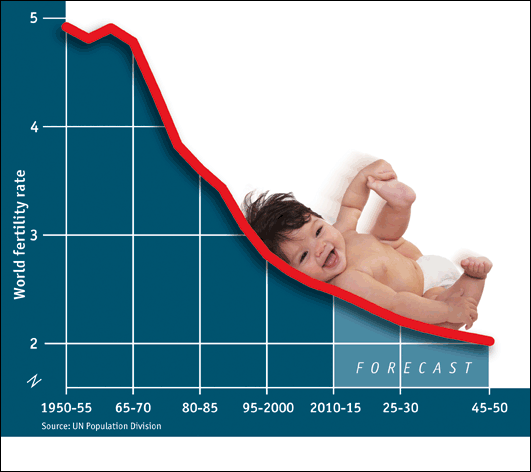
Adair Turner writes:  The United Nations’ latest population projections suggest that Japan’s population could fall from 127 million today to 83 million by 2100, with 35% of the population then over 65 years old. Europe and other developed economies are aging as well, owing to low fertility rates and increasing longevity.  Population aging in advanced economies is the manageable consequence of positive developments. By contrast, rapid population growth in many poorer countries still poses a severe threat to human welfare.

In 2008, the UN projected the world’s population reaching 9.1 billion by 2050 and peaking at about ten billion by 2100. It now anticipates a population of 9.7 billion in 2050, and 11.2 billion – and still rising – by 2100, because fertility rates in several countries have fallen more slowly than expected (in some, notably Egypt and Algeria, fertility has actually risen since 2005). While the combined population of East and Southeast Asia, the Americas, and Europe is projected to rise just 12% by 2050 and then start falling, sub-Saharan Africa’s population could rise from 960 million today to 2.1 billion by 2050 and almost four billion by 2100. North Africa’s population will likely double from today’s 220 million.
Such rapid population growth, on top of even faster increases over the last 50 years, is a major barrier to economic development. From 1950 to 2050, Uganda’s population will have increased 20-fold, and Niger’s 30-fold. Neither the industrializing countries of the nineteenth century nor the successful Asian catch-up economies of the late twentieth century ever experienced anything close to such rates of population growth.

Ensuring that women are educated and free is by far the most important demographic challenge facing the world today. Worrying about the coming population decline in advanced countries is a meaningless diversion.   The Positive Aspects of Population Decline

birth-rate

How Bad is Unemployment in China?

According to official statistics, China’s unemployment rate has remained at an exceptionally steady 4.0-4.3% since 2002, despite massive change in the economy over that period. A new National Bureau of Economic Research paper analyzing national household survey data from 1988-2009 suggests that the official index may have significantly underestimated the actual urban unemployment rate.  

From the abstract:  The rate averaged 3.9% in 1988-1995, when the labor market was highly regulated and dominated by state-owned enterprises, but rose sharply during the period of mass layoff from 1995- 2002, reaching an average of 10.9% in the subperiod from 2002 to 2009.

The survey does not cover more recent data, so their research does not show whether the labor market has deteriorated as the Chinese economy has slowed. But their figures do point to the large, lasting impact of the mass closures of bankrupt state-owned companies in the 1990s. The unemployment rate was just 3.9% from 1988-95 and then climbed steadily upwards. State firms had played the biggest role in China’s north-east and so their closures dealt the region a particularly heavy blow, with its unemployment rate averaging 12.5% from 2002-9.

Just how worrying are these findings? The data comes from the urban household survey, which is conducted by the National Bureau of Statistics.  Their unemployment index is more volatile than the registered jobless rate, making for a closer fit to the ebb and flow of economic cycles in China.

But if the official rock-steady 4.1% jobless rate is trusted by no one, the conclusion that China suffers from chronic unemployment of more than 10% is also worthy of a large dose of skepticism. As the authors readily admit, there is a major gap in their data. The survey only covers people who hold local hukou, or residency permits, and therefore excludes the tens of millions of migrants who stream to cities for work every year. In Shanghai, for example, some 14m residents hold local hukou, but another 10m people live and work in the city on a permanent basis. The latter are outside the remit of the urban household survey.

There is also good reason to think that the 10.9% unemployment rate exaggerates the problem.

The dataset doesn’t reflect rural migrant workers, even though they have been a huge source of urban labor in the last decade, making up as much as half of China’s urban workforce today.  That could mean that the actual unemployment rate is lower.   On the other hand, nearly 60% of rural migrant workers work in construction and manufacturing (link in Chinese). Given China’s slowing economy and sluggish export demand, they might soon be pushing the true unemployment rate up. 

Reporting on the new unemployment index for CBS Moneywatch, Robert Hanley notes that China’s economic slowdown has been apparent in the rising instances of labor unrest in recent years:

"Maybe unemployment is worse than I thought"

“Maybe unemployment is worse than I thought

Is the Greek Bailout Deal a One-Night Stand?

Wolfgang Streeck writes:  Now the dust has temporarily settled over the ruins of Greece’s economy, it is worth asking if there wasn’t a brief moment when the actors had found a way to cut the eurozone crisis’s Gordian knot. At some point in July German finance minister, Wolfgang Schäuble, appeared to have realized that his dream of a “core Europe” with a Franco-German avant-garde would vanish into thin air if Greece was allowed to remain in the economic and monetary union. Rewriting the rules of the union to accommodate the Greeks, Schäuble realised, would pull the euro southwards, and France, Italy and Spain with it – forever breaking up the European core.

His Greek equivalent Yanis Varoufakis, for his part, may have learned from his encounters of the third kind with the Eurogroup that the only role there was for Greece in the Europe of monetary union was that of an underfed and overregulated welfare recipient. Not only was this incompatible with Greek national pride; more importantly, what the governors of Europe would be willing to offer the Greeks by way of “European solidarity” would, at best, be too little to live on,   The deal Schäuble offered in the last hour of July’s battle of the euro might have been worth exploring: a voluntary exit (an involuntary one not being possible under the current treaties) that gave Greece the freedom to devalue its currency and return to an independent monetary and fiscal policy, plus emergency assistance and some restructuring of the national debt, outside of the monetary union to avoid softening its rules by creating a precedent. A generous golden handshake might have also been an idea, protecting Germany from being blamed for having plunged the Greeks into misery or driven them into the arms of Vladimir Putin.   Future of Eurozone

Is the Greek Bailout Deal a One-Night Stand?

Making the Greek Deal Work?

The Greek deal needs to respond to three clear challenges.   (1)  Smart reforms:  a fundamentally different approach is needed, departing from the “laundry list” logic of disconnected reforms that suggest that there is one-size fits-all method that every European country could and should apply. Reform proposals need to bring in political considerations on what the growth model of a country is; how through well-connected and comprehensive packages of economic policy-changes a country can be led back to a plausible growth path. Also, some reforms are politically more costly than others. And some reforms can more easily be implemented in a favorable economic context than in recession.

(2)  Changing the Eurozone’s fiscal stance and investments: On investments, Mario Draghi once said, investments are today’s demand and tomorrow’s supply. That assessment is correct. Europe needs to recognize that there is only one solution to the conundrum of highdebt in the member states and the need for a change of the fiscal stance of the euro-area: a focused strategy to increase investments starting at the European level. This strategy has two pillars. First, it needs to be based on regulatory clarity. The lack of private investment in Europe derives largely from regulatory and political uncertainty in core areas such as energy or the digitalization of all sectors of the economy. A push towards European energy union could lead to a real investment boost. And an agreement on a single and identical piece of legislation on data protection by the largest possible number of European countries, replacing today’s 28 different legal contexts even if they derive from a single European approach, would increase the market size dramatically and help Europe to be more successful in innovation.

(3) Stronger cooperation between France and Germany. This relates to the necessary quantum leap in integration. The euro-area is still a weakly integrated political entity. Further work is needed on at least four fronts. First, Europe needs to start a clear and unstoppable process leading towards genuine Economic Union in Europe. EMU lacks convergence. EMU lacks mobility. EMU lacks solidarity. EMU lacks risk-sharing. EMU lacks sharing of sovereignty. We need an agreement by the Heads of State and Government to immediately setup a process in several phases leading from immediate action, to a first round of implementing measures, to finally a change of the Treaties to complete Economic and Monetary Union.    The Greek Deal

merkel_-_hollande_1677815

Germany Votes to Bailout Greece

Germany’s parliament has backed a third Greek bailout following a heated debate in the Bundestag, despite widespread misgivings over whether the country will manage to implement reforms in return for money.

Following three hours of lively debate, 453 voted in favour of the €86bn rescue package, while 113 voted against it and 18 MPs abstained.

Live German MPs approve third Greek bailout, Dutch slam ‘six months of chaos’ – live

The German Bundestag is expected to approve €86bn bailout, paving the way for Athens to meet debt deadlines.

A total of 63 MPs of Angela Merkel’s CDU/CSU conservative alliance rebelled against the government despite warnings that there would be consequences if they failed to toe the party line. Three conservative MPs were among those who abstained.

The result is a blow to Merkel, amounting to three more than the number who rebelled during a similar vote in July. It is far fewer, however, than the 120 that it was suggested might have voted against the government.

Absent from the chamber altogether were 47 politicians, with many said by colleagues to have deliberately chosen to stay away, rather than be forced to vote no and risk being accused of disloyalty towards Merkel. Of the 47 were from the CDU/CSU, and 16 from the SPD.

The Bundestag’s approval now paves the way for €13bn to be paid to Athens on Thursday to cover outstanding bills. A further €10bn will be put aside at the European stability mechanism, to be used to strengthen capital in Greek banks.

Bundestag observers said, notwithstanding that the vote was held during the summer holiday and with some MPs either ill or unable to return from far-flung places, never had so few voted in such an important vote. It was a sign of how controversial the topic has been, they added.

Addressing the parliament on behalf of the government, the finance minister, Wolfgang Schäuble, who until a few weeks ago was calling for a temporary exit of Greece from the euro, appealed to parliamentarians to vote in favor of the bailout, the third such deal in five years.

Merkel did not participate in the debate, apparently to avoid the vote becoming a decision on her leadership, even though the Greek crisis and her chancellorship are now arguably inextricably intertwined. Instead she sat in the chamber, nodding, laughing and talking to fellow MPs before casting her vote and swiftly departing with her entire cabinet for a business trip to Brazil.

Germany Goes Along

Trump’s Run No Mystery

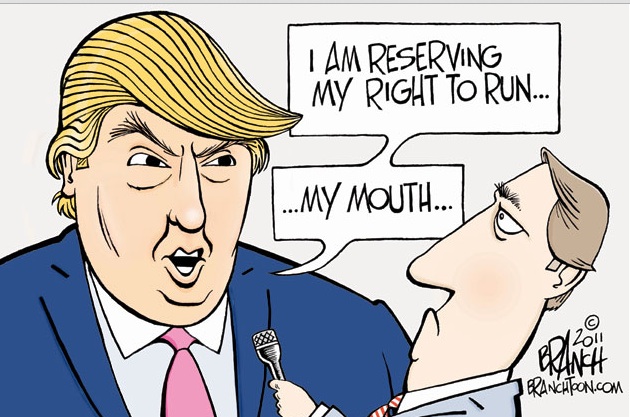
Why Donald Trump in the US?  Jeb Bush, the party’s apparent favorite, has said that he would speak from his heart.  Americans seem to want someone who will tell it like it is, which is a bit different.

On the Democrats side, Bernie Sanders is popular because he tells his truth about the issues.  When he speaks, potential voters feel that he is addressing issues as he sees them.  He is not programed by advertising and public relations people.

Trump has the same appeal.  James Surowiecki, a leading financial reporter, writes best about Trump’s appeal:  Trump’s lack of interest in policy and his inflammatory rhetoric make him easy to dismiss him a a candidate and it is difficult to take him seriously as the Republican nominee.  But his bizarre blend of populist message and glitzy ways has allowed him to connect with precisely the voters that any Republican needs to get elected: white voters with no education.  As long as he’s in the race, he is a big problem for the party.  He’s appealing to a very important part of the base, and bringing out issues other candidates don’t want to talk about.  Republicans may be hoping his campaign is a joke, but right now he’s the only one who is laughing.

Trumps Run

End Ban on Oil Exports in the US?

The Rocky Road to Globalization

The Economist reports:  When  the economics textbooks of the future are written, America’s ban on crude-oil exports will be a fine example of the perverse effects of protectionism. Similarly, a new decision by Barack Obama’s administration to allow American firms to sell some oil to Mexico will earn an honorable footnote in the story of the ban’s demise.

Geology, engineering, economics and politics are all at stake. In the fuel-hungry 1970s, America banned crude-oil exports in an effort to stabilize domestic prices. The country’s oil refineries are still configured to deal with the heavy, sour crude oil it used to import. Now, thanks to the shale revolution, American oil imports have plunged just as production has soared. Oil from shale is another kind of crude, light and sweet. It is not ideal for America’s refineries, which must make costly tweaks to deal with it. But the ban means this oil can’t be exported, either.

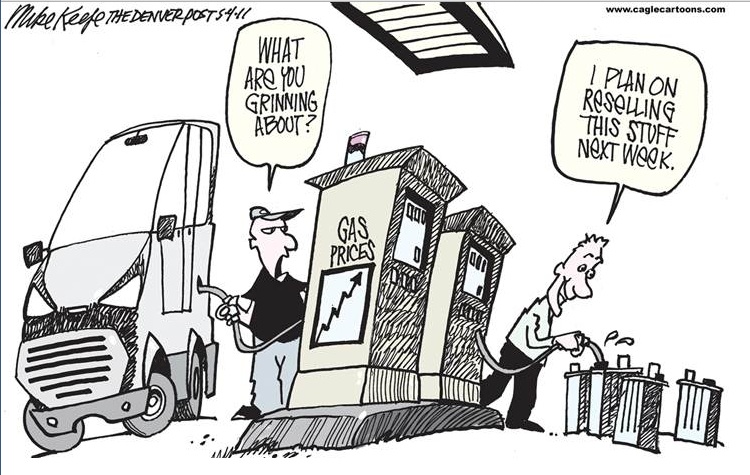
That archaic rule now keeps the price of America’s domestically produced oil, signalled by the West Texas Intermediate (WTI) benchmark, at a hefty discount—currently over $5 per barrel—to the world price. That has become particularly painful since OPEC’s decision in November to stop trying to curb production, which has sent prices tumbling. American oilmen are fuming: their potential export markets are being sacrificed, they argue, to the interests of America’s petrochemical industry, which enjoys artificially cheap feedstock thanks to the ban.

Others would benefit too.  Free trade in crude would boost American output, investment, jobs, pay, profits and tax revenues—and GDP by $86 billion.  With American crude bringing prices down, most likely the cost of fuel would fall a bit—for Americans, and also for other consumers.

The administration’s decision will test this theory. Mexico’s national oil company, Pemex, has long wanted to send its heavy crude to America, and import the same number of barrels of lighter American oil.  The Commerce Department has now decided to treat Mexico as part of the domestic American market, as far as oil is concerned.

The extent of the exemption is still unclear. But this is not the first breach of the ban. The definition of what constitutes crude oil owes more to art (and bureaucratic fiat) than science. What is heavy crude?  What is light?

The ban undermines America’s moral authority at the World Trade Organisation, where the administration has berated China, for example, for imposing export bans on scarce minerals. Higher American crude-oil exports would also hurt petrostates such as Russia and Iran.

The details will still be tricky. America’s cossetted crude-oil consumers would be willing to see an end to artificially cheap raw materials in exchange for other concessions. These could include laxer environmental rules, or a change in an even more archaic law, the Jones Act, which bans foreign ships from carrying cargo between American ports. This law delights ship-owners and unions, but imposes a hefty cost on anyone wanting to send a tanker from, say, a refinery on the Gulf coast to a port in the north-east.

Such a wholesale solution to this elderly quirk in the world oil market may still be some time off. But by lowering trade barriers for Mexican oil, the Obama administration will make America richer, improve the functioning of the world oil market and highlight the potential benefits of still more dramatic reforms. 

Oil Exports and Price

Bring US Corporate Taxes in Conformity with the World’s?

The Rocky Road to Globalization

President Barack Obama said last September that he would get tough on companies that avoid tax through “inversions”—merging with or buying foreign firms so as to shift their domicile abroad—some wondered if this would end a wave of corporate emigration. Some high-profile deals were called off, but other companies have continued to tiptoe out of America to places where the taxman is kinder and has shorter arms.

For many firms, staying in America is just too costly. Take Burger King, a fast-food chain, which last year shifted domicile to Canada after merging with Tim Horton’s, a coffee-shop operator there. Before the move, it would have had to pay up to 39% tax on foreign earnings when it brought them into America. Now that it is Canadian, it pays 39% only on profits earned in America, about 26% on Canadian profits and the (often lower) local rate elsewhere.

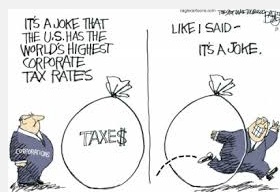
Inversions can cause a domino effect within industries, as the first companies to emigrate to a low-tax country gain an advantage that prompts rivals to follow suit. The logical way to stem the tide would be to bring America’s tax laws in line with international norms. Britain, Germany and Japan all have lower corporate rates and are among the majority of countries that tax firms only on profits earned on their territory. But the likelihood of a substantial tax reform in America is low—vanishingly so before 2017.

So, rather than making it nicer for companies to stay, the US Treasury has been trying to make it harder for them to leave. There has long been a rule whereby any inversion resulting in the American firm’s shareholders owning 80% of the merged group would be taxed as if it were still American. In September, loopholes in this rule were closed

AbbVie, a drug company, blamed these stricter rules when it abandoned plans to merge with Shire of Ireland. Walgreens, a pharmacy chain, insisted it also had other reasons for dropping a plan to move to Europe, though its patriotic decision to stay American earned it some good publicity.

Despite such speed bumps, inversions still make enormous sense for companies with large overseas operations. If anything, the rule changes have led to more companies looking to get out before it is too late.

Emigrating from Deerfield, Illinois to London, as in CF Industries’ case, or from Minnesota to Dublin, as in Medtronic’s, isn’t as dramatic as it seems. These tend to be mainly paper moves. “Here in the Netherlands you don’t even need a chimney to be domiciled,” says Indra Romgens, a corporate researcher, of the country’s many brass-plate headquarters. But the tides are slowly turning, as low-tax countries are beginning to require relocating companies to have a more substantial presence.

Now stricter anti-inversion rules make it harder for American firms to pursue de facto takeovers of foreign rivals, they are becoming the prey rather than the predators. If the American authorities succeeded in stopping inversions, all that would happen is that foreign takeovers of American firms would accelerate.

US Corporate Taxes