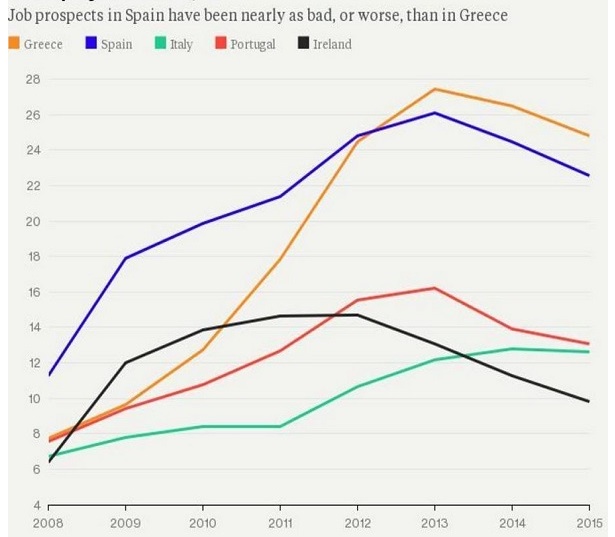
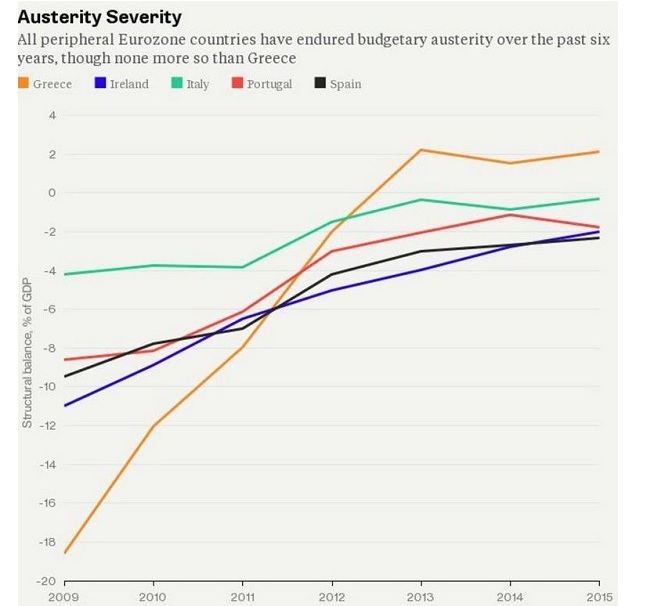
If Ireland, Portugal, Spain, and Italy had to swallow the bitter pill of austerity, the argument goes, so should Greece. But are the situations similar? When it comes to GDP impact none are close to Greece (first graph below). Only with unemployment, and then only for Spain, has there been comparable pain.
Does Japan Need Shock Therapy?
Bank of Japan Governor Haruhiko Kuroda fails to get much traction in his bid to revitalize his country’s economy.
Former Bank Governor Shirakawa always claimed the causes of Japan’s deflation were a rigid economy and bad demographics, not a lack of money supply. Kuroda has yet to concede the point explicitly, but his bank’s actions essentially do. BOJ officials have started issuing tacit admissions that Kuroda’s efforts at monetary stimulus have failed.
To be sure, sustained inflation would give the Prime Minister major bragging rights, and vindicate his decision to axe Shirakawa and take a more aggressive tack to end Japan’s lost-decade ordeal.
India’s credibility is still taking hits from its abrupt recalculation of the country’s 2014 gross domestic product, from 4.7 percent to 6.9 percent. At the time, one analyst fumed that officials were “smashing India’s credibility and making its statistics bureau a laughing stock in global financial circles.”
BOJ officials argue that “the price stability target and the quantitative and qualitative monetary easing, introduced by the Bank in 2013, contributed to strengthening the anchor of inflation expectations.” Too bad the neither data nor bond rates jibe with that view. Yields on 10-year government debt are currently around 0.43 percent, lower than 0.54 percent 12 months ago. If anything, the inverse of what the BOJ is arguing is true.
Meanwhile, the BOJ’s lobbying efforts to tweak official statistics are starting to fall flat.
The truth is, Kuroda’s team has gotten as far as it can with its two huge monetary infusions since April 2013. In addition to buying about $700 billion of government debt annually, the BOJ is also pumping money into everything from asset-backed securities to exchange-traded funds. The results can be seen in the 56 percent rally in the Nikkei, but not in the areas needed to generate a sustainable recovery like sizeable wages gain or capital investments by huge companies.
That has the BOJ resorting to cheerleading. Kuroda’s team continues to churn out report after report insisting reflation efforts are working. The common theme (including last week’s report by Kamada) is that the BOJ’s moves are lifting trend inflation, stimulating the economy and loosening financial conditions. Yet the International Monetary Fund seems to have missed the memo. It just downgraded its forecast for Japanese growth this year to a 0.8 percent from a prediction of 1 percent in April.
If Kuroda wants to motivate any audience it should be Abe’s cabinet. As BOJ governors past warned, ending deflation requires much more than printing yen — or moving the data goalposts. Aside the devaluation of the yen and modest efforts to improve corporate governance, the government has done little to remake the economy. Plans to encourage startups, loosen labor markets, cut red tape and better utilize the female workforce remain largely on the drawing board. Kuroda’s monetary bonanza was meant to pave the way for structural shock-therapy that has yet to materialize. Kuroda should know that applauding the government’s failures won’t do much to restore his credibility.
Greece Re-Joins EU for 90b Euros
Given the choice of being moneyless or giving up sovereignty to confirm its membership in the Eurozone and the EU, Greece has signed off on a deal which will give them operating money in exchange for firm and immediate dates for putting in place VAT taxes and new pension rules, among other economic reforms.
The banks care still closed, credit cards can be used in Greece in only. Re-capitalization of Greece to begin soon and in Greece.
Has fiscal sovereignty been given up? Is the deal undemocratic? To be seen. But if you are a member of a group, you obey its rules. This is the rocky road to globalization.
Yanis Varoufakis Assesses Greece’s Future
Greece’s financial drama has dominated the headlines for five years for one reason: the stubborn refusal of our creditors to offer essential debt relief. Why, against common sense, against the IMF’s verdict and against the everyday practices of bankers facing stressed debtors, do they resist a debt restructure. The answer cannot be found in economics because it resides deep in Europe’s labyrinthine politics.
Two options consistent with continuing membership of the eurozone presented themselves: the sensible one, that any decent banker would recommend – restructuring the debt and reforming the economy; and the toxic option – extending new loans to a bankrupt entity while pretending that it remains solvent.
Official Europe chose the second option, putting the bailing out of French and German banks exposed to Greek public debt above Greece’s socioeconomic viability.
To frame the cynical transfer of irretrievable private losses on to the shoulders of taxpayers as an exercise in “tough love”, record austerity was imposed on Greece whose national income, in turn – from which new and old debts had to be repaid – diminished by more than that.
Once the sordid operation was complete, Europe had automatically acquired another reason for refusing to discuss debt restructuring: it would now hit the pockets of European citizens! And so increasing doses of austerity were administered while the debt grew larger, forcing creditors to extend more loans in exchange for even more austerity.
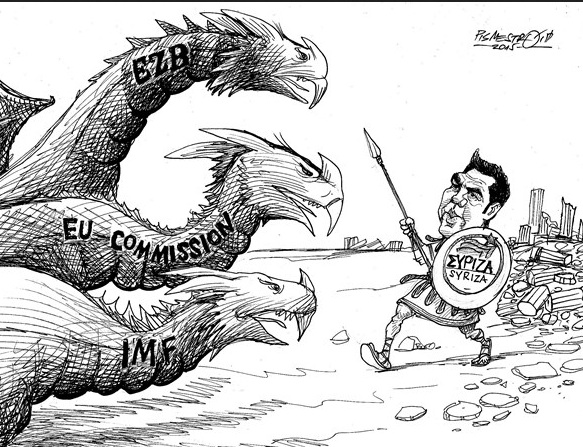
Our government was elected on a mandate to end this doom loop; to demand debt restructuring and an end to crippling austerity. Negotiations have reached their much publicised impasse for a simple reason: our creditors continue to rule out any tangible debt restructuring while insisting that our unpayable debt be repaid “parametrically” by the weakest of Greeks, their children and their grandchildren.
In my first week as minister for finance I was visited by Jeroen Dijsselbloem, president of the Eurogroup (the eurozone finance ministers), who put a stark choice to me: accept the bailout’s “logic” and drop any demands for debt restructuring or your loan agreement will “crash” – the unsaid repercussion being that Greece’s banks would be boarded up.
Five months of negotiations ensued under conditions of monetary asphyxiation and an induced bank-run supervised and administered by the European Central Bank. The writing was on the wall: unless we capitulated, we would soon be facing capital controls, quasi-functioning cash machines, a prolonged bank holiday and, ultimately, Grexit.
The threat of Grexit has had a brief rollercoaster of a history. In 2010 it put the fear of God in financiers’ hearts and minds as their banks were replete with Greek debt. Even in 2012, when Germany’s finance minister, Wolfgang Schäuble, decided that Grexit’s costs were a worthwhile “investment” as a way of disciplining France et al, the prospect continued to scare the living daylights out of almost everyone else
By the time Syriza won power last January, and as if to confirm our claim that the “bailouts” had nothing to do with rescuing Greece (and everything to do with ringfencing northern Europe), a large majority within the Eurogroup – under the tutelage of Schäuble – had adopted Grexit either as their preferred outcome or weapon of choice against our government.
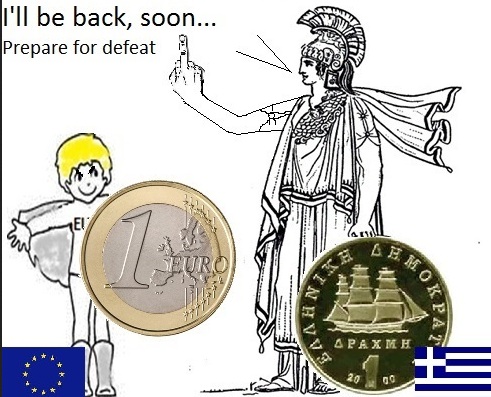
Greeks, rightly, shiver at the thought of amputation from monetary union. Exiting a common currency is nothing like severing a peg. Alas, Greece does not have a currency whose peg with the euro can be cut. It has the euro – a foreign currency fully administered by a creditor inimical to restructuring our nation’s unsustainable debt.
To exit, we would have to create a new currency from scratch. In occupied Iraq, the introduction of new paper money took almost a year, 20 or so Boeing 747s, the mobilisation of the US military’s might, three printing firms and hundreds of trucks. In the absence of such support, Grexit would be the equivalent of announcing a large devaluation more than 18 months in advance: a recipe for liquidating all Greek capital stock and transferring it abroad by any means available.
With Grexit reinforcing the ECB-induced bank run, our attempts to put debt restructuring back on the negotiating table fell on deaf ears. Time and again we were told that this was a matter for an unspecified future that would follow the “programme’s successful completion” – a stupendous Catch-22 since the “programme” could never succeed without a debt restructure.
This weekend brings the climax of the talks.
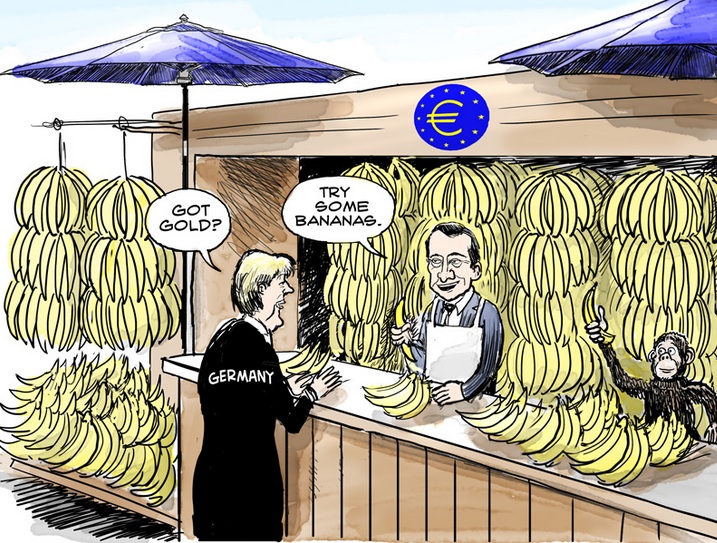
The euro is a hybrid of a fixed exchange-rate regime, like the 1980s ERM, or the 1930s gold standard, and a state currency. The former relies on the fear of expulsion to hold together, while state money involves mechanisms for recycling surpluses between member states (for instance, a federal budget, common bonds). The eurozone falls between these stools – it is more than an exchange-rate regime and less than a state.
And there’s the rub. After the crisis of 2008/9, Europe didn’t know how to respond. Should it prepare the ground for at least one expulsion (that is, Grexit) to strengthen discipline? Or move to a federation? So far it has done neither, its existentialist angst forever rising. Schäuble is convinced that as things stand, he needs a Grexit to clear the air, one way or another. Suddenly, a permanently unsustainable Greek public debt, without which the risk of Grexit would fade, has acquired a new usefulness for Schauble.
What do I mean by that? Based on months of negotiation, my conviction is that the German finance minister wants Greece to be pushed out of the single currency to put the fear of God into the French and have them accept his model of a disciplinarian eurozone.
Risk Necessary for Growth?
Robert Litan writes: We’re going to hear a lot from 2016 presidential candidates about the need for faster economic growth. Jeb Bush says annual growth of 4% would be his goal; that’s almost double the 2.2% U.S. growth rate since June 2009. Hillary Clinton has called for “inclusive” growth, or economic expansion that is distributed more fairly. (I suspect that many Republicans agree with her objective, while differing on what government should do to achieve it.)
Presidential elections are occasions for debating government’s role, so it’s natural to focus on things government can do to affect economic growth, such as simplifying the corporate tax code, removing distortions, and, for some, lowering rates; investing more in infrastructure and early-childhood education; and easing regulatory burdens, especially for new businesses, which have been the source of many major technological advances.

While some or all of these things should help growth, government has limited ability to influence the appetite for taking risks among entrepreneurs, investors, and larger companies. And without risk-taking, we are unlikely to see the kinds of major new innovations that will propel our economy toward a higher growth trajectory.
Two recent essays define this challenge. One is a thoughtful piece by Bloomberg View’s Barry Ritholtz on the decline in publicly traded companies in the U.S., from a peak of more than 7,300 in 1996 to just 3,700 in 2014. After surveying multiple possible causes for the nearly 50% decline–including the much-criticized Sarbanes-Oxley Act, which tightened public company reporting rules–Mr. Ritholtz cites academic research showing that mergers have played an outsize role in reducing the number of public companies.
This is important because when big companies swallow up others, it signals that acquiring companies have essentially outsourced their ideas rather than growing internally. It also suggests that the safer thing to do is to buy someone else rather than develop new products and services yourself. The merger trend is a sign of a collective failure of nerve, the risk-taking that historically contributed to much higher economic growth rates, such as the roughly 4% average from 1948 to 1973.
\Fortune editor Alan Murray reports that revenues of the Fortune 500 companies combined equal 71.9% of U.S. gross domestic product, or more than twice the 35% it totaled in 1955. In other words, despite continuing turnover in the Fortune 500′s composition, big companies are more important than ever as a share of the overall economy.
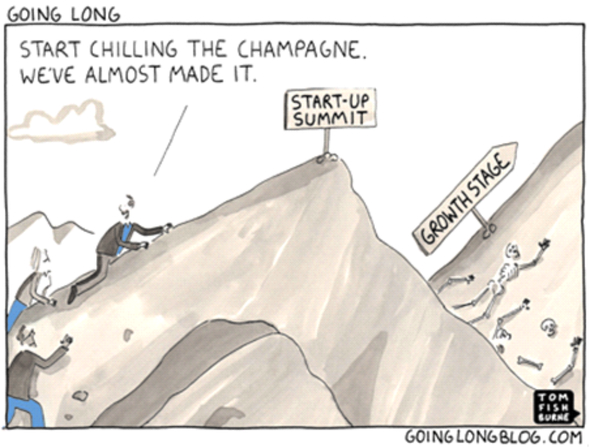
This wouldn’t be so worrisome for future growth were it not for the decline in the start-up rate, or share of new companies in the number of overall firms, which I have written about before. Despite the continuing emergence of new billion-dollar start-ups (“Unicorns”), the execs of big companies don’t appear to be especially worried. According to the Fortune survey, only 20% think their greatest challenges will come from start-ups.
At the top of their worry list, Fortune found, is the “rapid pace of technological change,” which is ironic since, so far, hype has exceeded reality. As Princeton professor Alan Blinderhas noted, productivity growth since 2010 has clocked in at just 0.4% a year, down from 2.6% over the preceding 15 years.
Unless a big boost in start-ups puts real pressure on large companies, the answer to the growth challenge lies mostly with large companies and those who head them.
Entrepreneur Alert: Vertical Urban Farming
Goldman Sachs and Prudential are investing in vertical urban gardening. Entrepreneurs envision selling fresh produce to high end restaurants and discounting to low income neighbors. Land costs high, but some in the sky. Entpreneurial opportunities abound.
Efforts to grow green business in New Jersey’s largest city Newark were bolstered by the announcement of a $30 million public-private commitment to create the world’s largest indoor aeroponic garden in Newark’s Ironbound, a community in serious need of investment, good jobs, and fresh produce.
Essentially, aeroponics is a plant-cultivation technique that doesn’t require soil or sun: Roots are exposed to the air and nutrition delivered via a fine mist.
Greece Makes its Promises
Efforts to End Elephant Poaching
Proceeds from poaching have become a fcator in financing terrorism. Defense departments,anti-terrorism departments and enforcement institutions are now working to prosecute poachers and end this trade.
1. Big Business
Wildlife hunting is big business – a recent 2013 estimate valued the illegal poaching trade in Africa as being worth $17 billion dollars a year and growing.
3. Big Profits
According to gun policy officials the going rate for a rifle in Kenya is around $100-120 – a fortune by local economic standards but a mere fraction of the money that can be made from just one elephant (a single tusk can be worth up to $240).
4. Chinese Prices
In China such a tusk would sell for more than $2000 – its value therefore increasing tenfold by the time it is shipped out of Africa and arrives in Asia.
5. Local Misunderstanding
A recent study found that less than a third of Chinese people surveyed knew that elephants are killed for their tusks.
6. Common mythology
A separate study showed 70 per cent think they grow back like fingernails. Another myth propagated is that elephants’ tusks fall out naturally.
7. 104 Deaths a Day
Animal rights groups estimate that poachers in Africa kill between 25,000 and 35,000 elephants annually – meaning about 104 die a day.
8. An Offence Without Prosecution
Of the 157 poaching-related cases detected in Kenya in the past three years, less than five per cent have been prosecuted and only three of those convicted were sentenced to jail.
9. Pulverizing the Trade
The Obama administration destroyed the US reserve of elephant tusks on November 5, 2013 – announcing that the pulverizing of 6 tons (5.4 tonnes) of ‘blood ivory’ would send out the right message to the world.
10. Not Far from Human
Elephants are more like us than you may know. They can be gay, left-handed, have the ability to grieve and – true to reputation – have amazing memories.
Is Greece Quarantined?
Brendan Simms writes: When the Greek crisis first blew in 2010, there were widespread fears that if Greece defaulted on its public debts, contagion would bring down banks across the eurozone and destroy the market for government bonds in the next-in-line states, such as Italy, Spain, Portugal, and perhaps even Ireland.
To be on the safe side European officials and banks have spent the last five years quarantining Greece so that any fallout could be safely contained and a G2K avoided For this reason, the European Union provided emergency bailouts for Greece, writing down a substantial proportion of the debt in return for commitments to reform state and economy.
In some sense, contagion will probably be contained. Sunday’s referendum was framed by the Greek government as a vote against austerity, not against Europe or even the euro. Observers must thus deal with the paradox that some of the most pro-European Greeks (along with many extreme leftist and rightist anti-Europeans) voted against the bailout deal. Greek Prime Minister Alexis Tsipras and his Syriza party want a return to the drachma. They know that most of Greece wants to stay in the euro, so they will not be in any hurry to leave it. Much better to wait until Brussels forces them out. Athens will play this game, in which the resignation of Yanis Varoufakis as finance minister is only the latest move, to the bitter end.
It may be that the financial contagion in Europe can be contained, but the strategic and political contagion will be immense. Unless it also leaves the EU, Greece may become an open door, as some Syriza ministers have already threatened, through which migrants pour in. The country will drift even more into the Russian orbit, with potentially fatal consequences to the EU’s common foreign policy, especially its sanctions over Ukraine. Above all, the irreversibility of monetary union will be called into question, with huge implications for all kinds of political and economic bets placed over the past three decades. No amount of modeling can quantify the likely damage to the union, but it will be colossal and perhaps fatal to deeper integration.
Either way, the Greeks are faced with an impossible choice: either to agree to an austerity program that is crushing the life out of its young people and its weakest or to return to the failed national politics that got the country into this mess.
Is Greece to Blame?
Mark Blythe writes: When the anti-austerity party Syriza came to power in Greece in January 2015, at some point, Europe was bound to face an Alexis Tsipras, the party’s leader and Greek prime minister, because there’s only so long you can ask people to vote for impoverishment today based on promises of a better tomorrow that never arrives. Despite attempts by the eurogroup, the European Central Bank, and the International Monetary Fund since February 2015 to harangue Greece into ever more austerity, the Greeks voted by an even bigger margin than they voted for Syriza to say “no” once more. So the score is now democracy 2, austerity 0.
When the euro came into existence in 1999, not only did the Greeks get to borrow like the Germans, everyone’s banks got to borrow and lend in what was effectively a cheap foreign currency. And with super-low rates, countries clamoring to get into the euro, and a continent-wide credit boom underway, it made sense for national banks to expand private lending as far as the euro could reach.
The ECB is not only violating its own statutes by limiting emergency liquidity assistance to Greek banks, but is also raising the haircuts on Greek collateral offered for new cash. In other words, the ECB, far from being an independent central bank, is acting as the eurogroup’s enforcer, despite the risk that doing so poses to the European project as a whole. We’ve never understood Greece because we have refused to see the crisis for what it was—a continuation of a series of bailouts for the financial sector that started in 2008 and that rumbles on today. It’s so much easier to blame the Greeks and then be surprised when they refuse to play along with the script. Is Greece to Blame