Greek Privitization?

Agnes Lovasz and Paul Tugwell write:  Greece will continue with efforts to privatize the country’s largest port and regional airports as it seeks ways to attract investment for other state assets, Economy Minister George Stathakis said, in a government concession in talks with its creditors.

A sale of the Piraeus Port would be a reversal on the part of Greece’s Syriza party-led government, which had earlier pledged to block such moves. As part of ongoing negotiations to unlock aid to Europe’s most-indebted nation, Greek’s European creditors have asked for more specific policy proposals in areas including labor market deregulation, a pension-system overhaul, sales tax reform and privatization of state-held assets. Still, Stathakis said the government doesn’t plan to sell other assets at the moment.

The Piraeus Port sale “is part of the bailout negotiations,” and the fact that the government “agrees to privatize the port is a compromise to creditors,” government spokesman Gabriel Sakellaridis told reporters in Athens today.

A venture led by Fraport AG won the right in November 2014 to use, operate and manage the 14 regional airports after it offered 1.2 billion euros ($1.4 billion) for 40 years and promised to pay an annual, guaranteed leasing fee of 22.9 million euros. Fraport also pledged to make 330 million euros in investments over the next four years. Greece is talking to Fraport and a decision should be reached “very soon.”

It’s “definite” that Greece won’t proceed with selling other state assets on a list that had been agreed on by the previous government such as water companies, the post office or Public Power Corp, Stathakis said. “We’re trying to work on a different model than privatizing to attract capital and investment such as for the country’s railways and other ports” and Greece is looking at “alternative options to 100 percent privatization.”

The sale of land at Hellenikon, site of Athens’s old airport that is Europe’s largest unused tract of urban real estate, “is an issue under discussion,” Stathakis said.

Greece’s most indebted state is locked in talks with its creditors over the terms attached to its 240 billion-euro bailout. Uncertainty over the country’s future in the euro area has triggered a liquidity squeeze, which pulled the economy back into a double-dip recession.

Stathakis said. “The gap between Greece and its creditors has been closed on most issues and while there are some areas of concern to do with the pension system and reform of value-added taxes, there are ways to bridge this difference and come to an agreement.”


Greek Privitization

Grexit?

Negotiations between Greece and its creditors have put finance ministers and policy makers at a loss for words, but they’ve found a go-to crutch to fill the awkward silences — “taking stock,” a rhetorical place-holder that takes up air time but doesn’t mean much. Sort of like the actual progress in the negotiations thus far.

A few days ago, Dutch Finance Minister Jeroen Dijsselbloem made his way to the podium in European Council’s Justus Lipsius building to a closed-door meeting of eurozone finance ministers for waiting reporters: “After our stock taking on Greece, we had a broad discussion on euroarea economic issues,” he said.

The same words came again a few minutes later.  “We really need to have an agreement on what has to be done to complete this program,” Dijsselbloem said, “Then we can take stock on what the fiscal indicators, macroeconomic indicators, what will they do.” He was talking about whether or not Greece would have a third rescue program beyond its first and second bailouts worth a combined !245 billion, the last !7.2 billion of which has been under negotiation for months.

How many times can stock be taken without anyone being able to explain precisely the inventory of the talks? In Brussels, there’s no limit and seemingly no one who is prepared to take stock of how much longer to keep taking stock.

In late April, before an informal gathering of finance ministers in Latvia, European Commission chief spokesman Margaritis Schinas, a Greek himself, said, “This meeting in Riga will be the next opportunity for minsters to take stock.” When European Commissioner    described the subsequent    session in which Greek Finance Minister Yanis Varoufakis was berated for his country’s lack of progress, he said simply, “We took stock of the situation.”

Just last week at the European Business summit, Moscovici was on a panel with Varoufakis. When it was his turn to speak, Moscovici said, “Yanis is brilliant in the European language. Of course we are closer. We learn to talk. I think we have a common language.” Then the former French finance minister couldn’t help himself: “I really hope there will be progress on which we can take stock.”

The Clintons and The Bankers

Nomi Prins writes:  When Hillary Clinton video-announced her bid for the Oval Office, she claimed she wanted to be a “champion” for the American people. Since then, she has attempted to recast herself as a populist and distance herself from some of the policies of her husband. But Bill Clinton did not become president without sharing the friendships, associations, and ideologies of the elite banking sect, nor will Hillary Clinton. Such relationships run too deep and are too longstanding.

To grasp the dangers that the Big Six banks (JPMorgan Chase, Citigroup, Bank of America, Wells Fargo, Goldman Sachs, and Morgan Stanley) presently pose to the financial stability of our nation and the world, you need to understand their history in Washington, starting with the Clinton years of the 1990s. Alliances established then (not exclusively with Democrats, since bankers are bipartisan by nature) enabled these firms to become as politically powerful as they are today and to exert that power over an unprecedented amount of capital. Rest assured of one thing: their past and present CEOs will prove as critical in backing a Hillary Clinton presidency as they were in enabling her husband’s years in office.

In return, today’s titans of finance and their hordes of lobbyists, more than half of whom held prior positions in the government, exact certain requirements from Washington. They need to know that a safety net or bailout will always be available in times of emergency and that the regulatory road will be open to whatever practices they deem most profitable.

Whatever her populist pitch may be in the 2016 campaign — and she will have one — note that, in all these years, Hillary Clinton has not publicly condemned Wall Street or any individual Wall Street leader.


Hillary Clinton’s access to her husband’s past banker alliances, amplified by the ones that she has formed herself, makes her more of a friend than an adversary to the banking industry. In her brief 2008 candidacy, all four of the New York-based Big Six banks ranked among her top 10 corporate donors. They have also contributed to the Clinton Foundation. She needs them to win, just as both Barack Obama and Bill Clinton did.

No matter what spin is used for campaigning purposes, the idea that a critical distance can be maintained between the White House and Wall Street is naïve given the multiple channels of money and favors that flow between the two. It is even more improbable, given the history of connections that Hillary Clinton has established through her associations with key bank leaders in the early 1990s, during her time as a senator from New York, and given their contributions to the Clinton foundation while she was secretary of state. At some level, the situation couldn’t be less complicated: her path aligns with that of the country’s most powerful bankers. If she becomes president, that will remain the case.  The Clintons and the Banks

Gender Discrimination in Hollywood?

Grumblings that Hollywood is a man’s world have percolated for decades and are borne out in grim figures: Women directed only 4 percent of top-grossing films over the last dozen years. Now this apparent truism is being challenged as a violation of civil rights.

The American Civil Liberties Union has asked state and federal agencies to investigate the hiring practices of major Hollywood studios, networks and talent agencies for what the organization described as rampant and intentional gender discrimination in recruiting and hiring female directors.

“Women directors aren’t working on an even playing field and aren’t getting a fair opportunity to succeed,” said Melissa Goodman, director of the L.G.B.T., Gender and Reproductive Justice Project at the A.C.L.U. of Southern California. “Gender discrimination is illegal. And, really, Hollywood doesn’t get this free pass when it comes to civil rights and gender discrimination.”

What the A.C.L.U. is requesting has precedent. In the 1960s, the federal Equal Employment Opportunity Commission held hearings about Hollywood and asked for the intervention of the Justice Department, which in turn found employment discrimination. A settlement was reached with the Association of Motion Picture and Television Producers and several unions: Remedial measures included employment referrals for minorities, although not women specifically, and the A.C.L.U. said enforcement measures sputtered and ultimately failed.

Note: One of the principals of this website was in the film business for ten years.  She won a Gold Medal in Venice for co-producing and co-writing a feature film.  During her stint in the business, she experienced no discrimination at all.  However, when she wanted to return to the film business after the birth of her first child, it was clear to her that woriking 36 hours a day for half the year was not possible for her because she wanted to be an active mother.  Many women do not want to leave their young children to be reared by nannies.  (That is the recommendation of Skaden Arps’ female partners to young women associaites.)

 Female Directors Still Shadows

US Senate Strikes Deal on Trade

On the Rocky Road to Globalism:

Alex Bolton: “Senate leaders have reached a deal to revive President Obama’s trade agenda, which stalled Tuesday after Democrats filibustered it. Under the agreement, senators will vote on two controversial bills favored by Democrats before moving to a wide-open debate on granting Obama fast-track authority to negotiate future trade deals. It comes a day after an embarrassing defeat for the White House that highlighted tensions between the president and liberal Democrats led by Sen. Elizabeth Warren (D-Mass.). Republicans said Democrats shifted their stance after getting pummeled in the media.”

Economics Trumps Politics in Policy?

Pierpaolo Barbieriic, economic historian is the author of a new book looking at Adolf Hitler’s role in the Spanish Civil War says lessons learned from that period in history could provides valuable insights for modern day Europe, specifically how economics trump politics and ideology when it comes to policymaking.

“There have been over ten thousand books written on the Spanish Civil War, but it was clear when I started this project that Franco wanted to forget afterward how much he had depended on Hitler and Mussolini,” says Pierpaolo Barbieri, author of the book Hitler’s Shadow Empire: The Nazis and the Spanish Civil War. “I argue that the Nazis paid for this and intervened in Spain in such a decisive manner not because of ideology but because of economics.”

“Things that look political have other motivations,” he said. Eventually, Hitler became an ideologically driven madman. But his early intervention in Spain showed a more pragmatic and economically calculated style of leadership, he said.

“At the end of the day it was Hitler’s choice and he went with the racial empire over the economic empire, but it wasn’t always so,” Barbieri said.

Barbieri, executive director of Greenmantle, a macroeconomic and geopolitical consultancy, says it’s also economics in large part which has caused turmoil in contemporary Spain. “The youth of Spain has a right to be angry. But the path forward doesn’t mean doing away with everything,” he says.

“I think Podemos isn’t the answer,” Barbieri said of Spain’s new left-wing political party formed last year. “They are a bunch of new guys with a lot of old ideas inspired by the governments in Venezuela and Argentina.”

The way forward, he says, is renewal, not upheaval. Sound policies in the 1970s and 1980s that led Spain to growth and European integration. That should be the guide.

“I believe a more plural and integrated Europe will emerge from this crisis. Now we see Spain recovering very fast; in March Spain created more jobs than the United States.”

The Argentine-born author says his next project will consist of looking at why Latin America has not become more integrated in spite of having “broadly the same levels of development, close cultural ties and histories.”

“We should be one economic unit, we can aim towards emulating the best part of the european integration project. Together we are stronger than divided,” he said.

Pocketbooks Count

Extreme Poverty in the US

The number of adults on welfare has dropped dramatically since its reform in 1996. As of 2011, a little over 1 million adults remained on the welfare rolls in a typical month, down from about 4.6 million at the program’s peak in the early 1990s. As these numbers plummeted, the number of single mothers joining the workforce or returning to it grew at rates that were largely unexpected. For these reasons, welfare reform has been touted as a success.

At the same time, in the years since 1996, a new group of American poor has emerged: families with children who are living on virtually no income—$2 or less per person per day in a given month. These are America’s “extreme poor.” The U.S. official poverty line for a family of three would equate to roughly $17 per person per day. What scholars call “deep poverty”—incomes at less than half the poverty line—is about $8.50 per person per day, over four times higher than our cutoff. This new group of American poor, the extreme poor, are likely experiencing a level of destitution not captured in prior poverty measures, one that few of us knew even existed in such a rich country.   Rise of Exttreme Poverty in US

Saudi’s Play on Oil

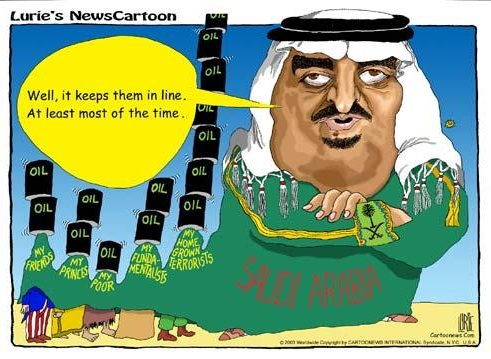
Anjli Raval in Riyadh writes:  Saudi Arabia says its strategy of squeezing high-cost rivals such as US shale producers is succeeding, as the world’s largest crude exporter seeks to reassert itself as the dominant force in the global oil market.

The International Energy Agency has released data backing up the Saudi position. The agency said that with the number of rigs running in the US plunging by 60 per cent in response to lower oil prices, US shale oil production had “buckled” in April, “bringing a multiyear winning streak to an apparent close”.

But the IEA also cautioned that it would be “premature” to suggest that Opec had “won the battle for market share”. It said global crude supply was growing, even from high-cost areas such as Brazil, as well as from other Opec member states such as Iran and Iraq.
However, the Saudi official said he expected the kingdom to maintain its dominance of global energy, despite the growth of alternatives to fossil fuels and competition from rival oil producers within Opec and beyond. “Saudi Arabia wants to extend the age of oil,” he said. “We want oil to continue to be used as a major source of energy and we want to be the major producer of that energy.”
Saudi officials explained that the policy was designed to put pressure on producers that require a higher oil price to be economic such as US shale drillers and companies operating in Brazil’s offshore fields. These they believed would be the first to collapse in a survival of the fittest as prices plunged.

Expectations are already rising that the market could start to tighten.

US shale producers would also disagree that Saudi Arabia has succeeded in squeezing them. The US oil industry has slowed down.

The Saudi official admitted “increased efficiencies” were likely as US shale and other producers adjusted to lower prices. He also said the impact of the price rebound was still “unknown” and “there is not yet any clarity on the US supply curve and drivers”.

Saudi Oil Production

Short-Term Energy Outlook in US

U.S. weekly regular gasoline retail prices reached a 2015 high of $2.69/gal on May 11, an increase of 28¢/gal from early April. Rising crude oil prices and a series of refinery outages in California have pushed gasoline prices higher in the past month. As a result of these outages, gasoline prices on the West Coast have increased by more than the U.S. average, with prices in Petroleum Administration for Defense District (PADD) 5 averaging $3.44/gal on May 11, an increase of 49¢/gal from the first week in April.

With crude oil prices projected to be relatively flat in the coming months, the U.S. monthly average gasoline price is projected to reach $2.68/gal in May, then decline as refineries in California resolve outages and refineries in the rest of the country increase production of gasoline following the spring maintenance season.

Total U.S. liquid fuels consumption rose by an estimated 70,000 b/d (0.4%) in 2014. In 2015, total liquid fuels consumption is forecast to grow by 340,000 b/d (1.8%).

Motor gasoline consumption, which rose by 80,000 b/d in 2014, increases by a projected 120,000 b/d (1.4%) in 2015 as lower prices and employment growth outweigh increases in vehicle fleet efficiency.

Consumption of distillate fuel, which includes diesel fuel and heating oil, is forecast to rise by 80,000 b/d (2.0%) in 2015 and by 60,000 b/d (1.5%) in 2016. This growth is driven by increasing manufacturing output and foreign trade.

Hydrocarbon gas liquids (HGL) consumption, which fell by 100,000 b/d (4.0%) in 2014, is projected to increase by 120,000 b/d in 2015 and by 60,000 b/d in 2016, as new petrochemical plant capacity increases the use of HGL as a feedstock.

U.S. crude oil production is projected to increase from an average of 8.7 million b/d in 2014 to 9.2 million b/d in 2015 and remain flat in 2016.

EIA expects onshore production to decline beginning in the second quarter of 2015 because of unattractive economic returns in some areas of both emerging and mature oil production regions.

EIA expects U.S. crude oil production to exceed 9.3 million b/d in the second quarter of 2015, then decline by 280,000 b/d through the first quarter of 2016. With forecast WTI crude oil prices rising to an average of $67/b in the second quarter of 2016, drilling activity is expected to increase again. plants, which reached a record high of 3.1 million b/d in October, is projected to average 3.2 million b/d in 2015 and 3.5 million b/d in 2016.

The growth in domestic crude oil and other liquids production has contributed to a significant decline in imports. The share of total U.S. liquid fuels consumption met by net imports fell from 60% in 2005 to an estimated 26% in 2014. EIA expects the net import share to decline to 21% in 2016, which would be the lowest level since 1969.

Active Aging? Jobs?

Asghar Zack writes:  Advances in health and social welfare in the 20th century ushered in a golden age for humanity. We’re living longer and in better health than ever before. Someone born in London today, for example, could expect to live 30 years longer than a counterpart did in 1900 – and will have access to pensions as well as universal healthcare provisions.

These advances have been a victim of their own success, however, and the downside is that ageing populations mean more pressure on resources, particularly on pensions and healthcare.

Amid all of this, we often overlook the idea that the new generation of older persons are a powerful resource. As a healthier group, they have the potential to contribute to not just their own well-being but also to sustain a greater economic and social prosperity for society as a whole.

Central to this is the idea of active and healthy ageing – the process of opening up opportunities and participation for older people and making quality of life better. As the World Health Organisation says: “Active” refers to continuing participation in social, economic, cultural, spiritual and civic affairs, not just the ability to be physically active or to participate in the labour force.  Active Aging

 Which countries are doing best?  The pro-family culture of Italy promotes care provision for grandchildren, while the Fit2Work initiative in Austria helps to maintain and improve the employability of employees and avoid premature withdrawal from the labour market due to sickness and work-related illness. Zero-hours contracts in the UK have come under criticism, but they have contributed to the kind of labour market flexibility that employers prefer in hiring older workers.


The indicators, including three for financial security. AAI

We can also break down this information separately for men and women to see what progress could be achieved simply by closing gender gaps. And, using the AAI toolkit, we can define the goalposts for countries to aspire for.

The figure below illustrates the position of 28 European Union (EU) Member States using the latest data available (corresponding mainly to 2012).