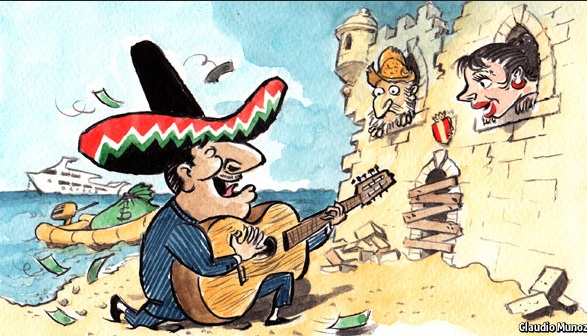
France and Italy Important to EU

For all the attention that’s been paid to Greece and its debtor negotiations lately, the coming battles over Europe’s troubled economy will be won not in Athens but mainly in Paris and Rome. France accounts for almost 22% of eurozone gross domestic product; Italy, more than 16%. Together, these two countries contribute more than 20 times Greece’s portion of eurozone GDP. If the eurozone is to escape its current stagnation, France and Italy must restart their economic engines once again.

The European economy has been given a lift in recent months by a weak euro and low oil prices. Regional elections in France and Spain have reduced concerns about populist parties derailing economic reforms. Politicians now have the breathing space to do the right things economically.

However, based on experience from the euro’s original launch at the turn of the century, there is reason for concern that such opportunities might be wasted. Back then, low interest rates induced some eurozone countries to go slow on structural reforms, relying instead on a monetary boost to the economy from the compression of sovereign-bond yield spreads. It would be most unfortunate if that experience were to repeat itself.

The real surprise now is that it is Italy, not France, that seems to have understood this. In February, Prime Minister Matteo Renzi’s government approved two decrees enacting the core of the labor-market reform. One improves the rules for firing employees on a permanent contract, giving them a right to severance pay but removing the previous right to court-ordered. The government also has reduced the time a worker can receive unemployment benefits, to 18 months from 2017 onwards.

Coupled with tax incentives introduced last year for companies that hire on regular as opposed to part-time contracts, it is now more enticing to hire in Italy than it has been in years.

In contrast, things in France are progressing much more tentatively. Paris continues to miss its budget-deficit targets, testing the European Commission’s flexibility. France’s prime minister, Manuel Valls, and its economy minister, Emmanuel Macron, have worked hard to convince the French Parliament of the merits of their reform package. Reforms would relax Sunday work restrictions, liberalize long-distance bus transportation, simplify employment tribunals and lay-off procedures, and deregulate white-collar professions such as notaries.

Limited in scope though this proposal was, the Valls government was nevertheless forced to resort to a rare constitutional provision to get it through the National Assembly on Feb. 19.

There is no time to waste. The Italian government has shown the way by creating the legislative framework for overcoming the two-tier labor market, while the French government is still dabbling with reforms that are only slightly more than symbolic. Paris still shies away from other essential steps, such as making its rigid 35-hour work-week regime more flexible.

It remains to be seen whether the measures required to make Italy’s labor market more flexible take proper shape in reality. But for now, at least, Italy has a head start on France.
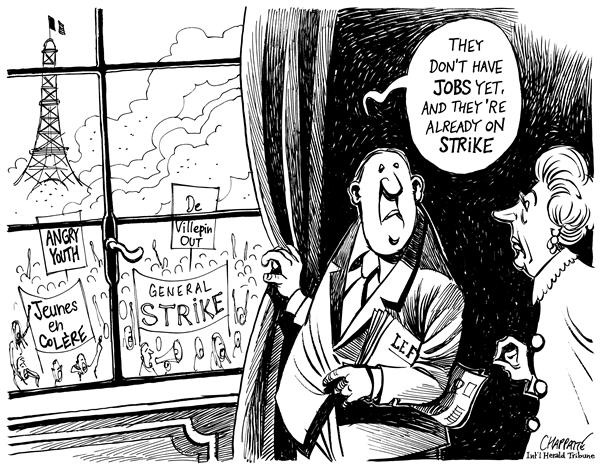
French workers

China Thrives as it Slows Down

Jim O’Neill writes: I just spent a week in China, where I participated in the Boao Asia Forum, a conference similar to the annual gathering of the World Economic Forum in Davos. The topic of my panel was what President Xi Jinping has called the Chinese economy’s “new normal”: an era of relatively slower growth, following three decades of double-digit economic expansion.

But what strikes me most about China’s economy is how remarkable it is. Indeed, its performance continues to astound me. Though it undoubtedly faces plenty of challenges, the key question is how likely they are to bring down the economy.

Of the four BRIC countries – Brazil, Russia, India, and China – Xi’s is the only one that has met my expectations for growth so far this decade. From 2011 to 2014, the Chinese economy grew at an average annual rate of 8% per year. If it continues to grow by around 7% for the rest of the decade, as the authorities and many observers expect, it will achieve an average pace of expansion of 7.5%, in line with my projections.  China’s New Normal

China Thrives

Social Progress and the GDP?

Michael Porter writes: Economic growth has lifted hundreds of millions of people out of poverty and improved the lives of many more over the last half-century. Yet it is increasingly evident that a model of human development based on economic progress alone is incomplete. A society which fails to address basic human needs, equip citizens to improve their quality of life, protect the environment, and provide opportunity for many of its citizens is not succeeding. Inclusive growth requires both economic and social progress.

The pitfalls of focusing on GDP alone are evident in the findings of the 2015 Social Progress Index, launched on April 9. The SPI, created in collaboration with Scott Stern of MIT and the nonprofit Social Progress Imperative, measures the performance of 133 countries on various dimensions of social and environmental performance. It is the most comprehensive framework developed for measuring social progress, and the first to measure social progress independently of GDP.  Why Social Progress Matters

Social Progress?

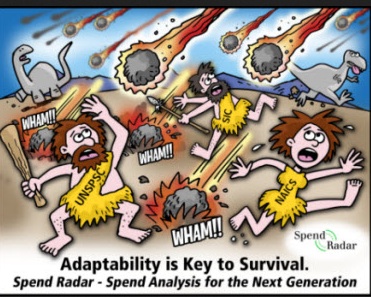
Entrepreneurs: How to Adapt

Mohamed A. El-Erian writes:  Like many readers, I still vividly recall when Nokia was the dominant player in mobile phones, with over 40% of the market, and Apple was just a computer company. I remember when Amazon was known only for books, and when dirty taxis or high-priced limousines were the only alternative to public transport or my own car. And I recall when the Four Seasons, Ritz Carltons, and St. Regises of this world competed with one another – not with Airbnb.

These changes happened recently – and fast. How did they occur? Will the pace of change remain so rapid – or even accelerate further? And how should companies respond?

Central to these companies’ success has been their understanding of a fundamental trend affecting nearly all industries: individual empowerment through the Internet, app technology, digitalization, and social media. Most traditional companies, meanwhile, remain focused on their macro environment, at the expense of responding adequately to the new micro-level forces in play.

Companies must recognize that both demand and supply factors are or will be driving the transformation of their competitive landscapes. On the demand side, consumers expect a lot more from the products and services they use. They want speed, productivity, and convenience. They want easy connectivity and expanded scope for customization. And, as the success of services like TripAdvisor show, they want to be more engaged, with companies responding faster to their feedback with real improvements.

On the supply side, technological advances are toppling long-standing entry barriers. The online car service Uber adapted existing technologies to transform a long-sheltered industry that too often provided lousy and expensive service. Airbnb’s “supply” of rooms far exceeds anything to which traditional hotels could reasonably aspire.

An existing company would have to be highly specialized, well protected, or foolish to ignore these disruptions. But, while some well-established companies in traditional industries are already looking for ways to adapt, others still need to do a lot more.

Banks are adapting, but much more slowly and hesitantly. If they are to make progress, they must move beyond simply providing apps and online banking. Their aim should be holistic engagement of clients, who seek not only convenience and security, but also more control over their financial destiny.

· First, companies should modernize core competencies by benchmarking beyond the narrow confines of their industry.

· Second, they should increase their focus on customers, including by soliciting and responding to feedback in an engaging way.

· Third, managers should recognize the value of the data collected in their companies’ everyday operations, and ensure that it is managed intelligently and securely.

· Finally, the micro-level forces that have the potential to drive segment-wide transformations should be internalized at every level of the company.

Companies that apply these guidelines stand a better chance of adapting to what is driving today’s rapid reconfiguration of entire industries.

Adaptability

Hungary and Greece Say Yes to Russian Pipeline?

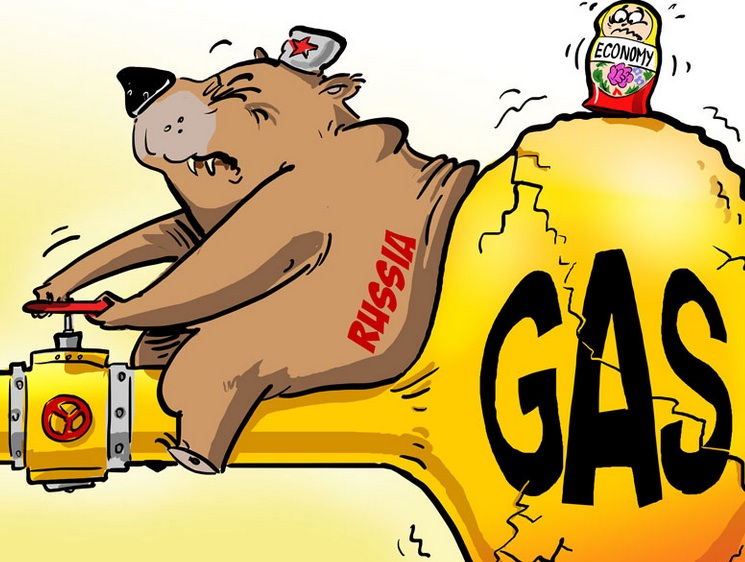
Anrdrew Rettman writes:  Greece and Hungary have endorsed plans for a Russian gas pipeline in the latest blow to EU unity over the Ukraine crisis.
Their foreign ministers, Nikos Kotzias and Peter Szijjarto, and counterparts from Serbia, Macedonia, and Turkey added their names to a declaration on the “Turkish Stream” project in Budapest.

Russian leader Vladimir Putin last year in Ankara said he’ll build Turkish Stream, a pipeline under the Black Sea to Turkey, after the EU blocked construction of South Stream, a pipeline under the Black Sea to Bulgaria, Serbia, and Hungary.

For its part, the European Commission blocked South Stream on grounds it violated EU anti-monopoly laws.

The Budapest communique underlines that it’s a statement of “political intent only, and that further exchange of views and dialogue is needed”.

The Turkish minister, Bozkir, told Hungarian media that “after the project’s feasibility studies are over, we’ll be able to give it a more qualitative estimate”.

The caveats come amid Turkish scepticism that Turkish Stream will be built because Russia lacks money and because its capacity exceeds the region’s requirements.

“Frankly, nobody in Turkey is taking it very seriously,” a Turkish source told EUobserver shortly after Putin unveiled Turkish Stream in Ankara last year.

“In the present climate, the Russians feel isolated. So they have the same reflex as the Iranians used to have – to announce some kind of new project with Turkey, and the whole idea is to show they still have international partners”.

The Budapest meeting represents a blow to EU unity over the Ukraine crisis despite the pipeline’s dim prospects.

Russia is courting Cyprus, Greece, Hungary, and Italy as potential veto-wielders on EU plans to extend economic sanctions before they expire in July.orts.

Nikolay Fyodorov, Russia’s agriculture minister, told Tass that Cyprus and Hungary might also get exemptions.

Tsipras told Russian media: “I think that the opportunity to strengthen our relationship is associated with tourism, as well as various cultural events”.

The Greek energy minister, Panagiotis Lafazanis, said: “I have a feeling that the visit of Alexis Tsipras to Moscow and his meeting with Vladimir Putin may become an important milestone”.

“The new chapter in the development of Greek-Russian co-operation, which will also include the Russian gas pipeline on Greek territory, may bring drastic and very positive changes to the political environment and the image of our region and of Europe”.

Pipeline

Is Russia a Top Military Exporter?

Samuel Benett writes:  Despite recent reports that Russia, along with the United States and China, is a top military exporter, Russian military equipment manufacturers are becoming less competitive in the global arms market and have been forced to withdraw from key sectors.

Prior to the fighting in Eastern Ukraine and the conflict over Crimea, Ukraine used to deliver technical components and technology to its Russian counterparts, maintaining the relationship established in the Soviet era, when certain key military industries were based in Ukraine.

Russian armored vehicles face increasing competition from Germany, China, and even Ukraine.

Despite such pessimism, there is little reason to think that Russian arms exports are going to suffer. Alexander Fomin, head of the Federal Service for Military-Technical Cooperation (FSMTC), recently said that over the past 11 years, the supply of Russian arms abroad tripled. Russia’s arms exports in 2014 exceeded $15.5 billion. The current portfolio of military orders amounts to $48 billion, according to Fomin. Responding to global instability and the proliferation of conflict, Russia has re-established military-technical cooperation and concluded contracts with Nigeria, Namibia, and Rwanda.

However, this year, exporting weapons will be more difficult, due both to sanctions and to violations of industrial integration, primarily with Ukrainian enterprises, and the resultant scarcity of parts.

Russia has to address gaps in precision electronic equipment and indigenous production.

Addressing Chinese competition, Shvarev noted that Beijing actively competes with Russia in the market segments where Russian exports are most competitive.

Ukraine’s military industry has dried up. Clearly it has suffered considerably since the start of hostilities with Russia-backed rebels, although there is still hope that Kiev can rebuild its domestic and export capacity following the cessation of hostilities. Military industry accounts for a good percentage of Ukrainian gross domestic product and involves large segments of the country’s economy.

To be fair, Russia’s defense industry has had its own issues securing sales on the global market. A few years back, Algeria refused delivery of Mig-29 Russian fighter jets due to the poor quality of the aircraft. In fact, such quality issues were severe enough that the Russian government began purchases of these aircraft in order to keep Mig manufacturers from going bankrupt. Russia also faced difficulties with its long-term client India when it came to the sale and modernization of an old Soviet aircraft carrier for Indian use.

Russia's Defense Industry

TV Show Passes Tough Gender Bias Test

Sarah Barrett writes:   After a good few months’ worth of watching Doctor Who, reading Doctor Who scripts, talking to other people about their thoughts on Doctor Who, getting briefly sick of Doctor Who, watching more Doctor Who, and doing a tremendous amount of copypasting things into other things, here’s what happened.

(The Bechel test: The Bechdel test asks if a work of fiction features at least two women who talk to each other about something other than a man. The requirement that the two women must be named is sometimes added. Originally conceived for evaluating films, the Bechdel test is now used as an indicator of gender bias in all forms of fiction. Almost half of all contemporary films fail the test, and critics have noted that the test is most informative when applied in the aggregate, because individual works may pass or fail the test for reasons unrelated to sexism.)

Turns out that out of 117 episodes, 96 pass the Bechdel Test, giving Doctor Who an overall pass rate of… 80%! That strikes me as not bad, but not outstanding either, for a show that has so many female main characters. I give you a B+, Doctor Who. I know you can do better. Especially since:

tumblr_niv3vfdIGQ1u7r37mo1_1280

The percentage of Bechdel Test passes between women of colour is low. 7%, and that’s really only because we had Martha as a main character, having conversations with her family and friends, for so long. The percentage of Bechdel Test passes between LGBT women is even lower – a mere 3%, and that’s almost entirely down to the existence of Madame Vastra and Jenny. The percentage of Bechdel Test passes between disabled women is lowest of all – 0% in fact – but I kinda expected that.

But I promised you some mild surprises, so here’s mild surprise number one: the Steven Moffat factor. The current Doctor Who showrunner receives a hell of a lot of criticism and often it’s deserved, but his series isn’t that far behind Davies’s series in terms of Bechdel Test passes. Davies’ series (1-4 plus specials) stand tall at 85%, but Moffat’s series (5-8) score 75%. Mild surprise number two: Steven Moffat actually wrote the most Bechdel Test-passing episodes. Not by much – only two more than Davies – but whaddayaknow.

tumblr_nivx46qhCd1u7r37mo1_1280

Mild surprise number three (and the nicest of them) is that when these results were published on Doctor Who TV, the response was pretty positive, way more than I expected.


Fishing Poacher’s Rescued on Africa’s West Coast

Environmental activist group Sea Shepherd said it rescued 40 crew members from a sinking “poaching” ship it was pursuing for months for allegedly illegally fishing in the Southern Ocean, but described the ship’s sinking as suspicious.

Sea Shepherd said its ships Bob Barker and Sam Simon picked up the crew, which included the captain, from life rafts from the Nigerian-flagged boat Thunder.

They had been sailing in the waters of Sao Tome and Principe, an island nation off Africa’s western coast.

“It is an incredibly suspicious situation, to say the least,” Bob Barker’s captain Peter Hammarstedt said in a statement.

“When my chief engineer boarded the Thunder in the hours leading up to the sinking, he was able to confirm that there were clear signs that the vessel was intentionally scuttled.

“Usually when a vessel is sinking, the captain will close all hatches so as to maintain buoyancy. However, on the Thunder, the reverse was done — doors and hatches were tied open and the fishhold was opened.”

Sea Shepherd said the crew were given food and water and were transferred to Sam Simon.

Video recorded by the activist group showed the ship sinking just hours after it said Thunder issued a distress signal on Monday afternoon.

Hammarstedt said Thunder’s captain, who was not named, complained about being rescued and “started applauding and cheering” when the vessel sank.

“We’ve been chasing the Thunder for 110 days now, and I think they’re basically at the end of their fuel, and they would have had to make a port call,” Hammarstedt told the Sydney Morning Herald.

“I think the captain of the Thunder made the decision that he preferred the physical evidence on board… was better on the ocean bottom than going into port with him.”

Thunder, on a list of boats deemed to have engaged in illegal, unreported, or unregulated fishing activities by multi-national body the Conservation of Antarctic Marine Living Resources (CCAMLR), is suspected of illegal fishing for Patagonian toothfish and other rare species in the Antarctic.

Toothfish is sold as Chilean sea bass, which is popular in high-end restaurants. It sells primarily in the United States, Europe and Japan, although there is also a growing market in China.

Fish

Has the US Lost Role as Underwriter of Global Economic System

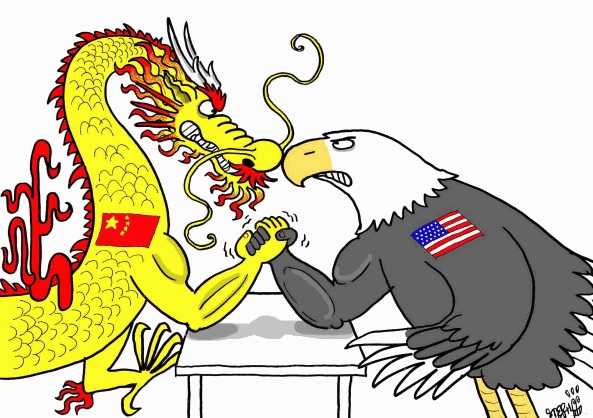
Lawrence Summers writes: This past month may be remembered as the moment the United States lost its role as the underwriter of the global economic system. I can think of no event since Bretton Woods comparable to the combination of China’s effort to establish a major new institution and the failure of the United States to persuade dozens of its traditional allies, starting with Britain, to stay out.  This should lead to a comprehensive review of the U.S. approach to global economics.

With China’s economic size rivaling that of the United States and emerging markets accounting for at least half of world output, the global economic architecture needs substantial adjustment. Political pressures from all sides in the United States have rendered the architecture increasingly dysfunctional.

Largely because of resistance from the right, the United States stands alone in the world in failing to approve International Monetary Fund governance reforms that Washington itself pushed for in 2009.   At the same time, pressures from the left have led to pervasive restrictions on the infrastructure projects financed through the existing development banks — which consequently have receded as infrastructure funders, even as many developing countries have come to see infrastructure finance as their principal external funding need.
With U.S. commitments unhonored and U.S.-backed policies blocking the kinds of finance other countries want

First, U.S. leadership must have a bipartisan foundation, be free from gross hypocrisy and be restrained in the pursuit of our self-interest.

Other countries are legitimately frustrated when U.S. officials ask them to adjust their policies — only to then insist that state-level regulators, independent agencies and far-reaching judicial actions are beyond their control.

Second, in global as well as domestic politics, the middle class counts the most. It sometimes seems that the prevailing global agenda combines elite concerns about matters such as intellectual property, investment protection and regulatory harmonization with moral concerns about global poverty and posterity while offering little that speaks to those in the middle.

Third, we may be headed into a world where capital is abundant, deflationary pressures are substantial and demand could be in short supply for quite some time. In no big industrialized country do markets expect real interest rates to be much above zero in 2020 or for inflation targets to be achieved.

These precepts are just a beginning. There are questions about global public goods, about acting with the speed and clarity that the current era requires, about cooperation between governmental and nongovernmental actors and much more. What is crucial is that the events of the past month will be seen by future historians not as the end of an era, but as a salutary wake-up call.

US No Longer Global Leaderal

The Impact of Hi Tech in Latin America

Luis A. Moreno: At the upcoming Summit of the Americas in Panama City, business and government leaders will discuss the economic challenges facing the Western Hemisphere, especially how to support inclusive growth in the wake of the commodities bonanza that endured for the better part of the last decade. Any strategy will have to account for an inescapable global phenomenon: the so-called “Second Machine Age.”

The MIT economists Andrew McAfee and Erik Brynjolfsson, among others, identify the Second Machine Age with the rise of new automation technologies and artificial intelligence. While optimists predict that these innovations will usher in an era of unprecedented abundance, less sanguine analysts estimate that nearly half of all jobs currently performed by humans are vulnerable to replacement by robots and increasingly sophisticated software.

Advanced technologies are already making inroads into some of Latin America’s principal industries. For example, carmakers, which employ hundreds of thousands of people across the region, are rapidly deploying robots that are more efficient and precise than humans. I

Service industries, which already account for two-thirds of all jobs in Latin America, are particularly vulnerable. One Brazilian startup’s tax-management software, for example, can perform in seconds operations that would demand thousands of billable hours from an army of accountants.

Is Latin America ready for this epochal change?

Most notably, Latin American and Caribbean economies must address their productivity gap – the result of their failure, with few exceptions, to boost productivity significantly since the 1960s. As they adjust to lower prices for oil, metals, and grain – and the eventual upturn in global interest rates – they will have to pursue productivity-enhancing reforms. Ensuring that the region’s already-skewed income distribution does not worsen – and, indeed, improves – is also essential.

The good news is that Latin America’s agendas for technology, productivity, and inclusivity overlap; for example, improvements in education and the encouragement of formal employment advance all three objectives.

First, companies can boost their own human capital by providing on-the-job training – a proven tactic that remains rare in Latin America. Here, there has been some progress.

Second, Latin American companies should increase their investment in research and development.

Latin American businesses can change this by emulating their counterparts in the Brazilian state of São Paulo, which have research contracts with leading public universities. Such links, common throughout North America, have helped to lift São Paulo’s R&D spending to 1.6% of GDP – higher than that of Spain or Italy.

Third, Latin American companies can help to improve education – often much faster than the government can implement effective reforms. In Peru, one businessman took matters into his own hands, commissioning the creation of an entirely new education model. Four years later, Carlos Rodriguez-Pastor has established 23 Innova schools, serving 13,500 students, where teachers’ knowledge and skills are continuously updated. He hopes to build a 200-school network in the coming years.

Finally, Latin American business leaders should support budding entrepreneurs, who lack not only the capital, but also the support system needed to turn their ideas into viable ventures.

Von Ahn, a professor at Carnegie Mellon University in the United States, has already sold one innovative company to Google. That company, reCAPTCHA, harnesses CAPTCHAs to have people decode a word from, say, a newspaper article that a computer scanner has been unable to recognize and digitize.

Latin America cannot afford to lose gifted innovators like von Ahn. It is in the interest of established business leaders to help mentor and finance these visionaries, enabling them to flourish at home so that they do not set up shop abroad.

Impact of Technology in Latin America