P&G Massages its Beauty Business

A.G.Lafley who has returned to P&G for his second act, remarked:  “Beauty is the industry of gret promises made and never kept.:

P&G had taken a slumbering company which sold “Oil of Olay” for $3.95 and successfully modernized  it by selling the product for $18.95 to a booming reception in sales.  t.

“For the prestige shopper, it was great value, but not too cheap to be credible,” Lafley and Martin wrote in “Playing to Win,” “and for the mass shopper, it signified that the product must be considerably better than anything else on the shelf to justify such a premium.” The result: double-digit sales and profit growth every year for a decade, beginning in 2000. So it went for lots of other P&G beauty brands as the company moved upscale but not too upscale (“masstige” was the buzzword), playing on its research and marketing strengths as it poached customers from more idiosyncratic, fashion-oriented competitors.

That decade ended five years ago, though, and P&G’s beauty business — which accounts for 23 percent of sales — hasn’t gone much of anywhere since. Lafley returned to the sputtering company in 2013.

One problem was that P&G had put the beauty division in the hands of people who didn’t understand the beauty business, assuming that general management is fungible, and functional management gets developed by moving it around every two or three years.

On the other hand, Lafley said P&G’s beauty division risked becoming too much like other companies in the industry:

What are the risks for us in Beauty? We start thinking we’re a beauty company and we spend all our time at the Oscars or the Grammys or Fashion Week, which now runs for months, and we don’t stay focused on the consumer.

So what was the right approach for P&G?

We’ve just got to get back to the strategy that worked for us, which was fundamentally beauty capable where we needed to be beauty capable and playing to P&G strengths where P&G strengths make a difference for consumers and customers.

It needed to be a balancing act, then, and balancing acts are hard. Lafley isn’t giving up on it, but he is apparently looking to dramatically cut down on the number of beauty brands his company has to manage. One of the key questions in strategy, Lafley and Martin wrote in their book, is “Where will you play?” More often than not the right answer is, Not there.

 Beauty Business

Ending the $20 Billion Traffic in Wildlife Business?

William deBuys writes:  Last month China announced that it would ban ivory imports for a year, while it “evaluates” the effectiveness of the ban in reducing internal demand for ivory carvings on the current slaughter of approximately 100 African elephants per day. The promise, however, rings hollow following a report in November (hotly denied by China) that Chinese diplomats used President Xi Jinping’s presidential plane to smuggle thousands of pounds of poached elephant tusks out of Tanzania.

Meanwhile, the Obama administration has launched its own well-meaning but distinctly inadequate initiative to curb the trade. Even if you missed the roll-out of that policy, you probably know that current trends are leading us toward a planetary animal dystopia, a most un-Disneyesque world in which the great forests and savannahs of the planet will bid farewell to the species earlier generations referred to as their “royalty.” No more King of the Jungle, while Dorothy’s “Lions and tigers and bears, oh my!” will truly be over the rainbow. And that’s just for starters.

The even grimmer news that rarely makes the headlines is that the lesser subjects of that old royalty are vanishing, too. Though largely unacknowledged, the current war is far redder in tooth and claw than anything nature has to offer. It threatens not just charismatic species like elephants, gibbons, and rhinos, but countless others with permanent oblivion.   Illegal Traffic in Wildlife

Illegal Wildlife Traffic

Google v Facebook: Monetizing Time

Derek Thompson writes:  In 2011, Hal Varian, the chief economist at Google, wanted to study the millions of hours saved by Google searches. His team took questions like, Does using butter or margarine affect the size of baked cookies? and compared the time it took to Google the results versus researching the answers offline, in cookbooks.

Varian concluded that the typical Google question saved 15 minutes.  In 2011, the mobile advertising market was a pittance. Today, it’s a $7 billion industry, and mobile devices now command 20 percent of our attention,  more than radio and print combined. Google has used its time-saving, bottom-of-funnel advantage to become, by a wide margin, the richest company in mobile advertising.

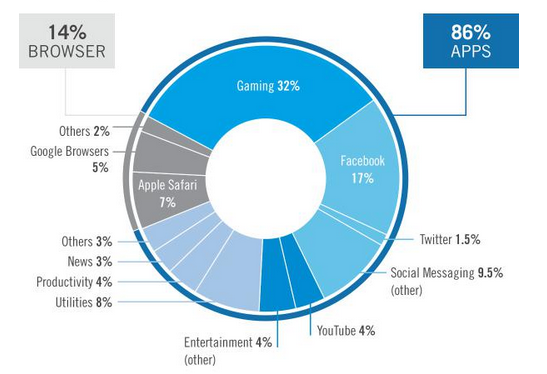
Facebook, too, is an engine of consumer surplus, but it earns its prodigious income by monetizing time spent, rather than time saved. A full account of hours logged on Apple and Android mobile devices finds that, when you take out gaming and browsers, Facebook accounts for approximately a third of our time on mobile devices. Even more monopolistically, the four most-downloaded non-gaming apps today—Facebook Messenger, Facebook, WhatsApp, and Instagram—are Facebook, built by Facebook, or bought by Facebook.


How Do People Spend Their Time on iOS and Android Devices?

MondayNote | Data: Flurry Analytics, Comscore, NetMarketShare

An easy conclusion to draw from this is that Facebook is mobile, and mobile is Facebook, and the future of our attention belongs to Facebook.

But that projection is based on a theory of monetizing time that says that more time is always more valuable for all media companies. And that’s not necessarily true. The single richest company on mobile, Google, makes more than twice as much money on mobile advertising than Facebook does, on less than half the time. This suggests that there is still considerable room for mobile innovations, even in media, that are designed around saving time rather than taking time.

You might say I’m making a false comparison, because Facebook is a media company, and Google is a search company, and the former category is all about soaking up time that the latter category saves. But that dichotomy is misleading.

As media companies search for a “God metric” to brag about to advertisers, many of them are converging on “engaged time.” There are good reasons for this. The minutes people spend on an article page says something more about readers’ concerted attention than raw page views and upvotes. But time is a war that Facebook is winning in a blowout. As News Feed proves itself to be a most ingenious engine of engaged attention, maybe competitors should be changing the argument. Even with all the time in the world, most of us would still like to save some.

Is Inflation Irrelevant?

Alice RIvlin in a speech before the Economc Policy Conference:  I want to draw your attention today to what I perceive as a cultural lag in thinking about the objectives of economic policy. Why are we still so focused on fighting inflation? Why are so many people in this room devoting so much time and attention to guessing when the Federal Reserve will start raising short-term interest rates and get back to its “normal” job of protecting us from inflation? Is inflation an important threat to our economic well-being? Is when to raise interest rates the most urgent question facing the Fed at the moment? Or are we suffering from cultural lag?

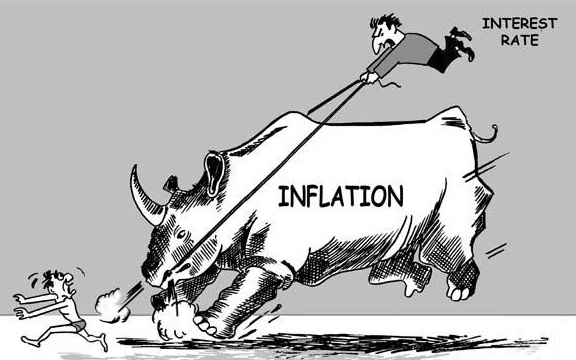
Central banks have amply proved that they know how to stop inflation—Paul Volcker showed that. They have been much less successful in getting little inflation going.

Does the new normal for which current tools of monetary, fiscal, and regulatory policy need to be restructured? In the Volcker era of central banking, inflation was the principal threat to sustainable growth—and central bankers had to be brave enough to raise interest rates to tame the beast and steadfast in communicating their determination to do so. Paul Volcker demonstrated that he was a brave man.

But after Volcker slayed the dragon over three decades ago, inflation gradually drifted down, and the beast has hardly wiggled its tail for a long time. The last time the core PCE hit 3.0 percent was 1992. The surprise of the second half of the 1990s was the co-existence of strong job growth, low unemployment—with the unemployment rate even dipping briefly below four percent—and no worrisome rise in inflation. The surprise of the current long recovery is that, even with decent economic growth and persistently impressive job creation, we still have wages barely budging and inflation below two percent and recently falling. Just possibly, destructive inflation is an oh-so-last-century threat that should be moved down our list of macro-economic concerns to make room for others. In any case, it is threat we know how to deal with, so we should focus on the ones for which we are less equipped.  Is inflation irrelevant

Inflation

Success in the Food Business?

Danny Meyer talks about success in the food business.  “Shake Shack was an accident.  We didn’t mean it to be anything more than a hot dog stand.  It was Chipotle that said, what the world wants is well-sourced, well-prepared food, not necessarily served at a table.  My hope is that people from the fine dining industry take their food public and make is accessible to people.

Sourcing has been at the heart of our growth. Our buns are made in Lancaster County.  Their flour had GMOs. We didn’t want to use flour with GMOs, so they began sourcing GMO free flour in Canada.

Chipotle, Whole Foods, and Starbucks care about their employees, their communities and make money for their shareholders.

Shake Shack. the original

How to Deal with Global Economic Divergence?

Mohamed a el Erian writes: The world is increasingly characterized by divergence, in economic performance, financial policy and financial markets.  We are on a very bump road to globalization.

Experimental policies in the advanced markets, like the Euro-zones large-scale asset purchases,were able to slow a vicious cycle of subpar economic performance.   At the same time, the US Federal Reserve is exiting from these policies.  Market forces have led to dramatic shifts in exchange rates.  Even healthy economies like South Korea are willing to lower the value of their currency and leave the US standing alone.

Political leaders worldwide seem unwilling to perform their economic governance responsibilities.  These include structural reforms to revamp the growth engines, efforts to rebalance aggregate demand, and elimination of debt overhangs.  This probably arises from ‘inertia’ politics —  a “can’t, won’t, shouldn’t’ mentality.  Leaving central banks and market forces to govern the globe is simply not enough.

Anti-Corruption Protests in Brazil

Paolo Prada writes: Close to a million demonstrators marched in cities and towns across Brazil on Sunday to protest a sluggish economy, rising prices and corruption – and to call for the impeachment of left-wing President Dilma Rousseff.

The protests in the continent-sized country come as Brazil struggles to overcome economic and political malaise and pick up the pieces of a boom that crumbled about the time Rousseff took office in 2011.

Rousseff, now early into her second four-year term, is unlikely to face the impeachment proceedings called for by many opponents. A fifth year of economic stagnation and a multibillion-dollar corruption scandal at state-run energy company Petroleo Brasileiro SA, or Petrobras, has fueled their anger.

But for a president narrowly re-elected just five months ago, the protests are a sign of a polarized country increasingly unhappy with its leadership, especially as the hard-won gains of the recent boom begin to succumb to an economic slowdown.

The unexpectedly large demonstrations also promise to embolden opposition parties and restive allies, including the leaders of both houses of Congress, who are nominally part of Rousseff’s ruling coalition, but nonetheless are hindering efforts to pass reforms intended to jump-start the economy.

In a press conference Sunday night, two members of Rousseff’s cabinet recognized the rights of protesters, but downplayed the importance of the demonstrations, saying they were expressions of discontent by those defeated at the polls.

They also sought to discredit those who suggest impeachment. Miguel Rossetto, one of Rousseff’s top aides, criticized what he called the “intolerance” of those opponents and likened their demands to coup efforts.

In a statement posted online Sunday, Aecio Neves, a centrist who was defeated by Rousseff in October, said the demonstrations marked a day when Brazilians “went to the streets to reunite with their virtues, their values and also with their dreams.”

Sunday’s gatherings were mostly calm, with little of the violence that tarnished a wave of massive demonstrations in 2013, when Brazilians protested billions of dollars of spending, even as the economy faltered, to host the 2014 World Cup.

But if less vehement, the rallies Sunday possibly matched those of two years ago in scale. Estimates for the size of the crowds differed, but most calculations suggested roughly a million protesters nationwide.

In Sao Paulo alone, state police in late afternoon said that a million had turned out to march along skyscraper-lined Avenida Paulista, the heart of Brazil’s financial capital and biggest city. A private pollster later said it was only 210,000.

Earlier, more than 10,000 residents of Rio de Janeiro poured onto the Copacabana waterfront. Most dressed in the blue, green and yellow of Brazil’s flag. Crowds sang the national anthem and shouted “Dilma, out!”

“People feel betrayed, said Diogo Ortiz, a 32-year-old advertising worker, who called the Petrobras scandal “a national and international disgrace.”

Many protesters hail from the country’s wealthier classes, who traditionally have opposed the ruling Workers’ Party.

Underscoring class divisions, marchers said Rousseff and the ruling party have instigated the polarization by pitting their traditional supporters, the recipients of popular social welfare programs, against the rest of Brazil.

The party “is inciting the people against the people,” said Helena Alameda Prado Bastos, a 61-year-old editor in Sao Paulo.

The Workers’ Party, opponents complain, for too long ignored critiques that its heavy spending, subsidized lending, protectionist policies and corruption have sapped the vitality that led to average growth exceeding 4 percent during the decade before she took office.

Although the party also presided over those good years, during two terms of Rousseff’s predecessor, economists say she failed to adjust policies when a global commodities boom ended and sapped once-soaring export revenue.

Rousseff herself has not been accused of wrongdoing in the corruption probe, but many blame her for lax oversight of Petrobras, especially during years she served as the company’s chairwoman, prior to becoming president.

The ongoing scandal stems from a scheme through which prosecutors say Petrobras contractors paid kickbacks to corrupt executives and some Workers’ Party members.

So grim are Brazil’s economic prospects that many economists expect it to slip into recession. Investors, meanwhile, fear the country could lose its investment-grade status.

Inflation is running at a 10-year high, while Brazil’s currency, the real, has lost over 22 percent of its value against the dollar this year.

Campaign to End Corruption in China

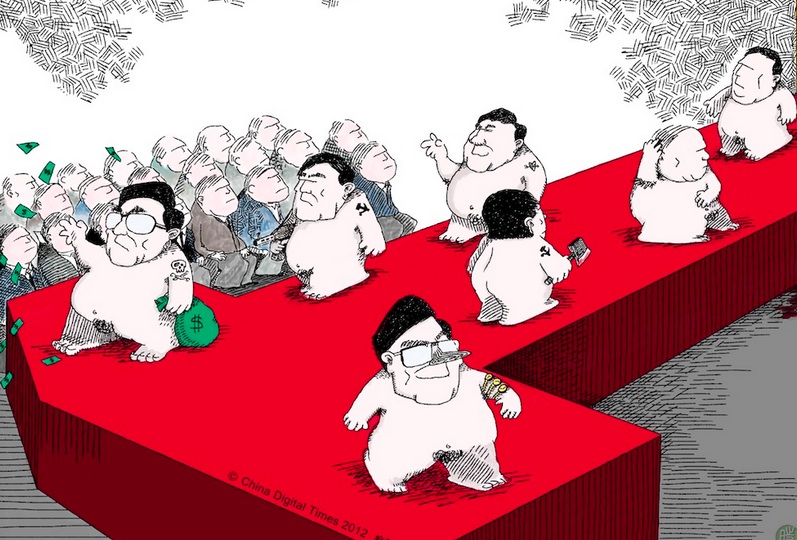
Benamin Kam Lin writes: The chairman of one of China’s top state-owned automakers, FAW Group Corp, and a senior provincial official are being investigated for “violating party discipline”, the Communist Party said on Sunday, employing its usual euphemism for corruption.

After taking over as party and military chief in late 2012, President Xi Jinping declared war on corruption at all levels in China, vowing to go after powerful “tigers” and lowly “flies”. Scores of senior officials have been brought down by the campaign, including former security tzar Zhou Yongkang.

Xu Jianyi, 61, chairman of state-owned China FAW Group Corp, and Qiu He, 58, deputy head of the party in southwestern Yunnan province, are being investigated for “serious violation of (party) discipline and laws”, the party’s Central Commission for Discipline Inspection said on its website. It gave no further details.

FAW Group Corp, which counts Faw Car Co Ltd as one of its units, is one of China’s biggest automakers which has joint ventures with Volkswagen, Toyota and General Motors in China.

Faw Car shares fell as much as 5.6 percent to more than a two-week low. The news also hit its other units with Tianjin FAW Xiali Automobile Co Ltd down as much as 3.6 pct and Changchun Faway Automobile Components Co Ltd declining as much as 2.2 pct.

Both Xu and Qiu hold a rank equivalent to a cabinet vice minister.

Qiu is well-known in China for ambitious projects and his autocratic and eccentric management style, demanding discipline from his staff. Once seen as a political rising star, his style won both praise and criticism.

Foreign automakers seeking to manufacture cars in China must form joint ventures with domestic partners and are restricted to 50 percent ownership limits, an arrangement generally seen as the cost of doing business in the world’s largest car market.

Such requirements expose companies to unknown risks at their JV partners and extend beyond the auto sector. Founder Securities, a joint venture partner of Credit Suisse AG, had assets frozen after accusations of embezzlement and its chairman later disappeared.

Caixin, a weekly magazine, said Qiu is being investigated for urban construction projects in Kunming, provincial capital of Yunnan, when he was the city’s party boss from 2007 to 2011.

China’s top prosecutor told the annual full session of parliament that prosecutors investigated 4,040 civil servants at the county level or above in 2014, or an average of 11 a day. The 11-day meeting ended on Sunday.

Weeding Out Corruption in China


US Falling Behind in Advanced Technologies?

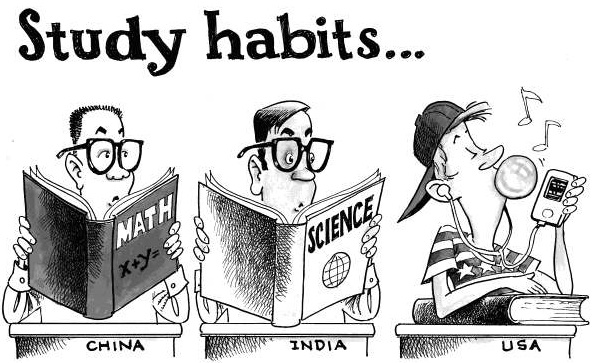
Is the US falling behind in advanced technologies?  The United States’ GDP of $16.3 trillion in 2014 was the highest in the world, due in large part to the strength of U.S. industries. However, all industries are not equal in terms of their contribution to economic output. While the U.S. economy is among the world’s strongest, however, other countries continue to invest in education, technology, innovation, and other industries that invigorate economies, and the U.S. is falling behind. The percentage of U.S. workers employed in what the Brookings Institution calls “advanced industries” has fallen from 11.6% in 1980, to 8.7% in 2013. While this was a slight improvement from 8.4% in 2010, the need for a resurgence in the nation’s most important industries is more pressing than ever.

US Education

Gaming Industry for Men Only?

Natalie Zina Walshots writes:  Anita Sarkeesian, a feminist critic best known for her YouTube series “Tropes vs. Women in Video Games,” cancelled an appearance at Utah State University after she received an anonymous threat of a shooting massacre were the talk to go ahead (as a concealed carry state, security at the event could not guarantee no one with a gun would be allowed in the building while Sarkeesian was speaking.

Sadly, Sarkeesian has long been the target of sexist attacks—ever since she first launched a Kickstarter campaign in 2012 to support the series. “The threats against Ms. Sarkeesian are the most noxious example of a weeks-long campaign to discredit or intimidate outspoken critics of the male-dominated gaming industry and its culture,” Wingfield wrote.

Even former avowed Gamergaters have hung up their trilbies and abandoned their positions as everything became more extreme and untenable—or they suddenly found themselves on the opposing side of the harassment campaign. Those within the industry openly made statements against Gamergate, including: gaming companies such as Blizzard and the Entertainment Software Association (commonly know as the ESA and gaming’s top trade group); publications like Game Informer, Polygon, and Giant Bomb; and creative luminaries such as Tim Schafer and Damion Schubert.

And yet—and yet—it is still happening. On January 11, Zoe Quinn charted her struggles to get the legal system to do something about the avalanche of hate spewing her way. She talked about how demolished her life was and continued to be by the campaign. She wrote, in full: “The same wheels of abuse are still turning, five months later. I’ve been coming to terms that this is a part of my life now, trying to figure out what to do about it, and how to move forward with so many people trying to wrap themselves around my ankles. It’s been hard to accept that my old life is gone and that I can never get back to it. But I’ve found purpose in the trauma, in trying to stop it from happening again, to use my experience to show how these things are allowed to happen, and to further a dialog on how to actually stop it. If I can’t go home, maybe I can at least get out of this elevator shaft. Maybe I can help end August. Maybe you can, too.”

In the games publication Giant Bomb’s discussion forums, game developer and tech writer Brianna Wu wrote “I was talking to Zoe Quinn this week, who told me about a folder on her computer called, ‘The ones we lost.’ And it was young girls that wrote her saying they were too scared to become game developers.

For every visible woman who has stepped away from their platform, how many less vocal or less well-known participants have we lost? In the wake of Gamergate, for instance, Kathy Sierra, a tech writer who was once the target of hacker and horrible person weev, walked away from the online persona she’d built as Serious Pony to insulate herself from further violence.  How many women stopped participating in online communities and massively multiplayer online and co-op games? How can we possibly know the real numbers of the ones we lost.

Gaming Industry Women