Egypt Expands Suez

Egypt is expanding the Suez canal in a drive to boost economic growth, and the canal has already achieved record income in 2014, General Mahab Mameesh, Suez Canal Authority board chairman said.

The Egyptian people succeeded in collecting more than 64 billion pounds (USD nine billion) in eight days for the massive expansion project because they believe that Egypt was heading towards further security, stability and economic development, Mameesh said.
He was speaking at a workshop about the development of the Suez canal, held on sidelines of the Egyptian Economic Development Conference (EEDC), and attended by Egyptian President Abdelfatah Al-Sisi and Saudi Crown Prince Muqrin bin Abdulaziz.

The expansion of the Suez canal aims at boosting its capacity to receive giant vessels, through deepening the navigation path to 66 feets as well as setting waiting time to 11 hours, down from 18, he said.  The Egyptian government has created legislations to protect investors, established a solid infrastructure that lure businessmen.  The new Suez canal will be linked to land, sea and air networks in order to facilitate transport of goods.

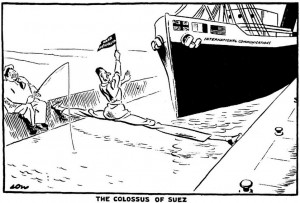
Suez Expansion

People of the US V Credit Suisse

UPDATE March 16, 2015:   Individual ezperts who testitfed before the Labor Department’s hearing on a waiver for Credit Suisse have been asked to provide more documentation of proof that Credit Suisse has a culture of corruption.  Very specific documentation was sent last week.  No deicsion has yet been made on this matter.  The CEO of Credit Suisse stepped down last wee, perhaps in part because Credit Suise wants to keep their $2 billioin in US pension funds management.

Last year Credit Suisse pled guilty to criminal charges to aiding and abetting tax evasion in the United States.  Now a ‘criminal’ Credit Suisse was banned from continuing to operate 2 billion dollars in pension funds in this coutnry.  They applied to the Labor Department for an extension, which they expected to be pro forma, In fact, a temporary exemption was granted.

Then Maxine Waters, a US representative from California cried out, Wait.  Let’s take a deerper look at this.  Let’s hold a public hearing.

On January 15, 2015, the hearing was held.  From Credit Suisse, the same old, same old was heard.  Top executives knew nothing of these programs to aid and abet tax evaders.  All the bad guys had been removed.  But reporters in Switzerland, intimately familiar with Credit Suisse’s business practices, asked the obvious question: Is the culture of Credit Suisse so corrupt that under no circumstances should this exemption be granted?

Hard evidence from the European justice system suggests the answer to this question is: Yes.

Mr. Neil Radey, Managing Director, General Counsell-America, co-General Counsel-Investment Banking, Credit Suisse Securities (USA) LLC said:  “Some commenters have alleged that senior management at Credit Suisse knew of the active assistance to U.S. customers evading taxes described in the plea agreement. These are claims that are unsubstantiated. Indeed, it was an independent investigation. It was conducted by external counsel, but it concluded that senior management was not aware of that misconduct.”

On November 21, 2011 a German district court ruling – file number10 KLs 14/11 – attested Credit Suisse to have instigated a large scale system to entice German citizens to evade taxes. The verdict further stated that Credit Suisse top management knew about this deliberate assault against the German revenue service. The court found that training materials were used to systematically train Credit Suisse staff to seek out German tax evaders. The verdict clearly confirmed that Credit Suisse’s top management had knowledge of the tax evasion crimes.

Neither the Credit Suisse internal tax investigation nor Credit Suisse top management reported any of the bank’s tax fraud found by the German Court to the US authorities.

Considering the German court’s unambiguous verdict against Credit Suisse, the fact that the bank’s senior management is still denying its knowledge about the tax evasion scheme and the fact that Credit Suisse is a repeat offender, Credit Suisse or its affiliates should not be given any exemptions. Credit Suisse’s statements do not have credibility.

Since Credit Suisse has not come clean with its criminal past, it is hard to understand how the Department of Labor can grant an exemption.   The risk that Credit Suisse could continue to engage in criminal activities through its QPAM’s – as it has often done in the past —  is far too great.

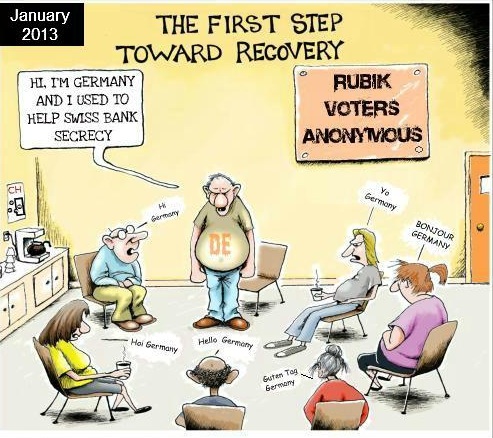
Credit Suisse


Is US Debt a Moot Issue?

Bruce Bartlett’s testimony:  There is no debt problem if United States retains its present monetary regime of a non-convertible fiat currency, with a floating exchange rate, and no debts owed in any foreign currency. That’s because for such a currency issuer, whatever debt level exists and falls due at any point, that debt can always be repaid because it is denominated in the currency the debtor nation can issue at will. All repayment takes then is the willingness of the issuer to issue the money needed and to use it to repay the debt due.

1. The nominal debt is irrelevant. By this I mean the dollar figure, which, as this is written, is $18,138,459,241,907.59. That’s a lot of money and it scares people. It makes them accept policies that may not only be unnecessary, but harmful. Cutting spending in a recession is clearly counterproductive and I think that the cuts that have been enacted over the last several years were unwise and slowed growth in the economy. The fact that the U.S. economy is doing marginally better than some in Europe is because they cut spending even more than we did.

2. The debt is a stock, not a flow. To determine whether the debt is “excessive” we have to compare it to something that approximates ability to pay. Typically, we look at the debt as a share of the gross domestic product. But this is not a proper comparison; we are comparing apples and oranges. To get an apples-to-apples comparison, we should compare the debt to the federal government’s assets. The comparable figure to GDP would be interest on the debt. Presently, net interest is 1.3 percent of GDP, well down from 3.2 percent in 1992. CBO currently estimates that this percentage will rise in coming years to 3 percent of GDP in 2025. This is due primarily to a projected rise in interest rates, rather than a rise in debt. This problem could be mitigated if the Treasury issued more long-term debt now while interest rates are low.

The government has many valuable assets, and among them the most valuable financial asset is its constitutional authority to create money whose financial value it can specify at will (which under present legislation is delegated to the Federal Reserve System and its member banks, and to the Treasury.

So, there can never be any diminution or increase in the capacity of a fiat sovereign government like the US government to repay its debt instruments regardless how small or large the principal value of those debt instruments is. Whether that value is $50 million or $50 quadrillion the value of the federal money asset ratio is still zero.

3. . . . Budget conventions grossly overstate the interest cost. The reason is that the budget treats the Federal Reserve as part of the public rather than part of the government. Presently, the Fed owns $2.5 trillion of Treasury securities, on which it receives interest from the Treasury. . . . But the Fed pays almost all of it back to the Treasury. In 2014, Treasury paid the Fed $116 billion in interest. After subtracting various costs, the Fed returned $99 billion to the Treasury. . . This amount should be subtracted from the federal government’s interest expense, just as we do with interest paid on trust funds. Instead, the Fed’s payment to the Treasury is treated as a miscellaneous receipt. . . .

4. Tax cuts increase the debt. This may seem like an obvious point, but some of my conservative friends often act as though this is not the case. According to the Congressional Budget Office, tax cuts enacted between 2001 and 2011 added close to $3 trillion to the national debt. . .

More generally, the first four points in Bruce Bartlett’s testimony to the Senate Budget Committee provide many reasons why the “debt crisis” notion should be viewed as seriously overblown.

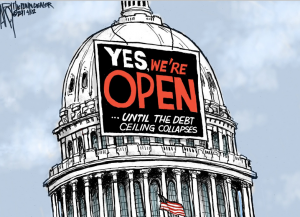
Debt Ceiling?

China’s Yuan used in 80% of Bitcoin Transactions

William Pesek writes: In a new report, Goldman Sachs says the yuan is now used in 80 per cent of transactions into and out of the cyber currency, topping the US dollar, yen and euro. Given that the Communist Party’s highest priority is stability, and the rampant use of bitcoin represents nothing if not the opposite, it’s probably only a matter of time until Beijing tries to crack down.

It wouldn’t be the first time. In December 2013 – at a time when the yuan accounted for about 50 per cent of bitcoin transactions – Zhou clamped down hard on the nascent payment system, citing concerns that it was enabling money laundering and undermining capital controls.

It’s proving to be a nifty way to move money across borders beyond the watchful eye of the government

The People’s Bank of China barred financial institutions from handling bitcoin transactions, concluding it wasn’t a currency with “real meaning”. A few months later, in March 2014, it went further, ordering banks and payment companies to close the trading accounts of more than 10 bitcoin exchanges.

But bitcoin traders continue to show up the People’s Bank of China. As Goldman Sachs points out, the trading volume on the mainland has risen markedly – even as bitcoins plunge in value (from about US$1,100 in late 2013 to around US$300) and lose cachet elsewhere. “Bitcoin,” writes Goldman Sachs analyst James Schneider, “has momentum in China.”

What gives? Some mainlanders are surely buying bitcoin to engage in relatively innocent forms of financial speculation. But they are probably outnumbered by the people who are using it to move yuan overseas, while circumventing Beijing’s currency controls. That’s partly because the mainland’s broader economic slowdown provides fewer lucrative investment opportunities. But it’s also because of Communist Party general secretary Xi Jinping’s ongoing crackdown on corruption, which has made it harder to launder ill-gotten funds. (Hong Kong money changers used to be the laundering method of choice, but are no longer readily available.)

Bitcoin’s value gyrates too wildly to be a viable transactional unit, but it’s proving to be a nifty way to move money across borders beyond the watchful eye of the government.

Bitcoin’s surging popularity on the mainland – despite the attempts to crack down against it – underscores how fragile the world’s second-biggest economy is at present. Data released on Wednesday showed industrial output since the beginning of the year was at its slowest pace since 2009, rising just 6.8 per cent in January and February. Deflation also seems to be on the horizon.

Wired magazine explored the rise of darkcoin, which is fast becoming the chosen medium of drug merchants and others active on the mainland’s black market. It’s not hard to imagine the development of other such cryptocurrencies with Chinese characteristics.

When the mainland previously faced money laundering problems, it had clearer solutions at its disposal. Last year, for example, Beijing clamped down hard on Macau, whose casinos had become a favoured laundromat for ultra-rich Chinese.

But now that it’s facing a stealthier threat in bitcoin, its options are more limited. Zhou is undoubtedly aware of the problem posed by bitcoin, but he may not yet know what he should do about it.

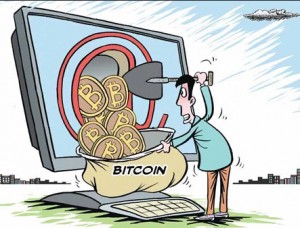
Bitcoins in China

How Switzerland Survives

Vladimir Putin made the argument today that a little gossip is good for politics, governance and the heart-rate. Otherwise life is boring.  All gossip surrounding his ten-day absence from the world scene is focused on TIchino, Switzerland, where his first or second or perhaps third child may have been born to a young Russian gymnast.  Italian politicians like Berlusconi use Switzerland for the same reason Putin did, privacy.  Now Switzerland has added to its list of crucial businesses — which includes cuckoo clocks, cheese, watches, privacy and beneficial owners, the mistress category. This tiny country knows how to survive. And we are entering the Kremlin’s announced competition for the best gossip on the Putin Absence,

 Tichino, Switzerland

Engaging Men in 50/50

The Women in Management group was originally created to spearhead initiatives specifically dedicated to the empowerment of GSB women. However, Jenn Wilcox Thomas and Wendy Wen, current co-presidents of WIM, believed the organization was missing a critical voice in its membership. Where were the men in their conversations? The two women shared a core philosophical belief that WIM needed to tap men as partners in advancing gender equity. Barnes too, shared this vision. As a son of two high-powered corporate executives (his mother is Brenda Barnes, former President and CEO of Pepsi-Cola North America), it was perfectly natural to him that women would be in positions of top leadership and that men would be their equal partners at home and in the workplace. For Barnes to collaborate with the WIM co-presidents seemed inevitable.

However, forming the partnership had its own challenges. Even after Barnes began paying membership dues to WIM, he felt like a “due-paying, non-member.” “They weren’t really sure what to do with me,” he recalls. Barnes remained undeterred. Eventually, someone handed him the WIM leadership application, so he applied to be on their board. Wen and Wilcox Thomas jumped on the opportunity to engage men in their initiatives. And with that, WIMmen was founded.

1.  Listen. Learn facts.  Listen to other’s stories.

2.  Recognize bias and don’t call people out.

3.  Expect to say “the wrong thing.”

4. Create small groups in safe places.

5.  Invite male superiors.

6.  Build on call support group.

7.  Invite across generations.

8. Commit to one act.

 Men and Women's Groups


Growing A Business: Kahn Academy

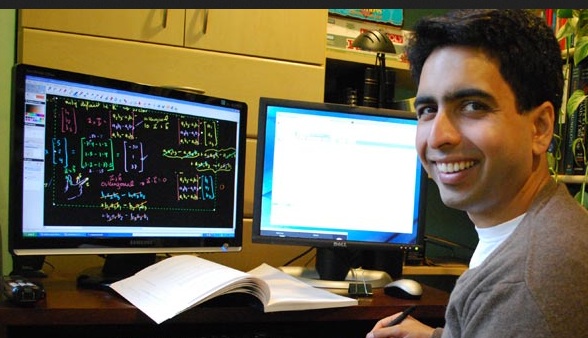
From a personal tutoring service for his young cousin, Salman Khan’s company Khan Academy has grown exponentially into a massive, global, online engine for learning. As part of Big Think’s collaboration with Singularity University on Exponential Leadership, Khan explains here how his hobby grew into something that has changed the face of education on an unprecedented scale.

In late January 2015, Big Think, where the world’s leading thinkers examine the most essential ideas of our age, and Singularity University, a teaching organization and accelerator, came together to find definitive answers to what constitutes exponential leadership — true leadership for the age of exponential disruption.  Salmon Kahn of Kahn Aademy speaks

Salmon Kahn

Connecting Education and Jobs for Women in the Arab World

Maysa Jabout writes: For Arab women, hard-won progress in education has not earned them the economic progress they deserve. Although young women seek and succeed in tertiary education at higher rates than young men, they are far less likely to enter and remain in the job market. Understanding and tackling the barriers that hinder women from working would unlock Arab women’s potential and yield significant social and economic benefits to every Arab State.

Echoing the trend observed globally, women in the Arab world outnumber men in pursuing university degrees.. This ratio of men to women pursuing college degress is favorable to women in Qatar (676 percent) and Tunisia (159 percent).

Yet three out of four women remain outside the labor force.

Young women entering the labor market are disadvantaged in comparison to their male peers. Of female youth actively seeking work, women are twice as likely as men not to find a job.

And, when an economic crisis occurs, women are the most vulnerable workers. For example, At this rate, it would take 150 years to reach today’s world female labor force participation average.

Success in education has not resulted in new and sustained jobs for women in Arab states.

As the graphs below demonstrate, a comparison of the percentage of women employed regionally between 2000 and 2012 sees very little progress resulting from a higher educated female population. Despite progress in countries like Qatar and Bahrain, where women are increasingly part of the labor force, almost all MENA countries are well below the global average.

Figure 1. MENA women’s participation in the workforce and gross tertiary enrollment rates, 2000 & 2012


*Click on graph to enlarge


*Click on graph to enlarge
Source: Calculations by the author based on data from the ILO and the UNESCO Institute of Statistics.

The reasons behind why educated Arab women are not working are not yet fully understood.  Understanding these barriers would have to consider the low level of jobs available in the Arab world, especially for young people. The Arab world is home to the largest number of unemployed youth in the world. Economic growth is simply not generating enough jobs for everyone.

Women, however, do not seem to have the support they need to compete for the few jobs that are available despite their high education levels and desire to work. In a 2010 World Bank survey of Jordanian female college graduates, 92 percent said they planned to work after graduation and 76 percent expected to do so full time.

For the few Arab women who choose the more challenging but potentially more rewarding path of entrepreneurship, in addition to the same challenges their male peers encounter, they struggle against family and personal laws that limit their ability to work independently or gain access to capital.

In the United Arab Emirates an equal number of women and men working would raise the country’s GDP by 12 percent; in Egypt, the same achievement would raise GDP by 34 percent.

Higher access to education without equal access to jobs is a lost opportunity for women, their families and their nations. Education alone does not fully protect or prepare women in the Arab world for gaining economic equality. Investment in education must be matched with national efforts to address all barriers to Arab women entering the job market and staying in it.

Greece’s Neck in a Noose?

The week after the leftwing Syriza candidate Alexis Tsipras was sworn in as prime minister, the ECB announced that it would no longer accept Greek government bonds and government-guaranteed debts as collateral for central bank loans to Greek banks. The banks were reduced to getting their central bank liquidity through “Emergency Liquidity Assistance” (ELA), which is at high interest rates and can also be terminated by the ECB at will.

In an interview reported in the German magazine Der Spiegel on March 6th, Tsipras said that the ECB was “holding a noose around Greece’s neck.” If the ECB continued its hardball tactics, he warned, “it will be back to the thriller we saw before February” (referring to the market turmoil accompanying negotiations before a four-month bailout extension was finally agreed to).

The noose around Greece’s neck is this: the ECB will not accept Greek bonds as collateral for the central bank liquidity all banks need, until the new Syriza government accepts the very stringent austerity program imposed by the troika (the EU Commission, ECB and IMF). That means selling off public assets (including ports, airports, electric and petroleum companies), slashing salaries and pensions, drastically increasing taxes and dismantling social services, while creating special funds to save the banking system.

These are the mafia-like extortion tactics by which entire economies are yoked into paying off debts to foreign banks – debts that must be paid with the labor, assets and patrimony of people who had nothing to do with incurring them.

Greece is not the first to feel the noose tightening on its neck.  In 2013 the ECB announced that it would cut off Emergency Lending Assistance to Cypriot banks within days, unless the government agreed to its bailout terms. Similar threats were used to get agreement from the Irish government in 2010. “We should be clear about what this means. The ECB’s move was completely unnecessary . . . . It looks very much like a deliberate attempt to undermine the new government.”

Weisbrot observed that the troika had plunged the Eurozone into at least two additional years of unnecessary recession beginning in 2011, because “they were playing a similar game of chicken. . . . [T]he ECB deliberately allowed these market actors to create an existential crisis for the euro, in order to force concessions from the governments of Spain, Italy, Greece, Portugal, and Ireland.”   Greece and the ECU Greece and the ECU

Greece?

Is Saudi Arabi Deliberately Going After US Oil Production?

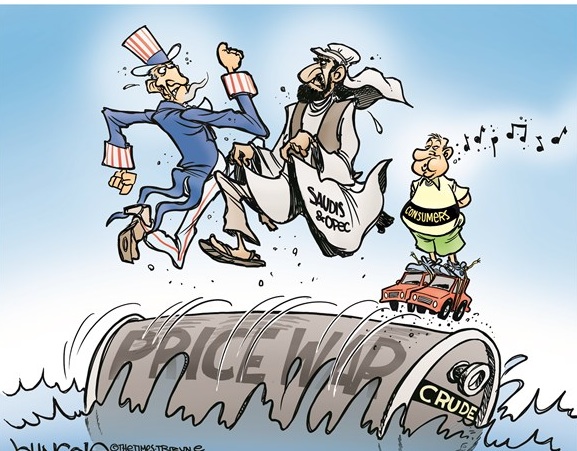
Saudi Arabia is largely responsible for the dramatic fall in oil and gas prices in recent months, a U.S. government official said.

Richard Fisher, the head of the Dallas Federal Reserve, said “the Saudis have engineered” the oil crisis. He was speaking at the Economic Club of New York.

“We are a huge supplier of energy. The Saudis took a while to realize what was going on,” Fisher said, referring to the massive growth of the U.S. oil industry in recent years.

Fisher is the most prominent U.S. official to pin the blame largely on Saudi Arabia.

As recently as July, oil traded at over $100 a barrel. By January, it had plunged below $50.

Saudi officials have repeatedly blamed supply and demand for the price meltdown. They say they were caught off guard by the price decline, and acknowledge this is putting a lot of pressure on U.S. shale.

“Although Saudi Arabia and OPEC countries did not engineer the reduction in the price of oil, there’s a positive side effect, whereby at a certain price, we will see how many shale oil production companies run out of business,” Prince Alwaleed bin Talal, a member of the Saudi royal family and prominent global investor, said in January.

The oil games: While the price of oil started falling at the end of the summer, it was exacerbated on Thanksgiving Day when OPEC, led by Saudi Arabia, voted not to scale back on production. That send oil prices diving.

Fisher also noted that the Saudis benefit not just economically, but politically from the oil price decline. Low oil prices especially hurt their biggest regional rival: Iran.

“I’m sure King Abdullah thought to himself, ‘I’ve also done a favor vis-a-vis Iran,'” Fisher said.  Iran’s economy needs oil to trade around $135. Saudi has far larger cash reserves and is thus able to withstand a downturn in prices for much longer.

What’s ahead for oil prices? Given how motivated Saudi Arabia is to keep prices low right now, Fisher doesn’t expect oil will shoot up to $100 a barrel again any time soon.

“From a budget stand point, [the Saudis] have reserves that can handle this,” he said.

While many energy companies are laying off workers and slashing spending, Fisher said that cheap oil’s overall impact on the U.S. economy will be positive. A typical American driver is expected to save $750 this year at the pump, according to government estimates.

Even in his home state of Texas, Fisher said the economy has diversified a lot more beyond oil, so it’s unlikely to be nearly as bad of an effect as the last oil bust of the 1980s.
Oil Price Wars