Women Dominating Finance in Washington

YELLEN ON FED TRANSPARENCY: “Central bank independence in conducting monetary policy is considered a best practice for central banks around the world. Academic studies, I think, establish beyond the shadow of a doubt that independent central banks perform better.” What is the difference between independence and accountability?

— WARREN VERSUS YELLEN: Sen. Elizabeth Warren (D-Mass.) grilled Yellen for not disclosing public data after a recent leak of proprietary information. Warren said during the hearing: “Apparently, there have been no consequences for the most recent leak. No action has been taken” [after a subsequent internal Fed investigation]. Hints from the US Fed effect  the markets. Do insiders get information earlier?

YELLEN SAYS NO TO CURRENCY MANIPULATION, via Vicki Needham: Federal Reserve Chairwoman Janet Yellen told lawmakers on Tuesday that she would have a significant problem with adding currency manipulation provisions into global trade agreements.  “Yellen said monetary policy decisions — such as the massive stimulus programs at the Fed since the 2008 financial crisis — can affect currency exchange rates but don’t amount to currency manipulation.”  t

OBAMA, WARREN TAKE ON WALL STREET.  “For the first time in his second term, President Obama is picking a fight with Wall Street. With Sen. Elizabeth Warren (D-Mass.) by his side, Obama announced Monday at AARP’s Washington headquarters that he is moving ahead with new regulations on financial advisers that are vehemently opposed by the business community.”

“Obama is seizing the populist mantle as the likely 2016 Democratic nominee, Hillary Clinton, is coming under intense pressure to take a stand against the captains of finance. Much of that pressure is being channeled into efforts to draft Warren, a critic of Wall Street, into the presidential race.”

“Business groups lined up against the plan on Monday, warning it would radically change the industry’s payment system and make it harder for low-income Americans to obtain financial advice. The push for the new regulations on investment advisers also stirred angst among centrist Democrats.

“‘Americans are going to be shocked when the only advice they have available to them is Jim Cramer on CNBC,’ griped one Democratic financial services industry insider who works with big businesses.”I

WARREN, CUMMINGS TEAM UP, via me: “Sen. Elizabeth Warren (D-Mass.) blasted the new Republican Congress on Tuesday, arguing they are risking a partial shutdown of the Department of Homeland Security (DHS) at a time when the middle class is getting ‘hammered.’

“Warren made the remarks during an appearance on MSNBC’s ‘Morning Joe’ with Rep. Elijah Cummings (D-Md.), where they announced a new political partnership to examine economic policies to address income inequality, among other issues.

— WARREN ON ‘MORNING JOE:’ “Republicans are now in charge and what have they spent their time on? First, they wanted to spend weeks on a pipeline that would principally benefit some foreign oil company, and now they want to spend a month on shutting down Homeland Security at a time when we face terrorist threats.”
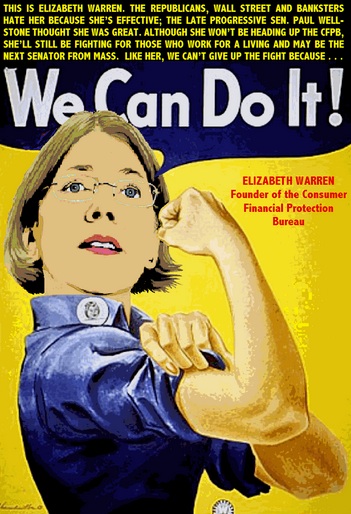

Warren Takes Off Her Gloves

Woman Lawyer Helps Company Self Report FCPA Violations

More than two years after Goodyear Tire & Rubber Co. self-reported its wrongdoing to securities regulators, the company has agreed to pay $16 million to settle foreign-bribery charges.

Goodyear subsidiaries had paid $3.2 million in bribes to land tire sales in Kenya and Angola.

“After receiving information about the bribes, Goodyear promptly halted the improper payments and reported the matter to commission staff,” the order states. “Goodyear also provided significant cooperation with the commission’s investigation.”

Whether to self-report Foreign Corrupt Practices Act violations has long been a hot topic for the defense bar. For Goodyear, represented by Jones Day partner Joan McKown, coming clean seems to have paid off—at least compared to the penalty imposed on Avon Products Inc. in December.

Avon paid $135 million to settle civil and criminal charges after allegedly making $8 million worth of payments in cash, gifts, travel and entertainment to gain access to Chinese officials.  The cosmetic company’s initial response was to instruct its audit team “not to create any electronic documents, not to send any e-mails regarding the follow-up review, and not to use the term ‘FCPA’ in any written document.”

Goodyear, by contrast, was lauded for “voluntarily producing documents and reports and other information from the company’s internal investigation, and promptly responding to commission staff’s requests for information and documents. These efforts assisted the commission in efficiently collecting evidence including information that may not have been otherwise available to the staff.”

The $16 million fine consisted of $14 million in disgorgement and $2 million in interest.”

Goodyear responded by divesting its ownership interest in its indirect Kenyan subsidiary, Treadetters, and cut off all business dealings with the company. In Angola, after halting the improper payments, its subsidiary lost its largest customer. Goodyear is now in the process of divesting the subsidiary.

Goodyear also took disciplinary actions against employees, expanded its anti-corruption training, instituted regular audits focused on corruption risks, put in place a new regional management structure and created a new senior position of vice president of compliance and ethics, among other steps.  Goodyear did not admit or deny wrongdoing.

“This settlement ensures that Goodyear must forfeit all of the illicit profits from business obtained through bribes to foreign officials as well as employees at commercial companies in Angola and Kenya,” Scott Friestad, associate director of the SEC’s Enforcement Division, said in a written statement.

Goodyear in a statement said that the company has “a comprehensive anti-corruption compliance program and continues to improve and enhance its ability to monitor, detect, investigate and address potential issues.”

Produced by Goodyear Tire and RubberFelix the Cat, 1927 Macy’s Day Parade, produced by Goodyear Tire & Rubber

Ladies: Can You Lobby If You’re Tough on Business?

Former Rep. Henry Waxman, who has tangled with industries including Big Tobacco, Big Coal and Big Pharma, thought his congressional experience would position him to help a large law firm advise corporations.

As his retirement from Congress neared, he wrote a business plan, sent it to public-policy group managers and talked to peers who’d preceded him in private practice. A lawyer before he entered Congress 40 years ago, Waxman believed he could “give good counsel to people who have issues that I could help them think through.”

But after more than a month of searching, the fifth most senior Democrat in the U.S. House has changed his mind. K Street, it seems, isn’t for everyone.

Waxman had run up against the contradictions many politicians face when they leave Capitol Hill. He felt comfortable as an advocate, but didn’t want to lobby. He would work hard, but not full-time. He could advise companies, but not be a hired gun to any paying customer.

Few large general-service firms with public policy shops fit this ideal. The firms serve companies across many industries and can be sensitive about offending those clients. And Waxman’s résumé read like a hit list of corporate America.

As a past chairman of the House Oversight Committee and of the Energy and Commerce Committee, he was a force behind passage of the 1990 Clean Air Act amendments, which targeted coal power plant emissions; the Family Smoking Prevention and Tobacco Control Act; and the Affordable Care Act.

Even the Hatch-Waxman Act—which Waxman in his business plan calls the “Waxman-Hatch” Act—cut away power and money from brand pharmaceutical companies. On the other hand, it empowered the generic drug industry.

The Chamber of Commerce gets more specific: Waxman voted in line with business interests only 27 percent of the time during his career. That places him among the 25 least business-friendly House members in office as of 2013, as defined by the Chamber.

Waxman said late last week that he would join his son Michael in  a four-person D.C. public relations company called Waxman Strategies.

Bidding typically is intense for former lawmakers in D.C. lobbying shops, with former senators going for at least $1 million and House members for about $500,000. “It’s a lot of money. That would be the great advantage. But money’s not everything,” Waxman said of the legal industry.

Waxman added: “I’m not changing my views. I’m proud of the work I’ve done and I want to continue working on things I think work well.”

Lobbyists?

Good News: Successful Women in Tech

Craig Newmark writes about six women who are doing well by doing good in the technolocy field. Here are the first three.  To be continued.

1. Jessica Greenwalt, CoFounder & Lead Designer of CrowdMed
While in high school, she started a freelance design company which grew into an international design and web development firm, then Founded Pixelkeet, the world’s only “parakeet run” graphic design & web development firm.

More recently, Jessica CoFounded CrowdMed, whose approach and health care innovation helps people to overcome obstacles and silos that exist within the medical establishment – empowering patients and assisting doctors who simply cannot know everything about every medical condition. CrowdMed helps diagnose medical issues faster and more accurately – not only improving outcomes, but saving lives.

2. & 3. Alice Brooks and Bettina Chen, Founders of Roominate
Alice grew up playing in her dad’s robotics lab and made her first toy when she was only eight years old. When she asked her dad for a Barbie, he gave her a saw instead. So she made her own doll out of wood and nails! As a young girl, Bettina loved Lego and built cities filled with spaceships with her older brother. More recently, Bettina has conducted research on bionic contact lenses and worked as an electrical design engineer at Discera and KLA-Tencor.

Alice and Bettina are changing the way girls play and learn through Roominate, our innovative line of wired building toys for girls. Roominate is designed to get girls ages 6+ excited about STEM (science, technology, engineering, and math). With Roominate, girls practice hands-on problem solving, spatial skill development, and get an intuitive introduction to circuits. Roominate blends creativity, engineering, design, and fun.

When women rock tech

Iran and Saudi Arabia: Team Players?

­

Arash Karami writes: Ayatollah Rafsanjani head of Iran’s Expediency Council, has said that to resolve many of the issues plaguing the Middle East, there needs to be cooperation between the two regional rivals, Iran and Saudi Arabia. When Rafsanjani was asked about Iran-Saudi relations, he said that after statements by Ayatollah Ahmad Jannati about the passing of King Abdullah bin Abdulaziz, “The situation became worse.”

Rafsanjani believes that relations with Saudi Arabia can be improved once again, just as they were after the Iran-Iraq war in the 1980s. Rafsanjani said that after the 1979 revolution, relations with Riyadh deteriorated over Tehran’s desire to export the revolution and the Saudi support for Iraqi President Saddam Hussein in the war. However, when he became president in 1989, then-Supreme Leader Ayatollah Ruhollah Khomeini urged him to improve ties because Riyadh had banned Iranian pilgrims to Mecca, insisting citizens of a Muslim country must be able to go perform a religious duty.

Rafsanjani said that there had been two important meetings with Abdullah, one in Senegal and one in Pakistan. At the time, one of the main problems between Iran and Saudi Arabia was the price of oil. According to Rafsanjani, Abdullah said that if oil becomes too expensive, oil-purchasing countries will seek other sources of fuel. Interestingly, some believe that the sudden drop in oil prices today is related to Saudi desires to make shale gas an undesirable investment. Rafsanjani said he was able to satisfy Abdullah’s concerns regarding other forms of fuel.

Rafsanjani also said that relations had gone beyond the diplomatic, and that his and the king’s families had become close. “We have many problems in Bahrain, Syria, Iraq, Lebanon and even the occupying regime of Jerusalem [Israel]. … These are the problems, and we have to solve them. In my opinion, we can return.”

Rafsanjani stressed, “If our two countries can cooperate with each other, many things will be solved,” saying that it could eliminate a great deal of terrorism. He added that different commissions could be created to address the various issues. For instance, in the last agreement between Rafsanjani and Abdullah, they had agreed upon a commission to allow clerics to address religious differences so that they could focus on governance.

Given the regional issues mentioned above, however, powerful decision-makers in Tehran and Riyadh show no sign of being ready for a decrease in tensions between the two countries.

Iran and Syria

JPMorgan Wants to Stay in One Piece?

Large deposits, ones unimaginable for most of us, are going to be charged fees or have to find others who welcome their business.

JPMorgan Chase & Co announced it is aiming to save around $1.4 billion in annual expenses by cutting costs and simplifying businesses mainly in its consumer- and investment-banking units.

JPMorgan is urging some of its biggest customers to take their cash elsewhere or be hit with fees, saying that holding very large deposits has become too costly under new liquidity rules.

It says it is taking the step because it no longer makes financial sense to hold such sums.

As the biggest US bank by assets, and among the most complex and interconnected, JPMorgan feels particularly squeezed by new rules which effectively penalize banks for holding big, uninsured deposits that could flee in the event of a big market shock.

Under the rules, overseen by the Federal Reserve and finalized last September, banks have to maintain higher reserves against such deposits, meaning that they cannot put those funds to more profitable use.

US banks including Bank of New York Mellon and Goldman Sachs are already charging some customers for large deposits, and the Swiss and Danish central banks have both cut their deposit rates to negative territory.

Under the new regime, a big hedge fund or private equity firm would be encouraged to shift excess cash into other JPMorgan products such as money market funds, or find a new bank to hold their money.

The new rules treat various types of deposits differently, according to how likely they are to be withdrawn in a crisis. Retail deposits, which are covered by federal insurance, are seen as less likely to be pulled out, so require banks to hold reserves of as little as 3 per cent against them. The reserve requirement rises to 40 per cent for some corporate deposits, however, and as much as 100 per cent for deposits from other financial institutions.
“Clients know that we are doing this because we have no choice”

The bank is determined to resist calls for a break-up. JPMorgan has been hit by about $22bn in post-tax legal costs since 2010, prompting politicians, regulators and analysts to argue that it has grown too big to manage.

Ms Lake said splitting into two would lead to about $3bn in lost cost synergies, damaging the ability of the bank to invest throughout business cycles, while shrinking the excess capital available to shareholders.

 Jamie Dimon

Women Beware: This Time it is not Different

The great Harvard economist Carmen Reinhart wrote a wonderful book with Kenneth Rogoff.  “This Time It’s Differnent.”  Over centuries it hasn’t been. And now it isn’t either.

Remember subprime?

It’s not that it’s back. It never left.

But this time is different.

Remember how low interest rates led investors into buying packaged, securitized boxes with black holes?

It’s not that that’s back. It never left.

But this time is different.

What’s different? Today I’ll tell you…

Shah Gilani notes:The new subprime buildup isn’t about credit-damaged borrowers taking out mortgages. And new securitized boxes aren’t being filled with mortgages.

This time is different because credit-impaired borrowers are buying autos, borrowing on newly minted credit cards and taking out personal, mostly unsecured, loans. This time, institutional investors, mutual funds and retail investors are buying pieces of packaged leveraged loans.

This time is different because the dice are different.

According to a recent report released today – compiled by credit-reporting firm Equifax Inc. for The Wall Street Journal – in the first 11 months of 2014, four out of 10 auto loans, credit cards and personal loans went to subprime borrowers with credit scores of less than 640. That’s 50 million loans for $189 billion, in 11 months.

Subprime lending has helped boost auto sales 59% since 2009. That’s why we’re seeing record auto sales – lenders are throwing record amounts of money at borrowers, especially subprime borrowers.

Like private equity companies and hedge funds and venture capital firms, are able to borrow at next to nothing and put that money out to work in the “free market.” There they look to maximize the yield they get on the loans they make.

These non-bank lenders play in different sandboxes. Some throw money at auto dealers, both new- and used-car shops, so anybody who comes in the door can get a loan, as long as they’re willing to pay sky-high interest rates. Some back lending sites, like LendingTree or Elevate, which help themselves and their backers by lending money at high rates.

In 2014 LendingTree upped the loans it made to borrowers with FICO scores of 500 to 619 by 761% over 2013. None of the loans were mortgages.

Elevate, for its part, lends out at annual interest rates from 36% to a mere 365%.

The New York Federal Reserve said last Tuesday that total household debt rose $306 billion in just the fourth quarter of 2014.

With so much of that debt being carried by subprime borrowers, something’s bound to break.

But not to worry.  Most of the debt that might turn rotten isn’t sitting on banks’ balance sheets. It’s in private hands. Or public hands, depending on which investors are backing private equity shops, hedge funds and VC firms – or, sometimes, as in a lot, the crap gets packaged and sold off to other yield-hungry “investors.”

Banks themselves are packaging some new, old stuff this time around. They’re making “leveraged loans” to companies whose balance sheets are leveraged up with debt already. Borrowers apparently like the leverage to sometimes speculate on their own businesses, maybe buy each other out, maybe pay their controlling masters’ fees, maybe pay dividends, maybe buy back their overpriced shares, maybe just pay off old debt with new debt.

But not to worry.

In other words, don’t worry, this time risks are being spread around, not to just the same people as before, but to new investors who just know this time is different.

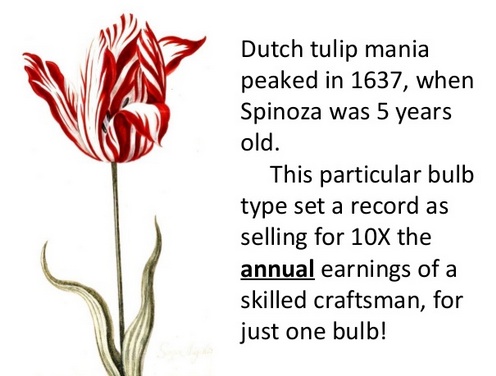
Tulip Craze

Would Venture Exchanges Help Women?

U.S. regulators are considering taking steps to promote the creation of “venture exchanges” that aim to help smaller companies get listed and actively traded, Securities and Exchange Commission Chair Mary Jo White said on Friday.  “It is something we have been encouraging for some time. There have been venture exchanges approved by the SEC before.  Clearly what we are looking at is how do we improve … the liquidity for the securities of small companies,” she said.

Is this a way to help start-ups?

Critics say current listing standards are often too costly and rigorous for small companies.

For those that do list, their stock is often less liquid.

Although Congress passed a law in 2012 designed to help small companies raise capital and go public by easing certain burdens, many say the measures fall short and that more must be done.

Venture exchanges typically have not fared well in the United States, though there has been some success in Canada.

Canada-based TMX Group runs a venture exchange that counts 80 U.S. firms among its 2,200 listings, its chief executive, Lou Eccleston, said.  He sees the potential to launch a similar venture in the United States, but added that he has no immediate plans to do so.

White did not elaborate on what next steps the SEC may take concerning venture exchanges.

SEC Democratic Commissioner Luis Aguilar told reporters on Friday that he recognizes the important role that venture exchanges can play, but said the SEC should first carefully analyze why prior efforts to launch them had failed.

Does the SEC need a boost from Congress to be effective.?

For instance, under the federal unlisted trading privilege rules, stocks listed on the New York Stock Exchange or Nasdaq are allowed to be traded on rival platforms where they aren’t listed.

But such a model won’t likely work for a small company listed on a venture exchange.

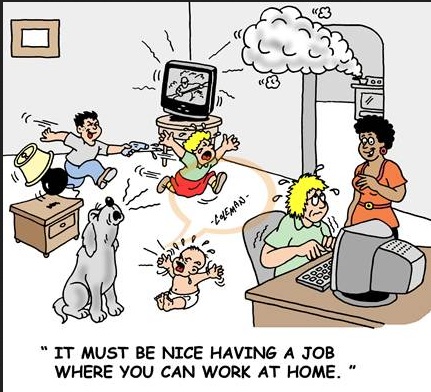
Can Women Run Small Businesses from Home?

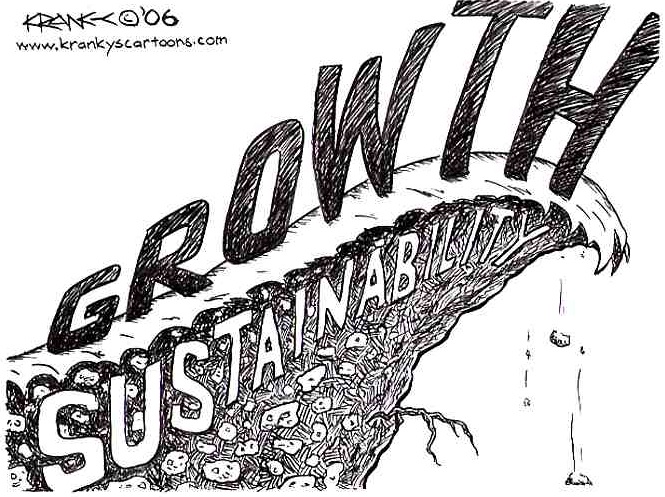
Women Focus on Growth and Its Meaning?

Philip Pilkigton throws out some new ideas: The basic idea runs as such: firms want to expand. In order to expand, they must invest. But in order to invest they must accumulate profits. Now, you will probably think “they can borrow money to invest to too”. This is true. But in the Post-Keynesian theory it is sometimes assumed that the leverage ratio of firms remains somewhat constant. We will come back to this in a moment. Let us now lay out the most basic form of the Post-Keynesian growth equation for the firm. It runs as such:

leverage equation

How should we read this intuitively? The most interesting component from our perspective is the convention that allows the firm to borrow, p. As we can see, when this term increases in numerical value this leads to a higher denominator. This means that a higher rate of growth, g, will be able to take place for a lower rate of profit, r.

The growth equation as laid out above remains a handy tool provided we recognise it for what it is.  I remain highly skeptical of long-run modelling and of the usefulness of some of the comparative statics approaches that are deployed.

Should we redefine growth and its centrality in our economic thoughts?

Growth?

Women Crediting Women

Brittany Cooper writes:  Ruth Bader Ginsburg has emerged as the liberal hero of a hopelessly right-wing Supreme Court, a ram in the bush for those of us who look on in horror as the court presides over the dismantling of key pieces of legislation like the Voting Rights Act, anti-discrimination law and affirmative action policy, which have been so critical to African-American advancement since the 1960s.

Recently Ginsburg reflected on the history behind one of her key legal accomplishments, the 1971 case of Reed v. Reed. After an estranged couple lost their son, his mother, Sally Reed, petitioned to administer his estate. But Idaho law maintained that “males must be preferred to females,” in such matters. Ginsburg authored the plaintiff’s brief for the case when it reached the Supreme Court, arguing that the 14th amendment protected against discrimination based upon sex. When the court ruled in Sally Reed’s favor, it was the first time that the Equal Protection Clause had been applied to a case of sex discrimination.

But much of the legal groundwork for that argument can be attributed to Dr. Pauli Murray, a Howard University-trained lawyer, who began to argue in the 1960s, that the Equal Protection Clause should be applied to cases of sex discrimination in much the same way that it had been applied to cases of racial discrimination. Murray’s argument constituted what legal historian Serena Mayeri termed “reasoning from race,” in which race analogies were used to make clear the subordinate status of women. Though today we speak of these matters in the language of intersections, a term gleaned from legal scholar Kimberlé Crenshaw, it is Pauli Murray’s initial invocation of the race-sex analogy for black women’s positionality within the law that is the most direct precursor to Crenshaw’s theory of intersectionality.

Ginsburg named Murray and Judge Dorothy Kenyon as co-authors of her brief in the Reed case, because even though they didn’t help to write it, these two women had been pioneers in creating the legal strategy for fighting sex discrimination. Ginsburg’s choice to name these women as co-authors is a model for how to solve contemporary issues among young feminists over white feminists’ appropriation without attribution of the intellectual and political labor of women of color.

Giving Credit Where Credit is Do  Woman to Woman