Do Women Get Jobs Too Tough to Do?

Are women set up to fail — by being appointed to positions of power only in hopeless situations?

Two British academics say so, and they claim to have proved it this year. In one study, they took 83 businesspeople — roughly half of them women — and described to them two companies, one that was steadily improving in profitability and another that was steadily declining. The subjects were told to pick a new financial director for the firm and were presented with three candidates: a man and a woman who were identical in experience and a lesser-qualified male. The subjects were slightly more likely to pick a man to lead the successful firm but were far more likely to pick the woman to lead the failing one. Two other experiments with similar designs yielded the same result: When presented with men and women to lead a company that’s going down the tubes, people pick the woman.

What’s going on? In a write-up of their experiments in The Leadership Quarterly in October, the academics, Michelle Ryan and Alex Haslam, called it “the glass cliff,” which they contend is an invisible form of prejudice. In other words, people will give women a position of power only when there’s a strong chance of failure. Why? “If someone has to be the scapegoat to take the fall, you’re not going to put your best man forward,” Ryan says. Women are thrust into desperate situations precisely because they’re likely to fail, generating “proof” that women can’t handle responsibility.

The theory has some historical evidence to back it up too. When the academics examined the performance of the 100 biggest firms in Britain, they found that women were disproportionately hired as C.E.O.’s only after their firms had been struggling for years. When firms were doing well, they rarely appointed women to lead.

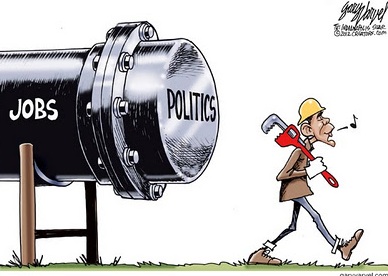
Ryan and Haslam say the data also suggest the glass cliff applies to minorities. When you consider this year’s American presidential election, the glass-cliff theory becomes particularly tantalizing — because it might neatly explain the rise of Hillary Clinton and Barack Obama.  Perhaps it was only during extremely hard times that America would finally consider a woman and a black man for the highest office. Hopefully Americans learned their lesson from Obama’s failures.  Tough Jobs

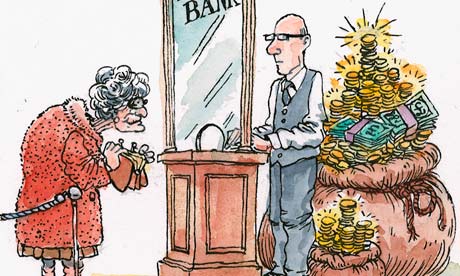
Shrinking Banks?

Mark Gilbert writes:  Some of the world’s biggest banks are starting to acknowledge that size isn’t everything. It’s a welcome development in the effort to solve the “too big to fail problem.”  Instead of  focusing on the final pair of words as a potential solution (seeking to avert failure by concentrating on capital buffers), rather focus on the first two words (eliminating systemic risk by making the banks smaller). It’s also proof that regulators are succeeding in nudging the world of finance toward a better place

Leading the way is Royal Bank of Scotland, which hasn’t made a profit since 2007 and remains a ward of the state after a $70 billion bailout more than six years ago left it 80 percent owned by the U.K. government. The size of the RBS rescue reflects the sprawling institution it was then; now, the bank is “no longer chasing global market share,” according to Chief Executive Officer Ross McEwan.

JPMorgan Chase, the world’s biggest investment bank, is also going on a diet. Daniel Pinto, who runs its corporate and investment business, said this week that new capital rules may prompt it to cut back on interest-rate trading and the prime brokerage businesses that services hedge-fund managers; it’s also closing branches in its consumer unit as it tries to shave off $2 billion in costs by 2017. And HSBC, Europe’s biggest bank by market capitalization, said this week it will consider “extreme solutions” for divisions that can’t generate sufficient returns on capital as part of a “journey to simplify the firm.”

Both JPMorgan and HSBC are displaying enlightened self-interest. Analysts have deemed both to be candidates for a break-up, either by investors who want to unlock perceived value in splitting retail entirely from investment banking, or by regulators who see the two functions as incompatible. Slimming down is a way of addressing the allegation that they’re too big to manage without executives having to oversee the total dismantling of their own train sets.


Shrinking Banks


Smaller banks are a welcome consequence of regulators tweaking the rules on capital to make some risky activities too expensive to be profitable. While we won’t know for sure whether the too big to fail issue has been resolved until a large institution goes bust, the financial industry is at least moving in the right direction.

Banking-reform-cartoon-by-008

Arming Youth a Consequence of Ukraine Debt Burden?

Mark Whitehouse writes:  Even as its conflict with Russian-backed secessionists festers, the Ukrainian government is facing a growing threat on the economic front: A sovereign debt burden that is rapidly becoming unbearable.

The insurgency in the east has undermined the Ukrainian government’s finances in two ways beyond the direct costs of war. First, by crippling industrial regions that accounted for as much as 20 percent of the country’s output, it has pushed the economy into a deep recession. Second, by triggering capital flight and an attendant plunge in the value of the Ukrainian hryvnia, it has made the government’s largely dollar-denominated debts much larger in local-currency terms.

Here’s a chart showing Ukraine’s government bonds and loans outstanding as a percentage of gross domestic product, with the latest data point adjusted for the hryvnia’s exchange rate as of Feb. 26:

UkrA20150226

As the chart shows, the Ukrainian government’s debt stands at more than 100 percent of gross domestic product. That’s up from about 40 percent in early 2014, when Russia initiated the annexation of Crimea, and well above the 70 percent level at which the International Monetary Fund typically considers an emerging-market country to be at elevated risk of insolvency. Even if the government eventually managed to stabilize its economy and its borrowing costs, it would likely have to run a budget surplus (excluding interest payments) of about 4 percent of GDP indefinitely — an unprecedented feat for just about any country — just to keep such a debt burden from growing.

To make matters worse, an outsized chunk of Ukraine’s debt comes due over the next few years. Total interest and principal payments through 2017 add up to $27 billion, dwarfing the country’s $5 billion in foreign reserves and even the $17.5 billion that the IMF is considering lending to the government. Here’s a breakdown of the principal owed by year:

UkrB20150226

Ukraine is planning to ask for relief from creditors. Russia, to which Ukraine owes $3 billion due in December, could refuse, leaving the losses to fall primarily on private bondholders, among the largest of which is U.S. asset manager Franklin Templeton. The country’s finance minister said that the government would be looking to get as much as $15 billion in concessions — an amount that analysts at Goldman Sachs estimate could cut the value of Ukrainian bonds by as much as 50 percent. Judging from the speed with which the government’s finances are deteriorating, that may be just the beginning.

Children Learning to Fight in the Ukraine

Women Drivers Rejoice, But…

Oil prices have stabilized somewhat around the $60 per barrel mark, and over the past few weeks oil has shown less volatility than the preceding six or seven months.

But another swoon could be just over the horizon. That is because oil producers are starting to run out of storage. As production has soared and global demand has failed to keep up, oil producers have been diverting oil into storage tanks at a remarkable rate since last summer.

The latest EIA data shows that weekly inventories jumped by another 7.7 million barrels, with total inventories now having reached 425.6 million barrels, the highest level l of oil sitting in storage in over 80 years, and more than 20% higher than the five-year average.

The data is also important because it highlights two things. First, oil production has not leveled off yet, despite several months of prices sitting below the breakeven mark for many producers. But also, the data indicates that U.S. producers may soon start to top off storage tanks. If production does not decline and oil storage capacity begins to run out, the glut of oil on the market could worsen pretty quickly, sending prices down once again.

Rig counts continue to decline amid weak prices.

On the other side of the world, the Russian Arctic is also seeing a pullback in activity. Although the culprit is not entirely, or even primarily, the collapse of oil prices, Russian state-owned firm Rosneft plans to postpone exploration of 12 Arctic licenses. Rosneft had ambitious plans to tap Arctic oil with the help of several international oil majors, but western sanctions have forbidden the involvement of those firms. While the Russian government originally scoffed at western sanctions when they were introduced last year, the major delay to Russia’s Arctic dreams demonstrates that the West’s ploys are having a bite.

When adding in the deteriorating currency and depressed oil prices, Russia may produce 560,000 barrels less per day in 2020 than it otherwise would have,

Meanwhile, in the short-term, Russia’s dispute with Ukraine over natural gas pricing is once again coming to a head. Gazprom has insisted that Ukraine has only paid for gas through the end of the week.

Other oil exporters are also showing more and more signs of strain. Norway’s exports have fallen by more than 18% year-on-year for the month of January.

Brazil’s state-owned oil company Petrobras shares dropped to “junk” status. The corruption probe that has widened in recent months is taking its toll. Already the world’s most indebted oil company, Petrobras’ fortunes have taken a turn for the worse over the last six months.

While demand for crude is showing some signs of life, the final deathblow is drawing near for the infamous Keystone XL pipeline. Despite Obama’s  insistence that he merely opposed the procedural runaround pushed by the most recent legislation and that he may “still” approve the pipeline, at this juncture his veto makes final approval unlikely.


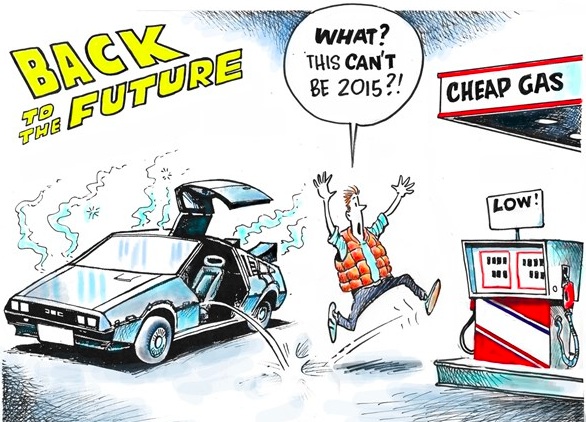
Pump Prices.

US Exit Bonuses Under Scrutiny

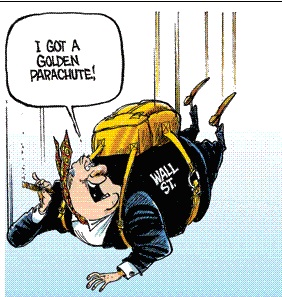
Antonio Weiss was recently in line to receive a $20 million bonus from his investment-bank employer for agreeing to take a Treasury Department undersecretary position. Weiss, who eventually took an advisory job that did not require Senate confirmation, is only the latest in a series of would-be and actual public officials who have stood to benefit from these “golden parachute” deals.

But why? If you go into government, you’re supposed to work for the public, not for Wall Street. Why is it in the interests of a bank or its shareholders to reward top executives – those who make millions of dollars a year because of all they presumably do for their employers — to leave? If the bank is motivated by something other than a desire to wield inappropriate influence on newly minted government officials, what is that motivation? This seems like a very fair question for shareholders to ask.

The AFL-CIO recently filed proposals to let big-bank shareholders demand greater transparency around these practices.  The banks’ reaction?  Panic.  They’re working as we speak to persuade the Securities and Exchange Commission to step in, allowing them to keep their policies a secret and their shareholders in the dark.

When bankers get large bonuses for taking government jobs, it sends a dangerous message about who is really calling the shots. If the big banks think these practices are defensible, they should defend them in the light of day.  They should let their shareholders know the facts and judge for themselves.  But if these policies are so indefensible that Wall Street needs to keep them a secret, that should tell shareholders and the public all they need to know.

Golden Parachute

A Bad Day for Banks

Matt Levine brikskly sums it up:

Rough day for Royal Bank of Scotland.  RBS last posted net income back  when just about anyone could post net income; since then, counting today’s 3.5 billion pound ($5.4 billion) net loss for 2014, the total losses come to just under 50 billion pounds. That’s more than 9,000 pounds for every man, woman and child in Scotland. It’s more than Bank of America has paid in mortgage settlements.  At some point, if you were RBS’s managers or its owners (mostly the U.K. government), wouldn’t you start thinking it might not be worth it to keep going?

A very bank-y thing about RBS is that, after seven years of multi-billion-pound losses, management’s focus is on share repurchases: “By the time we get to 2016, we hope to have satisfied the preconditions we think are needed in order to start a discussion” with regulators about dividends or share repurchases, says the chief financial officer. I feel like the regular-company model is, if you make a lot of money, you give it back to shareholders; if not, not so much. The RBS model is more like: We are losing so much of your money, you shouldn’t trust us with it, here, you take it back. Capital requirements make this difficult, but if RBS can shrink its assets faster than it loses money, it stands a chance.

And for Standard Chartered. StanChart’s board rather surprisingly parted ways with its chief executive officer, Peter Sands, and replaced him with former JPMorgan banker

The chairman is also leaving. “With the share price having about halved since its March 2013 peak, the stock market was looking for a fresh start.

And for HSBC.  HSBC executives did not enjoy testifying before Parliament about all the tax-dodging that HSBC facilitated, tCEO Stuart Gulliver’s use of a Swiss bank account held by Panamanian shell company to receive his bonuses, which Gulliver has patiently and repeatedly explained was just to keep his co-workers from seeing how much he made, and not to dodge taxes.

And for Morgan Stanley.

Morgan Stanley agreed to pay $2.6 billion to settle Justice Department mortgage-fraud claims,and also “increased legal reserves for this settlement and other legacy residential mortgage-backed securities matters by approximately $2.8 billion” for 2014.

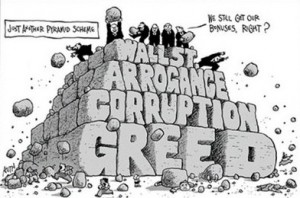
Pyramids?


Can De Facto Immunity from Criminal Charges Against Bankers End?

he American Banker contributor J. W. Rizzi writes:  Big banks are once again in the spotlight for a host of alleged misdeeds including tax evasion, money laundering, price rigging and manipulating foreign exchange rates. But despite the seriousness of these accusations, federal prosecutors have yet to file criminal charges against a senior bank executive.

By contrast, hundreds of officials were jailed during the savings and loan crisis and past corporate fraud cases including Enron and World Com. The big difference between then and now comes down to the size of the defendants. The Department of Justice has deemed senior officials of the country’s biggest banks too important to charge.

In the past, prosecutors relied on deferred prosecution agreements on to settle criminal cases against big. These agreements gave banks conditional amnesty upon paying a fine and promising to implement reforms in the future. Public concern regarding this lenient treatment has since forced the DOJ to insist that big banks pleading guilty to criminal violations. But this tougher stance is mostly for show. The entities that plead guilty are lower-level, nonbanking subsidiaries. Thus the parent company’s banking licenses are not at risk. And of course, executives get off scot-free.

Crimes are committed by humans — not organizations. If prosecutors decline to jail or even fine individuals, criminal law hardly works as a deterrent.

Banking is a team sport. Someone is always either calling the plays or condoning the play selection. If bank management truly didn’t know about their employees’ misdeeds, they should have known about it. And if institutions are too big and complex for senior officials to know what their underlings are doing, they should scale back.

When we allow managers to plead ignorance as a defense for wrongdoing, we encourage further ignorance and illegal activity.

Prosecutors have struck a Faustian bargain with too big to fail banks. In exchange for declining to file charges against senior management, they get a quick plea, substantial fines and the appearance of being tough on crime. Everyone wins — except the public.

Federal Reserve Governor Daniel Tarullo  and otehr regulators insist that big banks must improve oversight to reduce illegal employee behavior and bolster their culture. But the problem is criminal, not cultural, and regulators are poorly suited to handle criminal activities. The DOJ should be leading the charge.

There is a simple way to stop bankers from violating the law, and it doesn’t require new laws or breaking up the largest financial institutions. The DOJ simply needs to begin charging the bankers who commit crimes instead of focusing solely on the firms for which they work. When appropriate, prosecutors can also assess monetary fines and damages against the banks as restitution.

This is not about bashing big bankers or punishing them for bad business decisions and excessive risk-taking. It’s about eliminating the de facto immunity from criminal charges that bankers currently seem to enjoy.

By prosecuting individuals who are responsible for misdeeds, the DOJ can curtail illegal activity and restore public trust in big banks — and in the law itsel.

 Big Bankers Behind Bars?

Merkel’s Role Change?

Joschka Fisher writes: Merkel’s role has changed.  Her ten years in power were largely characterized by a new German Biedermeier era. The sun was shining on Germany and its economy, and Merkel regarded it as her highest duty to maintain citizens’ sense of wellbeing by not disturbing them with politics. But Germany’s new significance in Europe has put a brutal end to Merkel’s neo-Biedermeier era. She no longer defines her policies in terms of “small steps”; now she takes strategic threats seriously and confronts them head-on.

This is also true of the Greek crisis, in which Merkel – despite her public image in southern Europe – was not aligned with the hawks in her party and administration. Indeed, Merkel seems to be well aware of the unmanageable risks of a Greek exit from the euro – although it remains to be seen whether she can muster the determination to revise the failed austerity policy imposed on Greece.

Greece has also shown that the euro crisis is less a financial crisis than a sovereignty crisis. With the recent election of the anti-austerity Syriza party, Greek voters stood up against external control over their country by the “troika” (the European Commission, the European Central Bank, and the International Monetary Fund), Germany, or anyone else. Yet if Greece is to be saved from bankruptcy, it will have only foreign taxpayers’ money to thank for it. And it will be nearly impossible to convince European taxpayers and governments to provide further billions of euros without verifiable guarantees and the necessary reforms.

The Greek conflict shows that Europe’s monetary union is not working because one country’s democratically legitimized sovereignty has run up against other countries’ democratically legitimized sovereignty. Nation-states and a monetary union do not sit well together. But it is not hard to understand that, should “Grexit” occur, the only geopolitical winner would be Russia, whereas in Europe, everyone stands to lose.

Though the geopolitical risks have, so far, barely figured in the German debate, they greatly outweigh any domestic policy risks of finally coming clean with the German public. Greece, Germans should be told, will remain a eurozone member, and preserving the euro will require further steps toward integration, up to and including transfers and debt mutualization, provided that the appropriate institutions for this are established.

Such a step will require courage, but the alternatives – continuation of the eurozone crisis or a return to a system of nation-states – are far less attractive. (Germany has a new national-conservative party whose leaders’ declared aim is to pursue a pre-1914 foreign policy.) In view of the dramatic global changes and the direct military threat to Europe posed by Putin’s Russia, these alternatives are no alternative at all, and the Greek “problem” looks insignificant.

Merkel and French President François Hollande should seize the initiative once again and finally put the eurozone on a sound footing. Germany will have to loosen its beloved purse strings, and France will have to surrender some of its precious political sovereignty. The alternative is to stand by idly and watch Europe’s nationalists become stronger, while the European integration project, despite six decades of success, staggers ever closer to the abyss.

Merkel

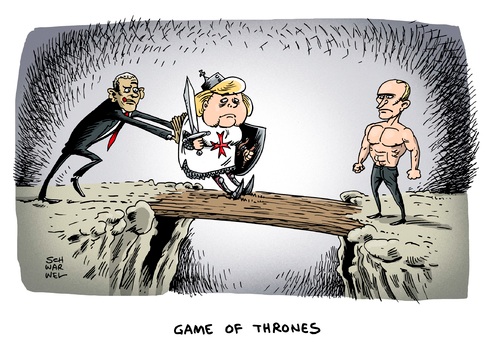
Do Women Understand Putin Better Than Men Do?

FIona Hill writes: In Ukraine, and in his whistle-stop trip to Hungary, Putin is out to score points for Russia. He is not out to win friends in Ukraine or Europe. Nor is he out to restore a Russian empire, or build a new Moscow-centric geopolitical order. Putin wants respect for Russia, not external obligations. He wants respect in the old-fashioned, hard-power sense of the word.

Putin is a practitioner of realpolitik in its starkest form. In his interactions with regional leaders, Putin has laid out his view that all the states that emerged from the USSR are appendages of Russia. They should pay fealty to Moscow. Other European countries, including the former great powers of France, Germany and the UK, are satellites of the United States, grouped under the umbrella of NATO and the European Union. The unaligned operate in the shadows of two blocs, as Putin put it once to Georgian leaders. The only open question for Putin is who gets to decide the final borders of his new Yalta, Russia or the United States. The future of Ukraine and the Donbas are one set of decision points. Elsewhere, Russia has announced it will lift border controls between Russia and Georgia’s separatist regions of Abkhazia and South Ossetia; and Putin is questioning other borders in the Soviet Union’s old stomping grounds in the Baltics and Eastern Europe. He is challenging the European Union’s frontiers by appealing to eastern Orthodox countries like Greece and Cyprus, where politicians and populations feel aggrieved at their treatment by the austere Protestant powers of northern Europe who set the tone for European economic reform.

Redrawing borders in Crimea was Putin’s first major victory. Putin has long expressed his personal sense of humiliation when Russia lost its geopolitical position in Europe with the fall of the Berlin Wall. Twenty-five years later, Putin told the world Russia was no longer in retreat.

Right now the West looks weak to Putin. In his view, the tables have been turned. The eurozone crisis has undermined the European Union politically and economically. The United States is overextended after more than a decade of wars in Afghanistan and Iraq and seems incapable of dealing with crises in the Middle East. China is the dominant player in East Asia. Putin is taking full advantage of the situation, snubbing his nose at sanctions and running rings around European diplomats who are anxious to end the war in Ukraine. He has rallied the population at home with emotional evocations of Russian imperial glories, Soviet nostalgia and the idea of a unique “Russian world.” He has depicted himself as the leader of an international coalition of conservative politicians and states confronting the excesses of a decadent West. Russian history, imperial nostalgia, religion and values have all proven potent instruments for Putin to reassert Russia’s position.

With no endgame in sight in Ukraine, Putin is now focusing on the European arena.

Putin and Women Leaders

Keystone: A Diplomatic Issue?

Michael Bloomberg calls for a Solomoic decision on the Keystone Pipeline.  He points out that Democats exaggerate its environmental mpact, Repubican its economic impact.  He calls on Preisdent Obama to go to Canada on a diplomatic mission and settle this matter.

Bloomberg is right and this moment after Obama’s veto gives Obama an opening.  Secretary of State Kerry has been doing such a good job that Obama would be wise to involve him.

US oil independence depends on Canada, one of our closest allies.  A big climate conference in December is going to make both the US and Canada, who rank low on cleaning up the environment, look very bad if they don’t act.  The Queen of Sheba could have solved this problem as well as Solomon.

Keystone