Cautionary Tale for Entrepreneurs

Sarah Fenwick in Cyprus writes of her efforts to get an EU businss grant.

I’m a Cypriot citizen and EU citizen and decided to look for other types of opportunities to improve my career. Never one to give up easily, I heard about some EU grants offering five million euros in financial resources to women entrepreneurs, and since my goal was always to own a business doing what I love, I scraped together 1000 euros to pay a consultant to do the paperwork and submit my business plan to the ministry of commerce.

I had originally budgeted for the full 100,000 euros allowed, which the government would fund by 50% with a grant, but somehow, due to a complicated procedure I didn’t understand fully, the budget submitted ended up being under 20,000 in total. My consultant told me it was because I would be working from a home office, and despite my explanations that online marketing and journalism are done from wherever there is an Internet connection, this flexible services approach was not a business model that would be understood by the ministry and I would just have to accept their decision.

Then, I waited. And waited. And waited, getting on with my productive work with CyprusNewsReport.com and working as a marketing consultant and jazz singer. Since the grant hadn’t come through yet, I could not see the reason to commit financial resources like getting a bank loan – which the consultant had suggested to do on the basis of the prospect of receiving the grant.

After many months, I contacted the ministry directly to ask what the status of my application was, and after many more months, received an official response that was quite unclear to me. The letter was in Greek and said that I’d received enough points to be accepted in the grant scheme but since there was not enough money for all the successful applicants, other candidates were put ahead of me based on this internal points system.  EU Business Grants in Greece

Cyrpus and EU Loans

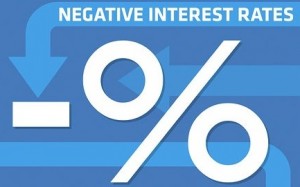
Negative Nominal the New Norm?

Nouriel Roubini writes:  Monetary policy has become increasingly unconventional in the last six years, with central banks implementing zero-interest-rate policies, quantitative easing, credit easing, forward guidance, and unlimited exchange-rate intervention. But now we have come to the most unconventional policy tool of them all: negative nominal interest rates.

Such rates currently prevail in the eurozone, Switzerland, Denmark, and Sweden. And it is not just short-term policy rates that are now negative in nominal terms: about $3 trillion of assets in Europe and Japan, at maturities as long as ten years (in the case of Swiss government bonds), now have negative interest rates.

Investors have long accepted real (inflation-adjusted) negative returns. When you hold a checking or current account in your bank at a zero interest rate – as most people do in advanced economies – the real return is negative (the nominal zero return minus inflation): a year from now, your cash balances buy you less goods than they do today.

In other words, negative nominal rates merely make your return more negative than it already was. Investors accept negative returns for the convenience of holding cash balances.

Moreover, if deflation were to become entrenched in the eurozone and other parts of the world, a negative nominal return could be associated with a positive real return. That has been the story for the last 20 years in Japan, owing to persistent deflation and near-zero interest rates on many assets.

One still might think that it makes sense to hold cash directly, rather than holding an asset with a negative return. But holding cash can be risky, as Greek savers, worried about the safety of their bank deposits, learned after stuffing it into their mattresses and walls: the number of armed home robberies rose sharply, and some cash was devoured by rodents. So, if you include the costs of holding cash safely – and include the benefits of check writing – it makes sense to accept a negative return.

Beyond retail savers, banks that are holding cash in excess of required reserves have no choice but to accept the negative interest rates that central banks impose; indeed, they could not hold, manage, and transfer those excess reserves if they were held as cash, rather than in a negative-yielding account with the central bank. Of course, this is true only so long as the nominal interest rate is not too negative; otherwise, switching to cash – despite the storage and safety costs – starts to make more sense.

In a “risk-off” environment, when investors are risk-averse or when equities and other risky assets are subject to market and/or credit uncertainty, it may be better to hold negative-yielding bonds than riskier and more volatile assets.

Over time, of course, negative nominal and real returns may lead savers to save less and spend more. And that is precisely the goal of negative interest rates: In a world where supply outstrips demand and too much saving chases too few productive investments, the equilibrium interest rate is low, if not negative. Indeed, if the advanced economies were to suffer from secular stagnation, a world with negative interest rates on both short- and long-term bonds could become the new normal.

To avoid that, central banks and fiscal authorities need to pursue policies to jump-start growth and induce positive inflation. Paradoxically, that implies a period of negative interest rates to induce savers to save less and spend more. But it also requires fiscal stimulus, especially public investment in productive infrastructure projects, which yield higher returns than the bonds used to finance them. The longer such policies are postponed, the longer we may inhabit the inverted world of negative nominal interest rates.

Why Would You Put Your Money in this Bank?

Does Greece Need to Boost Trade?

Rbecca Harding writes:  The past for Greece has been as a strong trading economy and that is where its future lies.  Greece has a service economy dominating trade (which includes tourism) and that has shrunk by approximately 50% from the 2008 peak.  It is expected to bottom out at less than 40% of peak in 2017 and 2018 before it starts a slow climb.  The key to a better future is to turn service sector exports around sooner and then get the growth moving faster than now projected.

Is the Past the Future for Greece?

Inflation in the EU?

Economists at the New York Federal Reserve write: Euro area inflation expectations have been falling at both short- and long-term horizons, with the latter development suggesting the current low inflation environment is perceived as likely to persist. Because long-term inflation expectations play a key role in the decisions of households and firms, economists have stressed the importance of long-term inflation expectations being anchored at a central bank’s target. In this post, we use survey data on inflation forecasts to document evidence of recent “unanchoring” of euro area long-term inflation expectations, and note the difference in comparison to the 2008-09 period, when current inflation and short-term inflation expectations also declined but long-term inflation expectations remained steady.  EU Inflation

 Inflation in the EU

Should Women Be Named John, Robert, William and James?

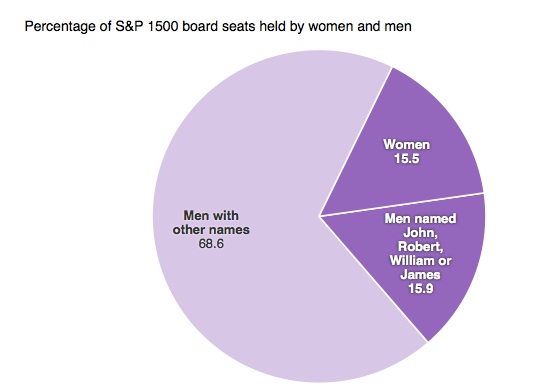
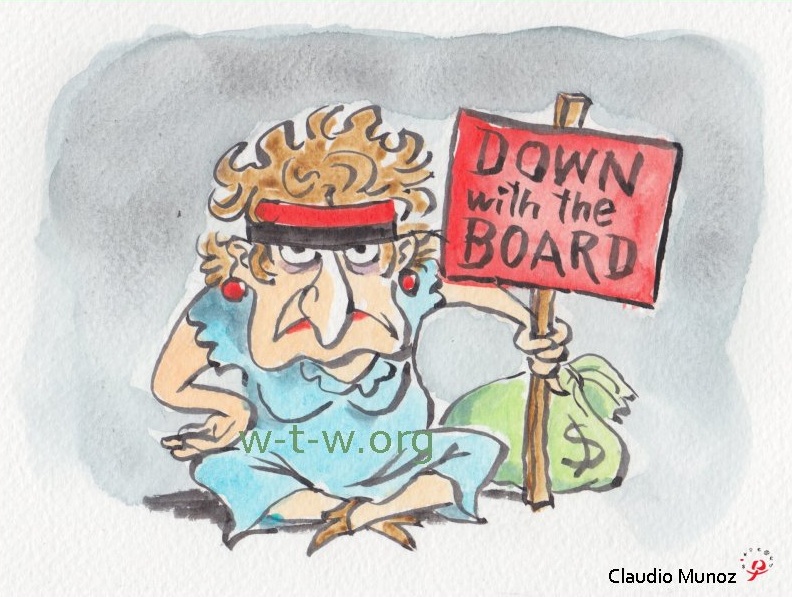
We all know that there aren’t enough women on corporate boards.  The percentage is somewhere around 16 to 19 percent, depending on who’s doing the counting and how.

Yet while it’s clear the percentages are low, it’s not always easy to put that into perspective.

Corporate Boards, men and women

It looked at companies in the S&P 1500 at the time of their 2014 annual meetings and found that 2,150 of the 13,850 total board seats were held by women. Then it noticed an interesting detail. Slightly more of the seats — 2,200 of them — were held by men who were named John, Robert, William or James.

(No word on how the numbers would fare if you added every Tom, Dick and Harry.)

The closeness of these numbers is pretty eye-opening and unsettling. ‘The pace of change is absolutely glacial,” says Karyn Twaronite, the firm’s global diversity and inclusion officer. “The idea that we can essentially pick out four common men’s names, at random, and find this shows there’s a long way to go.”

Women on Boards

A Woman’s Guide to a Man’s World

Katherine Sierra writes: In the ’80s, skate culture devolved from a vibrant, reasonably gender-balanced community into an aggressively narrow demographic of teen boys. If you think tech has sexism issues, skate culture makes tech feel like one big Oprah show.

My surfer friends and I would occasionally gather on a summer evening, loosen the trucks on our boards, and carve the lazy hills of the Altadena suburbs. But the space between sessions grew longer, and eventually I was the last remaining woman in our group.

Then I found a new love: programming.

I felt that same beautiful freedom writing code that I knew and loved from skating. Compared with what skate culture had become, everything about tech felt fresh and possible. Where skateboarding now celebrated destruction, computer culture celebrated creation.

Fast forward 30 years. Rodney Mullen believes skate culture has something positive to offer the tech world, and the tech world is paying attention. Rodney can help tech—and I hope tech listens—but only if we decouple Rodney from the toxic, sexist, soul-crushing culture of modern skating. Soul-crushing, that is, for women.

Rodney has the same big heart and cognitive biases of so many men in tech—kind, brilliant, wonderful men that cannot grasp how the community they find so accepting and open can be so … not. Rodney believes open-source and hacking culture has so much in common with skateboarding, a culture in which nobody “owns” a trick and everyone learns from and builds upon what others have done. And Rodney’s right: skating does have the bold, innovative, rule-challenging fear of the status quo that Silicon Valley seems to have lost.

But a fresh POV can never be worth lionizing a deeply sexist culture.

Skating Boarding

China Joins the World with Growth Policies

China’s Premier called for more active fiscal policy and a central bank publication said additional monetary easing is needed, signaling more support is on the way for the world’s second-biggest economy.

Li Keqiang’s call to aid growth accompanied an announcement of tax breaks for small business, according to a government statement summarizing a cabinet meeting yesterday. Meanwhile, the central bank should cut bank’s required reserve ratios further to deal with deflation risks, said an article in the People’s Bank of China’s newspaper published today.

“To fend off possible deflation, the central bank should continue to adjust tools, from required reserve ratios and benchmark interest rates, at the right time,” the Financial News article said.

Further stimulus would see China joining Europe and Japan in accelerating pro-growth policies.  The government said it will give more small businesses tax breaks and accelerate water management projects.

“To cope with the current downward pressure on growth and to keep economic operation within a reasonable range, China’s active fiscal policy must become more effective and more efficient,” according to the statement.

The policies suggest China’s budget deficit will widen this year to 2.8 percent of gross domestic product, from 1.8 percent in 2014, Nomura Holdings Inc. economists led by Yang Zhao wrote in a note today.

“These measures should help mitigate the pace of the economic slowdown,” Zhao wrote. “However, such measures tend only to provide a cushion for the economy but cannot drive a turnaround of the growth downtrend.”

China this month cut the amount of cash banks must set aside as reserves by 50 basis points, its first across-the-board reduction since May 2012. It will inject as much as 600 billion yuan ($96 billion) into the banking system, Australia & New Zealand Banking Group Ltd. economists estimated.

China's Growth Policy

In Greece Do as the Greeks Do?

Whatever the pros and cons of the current agreement between Syriza and the euro-institutions, it has at least given Syriza a bit of time to consider some longer-term policy options.

A number of commentators and economists from both sides of the political spectrum have recently proposed a ‘third way’ in the shape of a parallel or complementary currency.  A complementary currency (or ‘-ies’) could help boost short-term liquidity by providing an alternative ‘means of exchange’ function to the euro.

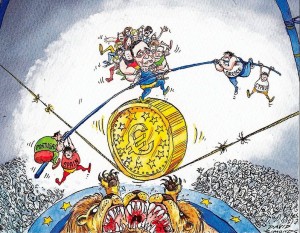
But what Greece really needs – if it does stay in the euro – is more euros, the currency that its vast public debt mountain is denominated in.  At the moment, it’s not clear where such euros would come from. It would not come from government spending, since Syriza is required to run a primary surplus – in other words, save more than it spends. Even if Greece is eventually allowed to participate in the European Central Bank (ECB)’s quantitative easing (QE) program, it is unlikely to get mney into the real economy.  And while Syriza is no doubt serious about clamping down on tax avoidance, the scale of the debt and the EU institutions’ refusal to write any of it off, suggests that this is not a long term solution.  Further inward investment also looks unlikely given Syriza’s plans to reverse or at least put on hold further privatisation.

There is, however, one type of institution in Greece that can create euros out of nothing. The commercial banks. Unfortunately Greek banks have stopped lending since the crisis began – many of them are basically insolvent and have very little appetite for making loans to Greek firms that look very shaky themselves (see figure 1 below). They are currently being kept alive with emergency funding from the ECB.

But what if Greek banks lent to the Greek government?  Economist RIchard Werner proposed  ‘enhanced debt-management’.  If such loans were long-term contracts and not tradable (unlike sovereign bonds), the interest rates the government would pay on them would be considerably lower than it pays to borrow on international markets since governments receive, according to global Basel regulations, the lowest risk weighting of 0%. This also means the banks would need zero new capital to back these loans. Eventually they would start lending normally to businesses again.

Meanwhile, the Greek government could use these loans to invest in infrastructure and capital intensive projects that Syriza has already identified as much needed. These would have strong multiplier effects that would boost employment and demand in Greece, raising tax revenues (assuming Syriza was successful in its tax collection reforms) and thus enabling it to sustainably reduce the public deficit without further damaging austerity.

Syriza claims to have won some space to design and implement their own reforms rather than have them laid down by the Troika. By using their own commercial banks’ power of credit creation, they might just be able to turn the debt-deflation spiral in to a positive feedback loop, with healthier banks and sensibly priced government debt that’s not subject to speculative attacks from bond vigilantes, increasing demand and a reducing deficit.

Greek Infrastructure

Will Brazil Crash?

The Economist:  The middle classes certainly know how to live in Brazil, with Copacabana and Ipanema just minutes from the main business districts a game of volleyball or a surf starts the day. Hedge-fund offices look out over botanical gardens and up to verdant mountains. But stray from comfortable districts and the sheen fades quickly. Favelas plagued by poverty and violence cling to the foothills. So it is with Brazil’s economy: the harder you stare, the worse it looks.

Brazil has seen sharp ups and downs in the past 25 years. In the early 1990s inflation rose above 2,000%; it was only banished when a new currency was introduced in 1994. By the turn of the century Brazil’s deficits had mired it in debt, forcing an IMF rescue in 2002. But then the woes vanished. Brazil became a titan of growth, expanding at 4% a year between 2002 and 2008 as exports of iron, oil and sugar boomed and domestic consumption gave an additional kick. Now Brazil is back in trouble. Growth has averaged just 1.3% over the past four years. A poll of 100 economists conducted by the Central Bank of Brazil suggests a 0.5% contraction this year followed by 1.5% growth in 2016.

Both elements of that prediction—the mild downturn and the quick rebound—look optimistic. The prospects for private consumption, which accounted for around 50% of GDP growth over the past ten years, are rotten. With inflation above 7%, shoppers’ purchasing power is being eroded. Hefty price rises will continue. Brazil is facing an acute water shortage; since three-quarters of its electricity comes from hydroelectric dams, this is sapping it of energy.

Water Shortage

To avoid blackouts the government plans to deter use by raising prices: rates will increase by up to 30% this year. With the real losing 10% of its value against the dollar in the past month alone, rising import prices will bring more inflation.

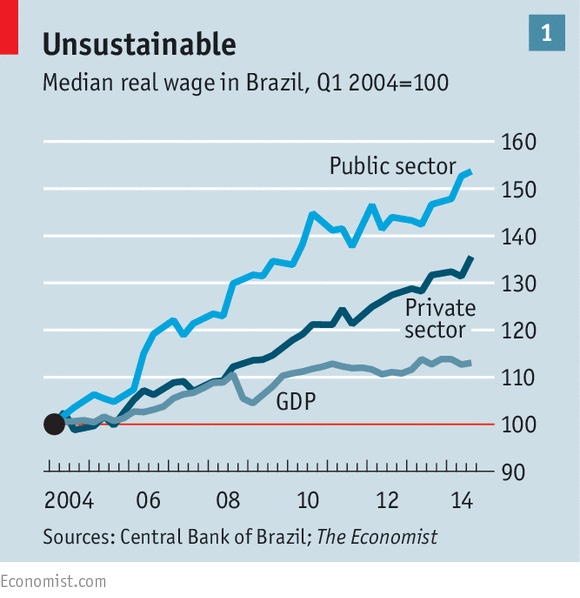
There is little hope of disposable income keeping pace. One reason is that Brazilian workers’ productivity does not justify further rises. In the past ten years wages in the private sector have grown faster than GDP; cosseted public-sector workers have done even better (see chart 1). Since Brazil’s minimum wage is indexed to GDP and inflation, a recession will freeze real pay for the millions who earn it.  Brazil’s Dilemma


No Jobs for Our Children?

Youth unemployment has been at the forefront of political and academic debate since the unfolding of the Great Recession in 2008, exploited to a greater or lesser extent by the contenders of most elections that have taken place across Europe since then. Edited by Juan Dolado of the European University Institute, this eBook takes into account the relevance of policy lessons from recent experience to provide a clear analysis of the factors that affect the impact labour-market policies have on youth unemployment. The contributors present a case-by-case analysis for a range of countries across Europe, spread both geographically and also by the divergent approaches taken. It covers countries with dual vocational training systems; dual labour markets; those where the ratio between youth and adult unemployment is notably high or low; and an overview of the recently launched Youth Guarantee programme. No Jobs for Young People

Jobless Young