Men are Geniuses? Women Work Hard?

Viven Chen writes.  People believe genius has a gender—and it is almost always male.

That’s the pitiful news from two new studies about perceptions of intelligence. The attitude is pervasive among ordinary folks as well as those who toil in the ivory towers of academia.
In one study of 2,043 Americans by branding firm Edelman Berland, 90 percent of those surveyed said that geniuses tend to be male, reports Fast Company. What’s shocking is that women (93 percent of men v. 87 percent of women) largely share that view, too.
In another study, researchers from Princeton and University of Illinois surveyed over 1,800 academics in 30 disciplines about the profile of success in their fields, focusing on whether it depends on hard work or brilliance. Here’s how Live Science describes the finding:
The researchers found a trend: The more importance that the academics in a given field placed on being brilliant, the lower the percentage of women with Ph.D.s there was in that field.

Although the researchers found no evidence of an intellectual disparity between the genders, they say that cultural assumptions about intelligence could be keeping women away from certain fields and hindering their success. Instead of being innately brilliant, women are perceived as hardworking:

Women who are presented as intellectually accomplished tend to be portrayed as incredibly hardworking — for example, Hermione Granger in the “Harry Potter” series, Leslie said. “In this way, women’s accomplishments are seen as grounded in long hours, poring over books, rather than in some special raw effortless brilliance.”
And guess what other group is also perceived to be lacking true genius? African-Americans. The researchers also found that the fields whose members felt that a spark of genius was required for success were less likely to have African Americans with Ph.D.s.
“Like women, African Americans are the targets of negative cultural stereotypes about their intellectual abilities,” said study co-author Andrei Cimpian, an associate professor of psychology at the University of Illinois at Urbana-Champaign.

The stereotypes become self-fulfilling prophecies. “Any group that’s stereotyped to lack a trait that a field values is going to be underrepresented in that field,” said Cimpian to Washington Post.
So where does the legal profession fall in this spectrum? I, for one, have no doubt that women in law are saddled with similar stereotypes: Diligent and competent, perhaps, but not much more. Indeed, if you were to picture the ace litigator or ultimate dealmaker, you’d probably envision David Boies or Marty Lipton.

If you think long and hard enough, you can probably come up with some women who meet the smart quota. But off-the charts brilliant and awe-inspiring? Well, that’s still a man’s job.  And you’re still baffled why women aren’t getting ahead?

Math Genius


A Woman Rises at Toyota

Benjamin Snyder writes: Automaker Toyota has promoted American Julie Hamp, the current head of communications for North America, to managing officer. She’ll be the highest ranking woman in Toyota’s 77-year history. The move is part of a broader push for diversity among Toyota’s executive ranks as part of a restructuring. The company’s leadership culture has been made up mostly of Japanese men. “Toyota has realized that they’re not a Japanese carmaker, they’re a world carmaker,” Edwin Merner, president of Atlantis Investment Research in Tokyo, told Bloomberg. “If they’re going to understand overseas markets and plan, design and build cars, then they have to have people who have a good understanding of those markets.

Toyota characterized the moves this way in a statement:

By appointing talented people from affiliates outside Japan to executive positions, Toyota aims to foster innovation by enabling people from many different backgrounds to contribute and provide input.

The once-untouchable auto firm has had a rough few years. A seemingly unending recall crisis partly dinged the company’s reputation and the global recession hurt sales. But the firm’s fortunes have started to turn around recently.

February sales in the U.S. surged ahead 12.1%, compared to the same month last year. And its Lexus luxury division is making gains against European competitors: Last month marked the fourth straight month of record new Lexus sales, according to the company. Lexus is ranked as the industry’s top brand.

Julie-Hamp-300x246

TIAW Honors Selima Ahmad

The International Alliance for Women announced that Selima Ahmad has been awarded the 2014-2015 TIAW World of Difference Lifetime Achievement Award recipient.  This prestigious honor is bestowed each year upon a woman of great achievement, whose actions have truly made a difference globally in the economic empowerment of women.

Ms. Ahmad’s contributions are greatly admired and recognized internationally: as a role model for women in business through her work at the Nitol-Niloy Group, as a member of the board of directors of the Sonali Bank Limited and as a tireless champion of women entrepreneurs through her work as the founder of the Bangladesh Women Chamber of Commerce and Industry.  She has enabled women to aspire to a brighter future, to engage as entrepreneurs and to also move beyond micro businesses into more ambitious ventures, all within a society that faces significant hurdles for women in the norms of tradition and culture.

Ahmed said in a recent interview:

When we started the BWCCI, we decided to do business to make a maximum of profit for our members and get things done without corruption or damaging the environment. We have always ensured that all members of the chamber are highly ethical. Ensuring there is no corruption is very challenging in Bangladesh. To help our women entrepreneurs who are confronted with corruption, we have established a hotline centre, so members can get advice and support from our advocacy teams set up in 7 divisions across Bangladesh. If one member goes to government offices or any other type of offices and is faced with corruption, the following day, she will go back with a group of women, to ensure things get done without bribery.

We also engage closely with the Media, particularly at local level, who can be great allies and support our women’s development. Sometimes the media can be a shield against ‘enemies’ (self-interested people), to support your initiative. You need to have a good rapport with the media – you cannot hide. If you are honest and passionate about your work, in my experience they are always supportive.

We grow leaders through ‘handholding’ women entrepreneurs and through the many training programmes we provide.  Also by taking them to different conferences and events around the world, they can showcase their work, gain exposure and learn from other people. I really believe that seeing is believing and when we bring grassroots entrepreneurs to global conferences, like the Global Summit of Women, it gives our members more exposure and they learn a lot from other women entrepreneurs around the globe. I have seen the changes in these grassroots entrepreneurs after they come back from such an experience.

I believe that leaders are not born, that they can be trained. We have a Women and Leadership programme where we have already trained 50 women in leadership skills and democracy and are currently training another 20 more. I think more and more women will come into leadership, through training, in 5 or 6 years.

Selima Ahmad


Women Entrepreneurs: Attention!

Howard Gold writes:  After much anticipation, the Nasdaq Composite Index has closed above the 5,000 mark for the first time since March 2000, and it’s very near its Internet bubble all-time closing high of 5048.62..

This NASNAQ has many fewer companies than traded in 2000, their average market capitalization is almost twice as high, and their median age is 25 years, vs. 15 at the bubble peak.

Some stalwarts from 2000 are shadows of their former selves. Microsoft, Intel,  and Cisco for instance.

But the old guard has been more than replaced by a new wave of technology and biotechnology powers. Apple Amazon Priceline nd Starbucks  added more than $1 trillion of market capitalization since 2000, with Apple alone contributing an astonishing three-quarters of that gain.

Companies that weren’t even public when the dot.com bubble burst — Google , Facebook, Netflix and Tesla Motors have created $635 billion in value for Nasdaq investors.

And biotechnology stalwarts Amgen, Biogen Idec Celgene and Gilead Sciences have tacked on $315 billion in stock market value since March 2000.  Altogether, that’s $2 trillion in additional market value created by only 12 companies.  Biotech, in fact, has been an even bigger winner than technology itself.

Finally — after much anticipation, the Nasdaq Composite Index has closed above the 5,000 mark for the first time since March 2000, and it’s very near its Internet bubble all-time closing high of 5048.62.

Of course, that’s still way short of its inflation-adjusted peak, which would require an additional gain of more than 2,000 points, as Lance Roberts of STA Wealth Management wrote recently.  But it is innovation that is driving the market, and this is good news.  Particularly for women entrepreneurs.

Innovation

Does India Intervene Too Much in Business?

Dhiraj Nayyar writes: India’s central banker Raghuram Rajan certainly cheered investors with his second surprise rate cut in less than two months: The country’s benchmark stock index temporarily zoomed to a record after Rajan lowered the repruchase rate,  the rate at which commercial banks borrow from the Reserve Bank of India — by 25 basis points to 7.5 percent.

The move should boost investment and consumer sentiment in a country that remains burdened by high interest rates relative to the rest of the world. It should add to any growth momentum generated by Prime Minister Narendra Modi’s first full-year budget.

India does confront several major structural problems that hamper the economy — in land, labor and capital markets — most of which emerge from the excessive and misplaced intervention of its leviathan state. None of those problems, however, preclude a sound macroeconomic environment characterized by low and stable inflation, which is critical to investor and consumer confidence. Between 2010 and 2014, when GDP growth rates cratered, rampant inflation damaged India’s prospects as much if not more than a lack of policy reform. That’s why Rajan has made reining in inflation his top priority.

Three factors could explain Rajan’s decision — all of which involve less-than-flashy measures announced by the government this week. First, Rajan appears convinced that Modi’s administration is serious about improving India’s fiscal position. The central bank governor would always have been reluctant to ease monetary policy as long as fiscal policy was too loose and fueling inflation on its own. Ironically, in the budget, the government actually delayed its fiscal consolidation targets for a year.

Second, for the first time, the government and the RBI have signed a formal agreement on a new montary policy framework.  The Finance Ministry has given the central bank an explicit inflation target of 4 percent, plus or minus 2 percent. Any deviation from this target would require an explanation from the RBI governor.

Third, the government has laid out plans for radical reform of the RBI.  The bank has been stripped of its responsibility for managing the government’s debt — which posed a conflict of interest given its task of setting rates. More importantly, interest rates will henceforth no longer be decided by the governor alone but by a monetary policy committee.

Modi’s budget may not have been radical enough for some critics, focusing more on incremental reforms rather than the kind of sweeping changes many free-market proponents wished to see. But bringing the Finance Ministry and the RBI onto the same page is a major accomplishment in itself. “This makes explicit what was implicit before — that the government and the Reserve Bank have common objectives and that fiscal and monetary policy will work in a complementary way,” Rajan said in today’s RBI statement. That in itself should be a boost to growth, no less than the mood of India’s giddy punters.

RBI India

Women’s History Month: An Engineer Speaks

Allison Lantero writes:  Pam Fletcher is the executive chief engineer for electric vehicles at General Motors, including Chevrolet’s plug-in electric car: the Volt. She spoke with Energy.gov about what inspired her to pursue a career in engineering and what she likes to do when she’s not working on cars.

What inspired you to work in vehicle engineering?  My dad had multiple motorsports hobbies. Over time working with him and then going to the racetrack, just that adrenaline and excitement of the track on the weekends was something I really, really started to love.

So going into engineering, I wanted to keep perpetuating the fun and excitement that we’d had at home. I never changed my major or guessed at what my major was going to be; I had a pretty clear line of sight

How did you get to where you are in your career path?  At the time I went to GMI (now Kettering University), you had corporate sponsors. So you have a type of co-op experience, and my sponsor was McLaren, which had racing programs they were managing, as well as niche performance production cars.

Electronic controls were coming into play on power-train transmissions, and I really liked that, but I knew that the real intellectual property in that space was owned by the automakers. So that’s when I went to work for GM.

Why did you decide to start working on advanced vehicles?  In the beginning it was the technology to be honest. I like being on the forefront of what’s new.

What is the most rewarding aspect of working on advanced vehicles?  No question: it’s surprising, delighting, and exceeding the expectations of our owners

What is your favorite feature of plug-in electric vehicles?  It’s the fun to drive part! You step on the accelerator and it’s instant go and when it accelerates it’s smooth, it’s quiet. I have two little nephews and when I go to see them they always say, “And you’re bringing the cool car, right?

What is a “day in the life” of GM’s executive chief engineer for electrified vehicles like?  I go anywhere from the proving grounds — where you’re actually driving and testing vehicles — to the design studio — where we’re trying to make them look beautiful — down to our assembly plant — where you can actually see the cars built. So it’s really pretty cool.

What is the best part about working in a STEM field?  Careers in science and math can be so rewarding, because everything in life has science behind it.  Even the cosmetics industry.

What advice do you have for young women interested in your field?  Number one, have confidence in your abilities. I think many women underestimate what they’re capable of. And then, don’t be afraid to ask questions and dig in the details so you can get a full understanding of whatever the problem is you’re trying to solve. And once you get that fundamental understanding, then you can start building a solution. Don’t be afraid to ask the clarifying questions, and just go for it!

Plug In Vehicles

Japan Overheating?

Takashi Nakamichi writes:  Japan’s central bank should hold fire on extra measures for some time to ensure the economy doesn’t “overheat,” an economic adviser to Prime Minister Shinzo Abe said.

The inflation rate may be falling back toward zero on a drop in global oil prices, but it will “eventually start rising on its own” and likely reach around 2% by early 2016.

Mr. Honda, one of the most vocal advocates of aggressive monetary easing, said cheaper oil in the long run will strengthen inflationary pressure by stimulating consumer spending. A weak yen, the effects of the ongoing Bank of Japan easing, and anticipated increases in base pay this year will also put upward pressure on prices.

“Under these circumstances, if you undertook additional monetary easing, (the inflation rate) would go even higher,” Mr. Honda, a Shizuoka University professor, said. “Is it necessary to do such a thing?”

Mr. Honda added that even if the inflation rate declines further, as long as the main cause of it is an oil-driven drop in costs, and as long as Japan’s demand-supply gap is improving, “additional easing shouldn’t be undertaken.” Otherwise, the economy “could overheat over the latter half of this year,” he said.

Mr. Honda’s remarks were the latest in a series of comments from the government and advisers to the prime minister suggesting that the Abe administration sees additional easing as counterproductive, at least in the near-term. The development represents a rare departure from the traditional pattern in which the government regularly pushes the BOJ to do more to end a decade and a half of deflation.

Ruling party politicians appear particularly worried that if extra easing causes the yen to weaken more, further raising the costs of imports, that would reflect poorly on their parties in next month’s municipal elections. Yet if domestic demand remains weak beyond the summer, further easing could become necessary.  The yen’s  period of excessive strength appears to have ended.

A measure of fair value known as purchasing power parity suggests the present dollar-yen levels may be at a kind of upper limit in the exchange rate’s comfort zone.

The yen could weaken further if the BOJ takes additional easing action or if the U.S. Federal Reserve starts raising its policy interest rate, but that would only be a temporary “overshoot,” Mr. Honda said. “Even if the Japanese yen depreciated more, it would come back to the comfort zone. That’s my guess.”

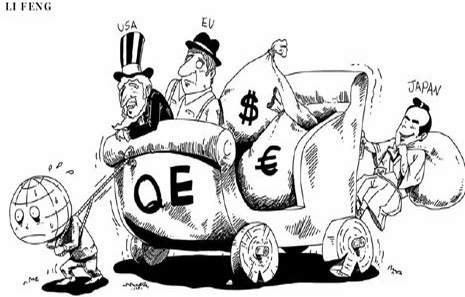
QE?

Oil & Money Mixes Like Oil & Water?

During the month of February, Russia used 10 percent of its reserve fund to make up for revenue shortfalls due to low oil prices.

The Reserve Fund is used to support public finances in times of low prices for exports, and is held in dollars, euros and British pounds.  It fell to $77.05 billion from $85.09 billion in January.  The 20 percent fall in the ruble was sharper.

The finance ministry used 500 billion rubles ($8 billion) from the fund to supplement a drop in budget revenue.

Cuts of 10 percent are planned in most aras of government spending this year, with defense and infrastructure spending largely exempt, in response to a fall in the price of oil and gas. Around half of Russian government revenues typically come from taxes on the oil and gas industries.

Russian Oil Prices

Is a Technocratic, Nonpartisan US Fed a Good Thing?

Justin Fox writes:  The Federal Reserve System is a strange, ungainly beast. Its strangest and ungainliest appendages are the regional Federal Reserve Banks, 12 technically private institutions scattered unevenly across the nation. The Federal Reserve Bank presidents are chosen by boards of local citizens — although not, since the Dodd-Frank Act, by local bankers, and are paid on a scale that only state-university football and basketball coaches as government officials).

Yet these well-remunerated private citizens get to help set the nation’s monetary policy. The New York Fed president has a permanent say in the deliberations of the rate-setting Federal Open Market Committee; the other 11 presidents rotate through four voting spots — and they can come to the meetings even when they don’t vote.

Is this weird?  Probably.  But it is not a bad system that has reduced the effectiveness of the Fed and public trust in it.

In a Brookings Institute report which is great on the Fed history even if you disagree with the conclusions, Conti-Brown argues that the Fed would be more effective and more trusted if some or all of the Federal Reserve Bank presidents were appointed by the president and approved by Congress — or, better yet, if the Federal Reserve Board appointed them.

Former Philadelphia Fed President Charles Plosser argued that this was a solution in search of a problem. None of the Fed’s big historical failures — the Great Depression, the Great Inflation of the 1970s, and the 2007-2008 financial crisis — could really be attributed to the appointment process at regional reserve banks.

The Federal Reserve Bank presidents were a big cause of the Fed’s dawdling in the early 1930s; in 1935 Congress shifted the balance of power away from them to the Federal Reserve Board in Washington. But his bigger point that it isn’t clear what Conti-Brown’s proposal would fix seems right. In fact, I could think of a couple of things it would mess up.

The first is the Fed’s status as one of the last islands of technocratic, largely nonpartisan policy making in Washington. Technocracy and nonpartisanship aren’t always positives; they can be used to disguise interests and power relationships. Also, the technocrats can be terribly wrong, as they were in the lead-up to the financial crisis (not that the politicians were any righter). But at a time when Congress is riven by the deepest partisan divide in more than a century and even the deliberations of such supposedly technocratic agencies as the Securities and Exchange Commission and the Federal Communications Commission have become increasingly hijacked by party-line disputes, the tone of discourse within the Federal Reserve System stands out as a refreshingly civil and thoughtful exception.

The second thing is that having the Federal Reserve Bank presidents on the FOMC increases the diversity of opinion and economic methodology on the committee.

The unique appointment process for Federal Reserve Bank presidents brings people into policy making who might not be willing to take conventional government jobs. It then gives them the freedom to entertain new ideas and diverge from the consensus in a way that would be much harder for Federal Reserve Board employees to do. And it does this within a structure that still leaves the political appointees in Washington with a clear power advantage that makes early-1930s-style deadlock unlikely. That seems more like a desirable feature than a bug.

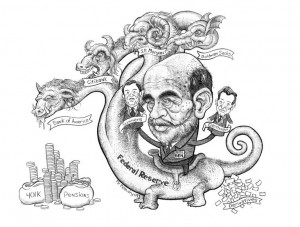
Is this what the Federal Reserve looks like?

Cuba Thaw and the Baseball Business

Peer Bjarkman writes:  Despite speculation—and lots of wishful thinking—that Cuban baseball players are about to flood American baseball diamonds, a drought of Cuban players is much likelier.  Optimists are now speculating and baseball fans are dreaming about how a promised Cuba-U.S. diplomatic accord might launch a building boom of big league academies on the long-isolated communist island and unleash a steady flow of Cuban talent onto big league rosters. But the realities of pending diplomatic relations may ironically benefit the Cuban baseball establishment far more by actually restricting the Cuban ballplayer pipeline.

Central to the Cuba question for many Americans has been the potential impact of a proposed détente on “baseball diplomacy” and on Major League Baseball’s own embargoed business transactions with the single talent-rich corner of the baseball universe to which it has so long been denied access. For decades Cuba has been recognized as a major wellspring of player talent and home to a celebrated domestic league spawning some of the greatest individual players never witnessed in action on big league diamonds. For years top Cuban national teams remained shielded from American view while dominating international tournament play such as Olympic tournaments and the Baseball World Cup. In a decade beginning in 1987, Cuban national teams playing in international competitions recorded a remarkable 156 consecutive victories without a single setback.

These Cuban juggernaut teams and big-league caliber Cuban players remained far off the radar for North American fans partly due to the vagaries of international politics. But they also remained hidden by the fact that international versions of the sport have very little resonance on a North American scene where generations of fans have learned to think of the national pastime almost exclusively in terms of Major League Baseball.

All that changed over a recent decade and a half that has witnessed a handful of Cuban stars like El Duque Hernández, half-brother Liván Hernández, José Contreras, and most recently Yasiel Puig and José Abreu abandon their homeland to pursue the fame and riches offered by North America’s professional leagues. In the past three seasons alone, no one has had a bigger impact on professional baseball in the U.S. than Cuban players. What began as a slow trickle of Cuban refugee ballplayers in the mid-’90s has suddenly exploded into a full-fledged invasion headlined by the sensational debuts of, among others, flame-throwing bullpen ace Aroldis Chapman in Cincinnati, flashy five-tool outfielder Yasiel Puig in Los Angeles, and slugging American League rookie-of-the-year José Abreu in Chicago.

Worsening economic conditions on the Communist island have of late precipitated a heretofore unprecedented flood of Cuban ballplayer “defections.” As many as 350 former Cuban players—with perhaps two dozen of them possessing genuinely big league credentials—are now expatriates actively seeking lucrative North American professional contracts. In a celebrity-obsessed American sports world where fans and journalists alike are increasingly as impressed by lavish signing bonuses as by ballpark statistics, it has been the top-dollar, bank-busting contracts thrown at some of these previously unknown high-profile Cubans ($42 million spent by the Dodgers on Puig, $30 million handed over to Chapman by Cincinnati, $68 million to Abreu, $72 million for Boston signee Rusney Castillo, and a lavish $80 million recently invested on untested slugger Yasmany Tomás by Arizona) that have drawn the bulk of the media headlines.

 Of course the rich harvest of Cuban talent through ballplayer defections has also been a story with a truly ugly side. There is hard evidence of an unsavory business that can only be labelled human trafficking in the removal of athletes from the island. Details of a smuggling operation headed by Zeta cartel operatives that spirited Puig through Mexico made headlines last April. Courtroom litigation in Miami—including several actions filed by Cubans reportedly now suffering repercussions for their roles aiding defections—has surrounded big leaguers Yoenis Céspedes, Leonys Martin, and Chapman. Recently several Miami gangsters were jailed for their involvement in transporting Martin out of Cuba. Stories abound concerning the unsavory activities of some player agents who seem just as bent on striking political blows against the Castro regime as in upgrading MLB rosters. And some agents have lured numerous lesser-skilled players off the island and then quickly abandoned them in Mexico or Haiti when big-money dreams did not pan out. While MLB clubs are benefiting from the defection phenomenon and its immediate talent pool, there are assuredly those in MLB circles who hope for a cleaner system that might come with diplomatic relations.  The Future of Cuban and US Baseball
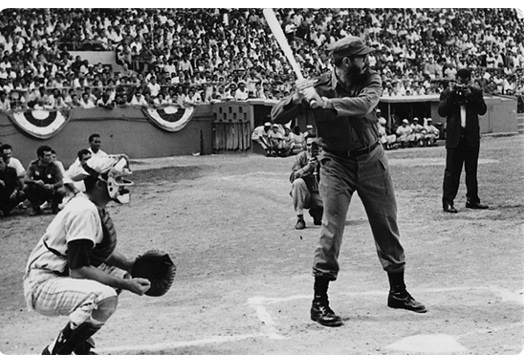
Fidel Castro at Bat