Was Obama Taken by Wall Street?

Geithner and David Axelrod, Obama’s Senior advisor, tell the following story:

“Axelrod was ‘livid’ when he found out that Geithner and [Larry] Summers ‘had quietly lobbied’ against an amendment to the stimulus that would have restricted the payment of bonuses at firms that received bailout funds. Those bonuses had become a huge political sore point for the administration, but the finance guys argued that retroactive steps to claw back the money would have violated existing contracts.

‘This would be the end of capitalism as we know it’ Geithner told Axelrod, to which Axelrod says he responded: ‘I hate to break the news, Mr. Secretary, but capitalism isn’t trading very high right now.'”


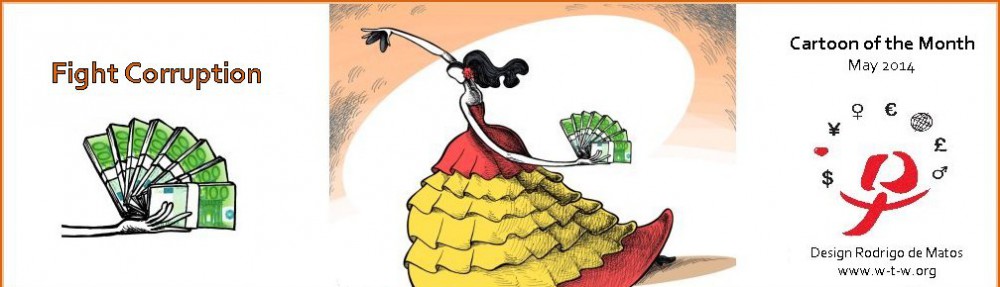
William K. Black writes:  Anyone that wants to save “capitalism” must destroy the current corrupt system “we know” that is posing as “capitalism.” To sum it up, there was no greater service that the Obama administration could have done for (real) capitalism than to produce “the end of capitalism as we know it.” Geithner was absolutely right in his diagnosis and absolutely wrong in his response. Wall Street hates “capitalism” – Geithner and Summers acted to save, rather than exorcize, its corrupt doppelgänger.

Geithner and Summers were so wedded to serving the interests of Wall Street – and crony capitalism – that they secretly sabotaged the efforts of progressives (supported in this unusual case by President Obama) to enact a legislative reform of compensation that was (1) legal, (2) economically efficient, (3) essential to restore “capitalism,” (4) essential to justice, and (5) politically popular. Obama discovered that he, and more importantly the American people, had been betrayed by Summers and Geithner – and did nothing. His administration died that day when he failed the most elemental test of leadership and integrity.   We are still struggling with the results.

Banking?

Vatican Addresses Inequality

Homeless men and women lined up Monday off St. Peter’s Square to take advantage of Pope Francis’ latest charitable initiative: a free shave and shower for the least fortunate.

Mauro Casubolo, 49, was one of the first clients as the pope’s barbershop opened in the public restrooms just off the Bernini Colonnade. His chin was still red from the shave — his first in three weeks — but he was grateful.

“It’s a beautiful thing he’s done for us, especially for us who live in the middle of the streets, because if you want to try to go find some work you can come here and have a shower,” he said.

Francis’ chief alms-giver, Monsignor Konrad Krajewski, has said the project is needed since homeless people are often shunned for their appearance and smell. The initiative is being funded by donations and the sale of papal parchments by Krajewski’s office.

Barbers volunteering on their days off — Rome’s barber shops are often closed Mondays — as well as students from a local beauty school are donating their time, as well as some sisters from religious orders and other volunteers.

Hairdresser Enrico Palmieri will do his first volunteer shift next Monday. “I was curious,” he said after getting his marching orders from organizers Monday. “It’s something beautiful.”

Casubolo says he gets by with handouts from local charitable organizations, but that what he wants most is a job. “Even if I need to clean steps somewhere, clean bathrooms, I don’t care,” he said. “As long as I have a salary that gets me to the end of the month, I’ll be OK. I can have a home and live like everyone else.”  He added: “I’m 49 years old — it’s not like I’m 60 or 80. For me it’s tragic that I’ve ended up this way.”

Before and After at the Vatican

Women Aren’t Funny Enough?

Why the schpiel, you may ask about women’s place in comedy? After all, Tina Fey and Amy Poehler hosted the Golden Globes thrice!  The Daily Show female correspondents are Samantha Bee, Kristen Schaal, and the leading “black female correspondent” Jessica Williams.

Yet, despite the progress, not only has The Daily Show—which was, incidentally, co-created by Hilarious Woman Lizz Winstead—never had a female host, but there currently is not a single female on any late night talk show.

The Daily Show has been simultaneously vigilant and hysterical in its reporting on the neverending war on women.

In fairness, The Daily Show exists in a world which assumes that women are less funny.  in a study from 2011 which had a group of men and women individually write captions for New Yorker cartoons.  They then had the men and women rate how funny they thought the captions were. The captions created by women were judged to be more or less as funny as those created by men, with men scoring on average only 0.11 higher. In a second related experiment, men attributed the less funny captions to women and the more funny captions to men. And when the male and female captioners were asked to rate themselves, men gave themselves an average score of 2.3, while women scored themselves at 1.5. In other words, the men saw themselves as funnier than the experiment detected.

Research also shows  for a woman, a good sense of humor means someone who is funny. For a man, it’s someone who gets how funny he is. Humor is sanctioned, fostered and appreciated more in men than women.

So having a female comedian anchoring a high-profile late-night show will give women the chance to show—and the world to see—just how funny women are. It will also, hopefully, have a ripple effect.

Yet, there’s no doubt in mind that affirmative action is the right thing to do.  Affirmative action is still worth it, and will remain that way until the personal prejudices and systemic roadblocks are eroded. Ironically, the very people who oppose affirmative action are proof of why it’s still so needed.

Like affirmative action, hiring a female comedian is not and should not be seen as an act of charity and a burden. Though affirmative action is the right and just thing to do, it’s not some selfless altruistic act on the part of white people. It’s in everyone’s best interest because it brings in qualified people, helps level the playing field (somewhat) and brings out talent.

Lady captions?


One Billion $s Hacked from Banks

An international hacking ring that’s been active since at least the end of 2013 has stolen up to $1 billion from banks around the world, according to a cybersecurity firm report. The group has breached more than 100 banks in 30 countries through methods including programming ATMs to release money at certain times and transferring money to fake accounts, according to Russian security company Kaspersky Lab. The hackers become familiar with banks’ systems through phishing, taking screen shots as well as filming employees using work computers, the report said. The theft targets banks instead of customers, which means the hackers are focused on stealing money rather than information, according to Kaspersky principal security researcher Vicente Diaz. Financial institutions in the U.S., Russia, Germany, China and Ukraine have been targeted, but the hackers may be casting a bigger net to include banks in Africa and Europe.

Big Money in Children’s Illegal Immigration

The Italian coastguard launched a massive operation to rescue more than 2,000 migrants in difficulty between the Italian island of Lampedusa and the Libyan coast.

Italy said it was evacuating staff from its embassy in Libya and suspended operations there, highlighting the worsening security situation in the violence-plagued country.

Some 2,164 migrants coming from Libya had to be saved from a dozen boats, Italian media reported, citing the country’s emergency services.

More than 900 other migrants were picked up by coastguard and customs police boats, while the rest were rescued by various ships in the area, the TV station said.

The Italian transport ministry said some of its coastguards had been threatened by four armed men earlier in the day who approached them by speedboat from the Libyan coast.

Last year, more than 3,200 people died while attempting to reach Italy by boat from North Africa.  The United Nations has described the sea crossing as the most dangerous route in the world.

To get more support, governments tie these immigrants to terrorism.  While this may well be the case, what is clear to us is that women and their children are involved.  While this particular instance in Italy may not involved human trafficking, it calls our attention to the perils of a treacherous journey taken for often nefarious reasons.

A fictional account of what is going on was written by popular Italian writer Andrea Camilleri in  Rounding the Mark, in which two seemingly unrelated deaths form the central mystery.  They take Detective Montalbano deep into a secret world of illicit trafficking in human lives.  Women’s children are wrested from families by profiteers who make vast sums of money selling them.

Human Trafficking

Is the World in Growth Mode?

Jim O’Neill writes:  The conventional wisdom about the state of the world economy goes something like this: Since the start of the 2007-2008 financial crisis, the developed world has struggled to recover, with only the United States able to adjust. Emerging countries have fared better, but they, too, have started to flounder lately. In a bleak economic climate, the argument goes, the only winners have been the wealthy, resulting in skyrocketing inequality.

This  turns out to be completely wrong.

Start with economic growth. According to the International Monetary Fund, during the first decade of this century, annual global growth averaged 3.7%, compared to 3.3% in the 1980s and 1990s. In the last four years, growth has averaged 3.4%.  3.4% is hardly disastrous by historical standards.

All of the large, developed economies are growing more slowly than they did when their economic engines were roaring. But it is only the eurozone that has badly disappointed in recent years., It has managed only a meager 0.3%.

For Japan, the US, and the United Kingdom, the prospects are brighter. It should be relatively straightforward for them to grow at an average rate that outpaces that of the last decade.  IMF’s decision to downgrade its growth forecast for much of the world is baffling. If anything, with oil prices falling, an upward revision seems warranted.

Another factor supporting a more positive outlook is the rebalancing that has occurred between the US and China, the world’s two largest economies. Each entered the financial crisis with huge current-account imbalances. They are coming back into balance.

It has recently become fashionable to disparage the economic performance of the large emerging countries, particularly China and the other BRIC economies (Brazil, Russia, and India). But it is hardly a surprise that these countries are no longer growing as fast as they once did.

The only real disappointments are Brazil and Russia, both of which have struggled (again, not surprisingly) with much lower commodity prices.

The conventional wisdom on wealth and inequality is similarly mistaken. From 2000 to 2014, global GDP more than doubled, from $31.8 trillion to over $75 trillion. Over the same period, China’s nominal GDP soared from $1.2 trillion to more than $10 trillion – growing at more than four times the global rate.

In 2000, the BRIC economies’ combined size was about a quarter of US GDP. Today, they have nearly caught up, with a combined GDP of more than $16 trillion, just short of America’s $17.4 trillion.

Statistics like these utterly disprove the idea that global inequality is growing. Gaps in income and wealth may be shooting up within individual countries, but per capita income in developing countries is rising much faster than in the advanced economies. Indeed, that is why one of the key targets of the United Nations Millennium Development Goals – to halve the number of people living in absolute poverty – was achieved five years ahead of the deadline.

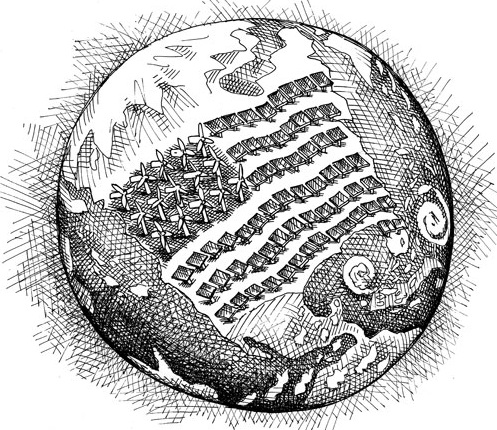
State of the World


Politics of Central Banking?

Barry Eichengreen and Beatrice Weder di Mauro write:  Around the world, central banks’ balance sheets are becoming an increasingly serious concern – most notably for monetary policymakers themselves. When the Swiss National Bank (SNB) abandoned its exchange-rate peg  causing the franc to soar by a nosebleed-inducing 20%, it seemed to be acting out of fear that it would suffer balance-sheet losses if it kept purchasing euros and other foreign currencies.

Similarly, critics of the decision to embark on quantitative easing in the eurozone worry that the European Central Bank is dangerously exposed to losses on the southern eurozone members’ government bonds. This prompted the ECB Council to leave 80% of those bond purchases on the balance sheets of national central banks, where they will be the responsibility of national governments.

Central banks are not profit-oriented businesses. Rather, they are agencies for pursuing the public good. Their first responsibility is hitting their inflation target. Their second responsibility is to help close the output gap. Their third responsibility is to ensure financial stability. Balance-sheet considerations rank, at best, a distant fourth on the list of worthy monetary-policy goals.

Equally important, central banks have limited tools with which to pursue these objectives. Indeed, a clear understanding of their priorities has often led central banks to incur losses when doing so is the price of avoiding deflation or preventing the exchange rate from becoming dangerously overvalued. The Chilean, Czech, and Israeli central banks, for example, have operated with negative net capital for extended periods without damaging their policies.

It is hard to fathom what the SNB was thinking. The sharp appreciation of the franc threatens to plunge the Swiss economy into deflation and recession. The risk of balance-sheet losses for the SNB, with its euro-heavy portfolio, may be greater now that the ECB has embarked on quantitative easing. But this is no justification for abandoning its mandate to pursue price and financial stability.

Last year, the SNB was dragged into the highly charged debate surrounding a referendum on a “gold initiative” that would have required it to increase its gold reserves to 20%, and limited its ability to conduct monetary policy. One rationale for the initiative was to bullet-proof the SNB’s balance sheet against losses. This goal was especially dear to the cantons, the states of the Swiss Confederation, which rely on transfers from the SNB for a significant share of their budgets.

The “gold initiative” was voted down, but the political debate was traumatic. In January, with the accelerating depreciation of the euro, the debate flared up again. The fear was that the SNB’s balance-sheet losses might anger cantonal leaders to such a degree that the central bank’s independence would be threatened.

Whether true or not, the political salience of the issue underscores the dangers of an arrangement that precludes the SNB from focusing fully on economic and price stability. The obvious solution is not to abandon the franc’s euro peg, but to change the cantonal financing mechanism.  And, to those who are concerned for the SNB’s independence, one might ask a fundamental question: What is independence for if not to ignore those who complain that the central bank is insufficiently profit-oriented?

Central Banks


Effort to Audit US Fed

February 15  Barry EIchengren and Beatrice Weder di Mauro write:  In the United States, the “Audit the Fed” movement is back. Motivated by growth in the Federal Reserve’s assets and liabilities, Republicans are introducing bills in both chambers of Congress to require the Fed to reveal more information about its monetary and financial operations.

But should central banks really worry so much about balance-sheet profits and losses? The answer, to put it bluntly, is no.  To be sure, central bankers, like other bankers, do not like losses. But central banks are not like other banks. They are not profit-oriented businesses. Rather, they are agencies for pursuing the public good. Their first responsibility is hitting their inflation target. Their second responsibility is to help close the output gap. Their third responsibility is to ensure financial stability. Balance-sheet considerations rank, at best, a distant fourth on the list of worthy monetary-policy goals.

(Our question: Do most Americans know that the Central Bank bought billions of dollars of sub-prime assets.  Sub=prime assets, based on inappropriate lending, brought the US economy down.  Auto loans are now being bundled the same way.  Will the Fed “have” to buy these?)

Robert Litan writes on February 14:  The Fed’s financial statements have long been audited by professionals.  Sen. Paul’ and those supporting his “audit” bill want the Government Accountability Office to give Congress annual reports on monetary policy functions of the Fed, or its core responsibilities.

If the same logic were applied to the private sector, then accountants would do far more than determine whether companies’ financial numbers are accurate: They would assess the performance of the business–something stock analysts do for public companies, and not always that well. What’s the issue here? Accountants are not trained to have experience in those businesses. Similarly, the economists employed by the GAO are no match for the economists at the Fed. It is not within their domain of expertise.

In creating the Fed, Congress established an expert, independent agency to manage the country’s monetary affairs. It’s fine for Congress to regularly asked the Fed, as it does other independent agencies, to report what it is doing. But why create, in effect, a “shadow Fed” elsewhere within the government, especially at time when lawmakers are trying to trim excess fat from federal spending?

If backers of the “audit the Fed” movement want to get rid of the agency, they should say so, and let that debate begin. If it does, central banks will win. No modern country operates without one, and it is inconceivable that the United States would prefer to have no central bank–and thus no way to fight financial panics other than to rely on Wall Street financiers, as was the case before the Fed was created (and policy makers had to trust J.P. Morgan to save the country). In the wake of the 2008-09 financial crisis, why would anyone want to embrace that approach?

If ending the Fed is not the objective, and “auditing” is the goal, this proposal is unnecessary and potentially dangerous. A ruly independent central bank keeps inflation lower than in countries where finance ministries manage monetary affairs. Many of those who back “audit the Fed” legislation also want lower inflation. Clipping the Fed’s wings and politicizing monetary policy is hardly an outcome they should welcome.

Note:  In 2010, the largest asset on the Federal reserve’s balance sheet at over one trillion dollars in face value.  These were the securities that brought the economy down. Who knew the Fed bought them?

February 10, 2015  Pete Schroeder reports: “One of President Obama’s top economic advisers said Tuesday he opposed ‘dangerous’ legislation that would give lawmakers closer scrutiny over Federal Reserve deliberations. Jason Furman, chairman of Obama’s Council of Economic Advisers, called pending legislation subjecting monetary policy deliberations to outside review ‘somewhere between superfluous and highly counterproductive.’

“He added that he would encourage President Obama to oppose the bill if it reached his desk. That opposition could be noteworthy, as previous efforts have stalled in a Democrat-led Senate, which is now in GOP control. Furman argued that the bill, presented by its proponents as a needed check on the central bank, would effectively allow lawmakers critical of the Fed to second-guess its moves.

“‘What that bill is about is about Congress supplanting its judgment as to what monetary policy should be,’ he said in an interview with Bloomberg TV. ‘Congress shouldn’t be telling the Fed what to do with monetary policy.'”

February 2, 2015  The Wall Street Journal says: “The Fed sees GAO reviews of its monetary policy decisions as a congressional intrusion into its independent decision-making. Former Fed Chairman Ben Bernanke strongly and successfully resisted ‘Audit the Fed’ proposals and Chairwoman Janet Yellen is sure to do the same. In a December news conference, Ms. Yellen said she would be ‘very concerned’ about such a bill and would ‘forcefully make the case’ against it.

“The Fed demonstrated its savvy in dealing with Congress during Dodd-Frank debates in 2010. Efforts to impose congressional inspections of monetary policy and to reduce the Fed’s bank regulatory powers failed. It emerged from those debates in most respects with more power than it had before.

“Ms. Yellen will have President Obama on her side again if the bill gets new life. She will also have the central bank’s 12 regional bank presidents, an influential but little seen force in Congress with strong connections in the deep-pocketed business and banking communities around the country. It remains hard to see the Fed losing this battle.

January 29, 2015:  While some criticize Rand Paul effort to get the US Fed audited, we do not think an audit will effect its independence, the big objection.

In fact, the Fed’s stated purpose is: 1.  Conducting the nation’s monetary policy by influencing money and credit conditions in the economy in pursuit of full employment and stable prices.  2.  Supervising and regulating banks and other important financial institutions to ensure the safety and soundness of the nation’s banking and financial system and to protect the credit rights of consumers.  3. Maintaining the stability of the financial system and containing systemic risk that may arise in financial markets.
4.  Providing certain financial services to the U.S. government, U.S. financial institutions, and foreign official institutions, and playing a major role in operating and overseeing the nation’s payments systems.

In fact, the US Fed has become the big banker to banking institutions.  One of the reasons that the general US population did not benefit from policiies instituted as the Great recession began was that this was not the Fed’s purpose.  The purpose was to save certain select financial institutions, to keep insolvent institutions in business.

What happened in 2007 was not a traditional panic, where flooding the economy with cash would help stabliize matters.  In fact, the panic began when financial institutions created runs on other financial institutions.  This is a complex issue and it has been poorly reported. Instead of increasing the monetary base, the Fed spent its time bailing out Bear Sterns, who had formed EMC, a company that issued mortgages to people with no income and no assets (NINA) so that Bear could bundle and securitzie the mortgages to sell through two hedge funds they had formed and also to other finanicial institutions.  Aurthorized by the Fed, Bear Sterns was directly bailed out by the New York Fed which created Maiden Lane.  And so on.

The US Fed is running wild.  It was become obvious that bankers are smarter than politicians.  Bankers wind Obama around their pinkies. But they also captivated Bill Clinton who is pretty smart about economics and bankers are heavily financing his wife’s Preisdential campagin.

Let’s see the audit.  American taxpayer’s money was loaned by the US Treasury to the Fed to swap currencies with foreign countries.  This is the people’s business.
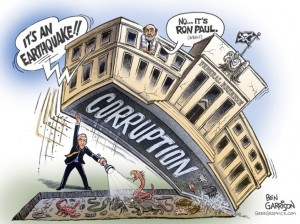
Audit the US Federal Reserve?