What Obama Wants from India

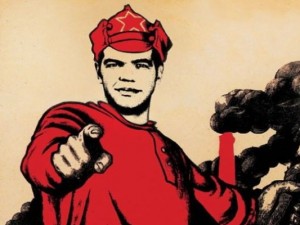
This is the first time a US president will be visiting India twice. Why is Obama placing such importance on India, and what does he expect from a country that was formerly in the Soviet camp and has disappointed so many, despite decades of “liberalization”?

Major bilateral issues are part of the trip’s agenda. Defense, energy and counterterrorism are the main course for the talks, but President Obama’s top concern is deepening economic ties with India. The visit comes at a particularly fortuitous time. Both the US and India are on promising growth curves. It is entirely possible that Obama’s visit could mark the beginning of the most vigorous US-India economic cooperation since the beginning of the liberalization process nearly a quarter century ago.

Obama’s visit can potentially help right US-India economic relations and send a clear signal to American businesses that India can be a serious, stable place to grow.

1) Tax

There is wide agreement that the Indian government’s decision to contemptuously disregard a Supreme Court decision and overturn 50 years of settled Indian law to implement retrospective taxation on certain types of major business transactions has derailed Indian economic growth and given the country a notorious reputation in investment circles. Although it was the Congress-led government that decided to overturn a court’s decision and tax past offshore M&A (mergers and acquisitions) transactions, the Modi government has done little substantively to reverse that decision, despite carefully worded promises that it would not undertake any new cases based on retroactive tax laws.

While there are signs that India and the United States will sign a significant agreement to resolve certain other types of tax cases, the Indians must understand there are no half measures for repealing a tax that marked the Indian tax regime as untrustworthy and out-of-step with modern practice.

Obama’s second priority will be to persuade India to change its inflexible and archaic labor laws.

Obama’s third priority will be to seek a reduction to India’s infamous red tape. While some “single-window” clearance systems have been implemented with fanfare, anyone who has to deal with Indian bureaucracy still has to run from pillar to post. Many promising areas of growth have ground to a halt on mistaken bureaucratic action or complete inaction.

More importantly, even a “yes” in India infamously means “maybe” rather than an unequivocal “yes,” and this ruffles American feathers.

Modi has made very public efforts to make the bureaucracy work better or, simply, to show up for work.

One testy issue that doesn’t matter a whole lot is intellectual property (IP). This is a hot-button issue in both countries, but it is almost exclusively focused on pharmaceutical patents.

India has valid concerns about providing up-to-date medicines to its impoverished population at affordable prices, but it also needs to encourage domestic innovators who are being lured abroad by countries such as Singapore. The United States has valid concerns about enforcement of IP rights, but its bargaining position must not be held hostage by the large pharmaceutical companies. The US must recognize that compared to China, India is a virgin when it comes to IP violations. The courts will enforce foreign IP holders’ rights on a timely basis, and there is little “home cooking” when it comes to such decisions. IP holders in China would love to face the comparably minor challenges one meets in India.

There is a rational way forward here, one that allows India to impose rational and just price controls on drugs while allowing a vigorous IP regime that encourages innovation in the country. India requires fresh ideas and economic thinking on this issue rather than framing this as either a leftist defense of the poor or a craven collapse to outside business interests. For its part, the United States should help India find a balance and not let the pharmaceutical lobby dominate the discussion. The best selling point for “Make in India” is that the country will not rip off American intellectual property in the manner of China.

Prime Minister Modi deserves great credit for looking at India’s greater interests and reaching out to a country that only recently had him on a blacklist and barred from entry. President Obama has a great chance to reciprocate the gesture. Both leaders have a rare opportunity to help each other unlock India’s economic potential.
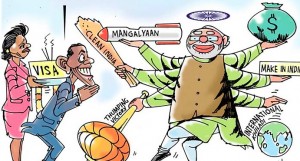
Obama and Modi Meet

Ukraine Stiffing China?

Eric Zuesse writes:  China is demanding refund of $1.5 billion in cash and of an additional $1.5 billion in Chinese goods that were paid in advance by China (in 2013), for a 2012 Chinese order of grain from Ukraine, which goods still have not been supplied to China.

Alex Luponosov, a Ukrainian authority on Ukraine’s banking system, says, “Ukraine won’t be able to supply the grain to China, because we don’t have it.” The reason he gives is that “there is a big shortage of technicians: combiners, adjusters, mechanics, farm-machinery operators — all of them were taken by the army.” Those men are being required to fight in Ukraine’s ‘ATO’ or ‘Anti Terrorist Operation,’ that’s occurring in Ukraine’s former Donbass region (the far-eastern tip of Ukraine), the place where the residents don’t accept the new Ukrainian Government’s legitimacy.

The RIAN report says that, “China is angry,” and it closes: “By the way, in addition to China’s $3B loan that’s to be repaid with grain [which cannot be supplied], Ukraine also received from China a $3.6 billion loan to pay for the gasification of coal, by Ukraine’s gas company, Naftogaz, which the Ukrainian Government has guaranteed up to 2.3 billion dollars. Information on the implementation of the coal-gasification project has not been made available, but there seems to be a high probability that this matter too will be decided in a court. If China decides to call in that loan, then the result will be the bankruptcy of either Naftogaz, or the Ukrainian Government.

The IMF, and other lenders, require Ukraine to win this war, because, if the Ukrainian Government doesn’t win, the natural gas and other assets that are in the ground in that region will not become available to be sold off by the Ukrainian Government in order to pay-off those investors; instead, the residents there (the people whom the Ukrainian Government is now trying to eliminate will control those assets, as being assets of a separate state — one which has not borrowed from these investors. The IMF wants the assets that are in the ground.

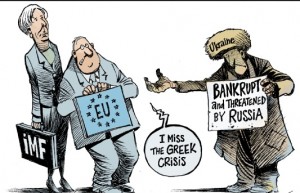
Ukraine's Financial Problems

The Greek Leader Tsipras Is?

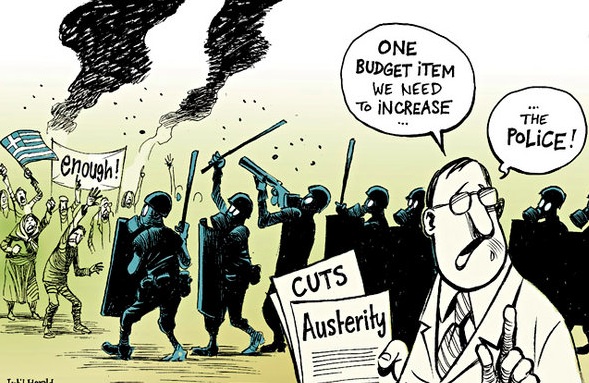
Sunday’s elections in Greece have brought Tsipras and his Syriza party closerto power.  In 2012, when Alexis Tsipras last ran to be prime minister of Greece, his compatriots were quite literally killing themselves in public squares because of the tough austerity measures that had strangled the country’s economy.

His alternative-left Syriza party, he said, may be the ticket out of the hell that Greece has become.  Tsipras did well on the reent ballot, perhaps because Greece has gotten worse. More than 200,000 Greeks have left the country in the last five years, and austerity has forced many businesses to shutter up or go off the radar. Greece’s black market economy is now estimated to account for nearly half of the country’s GDP.

There are also signs that Europeans in other countries who once fought to keep the eurozone intact at any cost now feel they could get along pretty well without Greece. After all, it has a population of only 11 million in a European Union of 500 million and it represents only about 1.4 percent of the union’s GDP.

Tsipras has promised the Greeks that Europe needs them and has no choice but to renegotiate Greece’s bailout debt conditions. And Greeks like what they hear.

Tsipras argues that in order to stay in the eurozone, Greece’s ruling party has negotiated a foolhardy payment schedule for its $378 million bailout debt that makes it impossible for the country to grow. The current repayment plan is 175 percent of the gross domestic product, and Tsipras wants a better deal, starting with his demand that Europe should simply erase most of the Greek debt.

The lessons the young leader has learned since the last elections are apparent. He has traded what amounted to fear-mongering in his last electoral campaign for consensus building, starting with a promise to some of his former naysayer European leaders. Many of Europe’s struggling countries have launched their own versions of alternative leftist Syriza parties and Tsipras had made the rounds to Italy, Spain and Portugal in recent months.

In 2012, Tsipras gave wide ranging interviews to most people who cared enough to ask. This time around, he is writing op-eds in Europe’s largest newspapers to garner support not only for voting Greeks who have moved abroad, but to get Europe’s other austerity-suffering countries to back the debt reshuffling proposal with the idea that such a precedent could help them, too.

Tsipras has come a long way in just a few years, but not all of Europe is optimistic about a Tsipras-led Greece. In an interview ahead of the World Economic Forum in Davos, Switzerland, Christine Lagarde, head of the International Monetary Fund, which owns a lot of the Greek debt, quashed Tsipras’s debt renegotiation promise and said there is very little wiggle room when it comes to renegotiating debt.

Dutch finance minister Jeroen Dijsselbloem, who heads the influential Eurogroup of European ministers agreed. “There’s no political support to write off Greek debt,” he said.

And in Germany, there was that Der Spiegel report that the German government would rather have a Greek-free euro than open the way for a trend that would be costly to the richer nations.

A Greek Leader

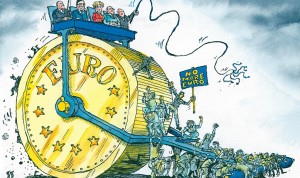
Is Greece on the Way Out of the EU?

Greece rejected the punishing economics of austerity on Sunday and sent a warning signal to the rest of Europe as the left-wing Syriza party won a decisive victory in national elections, positioning its tough-talking leader, Alexis Tsipras, to become the next prime minister.

With 60 percent of the vote counted, Syriza had 36 percent, almost eight points ahead of the governing center-right New Democracy Party of Prime Minister Antonis Samaras, who had conceded defeat. The only uncertainty was whether Syriza would muster an outright parliamentary majority or if it would have to form a coalition.

Appearing before a throng of supporters outside Athens University late Sunday night, Mr. Tsipras, 40, declared that the era of austerity was over and promised to revive the Greek economy. He also said his government would not allow Greece’s creditors to strangle the country.

“Greece will now move ahead with hope, and reach out to Europe, and Europe is going to change,” he said. “The verdict is clear: We will bring an end to the vicious circle of austerity.”

Anti Austerity WIns in Greece

Money Matters 101

We are introducing our weekly newsletter which will focus on a topic of particular interest, explain the topic clearly and briefly and provide urls for articles we’ve recently run on the subject.  If you’d like to receive the newsletter in your inbox, send your email to wtwfinance@gmail.com.

Quntitative easing is all over the news this week. Bond purchases are anticipated.  Rising and falling interest rates are suggested.

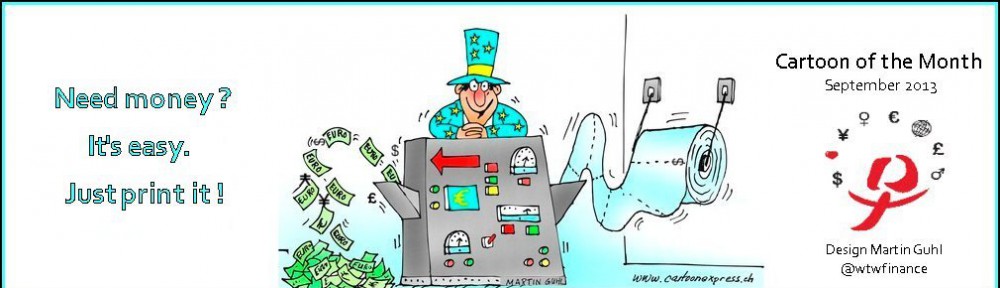
The Federal Reserve Bank in the US bought bonds to help the country recover from the Great Recession.  This is called “Quantitative Easing.”   More money is put in circulation.  Hopefully lenders are encouraged to issue more loans so business is stimulated.

The US Fed also lowered interest rates to almost zero.

Now the US Fed has stopped buying bonds, and they have signalled that at some time interest rates will rise.  Signals are a way to let markets prepare for intended changes.

The European Union is more complicated because there is a central bank for all its member nations and then national central banks for each member state.  It came as no surprise when Mario Draghi,  the European Central bank’s president, announced this week that he would  buy bonds.  He did not suggest an interest rate rise.

The. Central banks of member nations will purchase most of the risky sovereogn (or nation-specific) bonds.  These states are in.a position.to control their own economies and have a greater interest in seeing that the bonds do not default.

The real question in what’s called QE is the nature of the bonds purchased.  And who is taking the risk?

Quantitative Easing Explained

Quantitative Easing Worked

Central European Bank Adopts Quantitative Easing

Former US Treasury Secretary Doesn’t Think QE Will Work in EU

Quantitaive Easing a Contagion?

Same Old King in Saudi Arabia

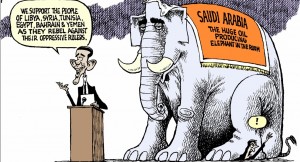
ing Salman, Saudi Arabia’s new ruler, will continue the policy of maintaining crude output to preserve market share even as prices have plunged.

Salman, 79, issued a royal decree to retain current ministers, according to the official Saudi Press Agency. Al-Naimi led OPEC’s Nov. 27 decision to maintain its crude production even as shale supplies spurred U.S. output to the highest in three decades. Salman said on Saudi national television that he will maintain the policies of his predecessor.

With production of 9.5 million barrels a day and exports of 7 million, Saudi Arabia accounts for more than a 10th of global supply and a fifth of crude sold internationally. The country’s refusal to surrender market share to rising U.S. output has contributed to the worst slump in prices since the global credit crisis of 2008.

Brent crude oil, the global benchmark, rose as much as 2.6 percent to $49.80 a barrel in London on Friday, before paring gains to $49.38 at 10:37 a.m. local time. West Texas Intermediate rallied as much as 3.1 percent.

The price increase following the death of King Abdullah will be temporary because it won’t alter the nation’s policies and U.S. oil output will continue rising.

In signs of a smooth succession, Salman was named king and Prince Muqrin, 69, another half-brother, has been chosen as Crown Prince. Salman appointed Prince Mohammed bin Nayef, the country’s Interior Minister, as deputy crown prince and his son Mohammed bin Salman as defense minister, Saudi State Television reported today.

saudi oil production

Perjury by US Fed in AIG Case?

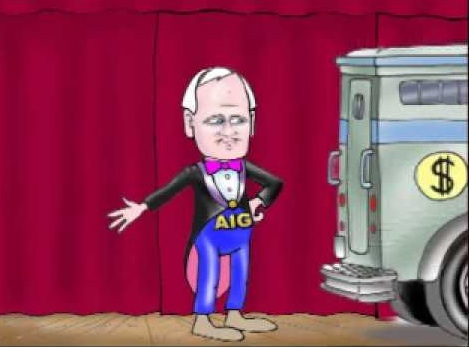
An  exchange, this one from Day 1 of the trial, with Q. as David Boies (representing Hank Greenberg of AIG) and A. as Alvarez. Bear in mind that after this testimony was entered into the record, Boies introduced into the record an e-mail dated Saturday September 20 that Morgan Stanley had informed Tim Geithner on September 19, a Friday, that Morgan Stanley would be unable to open the following Monday.

  1. Do you think that Morgan Stanley, on September 14th, 2008, could have continued to operate if you had taken away the primary dealer credit facility and not substituted something equal in its place?… THE WITNESS: – and I don’t know if Morgan Stanley was even borrowing on that day…. Q. Mr. Alvarez, did I hear you say that you didn’t know whether Morgan Stanley was borrowing from the primary dealer credit facility? A. On September 14th I think was your question. Q. Was it borrowing from the primary dealer credit facility at any time in September 2008? A. I don’t know the answer to that… Q. Would it surprise you that that number was as high as $100 billion? A. I just don’t know. Q. While we’re on the subject of Morgan Stanley, there came a time when the Federal Reserve System was apprised that unless Morgan Stanley got federal assistance or additional federal assistance to what they were already getting over a weekend, that Morgan Stanley would not be able to open the following Monday, correct? A. No, I’m not aware of that ever happening…I’m not aware that Morgan Stanley – I’m not aware of that. I don’t know what you’re referring to. Could you be more specific?.. Q. You were the general counsel of the Federal Reserve Board at that time? A. Yes, I was.

Boies later entered into evidence shows that the New York Fed immediately cranked up a team to analyze what to do about Morgan Stanley saying it was toast unless it got a rescue.  Federal Reserve and AIG

AIG Trial

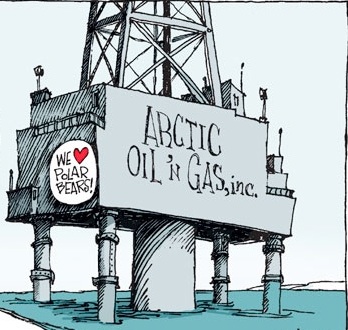
Russia Wants Artic Oil and Gas

Although the crisis in Ukraine continues to focus attention on Russia’s western border, Moscow is seeking to exploit a more lucrative prize along its vast northern frontage: the Arctic Circle. Melting ice has opened up new transit routes and revealed previously inaccessible oil and mineral deposits. Facing a year of harsh economic constraints, securing exploitable energy reserves remains a top priority for Moscow. The planned militarization of the Arctic is already underway, and funding is secured through 2015 (the Ministry of Defense was the only Kremlin ministry not to be curtailed in the most recent budget.

Although Russia faces a raft of internal and external problems such as a strained economy, matters in Ukraine and pressure from the international community, the Kremlin remains wedded to its pursuit of the Arctic. This has forced Russia’s neighbors to reassess their own military presence in places like the Barents Sea, as well as territorial claims to disputed parts of the Arctic Circle. Norway will press harder for a larger NATO presence in the northern region, but while military conflict remains a threat, Russia will stop short of instigating hostilities. The Kremlin knows that when it comes to acquisitions, actions speak louder than words, and any attempt to grab the rich, unclaimed territory of the Arctic Circle will have to be backed by force.   Russia Wants Artic Oil and Gas

Artic Oil and Gas

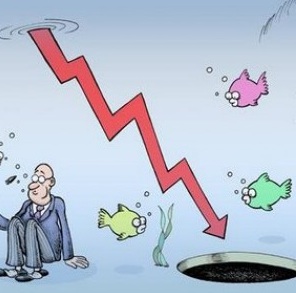
Cost of Deflation

Adair Turner writes:  As 2015 begins, the reality of deficient global demand and deflationary risks in the world’s major economies is starkly apparent. In the eurozone, GDP growth is slowing, and inflation has turned negative. Japan’s progress toward its 2% inflation target has stalled. Even economies experiencing more robust economic growth will miss their targets: inflation in the United States will not reach 1.5% this year, and China’s rate reached a five-year low of 1.4% last November.
In the advanced economies, low inflation reflects not just the temporary impact of falling commodity prices, but also longer-term wage stagnation. In the US, the United Kingdom, Japan, and several eurozone countries, median real (inflation-adjusted) wages remain below their 2007 levels. Indeed, in the US, real wages for the bottom quartile have not risen in three decades. And, though the US created 295,000 new jobs last December, actual cash wages fell.

The developing world is not doing much better. As the International Labor Organization’s latest Global Wage Report shows, wage gains are lagging far behind productivity growth.
Because real income growth is vital to boost consumption and prices, central bankers and politicians are now in the novel business of encouraging wage increases. Last July, Bundesbank President Jens Weidmann welcomed the fact that some German companies had raised wages above inflation. Japanese Prime Minister Shinzo Abe has gone a step further, repeatedly urging companies to increase wages – and encouraging them to do so by reducing corporate tax. So far, however, jawboning has had little effect.
This failure would not have surprised the monetarist economists who observed the high inflation of the 1970s. At the time, many policymakers blamed rapid price increases on “cost push” factors, such as pressure from trade unions for excessive wage hikes. Finance ministers and central banks frequently urged wage moderation, with many countries even introducing formal policies governing wages and prices.  But these policies proved largely ineffective.

The result in many countries has been stagnant real wages, increased inequality, and a potential structural bias toward deficient nominal demand. Given that wealthy people have a higher propensity to save, increased inequality tends to produce sluggish demand growth – unless, that is, the savings of the wealthy are lent to the poor.

The best way to achieve that is not through the current mix of ultra-low interest rates and quantitative easing. After all, though this approach would eventually stimulate demand, it would do so by driving up asset prices – thereby exacerbating wealth inequality – and by re-stimulating the private-credit growth that fueled the financial crisis. Cost of Deflation

Cost of Deflation


Monetary Policy Works?

Jeffrey Sachs writes:  The good news is that, even near the ZLB, monetary policy works. QE raises equity prices; lowers long-term interest rates; causes currencies to depreciate; and eases credit crunches, even when interest rates are near zero. The ECB and the BOJ did not suffer from a lack of reflationary tools; they suffered from a lack of suitable action.
The efficacy of monetary policy is good news, because fiscal stimulus is a weak instrument for short-term demand management. Ironically, in an influential 1998 paper, Krugman explained why. He argued at that time, and rightly in my view, that short-term tax reductions and transfers would be partly saved, not spent, and that public debt would multiply and create a long-term shadow over the fiscal balance and the economy. Even if interest rates are currently low, he noted, they will rise, thereby increasing the debt-service burden on the newly accumulated debt.

With all major central banks pursuing expansionary monetary policies, oil prices falling sharply, and the ongoing revolution in information technology spurring investment opportunities, the prospects for economic growth in 2015 and beyond are better than they look to the pessimists. There are rising profits, reasonable investment prospects for businesses, a large backlog on infrastructure spending almost everywhere in Europe and the US, and the opportunity to finance capital-goods exports to low-income regions, such as Sub-Saharan Africa, and to meet the worldwide need for investment in a new, low-carbon energy system.

If there is a shortfall of private investment, the problem is not really a lack of good projects; it is the lack of policy clarity and complementary long-term public investment. European Commission President Jean-Claude Juncker’s plan to finance long-term investments in Europe by leveraging relatively small amounts of public funds to unlock large flows of private capital is therefore an important step in the right direction.  Monetary Policy for Prosperity

QE in the EU?