Draghi Does It: QE, But a Big One

The European Central Bank (ECB) announced higher-than-expected monthly bond buying programme of 60 billion euros that will go on till September 2016. It, however, kept benchmark interest rate unchanged.

Announcing the extent of Quantitative Easing, ECB chief Mario Draghi also said the central bank will work towards the objective of bringing inflation closer to 2 percent. The ECB kept benchmark rate unchanged at 0.05 percent and left both marginal facility interest rate and deposit facility rate intact at 0.3 percent at -0.2 percent, respectively. European markets as well as US futures shot up post the QE announcement.

CAC was up nearly 1 percent while FTSE and DAX were trading 0.5 percent higher. The ECB chief said private and public bond-buying program will last until at least September 2016 and the measures will aid inflation that is seen moving up gradually in 2015. As of December 2014, inflation rate stood at minus 0.2 percent.

The asset-purchasing programme will start in March. Policymakers attending the World Economic Forum in Davos were certain that ECB would announce a QE —street was pegging iot lower at 50 billion euros per month — but remained skeptical of its success. Speaking to CNBC-TV18 in Davos, Jan Lambregts, Director, Head of Research (Asia) at Rabobank said he does not expect the ECB to give a full-fledged plan today. Federal Reserve’s three rounds of QE theoritically suggests the exercise would pump up stocks, commodities and bond yields leading to some real economic growth. If Draghi goes for it, he is expected to roll out similar initiatives instead of stopping at one. ECB’s bond-buying programme is expected to push the dollar to new highs and put downward pressure on commodities including crude.

Draghi Does It

Mothers: Where Are You?

Ramesh Ponnuru writes:  Democrats have a knack for stumbling into trouble with mothers who aren’t in the paid labor force.

In the late 1990s, Senator Chris Dodd said that being a full-time homemaker was a “wonderful luxury” for women who “want to go play golf or go to the club and play cards.” In 2012, Democrats said Ann Romney, who raised five sons, had “never worked a day in her life.” And a few months ago, President Obama suggested that for mothers to leave the labor force for a few years is “not a choice we want Americans to make.”

Two of Obama’s new proposals reflect ‘mother’ blindness.  Obama wants to triple the existing tax credit for child-care expenses, and create a new credit for second earners. Those proposals will help some parents and couples, but have nothing to offer families where one parent concentrates on home-based tasks. The second-earner credit is probably too small to affect couples’ decisions about work and child-care arrangements. So its main effect will be to lower the share of the tax burden paid by two-earner couples who were going to be working even without the credit.

There are two standard economic justifications for shifting the tax burden in this way, neither of them convincing.

One is that two-earner couples have higher costs than single-earner couples making the same income, so it’s harder for them to pay the same taxes.

The second is  that a progressive tax code, when applied to families rather than individuals, can penalize second earners. A second earner will often pay a higher tax rate than she would if she were single and making the same income, because she moves to a higher bracket when she marries a wage earner. The tax code thus discourages her from working. That’s true, but it’s just a special case of the way taxes discourage work, and not one that seems especially unjust or destructive. Marriage is (among other things) an economic partnership, and this feature of the tax code reflects that it involves pooling resources.

If the second-earner credit ignores that feature of marriage, Obama’s other proposal ignores how little Americans like commercial child care.

Given these preferences, it would make more sense to enlarge the child tax credit — not the child-care credit — and let parents use it as they see fit rather than requiring them to use the commercial day care most of them try to avoid.

But as most homemakers could tell you, paid work isn’t everything.

Stay at Home Moms

Is There a German Problem?

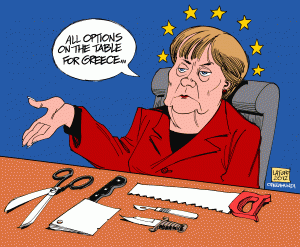
merkel-greeceTimo Behr writes: For many decades, Germany has been the engine of European integration. Germany’s unquestioning commitment to an ever-closer Union, its willingness to place European interests above its narrow national aims, and its ability to grease the wheels of integration with its ‘checkbook diplomacy’ have been vital for the European project to prosper.

But Berlin’s foot-dragging during the Euro-crisis and Angela Merkel’s heavy-handedness when dictating the conditions of the financial bail-out have been widely interpreted as a sign that Germany might be turning its back on Europe.

Germany’s Interior Minister and a Merkel confidant, sent a blunt message last year: it may be new to Europeans that Germany is defending its interests with vigor, he stated, but others better get used to the idea. And Germany’s tabloid die Bild celebrated Merkel’s bruising victory during the Greek debt crisis with the triumphant headline “Never again Europe’s paymaster!”

Despite everything, German politicians are still unanimous in their backing for the European project and support for Euroskeptic political parties is lower in Germany than elsewhere. Moreover, German reactions to the Euro-crisis have been largely driven by economic anxieties and fear rather than a revival of German nationalism. Reports about Germany’s rediscovered self-confidence and national drive are equally overblown. The truth is that Germany is still unsure about its path and all the talk about German “normality” simply serves to hide its continuing insecurities.

Germany’s political elite is still not accustomed to thinking strategically or taking leadership responsibilities. Neither are other Europeans clear about or comfortable with the idea of more German leadership in the new Europe. They fret about the lack of German initiative, yet they have little taste for German guidance and have been quick to stigmatize German reactions.

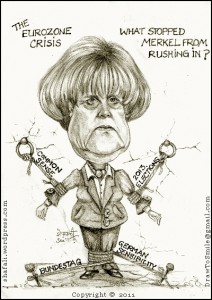
caricature-cartoon-sketch-drawing-portrait-angela-merkel-german-chancellor-and-the-eurozone-crisis


Summers: QE Won’t Work in EU

Larry Summers says he’s “all in” for bond buying program, but that quantitative easing on its own won’t save Europe’s economy.

The European Central Bank is widely expected to announce that it will begin a bond-buying program similar to the what the U.S. Federal Reserve has done with quantitative easing. Many expect QE will generate a huge boost for the European economy, much like it appears to have done in the U.S..

During a panel discussion at the World Economic Forum in Davos on the eve of the ECB’s QE announcement, Summers threw cold water on what it might do. Summers said that while he was he was “all for” European central bankers buying bonds, he thought we should be less optimistic about what economic benefit it might have.

The main reason that is the case, Summers said, is that longer-term interest rates, which QE is supposed to drive down to spur economic growth, are already low in Europe. Rates were higher in U.S. when the Federal Reserve first started buying bonds.

Instead, Summers says what Europe really needs is direct stimulus spending by governments.

International Monetary Fund managing director Christine Lagarde, who was on the Davos panel with Summers, said the prospect of QE is already having positive effects. She said a lower euro will help exports and create jobs. “QE in Europe has already worked in anticipation,” said Lagarde. “Look at the currency.”

Summers countered that the drop in the currency has yet to produce a real gain. “That’s why I am worried,” said Summers. “We have already had an impact, and the economic forecast for Europe has not improved.”

The weaker euro hasn’t yet, for example, been able to support business in Italy. New orders to industry fell 1.1% in December and were down 4.1% on the year, well below expectations. However, it has helped to turn around business confidence in Germany, which was badly dented last year by the Ukraine crisis.

The real problem Summers said is that all of Europe seems set on austerity and cutting back government spending at the same time. Summers said that collective belt tightening is going to lead to lower economic growth in Europe.

Summers


The Growth Package

Michael Spence writes: At a time of lackluster economic growth, countries around the world are attempting to devise and implement strategies to spur and sustain recovery. The key word is strategy: to succeed, policymakers must ensure that measures to open the economy, boost public investment, enhance macroeconomic stability, and increase reliance on markets and incentives for resource allocation are implemented in reasonably complete packages. Pursuing only some of these objectives produces distinctly inferior results.

China provides a telling example. Before Deng Xiaoping launched the policy of “reform and opening up” in 1978, the country had relatively high levels of public-sector investment. But the centrally planned economy lacked market incentives and was largely closed to the global economy’s major markets for goods, investment, and technology. As a result, returns on public investment were modest, and China’s economic performance was mediocre.

China’s economic transformation began with the introduction in the 1980s of market incentives in the agricultural sector. These reforms were followed by a gradual opening to the global economy, a process that accelerated in the early 1990s. Economic growth surged ahead, and returns on public investment soared, reaching an annual growth rate above 9% of GDP, shortly after the reforms were implemented.

The key to a successful growth strategy is to ensure that policies reinforce and enhance one another. For example, boosting returns on public investment – critical to any growth plan – demands complementary policies and conditions, in areas ranging from resource allocation to the institutional environment. In terms of effectiveness, the policy package is more than the sum of its parts.

The Growth Cornucopia

Is the Dollar as Strong as it Looks?

Barry Eichengreen writes: Economic pundits, almost without exception, are predicting a stronger dollar in 2015 – an expectation that is leading investors to place some very large bets.  The consensus reflects the fact that the United States is currently the only major economy where growth prospects are improving.

The revision was based mainly on personal consumption and business investment – the most stable and persistent components of GDP.

All of this not only enhances confidence that strong US growth will persist; it also reinforces the belief that the US Federal Reserve will begin raising interest rates, conceivably as early as April. For investors, this makes buying dollars even more attractive.

The other major economies, by contrast, are stagnant, slowing, or both. Europe’s economy is dead in the water, and the dreaded specter of deflation is looming ever larger. Because policymakers are out of options, there remains little doubt that the European Central Bank will pursue quantitative easing.

Meanwhile, in Asia, the Japanese economy’s sputtering indicators have spurred the Bank of Japan to increase its securities purchases, which likewise point to the prospect of a weaker yen. And unmistakable signs of slowing growth in China are leading investors to ask, for the first time in years, whether China’s government will seek to engineer a weakening of the renminbi’s dollar exchange rate.

Other emerging markets’ growth prospects are even worse – not least because of low commodity prices.

Where is the strength of the dollar threatened?  Because the strength of the dollar is already reflected in the markets, we have to look at fundamentals: the US economy outperforms the consensus forecast and the Fed initiates monetary tightening earlier than anticipated, or other economies’ performance is even worse than expected.

The second risk is that, even based on current growth expectations, investors may have gotten ahead of themselves in anticipating monetary-policy tightening. The Fed will raise interest rates when it senses that the economy is nearing full capacity and that inflation – wage inflation, in particular – is accelerating.

Labor-force participation will be key to shaping this environment. As it stands, the low official unemployment rate can be explained partly by declining participation rates, especially among workers aged 25-54.

But there are now signs that the participation rate of these workers is stabilizing, and may even be set to rise. If it does, the unemployment rate may stop falling, and upward pressure on wages would be limited. The Fed would then delay tightening for longer than anticipated.

Last but not least, unexpected financial problems – which lower oil prices could catalyze – would interrupt US growth and discourage the Fed from tightening.

Such developments would cause US debt yields to spike, disrupting growth. The dollar would become weaker, leaving investors wrong-footed. The dislocations could be severe.

Exchange-rate movements over horizons as long as a year do not function according to theoretical models. The behavior of currency markets has repeatedly confounded and even bankrupted sophisticated investors. With so much currently staked on the market moving in one direction, it is worth contemplating the consequences if this happens again in 2015.

Could the Dollar Weaken?

Bank Regulation Under Assault

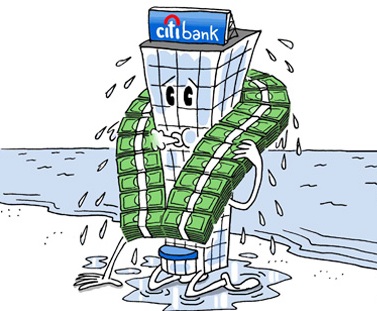
Mark Roe writes: Last month, the United States Congress succumbed to Citigroup’s lobbying and repealed a key provision of the 2010 Dodd-Frank Wall Street Reform and Consumer Protection Act: the rule that bars banks from trading derivatives. The Dodd-Frank law’s aim was to prevent another financial crisis like that of 2007-2008; the repeal reduces its chances of success.

Derivatives are contracts that derive their value from changes in a market, such as interest rates, foreign-exchange rates, or commodity prices. Banks can use derivatives to hedge risk – say, by ensuring that oil producers to which they lend lock in today’s prices for their product through derivatives contracts, thereby protecting themselves and the bank from price volatility. The borrower is thus more likely to be able to repay the loan, even if its product’s price falls.  It began when farmers looked at the sky and knew they could not rely on weather reports.

But derivatives can also be used for speculative purposes, allowing banks to take on excessive risk.  And this is where the big bucks are being mae today by big players.

The last crisis originated in the real-estate market, following a large and unexpected decline in home prices. It then spread to financial institutions that could not cope with the losses associated with mortgage delinquencies, foreclosures, and the depreciation of housing-related securities. Derivatives exacerbated the crisis, particularly after the portfolio of the bankrupt Lehman Brothers, then the world’s fourth-largest investment bank, was liquidated. The next day, the US government had to extend an $85 billion bailout to American International Group (AIG), the world’s largest insurer, owing to its inability to back up its deteriorating derivatives position. These failures disrupted worldwide derivatives markets, causing financial markets to seize up.

The Dodd-Frank rule that Congress just repealed, known as the “swaps push-out rule,” would have required that most derivatives-trading activities occur outside of government-insured banks. If a bank fails, the government stands behind most deposits. Though it does not formally guarantee anything else, it usually finds it easiest and quickest to bail out the entire bank – including its derivatives facility. If, however, derivatives are no longer embedded in the guaranteed bank, the government could more easily bail out a bank, while leaving the derivatives subsidiary to fend for itself.

This sub rosa government indemnification of major banks’ derivatives portfolios undermines financial stability. If a major bank defaults on its derivative trades, the banks with which it has traded could also fail. If several large, interconnected derivatives-trading banks collapse simultaneously, the financial system could be paralyzed, damaging the real economy – again.

And it is the large banks that are building up their derivatives portfolios the most. Indeed, this is another pernicious, albeit subtle, effect of the sub rosa guarantee of banks’ derivatives portfolios: the knowledge that, if a large bank fails, it will probably receive a government bailout – including for its derivatives desk – spurs traders to focus their dealings on big banks. Smaller independent dealers that the government could allow to fail thus become less appealing.

This explains, at least partly, why a handful of mega-banks in the US – namely, Citibank, Goldman Sachs, Bank of America, and Morgan Stanley – handle the bulk of derivatives trading. That creates a vicious cycle: the bailout option for too-big-to-fail banks concentrates the derivatives market among a few major institutions, increasing further their systemic importance.

The push-out rule sought to break this cycle. By separating derivatives trading from government-insured banks, it would have effectively eliminated the sub rosa subsidy. While the government would still have to back deposits for crisis-stricken banks – even if that meant bailing out the entire institution – it would have had the option of allowing the derivatives trading desks, functioning within separate organizations, to flounder.

This would have helped to undermine the perception that large derivatives dealers are invulnerable, thereby reducing their trading advantage. Mid-size dealers that could fail without causing excessive economic damage would get more business. And the financial sector would become more balanced – and less risky.

Against this background, the repeal of the push-out rule was a mistake.

It is possible that US regulators (and Congress) are so confident in the other steps they have taken to safeguard the financial system that they no longer believe this extra protective layer is necessary. But Citigroup’s success in lobbying for the rule’s repeal could also signal that regulatory efforts to mitigate systemic financial risk have reached the high-water mark in the US. If Citigroup – a poorly managed operation that had to be bailed out in the last crisis – could compel Congress to abandon such a rule, it is reasonable to ask whether the political tides have shifted, and financial regulation will not be tightened further. Perhaps, with each budget bill, Dodd-Frank will be rolled back further.

This outcome is not inevitable. The repeal can – and should induce regulators to reassess their approach. Specifically, they should revisit the consensus that banks will become gradually safer, and their required capital should amount to no more than 10% of their assets. If the banks are successfully lobbying for the right to pursue riskier activities, regulators should consider raising their capital requirements.

Only a few years have passed since the last financial crisis – and its effects are still being felt. Yet US lawmakers are already forgetting its lessons.   Dodd Frank Under Assault
No Sweat for Citibank


Lagarde: Closing the Gender Gap by 25% Could Employ 100 Million Women

Christine Lagarde writes: As 2015 begins, policymakers around the world are faced with three fundamental choices: to strive for economic growth or accept stagnation; to work to improve stability or risk succumbing to fragility; and to cooperate or go it alone.

For starters, growth and jobs are needed to support prosperity and social cohesion in the wake of the Great Recession that began in 2008. Six years after the eruption of the financial crisis, the recovery remains weak and uneven. Global growth is projected at just 3.3% in 2014 and 3.8% in 2015.

To break free from stagnation, we need renewed policy momentum. If the measures agreed by the leaders assembled at the G-20 in November are implemented, they will lift world GDP by more than 2% by 2018 – the equivalent of adding $2 trillion in global income. Furthermore, by 2025, if the laudable – yet not overly ambitious – goal of closing the gender gap by 25% is achieved, 100 million women could have jobs that they didn’t have before.

Sructural reforms and  building new momentum will require pulling all possible levers that can support global demand. Accommodative monetary policy will remain essential for as long as growth remains anemic – though we must pay careful attention to potential spillovers. Fiscal policy should be focused on promoting growth and creating jobs, while maintaining medium-term credibility. And labor-market policies should continue to emphasize training, affordable childcare, and workplace flexibility.

We must consider how we can make our increasingly interconnected world a safer place. Financial integration has risen tenfold since World War II. National economies are so interconnected that shifts in market sentiment tend to cascade globally. It is therefore critical that we complete the agenda on financial-sector reform.

Countries must now implement the reforms and improve the quality of supervision. We also need better rules for nonbanks, stricter monitoring of shadow banks, and improved safeguards and more transparency in the derivatives markets. Progress on closing data gaps in the financial sector is urgently needed as well, so that regulators can properly assess risks to financial stability.

Most important, the culture of the financial sector needs to change. The principal purpose of finance is to provide services to the other parts of the economy, which it cannot do unless it enjoys the confidence of those who depend on those services. Restoring trust should therefore start with an all-out effort to promote and enforce ethical behavior throughout the industry.

The third choice, whether to cooperate or go it alone, is the most critical. Sovereign states are no longer the only actors on the scene. A global network of new stakeholders has emerged, including NGOs and citizen activists – often empowered by social media.

The year 2014 was a tough one. The recovery was slow, a series of dangerous geopolitical risks emerged, and the world was confronted with a devastating Ebola outbreak. This year may be another tough one, but it could also be a good one – a truly multilateral year.

New momentum on global trade could help unlock investment worldwide. The adoption of the IMF reforms by the United States Congress would send a long-overdue signal to rapidly growing emerging economies.

Growth, trade, development, and climate change: 2015 will be a rendezvous of important multilateral initiatives. We cannot afford to see them fail. Let us make the right choices.

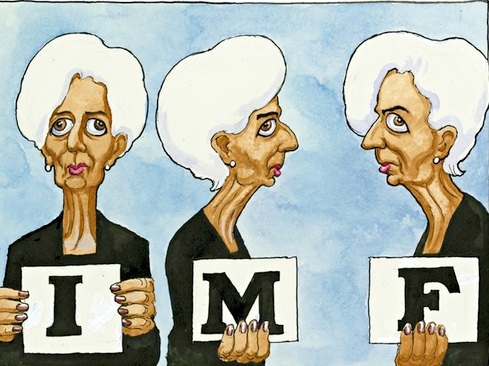
 Lagarde

Is Inequality Good for Anyone?

Suzanne Moore writes: Who will look after the super-rich and think about their needs  Private security costs a fortune, and with the world becoming an increasingly unequal place a certain instability increases. It could be dangerous!

Very smartly, Oxfam International is raising such questions at the World Economic Forum at Davos, where the global elite gather to talk of big ideas and big money. Oxfam executive director, Winnie Byanyima, is arguing that this increasing concentration of wealth since the recession is “bad for growth and bad for governance”. What’s more, inequality is bad not just for the poor, but for the rich too.

The economic climate is often represented as a natural force, like uncontrollable weather. It’s a shame that the planet is getting hotter, just as it’s a shame that the rich are getting richer. But these things are man-made and not inevitable at all. In fact, there are deliberate and systemic reasons as to why this is happening.

The rich, via lobbyists and Byzantine tax arrangements, actively work to stop redistribution. Inequality is not inevitable, it’s engineered. Many mainstream economists do not question the degree of this engineering, even when it is highly dubious. This level of acceptance among economists of inequality as merely an unfortunate byproduct of growth, alongside their failure to predict the crash, has worryingly not affected their cult status among blinkered admirers.

Even the mild challenge of Thomas Piketty, with his heretical talk of public rather than private interest being essential to a functioning democracy, is revolutionary in a world which buys the conservative idea that the elixir of “growth” simply has to mean these huge extremes in income distribution.

That argument may now be collapsing. The contortions that certain pet economists make to defend the indefensible 1% are often to do with positing the super-rich as inherently talented and being self-made. The myth is that everyone is a cross between Steve Jobs and Bono; creative, entrepreneurial, unique.

There are always those who will side with the powerful against the powerless, and economists specialise in this.

When we talk of neoliberalism, we are talking about something that has fuelled inequality and enabled the 1%.

Oxfam’s suggestions at Davos  are attempts to claw back some basic rights, with talk of tax, redistribution, minimum wages and public services. But isn’t it rather incredible that a charity has to do this? The Occupy movement has dissipated, but we are seeing in Europe, primarily in Greece and Spain, a refusal to accept the austerity narrative that we appear to have wolfed down here in the UK.

The neoliberal project may fail not because of huge protest, but because reduced income means reduced demand. Never mind the angry proletariat, a disappointed middle-class is something all politicians fear. To stem inequality, it is imperative to stop seeing it as inevitable. It’s a choice. A choice very few of us have any say in. The poor are always with us. And now the deserving and undeserving super-rich are too? That’s just the way things are? No. This climate can also change.

Inequaiity Bad for the Rich?

Will Turkey Fly in Davos?

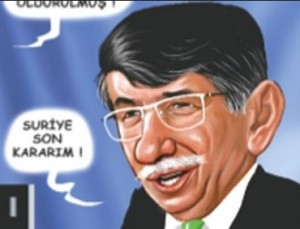
Semih Idiz writes:  Turkish Prime Minister Ahmet Davutoglu is no stranger to Davos, of course, having attended it last year in his capacity as foreign minister. Now he will be speaking as the prime minister of Turkey, which means it will be the first time Turkey is represented at this level at Davos in six years.

A series of policy miscalculations and blunders by Ankara concerning developments in the Arab world have since estranged many Arab regimes and significantly reduced Turkey’s profile as an active player in the region.

All eyes will therefore be on Davutoglu on Jan 24, when he speaks during a private session, to see if he brings anything new to the table at Davos.

Davutoglu will have the added responsibility of speaking as the prime minister of a country that holds the current presidency of the G-20 group, comprising the 20 largest economies in the world. It remains an open question, however, whether he can say anything new when he is laboring in the shadow of Erdogan, who is setting the tone for Turkey’s foreign policy.

Erdogan appears determined in his hard-line positions on Syria, Egypt and Israel, not to mention his generally anti-Western narrative.

It is unlikely therefore that Davutoglu could go against Erdogan at this stage, even if he wanted to, since this would be damaging for the AKP in an election year.

Davutoglu has little choice but to watch President Abdel Fattah al-Sisi gain international recognition, even though he toppled Morsi in a military coup. Sisi is also listed among the leaders who will attend Davos this year.

What Sisi has to say could end up being much more interesting and relevant to the current situation in the region if Davutoglu fails to go beyond the academic rhetoric we are accustomed to hearing from him.

Davutoglu’s remarks at Davos will nevertheless be studied for any sign that Ankara is seeking a way out of its current international and particularly regional isolation. A recent statement by Deputy Prime Minister Bulent Arinc about the need to improve ties with Egypt, for instance, have been taken as an indication that Ankara is searching for an opportunity to normalize ties with Cairo.

Yasar Yakis, a former AKP deputy and a veteran diplomat who also served as foreign minister in the early years of the AKP government, also went on the record recently to indicate that Turkey has to cooperate with Egypt to attain its targets in the Middle East.

Davutoglu is also aware of this view that has been underlined by a considerable number of Turkish analysts. He is also unlikely to be happy with Turkey’s isolation in the Middle East. This is, after all, the geography that he said only a few years ago with a striking certitude that Turkey would be the key player in.

In addition to this, Davutoglu is also aware that with Qatar bowing to pressure from Saudi Arabia on issues such as support for the Muslim Brotherhood and Hamas, Ankara is likely to end up even more isolated in the region in the future unless it recalibrates its policies according to the facts on the ground. He is not only laboring under the shadow of Erdogan today, but is also trapped by his own rhetoric.

Erdogan’s principle foreign policy adviser has referred to Turkey’s present international isolation as “precious loneliness” in an effort to bring a moralistic rationale to it.

If that is what lies at the core of the “vision” Davutoglu is referring to, then it is obvious he will have little to say anything new in Davos, even if his presence there breaks the ice after Erdogan’s dramatic exit in 2009.

Davutoglu